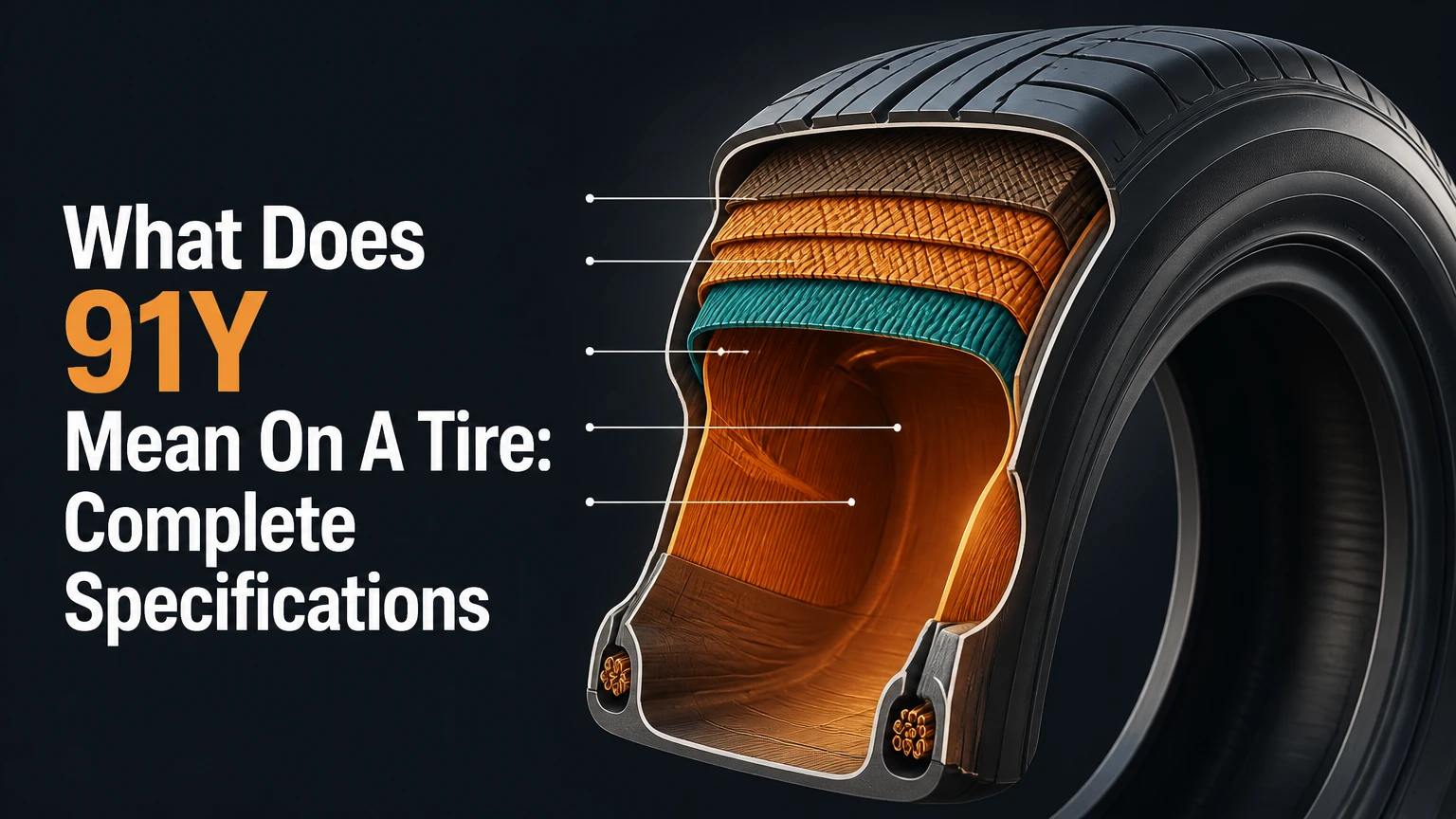
When drivers ask what does 91y mean on a tire, they are looking at the standardized service description that dictates maximum load and speed limits. The number 91 specifies that the tire can safely support a maximum load of 615 kilograms (1,356 pounds) at peak inflation pressure. The letter Y indicates the tire has been laboratory-tested to maintain structural integrity at sustained speeds up to 300 km/h (186 mph).
Key Facts / At a Glance
- Weight Capacity: A 91 load index supports 615 kg (1,356 lbs) per tire, totaling 2,460 kg (5,424 lbs) for a four-tire vehicle.
- Speed Capacity: The Y speed rating signifies a maximum safe operating speed of 300 km/h (186 mph).
- Inflation Dependency: The tire only reaches its 615 kg maximum capacity when inflated to the manufacturer-specified standard pressure (typically 35-36 PSI).
- Application Focus: Tires with a 91Y rating are specifically engineered for sports cars, performance sedans, and high-output electric vehicles.
- Temperature Limits: Many 91Y tires utilize summer rubber compounds that lose traction and risk permanent cracking in temperatures below 7°C (45°F).
What Does 91Y Mean On A Tire For Daily Driving?
The alphanumeric code 91Y acts as a strict physical boundary for vehicle safety. This code sits at the end of the tire size sequence (for example, 225/45R17 91Y). Operating a vehicle beyond either the weight or speed parameters specified by this code compromises the internal steel belts and nylon cords, risking an explosive blowout.
Decoding The 91 Load Index
The number 91 is a numerical index, not a direct weight measurement in pounds or kilograms. It corresponds to an internationally recognized load chart maintained by the Tire and Rim Association (TRA) and the European Tyre and Rim Technical Organisation (ETRTO). A rating of 91 assigns a strict maximum limit of 615 kg (1,356 lbs) per tire.
To determine the total vehicle carrying capacity, you multiply the single tire limit by four. This yields a theoretical maximum load of 2,460 kg (5,424 lbs). You must subtract the curb weight of the vehicle from this total to understand your actual payload allowance for passengers and cargo. Dynamic weight transfer complicates this further. When you apply the brakes heavily at high speeds, up to 70 percent of the vehicle weight shifts to the two front tires. The 91 index accounts for these dynamic shifts, provided the static load remains within the legal boundaries.
Decoding The Y Speed Symbol
The letter Y represents the highest standard speed rating in consumer tire manufacturing. A Y-rated tire can safely dissipate the immense heat generated at speeds up to 300 km/h (186 mph). Centrifugal force at these speeds attempts to tear the tread blocks away from the tire casing.
Tire engineers counteract this force by wrapping the internal steel belts with spirally wound nylon cap plies. These nylon wraps shrink as they heat up, pulling the tire tighter together and preventing high-speed expansion. According to the ETRTO 2023 technical standards report, operating a tire above its designated speed rating for more than ten minutes induces severe thermal degradation, resulting in irreversible structural damage to the internal adhesives. Tires capable of exceeding 300 km/h feature a Y enclosed in parentheses, written as (Y), and usually include the letters ZR within the size format.
How Do Internal Constructions And Compounds Differ?
Two tires can share the exact same 91Y designation but behave completely differently on the road. The service description only guarantees the load and speed minimums. The internal construction and the chemical composition of the tread rubber dictate how the tire actually performs.
Standard Load Versus Extra Load Internal Construction
The standard 91Y designation implies a Standard Load (SL) construction. An SL tire achieves its maximum 615 kg capacity at a standard internal pressure of 35 or 36 PSI. These tires feature a single-ply or double-ply sidewall optimized for ride comfort and low rolling resistance.
You will often see a variant marked 94Y XL in the exact same physical dimensions. The XL stands for Extra Load, though some manufacturers use RF for Reinforced. An XL tire contains a thicker bead filler and stronger synthetic cords within the sidewall apex. This reinforcement allows the tire to hold higher air pressures (typically 41-42 PSI), thereby raising the load index from 91 (615 kg) to 94 (670 kg). You should never replace an original equipment XL tire with an SL tire, as the weaker sidewall will buckle under the vehicle weight during aggressive cornering.
Rubber Compound And Performance Categories
Tire manufacturers blend silica, carbon black, and synthetic polymers to create different tread compounds capable of Y-rated speeds. Ultra-High-Performance (UHP) summer tires represent the most common 91Y format. These tires use massive solid tread blocks and sticky resin compounds designed to maximize mechanical grip on dry tarmac. However, these summer compounds undergo a glass transition state in cold weather. When ambient temperatures drop below 7°C (45°F), the rubber hardens like plastic, increasing braking distances by up to 30 percent.
UHP All-Season tires offer an alternative. These compounds balance the 300 km/h speed capability with added cold-weather elasticity. They feature smaller tread blocks and microscopic slits called sipes to bite into light snow. The trade-off is a measurable reduction in ultimate steering precision and maximum lateral grip during aggressive summer driving.
Which Service Description Should You Choose?
You must always match or exceed the original equipment load index, but you can safely adjust the speed rating based on your actual driving conditions. Choosing the wrong service description compromises vehicle dynamics, degrades ride comfort, and voids automotive insurance policies in many jurisdictions.
- For Daily Commuters: Standard touring tires (91H or 91V) offer a softer ride and longer lifespan than 91Y tires.
- For Performance Enthusiasts: True 91Y summer tires provide unmatched steering response and high-speed stability.
- For EV Owners: Upgrading to an Extra Load (94Y XL) variant prevents premature tread block tearing under instant torque.
Detailed Comparisons: 91Y Versus Common Alternatives
| Service Description | Max Load Per Tire | Max Speed Limit | Ideal Vehicle Type | Primary Advantage | Major Drawback |
| 91H | 615 kg (1,356 lbs) | 210 km/h (130 mph) | Standard Sedans | Longest tread lifespan | Sluggish steering response |
| 91V | 615 kg (1,356 lbs) | 240 km/h (149 mph) | Entry Luxury Sedans | Balanced ride comfort | Medium cornering grip |
| 91W | 615 kg (1,356 lbs) | 270 km/h (168 mph) | Hot Hatches | Excellent dry braking | Stiffer ride over bumps |
| 91Y | 615 kg (1,356 lbs) | 300 km/h (186 mph) | Sports Cars | Ultimate high-speed stability | Fastest tread wear |
| 94Y (XL) | 670 kg (1,477 lbs) | 300 km/h (186 mph) | Heavy Performance EVs | Handles high cornering loads | Noticeably harsh ride quality |
Upgrading To 94Y XL For Electric Vehicles
Electric vehicles demand stronger tire casings due to their heavy battery packs and instant torque delivery. A standard-load 91Y tire will often suffer from micro-tearing in the tread blocks when mounted on an EV. The immediate rotational force from an electric motor twists the flexible SL sidewall violently before the vehicle begins to move. Upgrading to a 94Y XL tire stiffens the sidewall, prevents this distortion, and provides the necessary weight support for the battery pack.
Downgrading Speed Ratings For Winter
Winter driving conditions provide the single legal exception for speed rating downgrades. A strict 91Y winter tire is difficult to manufacture because the soft, pliable rubber required for ice traction naturally generates excessive heat at high speeds. Tire industry regulations permit drivers to drop the speed rating from Y to V, H, or even T for dedicated winter tires. You must affix a visual warning sticker on the dashboard indicating the new lower maximum speed limit when you apply this downgrade.
How Much Do Performance Tires Cost And How Long Do They Last?
High speed ratings directly correlate with shorter tire lifespans and higher retail prices. The sticky resin compounds required to maintain grip at 300 km/h naturally scrub away faster under normal driving conditions.
The Uniform Tire Quality Grading (UTQG) system measures this wear rate. A standard commuter tire might carry a UTQG treadwear rating of 600, indicating a long lifespan. A dedicated 91Y summer performance tire typically carries a treadwear rating between 200 and 300. You are paying a premium price for a tire that will need replacing much sooner, a necessary trade-off for high-speed structural integrity.
Financial and Lifespan Profiles
| Tire Category | Typical Price Range (Per Tire) | Expected Lifespan | Best Use Case |
| Budget UHP Summer | $80 – $120 | 15,000 – 20,000 miles | Entry-level sports cars |
| Mid-Tier UHP Summer | $130 – $180 | 20,000 – 25,000 miles | Aggressive street driving |
| Premium UHP Summer | $190 – $300+ | 25,000 – 30,000 miles | Track days and luxury sports |
| Mid-Tier UHP All-Season | $140 – $190 | 35,000 – 45,000 miles | Year-round performance commuting |
| Premium UHP All-Season | $200 – $280 | 40,000 – 50,000 miles | High-mileage luxury vehicles |
Understanding Rubber Shelf Life
Regardless of remaining tread depth, the chemical bonds inside a 91Y tire degrade continuously over time. Exposure to ozone, ultraviolet light, and ambient heat causes the rubber compounds to harden and turn brittle. The National Highway Traffic Safety Administration (NHTSA) recommends a thorough professional inspection of all tires annually after they reach five years of age. You must universally replace any tire that reaches ten years from its manufacturing date. You can locate this date by reading the final four digits of the DOT code stamped on the sidewall, where the first two digits represent the week and the final two represent the year.
How To Select The Correct Replacement Tires
Replacing a 91Y tire requires verifying specific parameters against your vehicle documentation. Follow this exact sequence to prevent dangerous mismatches and ensure optimal handling characteristics.
Before You Start
- Time Required: 5-10 minutes.
- Difficulty: Beginner.
- Prerequisites: Access to the driver’s side door jamb and the vehicle owner’s manual.
- Key Metric: The original equipment load index is a mandatory legal minimum.
Step 1: Locate The Vehicle Tire Placard
Open the driver’s side door and locate the standardized tire information placard adhered to the B-pillar. This sticker lists the exact tire dimensions, the original service description, and the manufacturer-specified cold inflation pressures. Do not rely on the numbers printed on your current tires, as a previous owner may have installed incorrect replacements.
Step 2: Verify The Minimum Load Index
Compare the placard requirement to your prospective replacement tire. If the placard mandates a 91 index, you can safely install a 91, 92, 93, or 94. You must never install a tire with a load index of 90 or below. Installing an undersized load index is the most common cause of catastrophic sidewall failure during highway driving.
Step 3: Select The Appropriate Speed Rating
Check the placard for the original speed rating. If the factory specified a Y rating, installing a W or V rating reduces the vehicle’s top speed capabilities and softens the steering response. If you prioritize ride comfort and never approach the vehicle’s maximum limits, you can legally step down to a W rating in most regions. Track driving demands an exact match to the factory Y rating.
Step 4: Calibrate The Inflation Pressure
Inflate the newly installed tires to the exact pressure listed on the vehicle placard, never to the maximum PSI stamped on the tire sidewall. The sidewall stamping merely indicates the pressure at which the tire achieves its absolute maximum load. The automotive engineers calculated the placard pressure to optimize the vehicle suspension geometry and contact patch.
What Are The Load And Inflation Limits?
A tire is essentially a flexible pressure vessel. The 91 load index does not guarantee a 615 kg capacity at all times. The physical air volume inside the tire carries the weight, while the rubber simply contains the air. If you allow the pressure to drop, the load carrying capacity drops proportionally.
Standard Load Index 91 Inflation Chart
| Inflation Pressure (PSI) | Inflation Pressure (Bar) | Max Load Capacity (kg) | Max Load Capacity (lbs) |
| 26 PSI | 1.8 Bar | 485 kg | 1,069 lbs |
| 29 PSI | 2.0 Bar | 530 kg | 1,168 lbs |
| 32 PSI | 2.2 Bar | 570 kg | 1,257 lbs |
| 35 PSI | 2.4 Bar | 605 kg | 1,334 lbs |
| 36 PSI | 2.5 Bar | 615 kg | 1,356 lbs |
The Danger Of Underinflation
Driving a 91Y tire at 26 PSI reduces its load capacity to just 485 kg. If the vehicle is fully loaded with passengers and cargo, this underinflation creates severe sidewall flex. The excessive bending generates massive internal friction and heat, rapidly degrading the nylon plies. Overinflating a 91Y tire past 36 PSI does not increase the load capacity beyond 615 kg. It merely stiffens the ride and causes premature wear down the center of the tread.
What Are The Real World Limitations And Failures?
Drivers routinely experience performance issues and tire failures by ignoring the specific limitations of the 91Y service description. Understanding these failure modes prevents costly mistakes at the tire shop.
The Downgrading Mistake
Many consumers attempt to save money by purchasing an 87V tire instead of the required 91Y specification. The 87 load index can only support 545 kg per tire. This 70 kg deficit per corner removes 280 kg of total carrying capacity from the vehicle. Hitting a pothole at highway speeds with an overloaded 87V tire guarantees a sidewall pinch-shock, resulting in an immediate blowout and potential loss of vehicle control.
Mixing Ratings Across Axles
Installing 91Y tires on the front axle and 91H tires on the rear axle creates a dangerous handling imbalance. The Y-rated tires feature ultra-stiff sidewalls designed for rapid steering inputs. The H-rated tires utilize softer, more flexible sidewalls. During an emergency lane change, the front tires will react instantly while the rear tires flex and delay their response. This split-second difference induces violent oversteer, easily spinning the vehicle.
Ignoring Temperature Limits
Operating summer-compound 91Y tires in sub-freezing winter conditions physically destroys the tire. The high-performance resin blend loses all elasticity in the cold. When you drive on a frozen summer tire, the rigid tread blocks cannot flex over the pavement textures. The blocks tear and fracture, leaving permanent physical cracks across the tire surface. You must switch to dedicated winter tires or all-season compounds before ambient temperatures remain below 7°C (45°F).
The Bottom Line
Understanding what does 91y mean on a tire prevents dangerous structural failures and ensures optimal handling characteristics. The number 91 guarantees the tire will support 615 kg at correct inflation pressures, while the Y signifies a maximum tested speed limit of 300 km/h. You must treat the load index as a non-negotiable safety minimum. You may adjust the speed rating downward for winter driving or comfort, but matching the factory 91Y specification remains the only way to retain the precise steering dynamics engineered into your vehicle.
Frequently Asked Questions
Can you mix 91W and 91Y tires on the same vehicle?
You should never mix different speed ratings across axles. A 91W tire responds to steering inputs differently than a 91Y tire due to variations in sidewall stiffness. Mixing them creates unpredictable handling during emergency maneuvers and heavily increases the risk of losing control.
Are 91Y tires safe to use in the snow?
A 91Y tire is only safe in snow if it is specifically branded as an All-Season or Winter tire. The vast majority of 91Y tires utilize summer rubber compounds that turn completely rigid in freezing temperatures, offering zero traction on snow or ice.
Does a 91Y tire ride rougher than a 91V tire?
Yes, a 91Y tire will inherently ride rougher than a 91V tire. Manufacturers must reinforce the internal casing and thicken the sidewalls of a Y-rated tire to withstand centrifugal forces at 300 km/h. This added stiffness transmits more road impacts into the cabin.
Why do 91Y tires wear out so much faster?
The compounds formulated to maintain grip at extreme speeds rely on softer, stickier resins. These chemical blends prioritize maximum adhesion over longevity. Consequently, the tread rubber scrubs away against the pavement much faster than the harder rubber found on standard commuter tires.
What does the ZR mean in front of a 91Y rating?
The ZR designation is a legacy term indicating the tire can exceed 240 km/h (149 mph). Before the Y rating was formalized, ZR was the highest standard available. Modern tire nomenclature retains the ZR within the size description while adding the specific 91Y at the end for exact clarity.