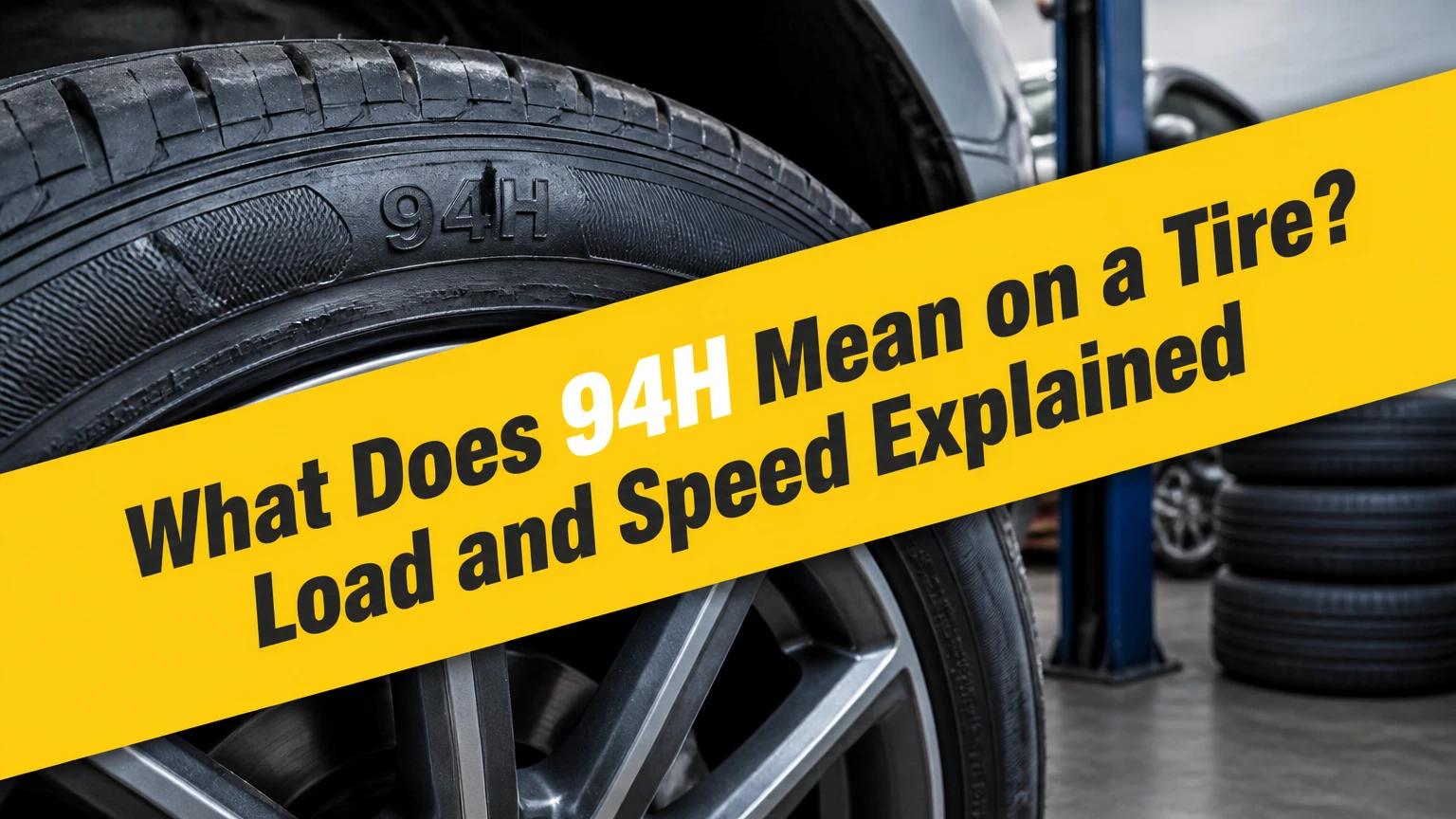
The 94H marking on a tire is a service description that combines a load index and a speed rating. The number 94 means the tire is rated to carry 1,477 pounds (670 kilograms) per tire under specified conditions, while H indicates a maximum rated speed of 130 mph (210 km/h) in standardized testing.
Key Facts at a Glance
- 94 is a load index, not a weight measurement: Load index 94 corresponds to 1,477 lb or 670 kg per tire.
- H is a speed rating: H-rated tires are designed for speeds up to 130 mph or 210 km/h under specified test conditions.
- Four 94-rated tires have a mathematical capacity of 5,908 lb: The vehicle’s certification label, gross vehicle weight rating, axle limits, and tire placard still take priority.
- 94H does not identify the tire size: Width, aspect ratio, wheel diameter, construction, and tire type appear elsewhere in the size code.
- The vehicle placard determines the correct replacement: A higher rating is not automatically a suitable replacement if the size, pressure, clearance, or construction differs.
- 130 mph is not a recommended road speed: Underinflation, damage, heat, heavy loading, wet pavement, and road conditions can reduce safe operating capability.
What Does 94H Mean on a Tire?
The 94H tire code means the tire has a load index of 94 and a speed rating of H. Load index 94 corresponds to 1,477 lb per tire, and speed rating H corresponds to 130 mph under the rating system used for passenger-car tires.
The two characters are often printed at the end of a complete size marking such as 205/55R16 94H. In that example, 205 describes section width in millimeters, 55 is the aspect ratio, R identifies radial construction, 16 is the wheel diameter in inches, and 94H is the service description.
The tire industry uses standardized load-index tables rather than printing the actual capacity in the code. A driver therefore cannot infer capacity by adding or multiplying the digits. The correct interpretation is 94 equals 1,477 lb, while H equals 130 mph.
What Does the Number 94 Represent?
Load index 94 represents a maximum rated load of 1,477 lb or 670 kg for one tire at the tire’s specified conditions. The number does not mean 94 lb, 94 kg, or a 94 percent capacity.
Four tires with load index 94 produce a simple arithmetic total of 5,908 lb or 2,680 kg. That figure is not automatically the vehicle’s allowable payload because the vehicle manufacturer may specify a lower gross vehicle weight rating, front-axle limit, rear-axle limit, or combined tire capacity.
The U.S. Tire Manufacturers Association and vehicle manufacturers treat load capacity as a fitment and inflation question, not as a number to use in isolation. A tire may carry its rated load only when mounted on an approved wheel and inflated according to the applicable tire and vehicle specifications.
What Does the Letter H Represent?
The letter H represents a speed rating of 130 mph or 210 km/h. Speed ratings describe the tire’s ability to manage heat generation, centrifugal force, tread stability, and structural stress during controlled testing.
“H” is a standardized code, not a statement that ordinary drivers should travel at 130 mph. The rating is established under specified load, inflation, wheel, temperature, and test conditions. A tire that has suffered impact damage or operates while underinflated may not retain the same safety margin in real-world use.
Speed-rating letters do not rank every performance characteristic. A 94V tire may provide sharper steering than a particular 94H tire because of its construction and rubber compound, but the letter alone does not guarantee shorter braking distances, longer tread life, or better wet grip.
How Does a 94H Tire Rating Work?
A 94H tire rating works by combining two independent engineering limits. The load index addresses how much weight one tire can support, while the speed symbol addresses heat and structural performance at a specified maximum speed.
Tire manufacturers establish these ratings through standardized industry and regulatory procedures. In the United States, the Department of Transportation regulates tire performance requirements, but “DOT-approved” does not mean every tire follows one identical public test sequence with the same speed increments and duration. Test details depend on the applicable regulation, tire category, and manufacturer procedure.
How Load and Speed Interact
Load and speed affect each other because a heavier load increases carcass deflection and heat, while higher speed increases flexing frequency and centrifugal forces. Correct inflation reduces excessive flexing, but inflation cannot turn an incorrectly sized tire into an approved replacement.
A 94H tire reaches its stated load and speed capability only within the conditions defined by its manufacturer and applicable standards. Maximum sidewall pressure may be required for the full load-index value, while the vehicle’s placard pressure is normally lower and optimized for the original vehicle configuration.
A practical rule follows: never evaluate a tire by the 94H code alone. Check the complete size, load construction, speed symbol, service description, wheel compatibility, and vehicle placard.
What Does 94H Not Tell You?
The 94H marking does not identify the tire’s dimensions, age, brand, tread compound, wet braking performance, winter traction, noise level, warranty, or run-flat capability.
| Marking or specification | Example value | What it identifies |
|---|---|---|
| Section width | 205 mm | Approximate tire width |
| Aspect ratio | 55 | Sidewall height as a percentage of width |
| Construction | R | Radial casing construction |
| Wheel diameter | 16 in | Nominal compatible wheel diameter |
| Service description | 94H | Load index 94 and speed symbol H |
| Manufacturing date | 2324 | 23rd week of 2024 |
The date code matters because rubber ages even when tread remains. NHTSA recommends checking tire age and following manufacturer guidance; many tire manufacturers advise replacement around six years from service or ten years from manufacture, although exact recommendations vary.
How Do You Verify Whether 94H Fits Your Vehicle?
The vehicle tire placard and owner’s manual provide the correct starting point for verifying 94H fitment. The placard is commonly located on the driver’s door jamb, door edge, glovebox, fuel-door area, or another manufacturer-designated location.
Use this sequence before purchasing:
- Read the placard size and service description. Record the complete marking, such as 215/60R16 95H, rather than only the 94H suffix.
- Check front and rear specifications. Some vehicles use different sizes or load ratings on each axle.
- Confirm the cold inflation pressure. Use the placard pressure, not the maximum pressure molded into the sidewall.
- Check the owner’s manual. Look for spare-tire, winter-tire, towing, trailer, and high-speed-use instructions.
- Confirm wheel and clearance compatibility. A tire with the same diameter but different width can contact suspension parts or bodywork.
- Match the vehicle’s minimum load and speed ratings. Never install a tire below the manufacturer’s specified rating without written approval from the vehicle or tire maker.
For example, if a placard specifies 205/55R16 91V, a 94H tire has more load capacity but a lower speed rating. It is not automatically an acceptable substitute. The correct answer depends on the vehicle manufacturer’s approved alternatives and local regulations.
Which Inflation Pressure Should a 94H Tire Use?
A 94H tire should normally be inflated to the cold pressure printed on the vehicle tire placard, not to the maximum pressure printed on the tire sidewall. The placard pressure is selected for the vehicle’s weight distribution, suspension, steering, ride, braking, and handling.
The maximum sidewall pressure tells you the tire’s pressure limit under a defined load condition. It does not prescribe the normal pressure for that vehicle. Checking pressure when the tire is hot can produce a misleadingly high reading because air pressure rises with temperature.
Check all four tires at least monthly and before long trips. Also inspect the spare, because a temporary spare may require a much higher pressure than the road tires. TPMS warns about significant pressure loss but does not replace a pressure gauge, and many systems do not identify gradual underinflation until handling and wear have already changed.
How Does 94H Compare With 94V, 94W, and 94Y?
94H, 94V, 94W, and 94Y tires share the same nominal load index of 1,477 lb per tire, but their speed ratings differ. A higher speed symbol can involve stronger construction, altered compounds, or different tread designs, although performance and comfort still depend on the specific model.
| Service description | Load per tire | Rated speed | Typical application |
|---|---|---|---|
| 94H | 1,477 lb, 670 kg | 130 mph, 210 km/h | Family sedans and compact crossovers |
| 94V | 1,477 lb, 670 kg | 149 mph, 240 km/h | Sport sedans and touring vehicles |
| 94W | 1,477 lb, 670 kg | 168 mph, 270 km/h | Performance cars |
| 94Y | 1,477 lb, 670 kg | 186 mph, 300 km/h | Ultra-high-performance applications |
A higher-rated tire is not automatically better for every driver. H-rated touring tires may deliver lower noise, a softer ride, and longer treadwear than a V-rated performance tire, while a V-rated tire may provide quicker steering response at the cost of comfort.
Can You Replace 94H With 94V?
A 94V replacement can be acceptable when the tire size, construction, wheel fitment, inflation requirements, vehicle approval, and local rules all match. Because 94V has the same load index and a higher speed rating, it is often a technically plausible upgrade.
The substitution still requires caution. A 94V tire from a performance line may have a stiffer sidewall, a different diameter tolerance, a shorter treadwear warranty, or reduced cold-weather flexibility compared with the original 94H model.
Follow the vehicle manufacturer’s approved replacement guidance. For winter tires, some manufacturers permit a lower speed rating with a dashboard label or other restrictions, while others require the original rating.
What Is the Difference Between 94H and 98H?
The difference between 94H and 98H is load capacity, not speed. Both tires carry an H speed rating of 130 mph, but load index 98 corresponds to 1,653 lb or 750 kg per tire, compared with 1,477 lb for load index 94.
| Rating | Capacity per tire | Four-tire arithmetic | Speed rating | Common construction question |
|---|---|---|---|---|
| 91H | 1,356 lb, 615 kg | 5,424 lb, 2,460 kg | 130 mph | Standard-load fitment |
| 94H | 1,477 lb, 670 kg | 5,908 lb, 2,680 kg | 130 mph | Standard-load or model-specific fitment |
| 98H | 1,653 lb, 750 kg | 6,612 lb, 3,000 kg | 130 mph | Often XL, but verify sidewall |
| 100H | 1,764 lb, 800 kg | 7,056 lb, 3,200 kg | 130 mph | Higher-load vehicle application |
The letters XL, Extra Load, or Reinforced identify construction separately from the numeric index. A 98H tire may be an XL tire, but the service description alone does not prove that. XL tires can require higher inflation pressure and may produce a firmer ride.
Are 94H Tires Suitable for Electric Vehicles?
A 94H tire is suitable for an electric vehicle only when the EV manufacturer approves that size and load rating. Battery weight, instant torque, and high curb weight can require an XL tire, a higher load index, special acoustic foam, low rolling resistance, or an EV-specific design.
Do not assume that every compact EV needs 98H or that every 94H tire is unsuitable. Some smaller electric cars use 94H tires, while heavier models require load indices above 100 or different pressure settings.
EV owners should compare the tire placard with the replacement tire’s load index, maximum load at placard pressure, speed rating, rolling resistance, and manufacturer approval. Correct pressure is especially important because underinflation increases rolling resistance, heat, shoulder wear, and energy consumption.
Can You Mix H and V Tires?
Mixing H- and V-rated tires can change vehicle handling and should generally be avoided unless the vehicle manufacturer or a qualified tire professional approves the arrangement. Different sidewall stiffness and response can affect steering balance during emergency lane changes, braking, and wet cornering.
If temporary mixing is unavoidable, place tires according to the vehicle maker’s instructions and keep the same size and load rating on each axle. For many rear-wheel-drive vehicles, higher-rated tires belong on the rear when mismatched tires are used, but manufacturer guidance takes priority because drivetrain and stability-control systems differ.
AWD vehicles deserve extra caution. Differences in rolling circumference, tread depth, and tire model can stress the drivetrain or trigger stability-system errors, even when the sidewall ratings appear compatible.
What Problems Make a 94H Tire Unsafe?
A 94H tire requires replacement when it has structural damage, exposed cords, a sidewall bulge, severe uneven wear, repeated pressure loss, or tread depth at or below the legal or manufacturer limit. The 94H marking cannot compensate for a punctured, aged, overheated, or incorrectly inflated tire.
Inspect for these failure modes:
- Sidewall bulge: Indicates damaged internal cords and requires immediate replacement.
- Tread separation or raised belt area: Requires removal from service, even if tread remains.
- Shoulder wear: Commonly indicates underinflation, misalignment, or suspension problems.
- Center wear: Often indicates chronic overinflation relative to the vehicle’s recommended pressure.
- Cupping or scalloping: Can indicate worn shocks, imbalance, or suspension movement.
- Repeated slow leaks: May result from a valve, bead seal, wheel crack, or puncture.
- Age cracking: Surface cracks in the sidewall or tread can signal rubber degradation.
A puncture in the central tread area may be repairable if it is small, discovered promptly, and repaired according to tire-industry procedures. A puncture in the shoulder or sidewall is generally not repairable.
What Do 94H Tires Cost and How Long Do They Last?
A typical 94H passenger-car tire costs $90-$220 per tire, excluding mounting, balancing, disposal fees, taxes, and alignment. A complete installed set commonly totals $450-$1,050, depending on tire brand, wheel size, retailer, warranty, and local labor rates.
| Expense or lifespan factor | Typical range | Main variable |
|---|---|---|
| Economy 94H tire | $90-$130 | Basic compound and shorter warranty |
| Mid-range 94H tire | $130-$180 | Touring construction and longer warranty |
| Premium 94H tire | $180-$220 | Brand, noise control, wet grip, warranty |
| Mounting and balancing | $20-$45 per tire | Retailer and wheel diameter |
| Four-tire alignment | $80-$180 | Vehicle suspension and local labor |
| Typical service life | 30,000-70,000 miles | Compound, rotation, pressure, roads, alignment |
Mileage warranties are not guaranteed mileage. Tire rotation intervals, alignment, climate, driving style, storage, road damage, and treadwear compound determine actual life. A tire used on a heavy vehicle, driven with low pressure, or exposed to high heat can wear out far sooner than its warranty number.
What Are the Most Common 94H Buying Mistakes?
The most common mistake is matching only the 94H suffix while ignoring the complete tire size and the vehicle placard. A tire can have the right load and speed code but the wrong width, diameter, construction, pressure range, or vehicle clearance.
Three practitioner rules prevent most fitment errors:
- Treat the placard as the baseline. Do not use the tire currently fitted as the only reference, because a previous owner may have installed an incorrect size.
- Compare load capacity at the required pressure. A tire’s headline maximum load may depend on a pressure that differs from the vehicle’s placard pressure.
- Replace AWD tires as a matched set when required. Tread-depth differences as small as a few thirty-seconds of an inch can matter on sensitive drivetrains.
Another counterintuitive point is that a higher speed rating does not necessarily improve braking. Tire model, compound, tread pattern, pavement temperature, and wet grip can matter more than the H-to-V letter change.
Frequently Asked Questions
Does 94H mean the tire weighs 94 pounds?
No. The number 94 is a standardized load index that corresponds to 1,477 lb or 670 kg of rated load per tire. The tire’s own weight is printed nowhere in the 94H code and varies by size, construction, brand, tread design, and whether the tire uses standard-load or XL construction.
Is a 94H tire good for highway driving?
A 94H tire is generally suitable for highway driving when the vehicle placard specifies that size and rating. H indicates a 130 mph laboratory speed category, but safe highway operation depends on pressure, load, tread condition, weather, traffic, road surface, and legal speed limits.
Can I use a 91H tire instead of a 94H tire?
A 91H tire has the same H speed rating but a lower load index, 1,356 lb or 615 kg per tire. It should not replace a 94H tire unless the vehicle manufacturer explicitly approves the lower load capacity, because reducing the rating can overload the tire during passengers, cargo, towing, or high-temperature operation.
Does a tire’s maximum PSI show the correct pressure for my car?
No. The maximum PSI molded on the sidewall is a tire limit associated with a specified load condition. The vehicle tire placard gives the recommended cold inflation pressure for the vehicle, and that value should normally guide routine inflation unless the manufacturer provides different instructions.
Should all four tires have the same 94H rating?
Matching all four tires is usually the most predictable arrangement, especially on AWD and performance vehicles. If the vehicle uses different front and rear sizes, follow the placard and owner’s manual. Never assume four identical 94H tires are correct when the vehicle requires different axle specifications.
How can I tell whether my tire is too old?
Find the four-digit DOT date code on the sidewall. The first two digits identify the manufacturing week, and the final two identify the year, so 2324 means the 23rd week of 2024. Inspect for cracking and follow the tire manufacturer’s age-replacement guidance even when tread depth remains.
The Bottom Line
What does 94H mean on a tire? The 94 means 1,477 lb or 670 kg of rated load per tire, and H means a 130 mph or 210 km/h speed category under specified test conditions. The code helps identify capacity, but the complete tire size, vehicle placard, inflation pressure, construction, condition, and local requirements determine whether the tire is actually correct.