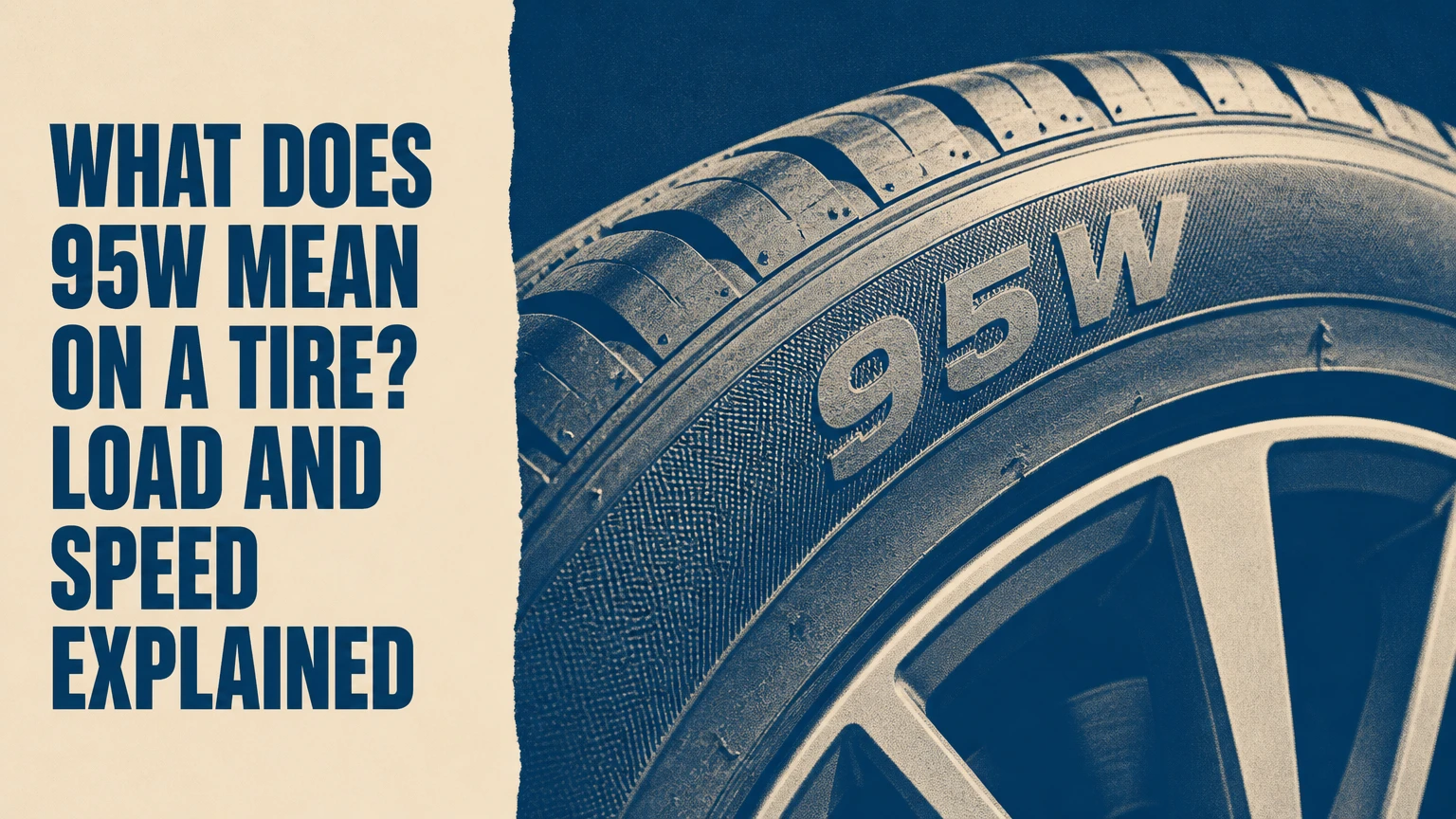
On a tire sidewall, 95W is the service description: 95 is the load index, allowing 1,521 pounds (690 kilograms) per tire under its specified test conditions, while W is the speed symbol for a maximum rated speed of 168 mph (270 km/h). The code does not specify tire size, pressure, vehicle payload, or driving speed.
Key Facts at a Glance
- A 95 load index corresponds to 1,521 lb (690 kg) per tire in the standardized load-index table.
- A W speed rating corresponds to 168 mph (270 km/h) under controlled test conditions.
- Four 95-rated tires have a theoretical combined index capacity of 6,084 lb (2,760 kg), but that figure is not the vehicle’s allowable payload or gross vehicle weight rating.
- The vehicle placard, usually inside the driver’s door, specifies the correct tire size and cold inflation pressure.
- A tire marked 95W is not automatically an XL tire. “XL” is a separate construction and load designation.
- A replacement should normally meet or exceed the vehicle manufacturer’s specified load index and speed symbol, subject to local regulations and tire-maker guidance.
What Does 95W Mean on a Tire Sidewall?
The 95W code identifies two performance attributes, not one combined rating. The number describes load capacity, and the letter describes speed capability; together they form the tire’s service description.
For example, a sidewall may read 225/45R17 95W. The components mean:
| Sidewall marking | Meaning | Example value |
|---|---|---|
| 225 | Nominal section width | 225 mm |
| 45 | Aspect ratio | Sidewall height is 45% of width |
| R | Internal construction | Radial |
| 17 | Approved rim diameter | 17 inches |
| 95 | Load index | 1,521 lb / 690 kg |
| W | Speed symbol | 168 mph / 270 km/h |
The service description is separate from the tire’s brand, tread pattern, seasonal category, manufacturing date, and optional markings. A 95W all-season tire and a 95W summer tire share the same nominal load and speed categories but can have different wet grip, snow traction, tread life, ride comfort, and noise.
A 95W marking also does not mean the tire should be inflated to the highest pressure printed on its sidewall. The sidewall maximum is a tire limit. The vehicle placard gives the pressure selected by the vehicle manufacturer for handling, braking, comfort, and load distribution.
How Much Weight Can a 95-Rated Tire Carry?
A tire with load index 95 is assigned a maximum load of 1,521 lb (690 kg) per tire in the standard load-index table. That value applies only when the tire is used at the pressure and conditions associated with its rating.
The four-tire arithmetic is straightforward:
1,521 lb × 4 = 6,084 lb
However, 6,084 pounds is not automatically the vehicle’s safe carrying capacity. Vehicle manufacturers set limits through the gross vehicle weight rating, axle ratings, suspension, wheels, brakes, and tire placard. A sedan with four 95-rated tires may weigh 3,500 pounds and have a much lower permissible payload than the tire arithmetic suggests.
| Load index | Capacity per tire | Four-tire arithmetic | Common interpretation |
|---|---|---|---|
| 91 | 1,356 lb / 615 kg | 5,424 lb / 2,460 kg | Lower capacity than 95 |
| 94 | 1,477 lb / 670 kg | 5,908 lb / 2,680 kg | Intermediate passenger rating |
| 95 | 1,521 lb / 690 kg | 6,084 lb / 2,760 kg | The rating in 95W |
| 96 | 1,565 lb / 710 kg | 6,260 lb / 2,840 kg | Higher capacity than 95 |
The load index is not a direct pounds-per-square-inch measurement. Tire load capacity depends on inflation pressure, tire construction, temperature, speed, and the applicable industry table. A tire carrying a heavy load at low pressure can overheat even when its printed load index appears sufficient.
Does 95 Mean the Tire Is Extra Load?
No. 95 identifies the load index, while XL identifies an Extra Load construction or service designation. A standard-load tire and an XL tire can sometimes share the same nominal load index, but they may achieve it at different pressures and use different casing designs.
A sidewall might show 95W, 95W XL, or 95W Extra Load. The XL marking matters when the vehicle placard or original-equipment specification requires that construction. Do not assume every 95W tire is interchangeable with every 95W XL tire without checking the complete fitment specification.
How Fast Can a W-Rated Tire Go?
A W speed symbol corresponds to 168 mph (270 km/h) in the commonly used passenger-tire speed-rating chart. Michelin describes the speed rating as “the maximum speed a tire can safely maintain over time,” but that rating applies under specified test conditions, with correct inflation, appropriate load, and a sound tire.
The rating is not a recommendation to drive at 168 mph. Public roads, weather, traffic, wheel condition, alignment, tread depth, and vehicle limits can make much lower speeds unsafe. A tire’s speed category also does not override a vehicle manufacturer’s maximum speed or local law.
| Speed symbol | Rated speed | Approximate metric value | Typical context |
|---|---|---|---|
| H | 130 mph | 210 km/h | Touring passenger cars |
| V | 149 mph | 240 km/h | Performance passenger cars |
| W | 168 mph | 270 km/h | High-performance passenger cars |
| Y | 186 mph | 300 km/h | Higher-speed performance applications |
Speed testing evaluates more than peak velocity. As speed rises, flexing in the sidewall and tread generates heat. The casing, belt package, bead, rubber compound, and cap ply must tolerate that thermal and mechanical stress. Underinflation, overload, impact damage, or excessive ambient temperature can reduce the safety margin substantially.
Is a Higher Speed Rating Always Better?
A higher speed symbol can provide additional heat and handling capability, but it is not automatically better for every vehicle. Higher-rated tires may use stiffer sidewalls and softer tread compounds, which can increase steering response while reducing ride comfort or tread longevity.
A higher rating also does not compensate for an incorrect size. Installing a W-rated tire with the wrong diameter, width, load range, or wheel specification can create clearance, calibration, or handling problems.
Does a 95W Tire Need a Specific Pressure?
The correct pressure comes from the vehicle placard or owner’s manual, not from the maximum pressure molded into the tire sidewall. The placard commonly appears on the driver’s door jamb, door edge, fuel-filler area, or glovebox, depending on the vehicle.
Check pressure when the tires are cold, meaning before driving or after the vehicle has been parked for several hours. The pressure should be measured with a reliable gauge and adjusted for the vehicle’s stated front and rear values. Some vehicles specify different pressures for normal and fully loaded operation.
| Pressure source | What it tells you | Should you use it for routine inflation? |
|---|---|---|
| Door-jamb placard | Vehicle-selected cold pressure | Yes |
| Owner’s manual | Pressure, load, and temporary-spare instructions | Yes |
| Tire sidewall maximum | Tire’s maximum permitted pressure or load condition | No, unless vehicle documentation specifies it |
| TPMS display | Current monitored pressure | Use as a warning and verification aid |
| Tire retailer listing | Product data and fitment | No, not as the vehicle pressure authority |
A 95W tire’s load capacity is pressure-dependent. Underinflation increases sidewall flex, rolling resistance, heat, and shoulder wear; overinflation can reduce the contact patch and produce center wear. The same pressure may not be correct for two different vehicles using the same 95W size.
Which Tires Can Carry a 95W Service Description?
A 95W service description can appear on several tire categories, including grand-touring all-season, ultra-high-performance all-season, summer performance, run-flat, and some electric-vehicle fitments. The 95W code does not identify the tread compound or seasonal capability.
| Tire category | Typical tread-life range | Main design priority | Limitation |
|---|---|---|---|
| Touring all-season | 45,000-70,000 miles | Comfort and mileage | Less dry grip than UHP tires |
| UHP all-season | 35,000-50,000 miles | Year-round handling | Snow traction remains limited |
| Max-performance summer | 20,000-35,000 miles | Dry and wet grip | Poor choice for freezing conditions |
| Run-flat performance | 20,000-40,000 miles | Temporary mobility after air loss | Firmer ride and higher replacement cost |
| EV-oriented performance | 30,000-50,000 miles | Load, noise, and rolling resistance | Model-specific availability |
These are typical market ranges, not guarantees. Alignment, rotation, acceleration, road surface, climate, tire compound, and tread-depth limits determine actual service life. A 95W tire with a 50,000-mile warranty may outlast a 95W summer tire by tens of thousands of miles because the categories prioritize different performance goals.
Are 95W Tires Suitable for Electric Vehicles?
A 95W tire can fit an electric vehicle only when its complete specification matches the vehicle. Electric vehicles often impose higher curb weight and instant torque, so the required load index, XL construction, rolling-resistance behavior, noise level, and wear performance deserve particular attention.
The load index alone does not confirm EV suitability. Check the placard for the required size and rating, then check whether the tire manufacturer approves the tire for the vehicle. Some EVs use acoustic foam, special compounds, reinforced sidewalls, or manufacturer-specific markings that are not represented by “95W” alone.
95W Versus 95V, 91W, and 96W
The most direct comparisons are 95W versus 95V and 95W versus 91W. A 95W tire carries the same indexed load as a 95V tire but has a higher speed category; a 91W tire has the same W speed symbol but carries less weight.
| Marking | Load per tire | Speed category | Difference from 95W | Suitable replacement when required by vehicle? |
|---|---|---|---|---|
| 91W | 1,356 lb / 615 kg | 168 mph / 270 km/h | 165 lb less capacity per tire | Usually no if 95 is specified |
| 95V | 1,521 lb / 690 kg | 149 mph / 240 km/h | Lower speed category | Sometimes, only with approval |
| 95W | 1,521 lb / 690 kg | 168 mph / 270 km/h | Reference rating | Yes, when placard specifies it |
| 96W | 1,565 lb / 710 kg | 168 mph / 270 km/h | 44 lb more capacity per tire | Often, if size and construction also match |
| 95Y | 1,521 lb / 690 kg | 186 mph / 300 km/h | Higher speed category | Often, if approved and correctly sized |
Is 95W Better Than 95V?
95W has a higher speed category than 95V, but 95W is not universally better. Both ratings carry 1,521 pounds per tire, while W is rated to 168 mph and V to 149 mph. The correct choice is the one approved by the vehicle manufacturer and appropriate for the climate and tire category.
A 95V touring tire may provide a quieter, more comfortable ride than a 95W UHP tire. Conversely, a 95W summer tire may provide more dry grip but perform poorly in cold weather. Comparing only the letter ignores tread design, compound, construction, and intended season.
Can I Replace 95W With 91W?
A 91W tire has the correct W speed symbol but a lower load index than 95W, so it should not replace a vehicle-specified 95W tire unless the vehicle manufacturer or tire professional explicitly approves it. The difference is 165 pounds per tire, or 660 pounds in four-tire arithmetic.
The reverse substitution, 95W for 91W, generally provides at least the required indexed capacity, but the complete tire size, wheel width, clearance, pressure, construction, and vehicle approval still matter. A higher load index can produce a firmer ride and does not automatically improve handling.
How Should You Choose a 95W Replacement?
Use the vehicle placard as the starting point, then match the full specification rather than shopping by “95W” alone. The process usually takes 10-20 minutes if the size and placard are accessible.
- Photograph the placard. Record the front and rear tire sizes, load index, speed symbol, cold pressures, and spare-tire information.
- Read the complete sidewall. Confirm width, aspect ratio, radial construction, rim diameter, service description, XL status, and run-flat markings.
- Match or exceed the required rating. Do not reduce the load index. Do not reduce the speed symbol without vehicle and tire-maker approval.
- Check the tire category. Select all-season, summer, winter, touring, run-flat, or EV-oriented construction for the actual climate and use.
- Confirm wheel compatibility. Verify rim diameter, approved rim width, bolt pattern, offset, and clearance when changing size.
- Install correctly. Have the tire mounted, balanced, and inspected for bead seating, valve condition, and TPMS compatibility.
- Set cold pressure. Inflate to the placard value, then recalibrate or reset TPMS if the vehicle requires it.
Success means the installed tire matches the approved size and service description, the pressure is correct when cold, and the vehicle has no steering pull, vibration, or warning light. A common mistake is buying a tire from an online listing that shows 95W but omits XL, run-flat, OE, or load-at-pressure details.
How Much Do 95W Tires Cost?
Typical retail pricing for a 95W passenger tire is $150-$350 per tire, with premium run-flat, EV-oriented, and track-focused models commonly reaching $400-$500 or more. Mounting, balancing, valve service, disposal, and taxes often add $20-$50 per wheel.
| Purchase item | Typical range | Four-tire example | Main cost variable |
|---|---|---|---|
| Budget 95W tire | $120-$180 | $480-$720 | Brand and warranty |
| Midrange 95W tire | $180-$280 | $720-$1,120 | Tread compound and testing |
| Premium 95W tire | $280-$400 | $1,120-$1,600 | OE, run-flat, or EV design |
| Mounting and balancing | $20-$50 per wheel | $80-$200 | Shop and wheel size |
| Alignment, when needed | $100-$200 | $100-$200 | Vehicle and adjustment range |
A cheaper tire can be a poor value if its wet braking, noise, warranty, or winter performance does not suit the vehicle. A premium tire can also be wasteful when the vehicle is a low-mileage commuter that never uses its performance capability.
What Problems Can a 95W Tire Develop?
A 95W marking does not prevent vibration, uneven wear, punctures, aging, or impact damage. The most useful diagnosis begins with the symptom and its speed or location.
| Symptom | Likely cause | Immediate check | Typical remedy |
|---|---|---|---|
| Vibration at 50-70 mph | Wheel imbalance or radial force variation | Balance readings and wheel runout | Rebalance or replace damaged component |
| Shoulder wear | Underinflation or alignment error | Cold pressure and camber | Correct pressure and align vehicle |
| Center wear | Persistent overinflation | Gauge accuracy and placard pressure | Reduce to placard value |
| Cupping or scalloping | Worn suspension or imbalance | Shocks, bushings, balance | Repair suspension and rotate tires |
| Steering pull | Unequal pressure, alignment, or tire conicity | Swap front tires when permitted | Correct pressure or diagnose alignment |
| Cracks or bulges | Aging, impact, or internal damage | Visual and internal inspection | Replace tire; do not repair a bulge |
A vibration that appears only at highway speed commonly points to balance, wheel damage, tire uniformity, or mounting rather than a missing speed rating. Rapid center wear usually indicates excess pressure, but alignment and suspension faults can create similar patterns.
Can Different Speed Ratings Be Mixed?
Mixing speed ratings is best avoided, especially across the same axle. If a temporary situation requires mixed ratings, the higher-rated tires generally belong on the rear axle when the vehicle manufacturer permits the arrangement, because rear-axle grip affects stability during braking and cornering.
AWD and four-wheel-drive vehicles can impose additional requirements for matching tire diameter, tread depth, and circumference. Even small rolling differences may stress the drivetrain or interfere with traction-control calibration. Consult the owner’s manual before replacing fewer than four tires.
Does a Winter Tire Need the Same Speed Rating?
A winter tire may have a lower speed symbol than the summer or all-season tire specified for warm-weather use, but the substitution should follow the vehicle manufacturer’s instructions and local regulations. Some vehicles require a dashboard speed reminder when lower-rated winter tires are installed.
Winter tires also need correct load capacity. A lower speed symbol does not authorize a lower load index, incorrect size, or unsuitable pressure. The tire’s severe-snow service symbol, compound, and tread design matter more for snow traction than the W marking.
Expert Rules for Reading 95W Correctly
Practitioner rule one: never use the four-tire load calculation as a payload estimate. The vehicle’s GVWR and placard control because axle distribution, suspension capacity, braking, and wheel ratings can limit the vehicle before the tires reach their theoretical combined figure.
Practitioner rule two: pressure is part of the rating. A 95W tire at the wrong pressure is not operating as the vehicle engineer intended, even when the sidewall code matches. Check cold pressure monthly and before long trips, because a small leak can create substantial heat at highway speed.
Practitioner rule three: service description is not tire quality. Two 95W products can differ sharply in wet braking, snow traction, noise, ride, rolling resistance, and tread life. Compare independent test results when available, but prioritize the vehicle’s approved specification first.
Practitioner rule four: replace sidewall damage, do not cosmetically judge it. A bulge indicates damaged casing cords and cannot be safely repaired with a plug or patch. A tire can retain tread while its age, impact history, or internal injury makes replacement necessary.
FAQ About 95W Tires
Is 95W Suitable for Highway Driving?
Yes, a correctly sized 95W tire is suitable for ordinary highway driving when it matches the vehicle placard and remains properly inflated. The W symbol describes a controlled maximum-speed category, not a requirement to drive fast. Highway safety still depends on tread depth, weather, tire age, balance, alignment, and load.
What Is the Difference Between 95W and 95W XL?
95W identifies a 1,521-pound load index and W speed symbol. 95W XL adds Extra Load construction, which may support the required load at a higher pressure or provide a reinforced casing. The markings are related but not identical, so confirm whether the vehicle requires XL before choosing a replacement.
Can I Put 95W Tires on Any Car?
No. A 95W tire is compatible only when its full size, load index, speed symbol, construction, wheel fitment, and pressure requirements match the vehicle. The door-jamb placard and owner’s manual identify the approved specification. A tire can physically fit a wheel and still be unsuitable for the vehicle.
How Long Do 95W Tires Last?
Typical 95W summer performance tires last about 20,000-35,000 miles, while touring or UHP all-season models may last 35,000-70,000 miles. Actual life depends on alignment, pressure, rotation, driving style, climate, road surfaces, compound, and the manufacturer’s treadwear warranty.
Does the W Mean the Tire Is for Winter?
No. W is a speed symbol, not a winter designation. Winter capability comes from the tread compound, sipe design, temperature range, and severe-snow service symbol. A W-rated summer tire can perform poorly on snow and ice, while a winter tire may use a lower speed symbol.
The Bottom Line
95W means a 1,521-pound-per-tire load index and a W speed category rated to 168 mph under specified test conditions. The code does not determine tire pressure, vehicle payload, seasonal performance, tread life, or whether the tire is XL. Before buying a replacement, match the complete sidewall specification to the placard, use the prescribed cold pressure, and treat what does 95w mean on a tire as the beginning of fitment research rather than the whole answer.