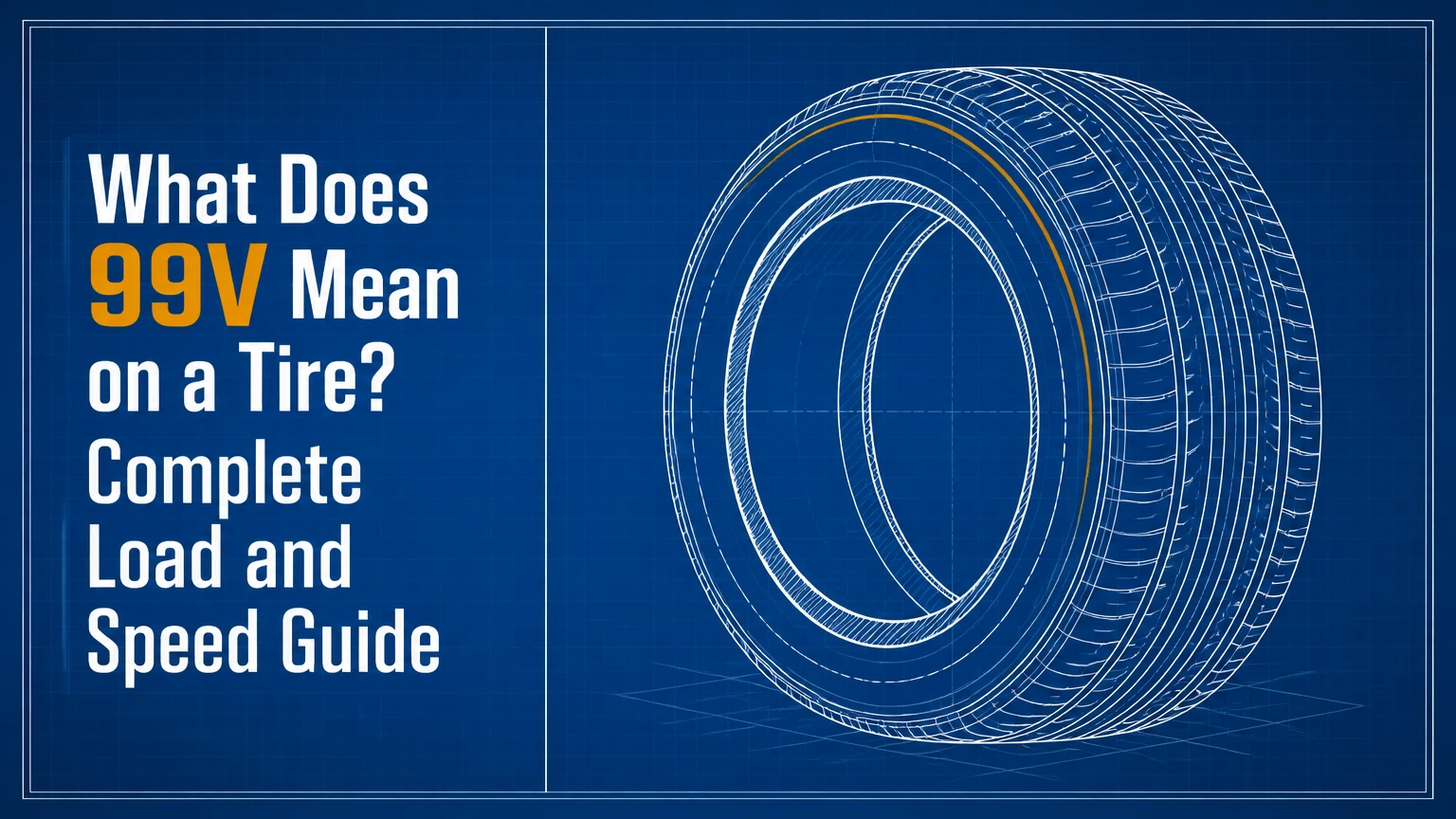
The alphanumeric code 99V on a tire sidewall indicates its specific load-carrying capacity and maximum safe speed limit. The number 99 represents a load index capable of supporting 775 kilograms (1,709 pounds) per tire. The letter V represents a speed rating approved for continuous operation up to 240 km/h (149 mph).
Key Facts / At a Glance
- Load Limit: 775 kg (1,709 lbs) per individual tire.
- Maximum Speed: 240 km/h (149 mph) under optimal conditions.
- Total Vehicle Capacity: 3,100 kg (6,836 lbs) for a set of four tires.
- Typical Vehicle Match: Mid-size sedans, sport crossovers, and modern minivans.
- Optimal Pressure: Must be inflated to the vehicle placard specification to maintain the structural integrity required for the V rating.
How Do You Read the 99V Tire Code?
The 99V code is read as two distinct performance metrics combined into a single service description. The first part is the numerical load index (99), and the second part is the alphabetical speed rating (V). Tire engineers place this service description immediately following the size dimensions, such as 225/55R17 99V, to specify exactly what forces the tire can withstand.
You will always find this service description printed on the outer sidewall near the wheel rim. Manufacturers mold this designation into the rubber during the high-pressure curing process. It serves as a legal safety standard required by transportation authorities globally, ensuring replacement parts match the original vehicle engineering. Every replacement tire you buy must meet or exceed the original equipment specifications indicated by this code.
Failing to match these specific numbers compromises vehicle stability and alters how the suspension handles weight transfer during emergency maneuvers. A mismatched service description changes the deflection rate of the sidewall, which directly impacts steering feedback and braking distances on wet pavement.
What Is the 99 Load Index?
The 99 load index translates directly to a maximum weight capacity of 775 kilograms or 1,709 pounds per individual tire at its maximum inflation pressure. When you install four 99-rated tires, your vehicle can safely support a gross vehicle weight of 3,100 kilograms or 6,836 pounds. This total limit must cover the curb weight of the vehicle itself, plus all passengers, cargo, and fuel.
Tire engineers determine this index using standardized charts published by organizations like the Tire and Rim Association (TRA) in North America and the European Tyre and Rim Technical Organisation (ETRTO). The 99 load index usually appears on Euro-metric tires. You must factor in vehicle weight distribution when calculating safety margins, as most cars carry 60 percent of their weight on the front axle. A 3,100-kilogram total capacity provides a wide safety buffer for a typical 1,600-kilogram mid-size sedan, ensuring the tires never approach structural failure during hard cornering.
| Load Index | Capacity (Pounds) | Capacity (Kilograms) | Typical Vehicle Application |
| 95 | 1,521 lbs | 690 kg | Compact Cars, Light Sedans |
| 97 | 1,609 lbs | 730 kg | Standard Sedans, Small Crossovers |
| 99 | 1,709 lbs | 775 kg | Mid-Size Sedans, Sport Crossovers |
| 101 | 1,819 lbs | 825 kg | Large SUVs, Light Trucks |
| 103 | 1,929 lbs | 875 kg | Heavy EVs, Full-Size SUVs |
What Does the V Speed Rating Mean?
A V speed rating certifies that the tire can safely maintain a maximum continuous speed of 240 kilometers per hour, which equals 149 miles per hour. The rubber compounds and internal steel belts are engineered specifically to dissipate the massive heat generated by centrifugal forces and road friction at these high velocities.
The letter V originally stood as the highest possible speed rating in early European classification systems before tire technology advanced to require W and Y ratings. Today, a V rating indicates a performance-oriented touring tire. “Speed ratings measure thermal endurance just as much as physical velocity,” states a 2023 technical bulletin from the Tire Industry Association. “A V-rated tire resists internal heat buildup significantly better than a standard touring tire.”
This heat resistance protects the integrity of the tire even if you never drive near 149 mph. High summer temperatures, heavy loads, and sustained highway driving all generate internal friction. The specialized synthetic rubber blends and extra nylon cap plies inside a V-rated tire prevent the tread blocks from separating from the steel belts under these thermal stresses.
How Do Manufacturers Test the V Speed Rating?
Manufacturers determine if a tire achieves a V certification through highly standardized indoor laboratory procedures. The testing protocol requires the tire to run continuously against a massive steel drum without showing any signs of structural degradation, tread separation, or internal blistering.
The industry relies on testing frameworks like the ECE Regulation 30 standard in Europe. Technicians mount the tire to a heavy-duty testing rim and inflate it to a specific baseline pressure. They press the tire against a 2-meter-wide steel flywheel to simulate the exact real-world weight loads specified by the 99 load index.
The testing machine increases the flywheel speed in increments of 10 km/h. To earn the V rating, the tire must spin at exactly 240 km/h (149 mph) for a continuous 10-minute interval without failing. After the endurance run, engineers dissect the tire to inspect the internal casing. If they find any belt deformation, air blistering, or cord separation, the tire fails the certification.
How Does 99V Compare to Other Tire Ratings?
The 99V rating occupies a specific middle ground between standard passenger tires and ultra-high-performance track rubber. You must understand how it stacks up against surrounding options to make an informed replacement choice for your specific vehicle and driving style. A higher speed rating generally brings stiffer sidewalls and better cornering grip, while a lower speed rating prioritizes ride comfort and longer tread life.
Vehicle manufacturers select the original equipment tire rating based on the top speed capability of the vehicle, the suspension tuning, and the expected braking loads. Changing the service description alters the original engineering parameters. The table below outlines exactly how the 99V rating compares to the most common alternatives you will find at a tire shop.
| Service Description | Load Limit (Per Tire) | Speed Limit | Best Suited For |
| 99H (Standard) | 1,709 lbs (775 kg) | 130 mph (210 km/h) | Family Sedans, Minivans |
| 99V (Performance) | 1,709 lbs (775 kg) | 149 mph (240 km/h) | Sport Sedans, Crossovers |
| 99W (High Speed) | 1,709 lbs (775 kg) | 168 mph (270 km/h) | Sports Cars, High-End EVs |
| 103V (Extra Load) | 1,929 lbs (875 kg) | 149 mph (240 km/h) | Heavy EVs, Full-Size SUVs |
Can You Use 99H Instead of 99V?
You should not downgrade to a 99H tire if your vehicle manufacturer originally specified a 99V tire on the door placard. A 99H tire supports the exact same 1,709-pound load but is only certified for continuous speeds up to 130 mph (210 km/h). Downgrading the speed rating compromises the original handling characteristics of your vehicle.
Installing an H-rated tire on a vehicle tuned for V-rated tires results in a noticeable loss of steering precision. The H-rated tire features a softer sidewall construction, leading to increased lateral flex during cornering. Furthermore, many major retail tire chains will refuse to install a tire with a lower speed rating than the original equipment due to liability concerns. In some jurisdictions, intentionally down-rating your tires can void specific clauses in your auto insurance policy if an investigator links a blowout to improper tire specifications.
Are 99V Tires Directional?
The 99V service description dictates only load and speed, meaning it has no bearing on whether the tread pattern is directional, symmetrical, or asymmetrical. You can purchase a 99V tire in any of these three tread configurations depending on the specific model you choose. Directional tires feature a V-shaped tread pattern designed to evacuate water rapidly, and they must be mounted to rotate in a specific direction indicated by an arrow on the sidewall.
What Are the Advantages and Disadvantages of a 99V Tire?
The primary advantage of a 99V tire is its superior high-speed stability and heat resistance, while the main disadvantage is a firmer ride quality compared to standard utility tires. Engineers design these tires with reinforced shoulder blocks, tightly wound steel belts, and specialized synthetic rubber compounds infused with high levels of silica.
These engineering choices create distinct trade-offs. You gain performance and safety at the expense of comfort and maximum longevity.
Performance Advantages
- Sharper Steering Response: The reinforced internal nylon overlays restrict casing expansion, yielding crisper steering feedback through corners.
- Thermal Management: High-grade rubber formulations resist internal friction heat buildup, sharply reducing the risk of catastrophic tread separation at highway speeds.
- Braking Stability: Stronger internal steel belts hold their shape under intense braking forces, keeping the rubber contact patch flat against the pavement for shorter stopping distances.
- Wet Traction: The silica-rich compounds typically used in V-rated tires maintain excellent pliability in rainy conditions, improving grip on slick roads.
Common Drawbacks
- Firmer Ride Quality: The rigid internal construction absorbs fewer road imperfections, transferring more bumps and vibrations into the cabin.
- Faster Wear Metrics: Speed-optimized compounds prioritize grip over hardness, resulting in a shorter tread life compared to utility tires rated H or T.
- Lower Cold Flexibility: Performance-oriented V-rated rubber compounds stiffen rapidly in freezing temperatures. Summer variations lose significant traction below 45 degrees Fahrenheit (7 degrees Celsius).
- Increased Acoustic Resonance: The stiffer tread blocks often generate a louder humming noise at highway speeds compared to softer passenger tires.
How Much Do 99V Tires Cost and How Long Do They Last?
A typical 99V tire costs between $110 and $230 depending on the brand tier, and it generally lasts for 45,000 to 65,000 miles under standard driving conditions. The total replacement cost for a complete set of four ranges from $500 to $1,100 once you factor in mounting, balancing, valve stems, and local disposal fees.
Pricing correlates directly with the research and development invested in the rubber compound. Premium brands utilize advanced silica mixing technologies that extend tread life without sacrificing the V-rated heat resistance. Budget brands often use older carbon black compounds that achieve the 99V certification but wear down much faster. The lifespan of any tire depends heavily on proper maintenance, regular rotation intervals, and maintaining exact alignment specifications.
| Brand Category | Average Price (Per Tire) | Expected Tread Lifespan | Best Suited For |
| Budget / Entry-Level | $90 – $130 | 35,000 – 45,000 miles | Low-mileage city commuters |
| Mid-Range / Value | $130 – $170 | 45,000 – 55,000 miles | Daily highway commuters |
| Premium Touring | $170 – $210 | 55,000 – 65,000 miles | Luxury sedans, long road trips |
| Premium Performance | $190 – $240 | 40,000 – 50,000 miles | Aggressive driving, sport sedans |
What Are the Most Common Mistakes with 99V Tires?
The most common mistake drivers make is running their 99V tires under-inflated, which completely negates the high-speed thermal protections built into the tire casing. Low tire pressure causes the sidewalls to flex excessively under the weight of the vehicle. This repeated mechanical friction generates extreme internal heat that degrades the rubber bonds.
According to a 2022 safety report by the National Highway Traffic Safety Administration (NHTSA), driving on under-inflated tires increases the risk of tread separation by roughly 300 percent. The V speed rating is only valid when the tire holds the exact cold air pressure listed on your driver-side door jamb. Running a 99V tire just 5 PSI below the recommended specification lowers its actual speed threshold and load-carrying capacity significantly.
A secondary failure mode occurs when owners mix different speed ratings on the same vehicle. Do not install 99V tires on the front axle and 99H tires on the rear axle. Mixing speed ratings creates asymmetric grip properties. During an emergency lane change, the stiffer V-rated tires will react faster than the softer H-rated tires, inducing unpredictable oversteer and potentially causing the vehicle to spin.
A trusted practitioner rule of thumb requires replacing tires in identical pairs at minimum. If you must replace only two tires, always place the new 99V rubber on the rear axle to prevent the back end from hydroplaning in wet conditions, regardless of whether your vehicle is front-wheel or rear-wheel drive.
Frequently Asked Questions
Are 99V tires good for snow and winter driving?
The 99V rating indicates load and speed, not seasonal traction. A 99V tire will perform poorly in snow if it is a summer or standard all-season model. For winter driving, you must look for a 99V tire that also features the Three-Peak Mountain Snowflake (3PMSF) symbol on the sidewall.
What happens if I put 99V tires on a heavy SUV?
If the SUV has a Gross Vehicle Weight Rating (GVWR) that exceeds the 3,100 kg (6,836 lbs) total capacity of four 99-rated tires, you risk structural tire failure. Heavy SUVs typically require a load index of 103 or higher. Always match the load index specified in your owner’s manual.
Does a 99V tire improve my vehicle’s fuel economy?
Usually, it does not. V-rated tires often have a slightly higher rolling resistance than standard H-rated or T-rated tires due to their stickier compounds and wider tread blocks. Upgrading to a 99V tire might result in a marginal decrease of 1-2 percent in overall fuel efficiency.
Do 99V tires require a specific type of wheel rim?
They do not require a special rim type, provided the tire diameter matches the wheel diameter (e.g., a 17-inch tire on a 17-inch rim). However, the wheel itself must be structurally rated to handle the 775 kg load limit and the physical stresses of high-speed driving.
Is 99V considered a low-profile tire?
No, 99V only denotes weight and speed capacity. The profile (or aspect ratio) is determined by the size code preceding it. A 225/40R18 99V is a low-profile tire, while a 225/65R17 99V has a tall, standard sidewall.
Can an electric vehicle (EV) use standard 99V tires?
EVs carry massive battery packs and generate instant torque, placing immense strain on standard tires. While a standard 99V tire supports the weight, EV owners should look for a 99V XL (Extra Load) designation or an EV-specific model to prevent accelerated tread wear and maximize battery range.
The Bottom Line
When you ask what 99V means on a tire, you are asking for the structural limits of the rubber keeping your vehicle safely on the road. The 99 guarantees each tire can shoulder 1,709 pounds of vehicle weight, while the V certifies the internal belts can dissipate heat at speeds up to 149 mph. Treating these metrics as absolute engineering boundaries ensures your suspension performs exactly as designed, keeps your braking distances short, and protects your passengers against catastrophic high-speed blowouts.