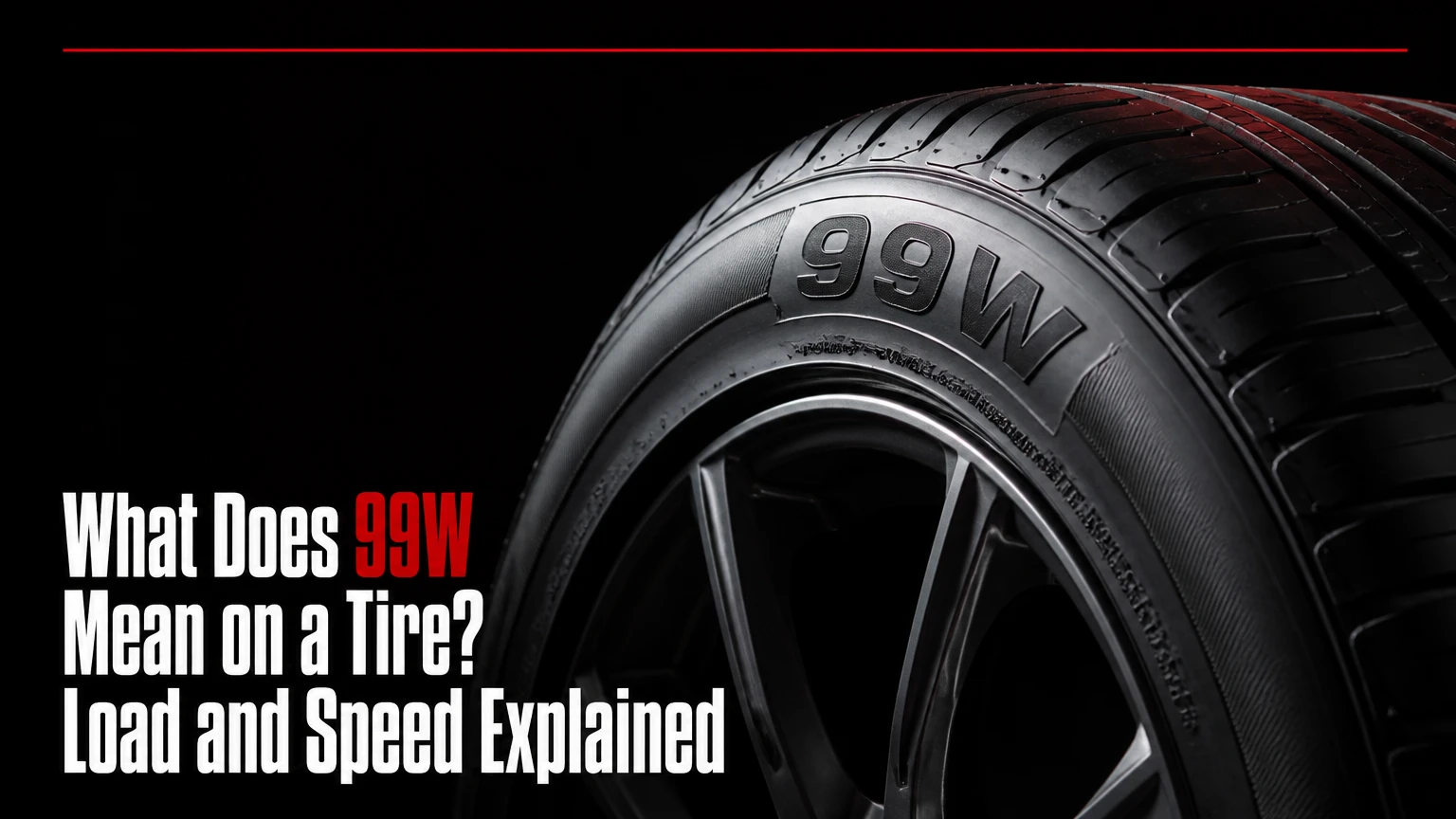
The marking 99W on a tire combines a load index and a speed rating. The number 99 means the tire can carry up to 775 kilograms (1,709 pounds) under its specified maximum conditions, while W indicates a tested maximum speed of 270 km/h (168 mph) when the tire carries the correct load and has proper inflation.
Key Facts at a Glance
99 is the tire’s load index, equal to 775 kg or 1,709 lb per tire.
W is a speed rating for speeds up to 270 km/h or 168 mph under controlled test conditions.
Four 99-rated tires have a theoretical combined capacity of 3,100 kg or 6,836 lb, but the vehicle’s GVWR and axle ratings still control.
A 99W marking does not specify tire size, pressure, tread life, winter performance, or vehicle compatibility.
The correct replacement must meet the vehicle manufacturer’s required load index, speed rating, dimensions, construction, and service description.
W does not mean winter. Winter suitability comes from the tire design and markings such as the 3-Peak Mountain Snowflake symbol.
What Does 99W Mean on a Tire?
A 99W tire is designed to carry 775 kg per tire and operate at speeds up to 270 km/h under the conditions used for its speed classification. The “99” and “W” describe different properties: 99 concerns load capacity, while W concerns heat resistance and performance at speed.
The code usually appears at the end of a complete tire size, such as 225/45R17 99W. In that example, 225 is the section width in millimeters, 45 is the aspect ratio, R identifies radial construction, 17 is the wheel diameter in inches, and 99W is the service description.
The marking alone does not tell you whether a tire fits a wheel or vehicle. A tire can have the correct 99W service description but still have the wrong diameter, width, rim size, load construction, or seasonal compound.
What is the 99 load index?
The number 99 is a standardized load-index code assigned to one tire. According to load tables used by the Tire and Rim Association and European Tyre and Rim Technical Organisation, load index 99 corresponds to 775 kg, or approximately 1,709 lb, when the tire is operated at its rated inflation condition.
Load index is not the same as the weight your vehicle should carry in ordinary driving. Vehicle engineers distribute weight between axles, account for suspension geometry, and specify an allowable gross vehicle weight. The tire’s capacity must meet or exceed the required load at each axle, not merely the vehicle’s empty weight.
What does the W speed rating specify?
The letter W identifies a maximum rated speed of 270 km/h (168 mph). The rating describes the tire’s tested ability to manage heat, centrifugal forces, and structural stress when correctly inflated and loaded.
The W limit is not a recommended road speed. Public-road speed limits, weather, traffic, vehicle condition, tire wear, and driver control remain limiting factors. A W-rated tire can lose capability when it is underinflated, overloaded, damaged, improperly repaired, or used with insufficient tread.
How Does the 99 Load Index Work?
Load index 99 applies to one tire, not the complete vehicle. Four tires marked 99 provide a theoretical total of 3,100 kg, calculated as 775 kg multiplied by four, but that total does not replace the vehicle manufacturer’s GVWR or axle-load limits.
A vehicle’s actual safe loading depends on the weakest relevant limit. For example, four tires may theoretically support 3,100 kg while the vehicle manufacturer limits the car to a 2,150 kg GVWR. The lower vehicle limit remains binding.
The U.S. National Highway Traffic Safety Administration advises drivers to use the tire information placard and vehicle certification label when determining the correct tire and loading information. The placard commonly appears on the driver’s door jamb, door edge, or fuel-filler area.
Load index 99 versus nearby ratings
The following values show the practical difference between common nearby load indexes. Each value applies to one tire.
| Load index | Maximum load per tire | Approximate pounds per tire | Difference from 99 |
|---|---|---|---|
| 97 | 730 kg | 1,609 lb | 45 kg lower |
| 98 | 750 kg | 1,653 lb | 25 kg lower |
| 99 | 775 kg | 1,709 lb | Baseline |
| 100 | 800 kg | 1,764 lb | 25 kg higher |
| 101 | 825 kg | 1,819 lb | 50 kg higher |
A lower index is not an acceptable substitute simply because the tire has the same dimensions. A higher index may be acceptable, but only when the tire size, rim width, pressure, construction, clearance, and vehicle manufacturer’s requirements also match.
Does 99 mean 775 kg in every application?
Load index 99 corresponds to 775 kg in the standard index table, but the tire may not deliver that capacity at every inflation pressure or operating condition. The tire’s load-and-inflation table determines the permitted load at a particular pressure.
Extra-load tires, commonly marked XL, Reinforced, or REINF, can use a different pressure and construction system than standard-load tires. The letters do not automatically make an XL 99W tire suitable for a vehicle that requires a different service description.
How Does the W Speed Rating Work?
A W-rated tire is classified for 270 km/h (168 mph) under a controlled test protocol, with specified load, inflation, temperature, and test duration. The rating indicates resistance to heat and structural stress; it does not guarantee equal braking, cornering, or wet grip across every W-rated model.
Manufacturers tune high-speed tires with combinations of belt packages, sidewall design, bead reinforcement, cap plies, tread compounds, and tread patterns. Those construction choices can improve steering response while increasing rolling resistance, noise, cost, or ride firmness.
Tire Review describes speed-rating tests as controlled procedures in which a tire runs against a test wheel while speed and temperature are managed. Real roads introduce potholes, camber changes, standing water, cold temperatures, and impact damage that laboratory tests do not reproduce.
Michelin summarizes the distinction directly: “The speed rating indicates the maximum speed capability of the tire.” That statement describes capability under specified conditions, not a safe operating target for public roads.
Speed-rating alternatives to W
| Speed rating | Maximum rated speed | Approximate mph | Common application |
|---|---|---|---|
| H | 210 km/h | 130 mph | Family sedans and compact crossovers |
| V | 240 km/h | 149 mph | Touring cars and many performance sedans |
| W | 270 km/h | 168 mph | Performance cars and high-speed grand touring |
| Y | 300 km/h | 186 mph | High-performance vehicles |
| (Y) | Above 300 km/h | Above 186 mph | Specialized ultra-high-performance applications |
The exact vehicle requirement matters more than the highest available letter. A Y-rated tire is not automatically better for a commuter because a higher rating can bring a firmer ride, greater expense, shorter tread warranty, or reduced cold-weather performance.
Can You Replace a 99W Tire With 99V or 99Y?
A 99V tire has the same 775 kg load index as a 99W tire but a lower speed classification, while a 99Y tire retains the same load index and raises the rated speed to 300 km/h. Whether either replacement is acceptable depends on the vehicle manufacturer, regional regulations, tire position, season, and intended use.
Do not assume a lower speed rating is safe because the vehicle rarely reaches the rating. Some vehicles use the specified speed class to preserve steering response, braking balance, electronic stability behavior, and high-load heat control.
A higher speed rating is often technically acceptable when the complete tire specification is compatible. It does not compensate for an incorrect load index, wrong size, unsuitable winter compound, inadequate pressure, or a wheel that is too narrow or wide.
| Tire code | Load per tire | Speed class | Typical replacement position |
|---|---|---|---|
| 99H | 775 kg | 210 km/h / 130 mph | Only if vehicle documentation permits |
| 99V | 775 kg | 240 km/h / 149 mph | Common downgrade question, verify first |
| 99W | 775 kg | 270 km/h / 168 mph | Original-equipment baseline when specified |
| 99Y | 775 kg | 300 km/h / 186 mph | Possible upgrade with full fitment confirmation |
| 100W | 800 kg | 270 km/h / 168 mph | Possible load upgrade, verify dimensions and pressure |
What is the difference between 99W and 99W XL?
Both codes have a 775 kg load index and W speed rating, but 99W XL adds a construction designation. XL means Extra Load, so the tire is built to carry its rated load at a higher inflation pressure than a standard-load tire of the same size.
The vehicle placard or owner’s manual may specifically require XL or Reinforced construction. This is common on heavier vehicles, some sport sedans, and many electric vehicles. Never inflate an XL tire to an arbitrary pressure; use the vehicle placard unless a tire professional confirms a different pressure for a documented fitment.
Which Tire Attributes Matter Besides 99W?
The 99W service description is only one part of tire selection. Correct fitment also requires the complete size, construction, load type, approved rim, pressure range, seasonal category, and vehicle position.
The following attributes can change real-world behavior more than the difference between W and Y. A quiet touring tire and a track-focused tire may both be 99W while producing very different wet braking, steering, noise, and tread-life results.
| Attribute | Example marking or value | Why it matters | Where to verify |
|---|---|---|---|
| Tire size | 225/45R17 | Controls diameter, width, and wheel fit | Door placard and manual |
| Construction | XL or Standard Load | Changes pressure and load behavior | Sidewall and fitment guide |
| Season | M+S or 3PMSF | Indicates mud-and-snow or severe-snow qualification | Sidewall symbols |
| Treadwear | UTQG 500 | Relative U.S. treadwear index, not mileage guarantee | Sidewall and manufacturer |
| Maximum pressure | Example: 50 psi | Tire limit, not normal vehicle pressure | Sidewall |
| Vehicle pressure | Example: 35 psi cold | Required operating pressure for the vehicle | Door placard |
| Position | Front, rear, staggered fitment | Axle loads and sizes may differ | Vehicle manual |
The DOT Tire Identification Number provides manufacturing information, including the production week and year in the final four digits. A code ending in 2324 indicates the 23rd week of 2024. Tire age is separate from tread depth because rubber compounds oxidize over time.
How Do You Choose a Replacement for a 99W Tire?
Choose a replacement by copying the vehicle’s approved specification before comparing brands or prices. The decisive factor is the manufacturer’s fitment requirement, not the tire’s advertised performance category.
Step 1: Read the vehicle placard
Record the front and rear sizes, load index, speed rating, and cold inflation pressures. A staggered vehicle may require different front and rear specifications, so one 99W code may not describe all four positions.
Step 2: Match the complete service description
Confirm the replacement’s size, load index, speed rating, XL status, and seasonal category. A tire marked 225/45R17 99W XL is not interchangeable with every tire that merely says 225/45R17.
Step 3: Check the wheel and vehicle clearance
Verify approved rim width, overall diameter, section width, suspension clearance, and fender clearance. A wider tire can rub during steering lock or suspension compression even when its wheel diameter matches.
Step 4: Compare the tire’s intended use
Select a grand-touring model for long commutes, a UHP summer model for warm-weather handling, or a severe-snow-rated winter model for sustained snow and ice conditions. The W letter does not identify any of these categories.
Step 5: Install and maintain the set correctly
Replace tires in axle pairs when possible, install the better-matched pair on the rear axle for most two-wheel-drive vehicles, and follow the vehicle manufacturer’s pressure recommendation. Relearn TPMS sensors when required by the vehicle.
Step 6: Recheck after installation
Confirm rotation direction, balance, valve condition, lug torque, and alignment. A post-installation inspection should catch rubbing, uneven bead seating, and incorrect pressure before highway driving.
How Much Do 99W Tires Cost and How Long Do They Last?
A typical 99W passenger tire costs $90-$380 or more per tire, depending on size, brand, construction, warranty, and performance category. A typical usable tread period is 30,000-45,000 miles, or approximately 48,000-72,000 kilometers, but high-performance compounds, aggressive alignment, heavy vehicles, and poor pressure control can shorten that range.
| Market category | Typical price per tire | Typical set of four | Typical use |
|---|---|---|---|
| Budget | $90-$130 | $360-$520 | Basic commuting and replacement value |
| Mid-tier | $140-$210 | $560-$840 | Touring and mixed daily driving |
| Premium touring | $220-$320 | $880-$1,280 | Noise, wet grip, warranty support |
| Premium UHP | $260-$380+ | $1,040-$1,520+ | Performance handling and high-speed stability |
Treadwear ratings are useful for comparing tires within the same manufacturer’s system, but a UTQG rating is not a guaranteed mileage figure. Tire Rack and manufacturer warranties commonly exclude wear caused by alignment, inflation, rotation, vehicle loading, and road damage.
The U.S. Tire Manufacturers Association recommends regular inspection and replacement based on age, condition, and manufacturer guidance. Many manufacturers advise professional inspection after six years and replacement around ten years from manufacture, even when tread remains, although specific recommendations vary.
What Problems Can a 99W Tire Develop?
A 99W tire can suffer from underinflation, overloading, impact damage, misalignment, imbalance, aging, or incorrect installation. The 99W marking does not prevent failures caused by operating conditions outside the tire’s design limits.
| Symptom | Likely cause | Immediate check | Corrective action |
|---|---|---|---|
| Center tread wears first | Overinflation | Measure cold pressure | Set placard pressure |
| Both shoulders wear first | Underinflation or overload | Check pressure and load | Inflate and inspect load |
| One shoulder wears first | Camber or alignment error | Inspect alignment angles | Align vehicle |
| Vibration at 80-110 km/h | Imbalance, runout, or damage | Dynamic balance inspection | Balance or replace |
| Cracks in sidewall | Aging, ozone, or underinflation | Inspect with tire removed if needed | Replace damaged tire |
| Cupped or scalloped tread | Worn suspension or imbalance | Check shocks and bearings | Repair chassis, then replace if needed |
Rapid center wear does not prove that a tire’s load index is wrong. It usually points first toward pressure, while one-sided wear more often indicates alignment or suspension geometry.
A bulge, exposed cord, deep cut, or sudden pressure loss requires immediate removal from service. No speed rating makes a structurally damaged tire safe.
Can you mix 99W and 99V tires?
Mixing 99W and 99V tires is not recommended unless the vehicle manufacturer or a qualified tire professional specifically approves the arrangement. The load capacity is equal, but the speed classification and construction may produce different steering response, heat behavior, and wet traction.
Never mix different speed ratings across the same axle. On vehicles with all-wheel drive, consult the manufacturer because differences in rolling circumference, tread depth, and tire model can stress the drivetrain or trigger stability-control problems.
When replacing fewer than four tires, match the same model and specification on one axle whenever possible. On many vehicles, the newer tires belong on the rear axle to reduce oversteer risk on wet roads.
Is 99W Suitable for an SUV or Electric Vehicle?
A 99W tire is suitable for an SUV or electric vehicle only when that vehicle’s approved tire specification includes the required size and load capacity. The code alone cannot establish fitment because many SUVs and EVs require higher load indexes, XL construction, acoustic foam, low-rolling-resistance compounds, or different front and rear sizes.
Electric vehicles often weigh more than similarly sized gasoline vehicles because of their battery packs. That extra mass can increase tire load, shoulder wear, and rolling resistance. EV-specific tires may also use sound-absorbing materials and compounds designed to balance efficiency with torque and weight.
A 99 index supports 775 kg per tire, but the correct calculation uses each axle’s permitted load and the vehicle’s certification label. The vehicle must never be loaded beyond its GVWR, even if the tires have a higher theoretical combined capacity.
Winter use introduces another limitation. A W-rated summer tire can lose grip in cold temperatures, while a winter tire may carry a lower speed rating that the vehicle manufacturer permits for seasonal use. Follow the vehicle manual and local rules rather than treating W as a year-round performance guarantee.
What Should You Check Before Buying 99W Tires?
Use the following checklist before ordering a replacement:
- Read the driver-door placard and record every approved size.
- Confirm the required load index, speed rating, and XL or standard-load status.
- Check whether the vehicle uses staggered front and rear sizes.
- Compare the tire’s UTQG, wet-grip information, noise design, warranty, and seasonal rating.
- Inspect the manufacturing date, especially for discounted or old inventory.
- Confirm the tire shop has the correct TPMS service parts and mounting equipment.
- Ask whether alignment, balancing, disposal, installation, and road-hazard coverage are included.
- Set pressure from the vehicle placard after installation, not from the sidewall maximum.
- Recheck pressure monthly and before long trips, with tires cold.
- Stop driving if the tire develops a bulge, exposed cord, repeated pressure loss, or severe vibration.
One practitioner rule matters more than many shopping comparisons: never choose a tire by the last three characters alone. The complete size and service description, the vehicle placard, and the tire’s construction must agree.
FAQ About Tire Load and Speed Markings
Does 99W mean the tire can carry 99 kilograms?
No. The number 99 is a coded load index, not a kilogram measurement. Load index 99 corresponds to 775 kg per tire, or approximately 1,709 lb, under the applicable load-and-inflation conditions.
Is a W-rated tire always better than a V-rated tire?
No. A W-rated tire has a higher tested speed classification, but a V-rated tire may deliver a quieter ride, longer tread life, lower cost, or better cold-weather suitability. The vehicle manufacturer’s required rating should be the starting point.
Does the 99W code show the correct tire pressure?
No. The 99W marking does not provide the vehicle’s normal operating pressure. Use the cold-pressure value on the driver-door placard or in the owner’s manual, and do not substitute the sidewall maximum for the vehicle recommendation.
Can a 100W tire replace a 99W tire?
A 100W tire carries 800 kg per tire instead of 775 kg and has the same W speed classification, so it may be an acceptable upgrade. Confirm the complete size, rim compatibility, XL construction, clearance, pressure requirements, and vehicle approval first.
Does W mean winter on a tire?
No. W means a 270 km/h speed rating. Winter capability is indicated by the tire’s compound, tread design, and markings such as M+S or the 3-Peak Mountain Snowflake symbol.
How can you tell when a 99W tire is too old?
Read the final four digits of the DOT Tire Identification Number. The first two digits identify the production week and the last two identify the year, so 2324 means the 23rd week of 2024. Replace tires according to manufacturer age guidance and condition, not tread depth alone.
The Bottom Line
What does 99W mean on a tire? It means 775 kg of load capacity per tire and a 270 km/h speed rating under specified test conditions. Use the complete tire size, vehicle placard, axle ratings, inflation pressure, construction marking, seasonal requirements, and tire age before approving a replacement.