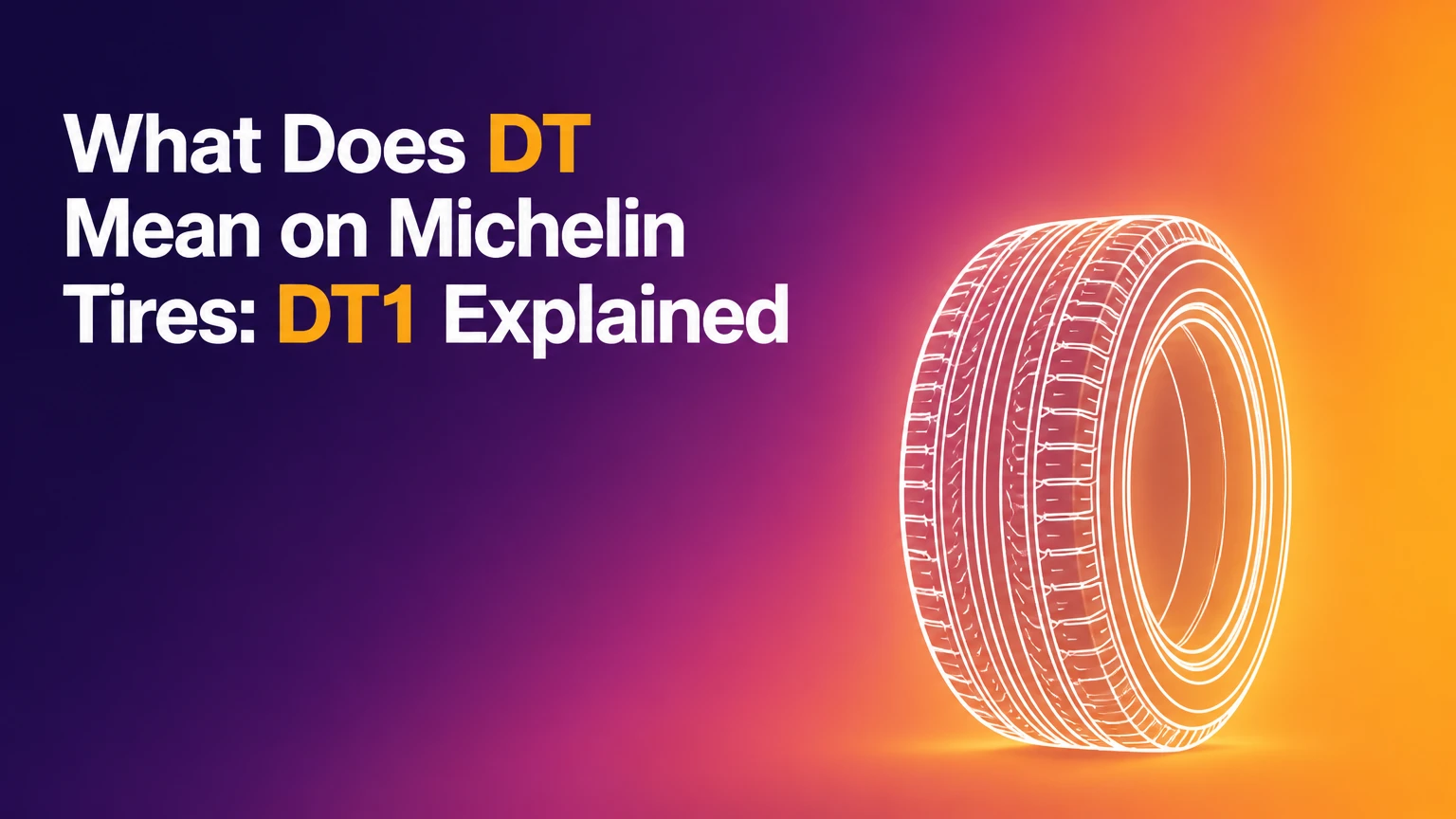
On Michelin tires, DT usually means Different Tread or Different Tread Pattern. The marking identifies a Michelin-developed variant with a tread design, compound, construction, or tuning specification adapted for a particular vehicle or original-equipment application, so DT is a fitment designation rather than a higher universal performance grade.
Key facts at a glance
- Michelin DT identifies a vehicle-specific or OE-developed tire variant, not a different tire size.
- DT1 and DT2 are product or homologation identifiers whose meanings can vary by tire family and vehicle program.
- A DT marking does not replace the size, load index, speed rating, run-flat status, or vehicle approval requirements.
- BMW’s star mark, Porsche’s N marking, and other OE symbols provide separate manufacturer-application information.
- Replacing a factory DT tire with a non-DT tire can alter steering response, noise, wet grip, or electronic-system calibration.
- The correct replacement is the complete Michelin specification listed by the vehicle manufacturer, not simply any tire with the same dimensions.
What does DT mean on Michelin tires?
DT means Different Tread on a Michelin tire, and the marking signals an altered or vehicle-specific Michelin specification. Michelin uses developed tire markings to distinguish products created around an automaker’s requirements, such as steering response, axle load, rolling behavior, wet grip, noise, or high-speed stability. The exact change is not identical across all DT products.
The term appears on the tire sidewall or in a retailer’s product description, often beside a model name such as Michelin Pilot Sport 4S or Primacy. A tire listed as “Pilot Sport 4S DT1” is therefore not automatically interchangeable with every ordinary Pilot Sport 4S in the same size.
Michelin’s official guidance on developed tires describes the concept as a tire “designed and developed specifically for a vehicle.” That wording matters because the vehicle approval, rather than the DT letters alone, determines whether the tire is appropriate.
DT is not a universal performance ranking
DT does not mean “top version,” “track version,” “extra durable,” or “dual tread.” It also does not establish that a DT tire has a higher speed rating or greater tread life than the standard version.
The marking describes a relationship between a tire specification and an application. A DT tire may be the best choice for the vehicle that requested it, while a standard version may be the correct choice for another vehicle.
Michelin and automakers can alter several properties during development:
- Tread block shape, spacing, or groove arrangement
- Rubber compound balance and operating temperature range
- Casing stiffness, belt package, or sidewall behavior
- Noise frequency and impact harshness
- Steering response and cornering compliance
- Wet-weather evacuation and dry-road contact behavior
Not every DT product changes every property. Public product pages often identify the approved application without publishing the complete compound formula or internal construction.
Why does Michelin make a different tread version?
Michelin makes a different tread version when the standard catalog tire cannot meet a vehicle manufacturer’s complete handling, comfort, noise, load, or stability target. Tire development is part of chassis tuning because the tire is the vehicle’s contact with the road, and small changes in stiffness or tread behavior can affect the entire driving response.
A sports car with a stiff suspension may need a different tire response from a luxury sedan using the same nominal size. The two vehicles can share 245/40R19 dimensions yet differ in axle load, alignment, steering ratio, damping, electronic stability calibration, and cabin noise targets.
How is a DT tire engineered?
Michelin and the vehicle manufacturer typically begin with the required size, load capacity, speed capability, and packaging envelope. Engineers then evaluate the tire through vehicle testing, computer modeling, laboratory measurements, and road or track validation.
The development target can include:
- Tread behavior: Engineers adjust block geometry and groove placement to manage dry grip, wet evacuation, and impact noise.
- Casing response: Sidewall and belt stiffness influence steering precision, ride compliance, and how quickly the vehicle responds to steering input.
- Compound behavior: Rubber formulation affects operating-temperature response, braking grip, wear, and rolling resistance.
- Vehicle integration: Testing considers suspension geometry, electronic stability control, anti-lock braking, torque delivery, and axle load.
- Production consistency: The approved tire must reproduce the tested behavior across the manufacturer’s production requirements.
A DT tire can therefore look similar to a standard tire while behaving differently under steering, braking, or load. Tread appearance alone cannot reveal the full engineering difference.
Does DT always mean a different rubber compound?
No. A DT marking does not prove that Michelin changed the rubber compound, and it does not prove that the tire has a different internal casing. The designation confirms that the tire is a distinct approved specification; Michelin’s public labeling may not disclose which engineering variables changed.
That distinction prevents a common overstatement. Some developed tires have visibly different tread patterns, while others may use less obvious construction or compound changes. The sidewall code, Michelin product record, and vehicle approval information provide more reliable evidence than visual inspection.
What do DT, DT1, and DT2 mean?
DT, DT1, and DT2 identify different Michelin developed-tire specifications, but the suffixes do not form a universal quality ladder. DT1 is not automatically newer, faster, or better than DT, and DT2 is not universally a second-generation upgrade. The meaning must be matched to the exact tire model, size, and vehicle application.
Retail catalogs and enthusiast communities sometimes describe DT1 as a revised or subsequent design. That may be accurate within a particular vehicle program, but it should not be generalized to every Michelin range.
| Marking | What it identifies | What it does not prove | Correct verification |
|---|---|---|---|
| DT | Different Tread or developed variant | Higher speed rating or longer life | Vehicle approval and Michelin part specification |
| DT1 | Numbered developed-tire variant | Universal “generation one” superiority | Exact model, size, and OE application |
| DT2 | Another numbered variant | Universal “generation two” superiority | Michelin catalog and vehicle manufacturer data |
| DT with OE symbol | Developed tire for a named automaker | Compatibility with every vehicle from that brand | Complete sidewall and fitment match |
The number can distinguish patterns or approvals that coexist in a product family. A buyer should not substitute DT1 for DT2 merely because the number appears higher.
Which OE markings appear with Michelin DT tires?
Michelin DT tires can carry an additional automaker approval mark, and that mark may be more useful than the DT suffix when selecting a replacement. Common examples include BMW’s star symbol, Porsche’s N designations, and other manufacturer-specific codes used by particular vehicle programs.
The mark is not a decoration. It identifies a tire specification evaluated for a manufacturer’s vehicle requirements.
| OE marking example | Associated manufacturer or program | Where it appears | What the buyer should confirm |
|---|---|---|---|
| BMW star, ★ | BMW approved tire | Tire sidewall and retailer listing | BMW model, axle, size, load, and speed rating |
| Porsche N0, N1, N2 | Porsche approved tire generation | Tire sidewall and product record | Correct Porsche N generation and axle position |
| MO or MOE | Mercedes-Benz approval, including run-flat variants where applicable | Sidewall and catalog listing | Mercedes approval and run-flat requirement |
| AO | Audi approval | Sidewall and retailer listing | Audi model, size, load, and speed specification |
| N-marked or other regional code | Manufacturer-specific program | Sidewall or technical listing | Exact vehicle-market approval |
The same automaker can use different approvals for different models, axles, or production years. “BMW tire” or “Porsche tire” is not precise enough.
Does DT change the tire’s size or sidewall specifications?
DT normally does not change the printed tire size, but the buyer must still match the complete sidewall specification. A 245/40R19 DT tire remains a 245/40R19 tire, yet it may differ from a standard 245/40R19 tire in approval, construction, run-flat status, load index, or speed rating.
Read the sidewall as a group of related attributes:
- 245: nominal section width in millimeters
- 40: sidewall height as a percentage of width
- R: radial construction
- 19: wheel diameter in inches
- Load index: maximum rated load code
- Speed symbol: maximum speed category under specified conditions
- XL or Reinforced: increased load construction where applicable
- Run-flat wording or symbol: ability to operate after air loss under stated limits
- DT or OE code: developed or manufacturer-approved variant
| Sidewall element | Example value | Meaning | Replacement consequence |
|---|---|---|---|
| Size | 245/40R19 | Width, aspect ratio, construction, wheel diameter | Must match the vehicle’s approved size |
| Load index | 98 | 750 kg per tire under the rating system | Equal or approved higher rating may be required |
| Speed symbol | Y | High-speed category under test conditions | Must meet the vehicle specification |
| Construction | XL | Extra-load casing | Do not replace with standard load without approval |
| Approval | DT1, ★ | Developed or OE-specific specification | Match the vehicle program when required |
| Run-flat status | ZP or catalog designation | Michelin Zero Pressure or approved run-flat construction | Match the vehicle’s spare-tire strategy and calibration |
A tire shop that matches only “245/40R19” has not completed the fitment check. The door-jamb placard, owner’s manual, and manufacturer fitment data remain the controlling references.
How do you identify the correct Michelin tire?
Identify the correct Michelin tire by comparing the vehicle placard, owner’s manual, tire sidewall, OE code, and axle position. Start with the recommended front and rear specifications, then confirm whether the vehicle requires a developed mark, run-flat construction, staggered sizes, or a specific load and speed rating.
Use this sequence:
- Read the door placard. Record front and rear size, cold inflation pressure, and load information.
- Check the owner’s manual. Look for replacement rules, temporary spare instructions, and all-wheel-drive requirements.
- Inspect the existing sidewall. Photograph the full marking, including DT, DT1, star, N, MO, AO, XL, and speed symbols.
- Confirm axle position. Front and rear tires may use different sizes or different developed specifications.
- Verify the product listing. Ask the dealer to confirm the exact Michelin model, size, load index, speed rating, and approval.
- Compare tread depth if replacing one tire. A new tire beside a substantially worn tire can create handling or drivetrain differences.
- Check production age and condition. Michelin recommends regular tire inspections, and many tire professionals use six years from manufacture as a replacement planning point, even though service life depends on storage, climate, use, and condition.
The DOT Tire Identification Number can identify the production week and year in the United States. It does not confirm DT status.
Standard Michelin versus DT Michelin
A standard Michelin tire and a DT Michelin tire can share a product name and dimensions while differing in vehicle tuning. The DT version is usually the safer choice when the vehicle was originally supplied with that approved specification, especially for high-performance, staggered, or all-wheel-drive applications.
| Decision factor | Standard Michelin version | DT or DT1 version | Practical effect |
|---|---|---|---|
| Intended application | Broad catalog fitment | Specific vehicle or OE program | DT has narrower fitment logic |
| Tread design | Baseline product pattern | Developed pattern or specification | Steering, wet behavior, and noise may differ |
| Vehicle approval | General product listing | Manufacturer or model approval | OE mark may affect recommended replacement |
| Availability | Often common stock | May require special ordering | Local inventory varies by size and region |
| Same-axle replacement | Match existing standard tires | Match existing DT specification | Avoid asymmetric behavior across one axle |
| Price | Retail catalog price | Product-specific retail price | Premium is possible, not guaranteed |
| AWD suitability | Depends on tread circumference | Depends on exact matched set | Tread depth and rolling circumference matter |
A DT tire is not automatically unsafe on a vehicle that did not specify it, but the reverse substitution can remove a vehicle-specific approval. Fitment databases and the automaker’s recommendations should decide the issue.
What does a DT marking change on the road?
A DT marking can change steering feel, braking balance, wet-road response, noise, ride impact, and the point at which the tire reaches its intended operating behavior. The result depends on the vehicle and the exact Michelin model, so no responsible specification can promise that every DT tire is quieter, faster, or longer-lasting.
Michelin’s technical development work focuses on matching tire characteristics to vehicle behavior. For example, a manufacturer may prioritize turn-in response on a sports car, while a luxury vehicle program may assign more weight to impact harshness and cabin resonance.
One practitioner rule is useful: judge a developed tire by vehicle integration, not by tread aggression. A less dramatic-looking tread can deliver more suitable stability or noise performance than a visibly sportier pattern.
Can you mix DT and non-DT tires?
Do not mix DT and non-DT tires on the same axle unless the vehicle manufacturer, Michelin, or a qualified tire engineer specifically approves the combination. Different tread and construction behavior can produce unequal steering response, braking traction, noise, and wear between the left and right tires.
Replacing all four tires with a complete, vehicle-approved set is the simplest solution. If only two are replaced, the matching pair normally belongs on the same axle, subject to the vehicle maker’s instructions and the tire shop’s assessment.
All-wheel-drive vehicles require extra care because systems can react to differences in rolling circumference, not only to visible tread design. A mismatch can contribute to driveline loading or warning lights, although an electronic stability-control error is not an inevitable result of every DT mismatch.
When is a standard tire an acceptable substitute?
A standard tire may be acceptable when the vehicle manufacturer lists it as an approved alternative, Michelin confirms the interchangeability, or the vehicle’s complete fitment specification does not require the developed mark. The same size alone is insufficient evidence.
Ask for a documented comparison of:
- Size and axle position
- Load index and speed symbol
- Run-flat or conventional construction
- Tread-depth difference
- Rolling circumference
- OE approval
- All-wheel-drive requirements
- Vehicle warranty or lease requirements
A tire retailer should not answer “yes” based only on the letters printed in a catalog. The answer belongs to the exact vehicle, model year, axle, and tire specification.
What should you do when one DT tire needs replacement?
When one DT tire is damaged, first determine whether the puncture is repairable and whether the remaining tire has compatible tread depth. If replacement is necessary, match the same Michelin model, size, load index, speed rating, construction, DT or OE marking, and axle position whenever possible.
Use this decision table:
| Situation | Preferred action | Why |
|---|---|---|
| Tread puncture in repairable area | Inspect and repair under Michelin and industry procedures | Preserves the matched pair when safe |
| One tire damaged, opposite tire nearly new | Replace one with exact matching specification | Limits tread-depth difference |
| One tire damaged, opposite tire worn | Replace both tires on the axle | Restores balanced axle behavior |
| AWD vehicle with one damaged tire | Follow vehicle maker’s circumference limit | Protects the driveline and control system |
| DT tire unavailable | Ask Michelin or the automaker for an approved alternative | Avoids unsupported substitution |
| Different DT suffix offered | Verify exact vehicle approval | DT1 and DT2 are not universal ranking codes |
Some manufacturers permit shaving a replacement tire to match the tread depth of the remaining tire. That is a specialist service, not a default recommendation, and it must comply with the tire maker’s limits.
How much do Michelin DT tires cost and how long do they take to obtain?
Michelin DT pricing and availability vary by size, model, market, and inventory; a fixed 5%-15% premium or 3-7-business-day lead time is not a universal rule. Typical U.S. retail differences can range from no difference to roughly $20-$80 per tire, while uncommon performance sizes may have much larger price variation.
The main cost drivers are production volume, wheel diameter, load rating, run-flat construction, regional distribution, and whether the tire is an active production item. A dealer may stock a common BMW-approved size but special-order a low-volume Porsche or Alpine specification.
| Purchase condition | Typical retail pattern | Typical availability | Buyer action |
|---|---|---|---|
| Common 17-inch touring size | $0-$30 DT-related difference per tire | Same day to 3 days | Confirm sidewall code before installation |
| 19-inch performance size | $20-$80 difference per tire | 2-7 days | Compare exact model and OE marking |
| 20-inch staggered performance set | $40-$120 difference per tire | 3-10 days | Verify front and rear specifications separately |
| Rare homologated size | Market-dependent, sometimes over $150 difference | 1-4 weeks | Order by vehicle approval, not generic size |
These figures are typical market ranges, not Michelin’s published price schedule. Taxes, mounting, balancing, disposal fees, alignment, and shipping can add $100-$250 to a four-tire installation in many U.S. markets.
When should a Michelin tire be replaced?
Michelin tires should be replaced when tread reaches the legal or manufacturer threshold, when structural damage appears, when aging or cracking compromises safety, or when wear becomes irregular enough to affect handling. In the United States, the commonly cited legal minimum is 2/32 inch, or 1.6 mm, but local rules can differ.
Michelin’s built-in tread-wear indicators sit in the main grooves. When the tread surface becomes level with those indicators, the tire has reached its wear limit under the manufacturer’s guidance.
Do not wait for the indicator if the tire has:
- Bulges, cuts, exposed cords, or belt separation
- Cracks in the sidewall or tread
- Repeated pressure loss
- Feathering, cupping, or one-sided wear
- Vibration that remains after balancing
- A puncture in the shoulder or sidewall
- A visible mismatch with the opposite tire on a driven axle
The DT marking does not change the wear indicator height. It does change the importance of replacing the tire with the correct developed specification when the vehicle depends on that tuning.
Common mistakes with Michelin DT markings
The most expensive errors usually begin with treating DT as a marketing badge rather than a fitment code.
- Matching only the tire size: Two 245/40R19 tires can have different load ratings, run-flat construction, OE approvals, and vehicle behavior.
- Assuming DT1 is always superior to DT: Numbered suffixes distinguish specifications; they do not create a universal performance ranking.
- Installing one different tire on an axle: A left-right difference can alter steering pull and braking balance, even when no dashboard warning appears.
- Ignoring front and rear differences: Staggered vehicles may require different sizes or developed specifications by axle.
- Treating a catalog description as proof: Retailer databases can omit or mislabel OE codes, especially after a product revision.
- Replacing a run-flat with a conventional tire casually: The change can affect spare-tire planning, pressure monitoring, suspension tuning, and manufacturer approval.
- Using visual tread similarity as evidence: Internal construction and compound differences are not reliably visible.
An alignment check is appropriate after abnormal wear, but alignment cannot correct a tire-specification mismatch. The tire and wheel must be identified first.
Which replacement choice fits each driving situation?
Factory DT vehicle used for normal commuting
Use the original DT or OE-approved specification when replacing tires. Normal commuting does not eliminate the vehicle manufacturer’s tested assumptions about rolling circumference, noise, steering response, and electronic controls.
High-performance vehicle used on roads and occasional track days
Use the specified developed tire for road driving, then confirm whether the automaker permits a separate track tire. A DT road tire is not automatically the ideal track compound, and track use can exceed its temperature, pressure, and durability design limits.
Older vehicle with discontinued DT stock
Ask Michelin, the automaker, or a specialist fitment provider for a current replacement or documented supersession. Do not select a generic tire solely because its dimensions match.
One damaged tire on an AWD vehicle
Measure the remaining tires and consult the vehicle manual before ordering. AWD systems can impose a tighter tread-depth or circumference tolerance than two-wheel-drive vehicles.
Used tires from an online marketplace
Avoid buying from a listing that omits the complete sidewall. Request photographs showing the DOT code, size, load index, speed rating, OE mark, DT suffix, and tread depth.
FAQ
Is a Michelin DT tire better than a regular Michelin tire?
A Michelin DT tire is better for the vehicle application it was developed and approved for, but it is not universally better. The standard Michelin version may be more appropriate for another vehicle, easier to source, or listed as the official replacement. Compare the complete vehicle fitment, not the DT letters alone.
Can I rotate Michelin DT tires?
You can rotate Michelin DT tires only according to the vehicle and tire design. Directional, asymmetric, staggered, or front-and-rear-specific setups restrict rotation. Follow the owner’s manual and Michelin’s rotation direction, because moving a tire across the vehicle can violate its mounting or approval requirements.
Does DT mean the tire is a run-flat?
No. DT identifies a developed tread or vehicle-specific specification, while run-flat status is a separate construction and product attribute. Michelin ZP, manufacturer run-flat codes, sidewall markings, and the vehicle manual determine whether the tire can operate after pressure loss.
Does a DT tire last longer?
A DT tire does not automatically last longer than a standard Michelin tire. Tread life depends on compound, alignment, inflation, vehicle weight, driving style, temperature, road surface, and maintenance. A vehicle-specific tire can wear differently because its compound and casing were tuned for a particular chassis.
Can I put DT tires on only the front axle?
Installing DT tires on only the front axle is appropriate only when the vehicle manufacturer specifies that arrangement or when the complete axle fitment is approved. On a staggered vehicle, front and rear tires can legitimately differ, but an arbitrary axle-only change can affect balance and control.
Where is the DT marking located?
The DT, DT1, or related developed-tire marking may appear on the sidewall, product label, retailer listing, or Michelin technical record. Inspect both sidewalls because a mounting position, dirt, or a partial photograph can hide the code. Record every marking before ordering a replacement.
The bottom line
What does dt mean on Michelin tires? DT means Different Tread or Different Tread Pattern, and it identifies a Michelin tire specification developed for a particular vehicle or OE requirement. The designation does not mean a universally superior tire, a different size, or automatic run-flat capability.
Match the vehicle’s approved size, load index, speed rating, construction, axle position, and OE code. If the car originally used DT, DT1, or another developed marking, replace it with the same approved specification unless Michelin or the vehicle manufacturer confirms an alternative.