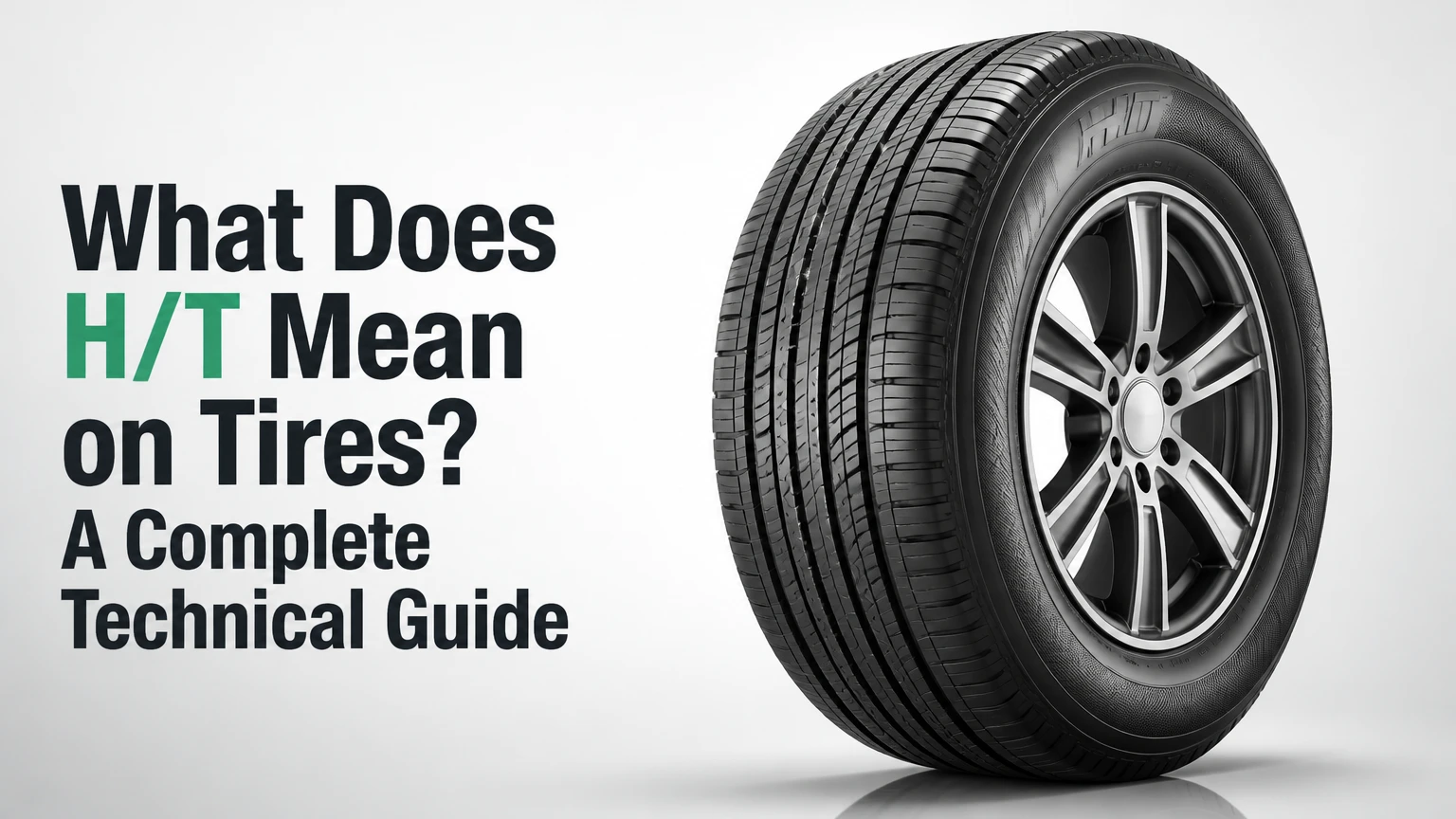
When consumers ask what does h/t mean on tires, the answer dictates their vehicle’s daily comfort, fuel economy, and safety margins. On vehicle tires, H/T stands for Highway-Terrain. Manufacturers engineer these tires specifically for sport utility vehicles, crossovers, and light trucks that spend the vast majority of their operational life driving on paved roads, highways, and city streets. They mirror the smooth ride and low rolling resistance of passenger car tires while supplying the reinforced load capacity required for heavier utility vehicles.
Key Facts / At a Glance
- Primary environment: Engineered for 90 to 100 percent paved road usage.
- Treadwear expectancy: Warranties typically cover 50,000 to 80,000 miles (80,000 to 130,000 kilometers).
- Standard starting depth: Tread grooves generally begin at 10/32 to 12/32 of an inch.
- Fuel efficiency: Delivers the lowest rolling resistance coefficient among all truck and SUV tire categories.
- Winter capability: Rated M+S (Mud and Snow) for light flurries, but generally lacks the 3PMSF severe snow certification.
What Are the Structural Features of Highway-Terrain Tires?
Highway-Terrain tires achieve their specific performance balance through highly specialized structural and chemical characteristics. Rubber engineers must build a product capable of supporting a 5,000-pound vehicle at 80 miles per hour without generating excessive heat or cabin noise. This requires a specific combination of tread block geometry, internal reinforcements, and compound chemistry.
Pitch-Sequenced Tread Blocks and Closed Shoulders
The most defining visual trait of an H/T tire is its tightly packed tread pattern. The outer edges of the tire feature continuous, closed shoulder ribs. These solid bands of rubber prevent air from escaping laterally as the tire rolls forward. Trapping this air reduces the rhythmic drumming noise commonly associated with heavy trucks. Furthermore, engineers use a technique called pitch sequencing. They vary the exact size and shape of the tread blocks around the circumference of the tire. As the tire rotates, these different-sized blocks generate different sound frequencies that actively cancel each other out, resulting in a near-silent cabin.
Dense Siping and Circumferential Grooves
Water evacuation is the primary safety function of an H/T tire tread. Wide, straight channels run continuously around the tire. These deep circumferential grooves can evacuate gallons of heavy standing water per second, preventing the tire from riding up on top of a water film. The individual tread blocks also contain thousands of microscopic, zig-zag slits known as sipes. When the tire presses against the pavement, these sipes open slightly to bite into thin layers of surface water, providing necessary grip on wet asphalt.
Specialized All-Season Chemical Compounds
Modern Highway-Terrain rubber relies heavily on silica-infused compounds rather than traditional carbon black. Silica allows the rubber to remain pliable when ambient temperatures drop near freezing, preventing the tire from turning into a hard, slippery plastic ring. Conversely, the compound must remain stable enough to resist melting or degrading under extreme summer highway heat. This chemical balance ensures consistent stopping distances 365 days a year across mild climates.
Reinforced Internal Construction
While an H/T tire looks like a passenger car tire on the outside, its internal skeleton is built for utility. The casing utilizes multiple layers of high-tensile steel belts overlaid with spirally wrapped nylon cords. The sidewalls contain dense polyester plies that resist flexing under heavy payloads. This internal rigidity prevents the tire from ballooning outward when loaded with passengers, cargo, or tongue weight from a trailer.
What Are the Different Types of H/T Tires?
Highway-Terrain tires are not universally identical across the market. Manufacturers divide the category into three distinct performance tiers based on the specific demands of the host vehicle.
Standard Touring H/T
The Standard Touring H/T focuses entirely on maximum ride comfort, long-term tread life, and low operational costs. These models feature the highest treadwear warranties, often exceeding 70,000 miles. They utilize symmetrical tread patterns, allowing them to be rotated to any position on the vehicle to ensure even wear. Drivers of daily commuter SUVs like the Honda CR-V or Toyota RAV4 rely heavily on this standard tier.
Performance Sport H/T
High-performance SUVs, such as the Porsche Cayenne or BMW X5, require tires that can handle rapid acceleration and aggressive cornering. Performance H/T tires utilize wider outer shoulder blocks to maximize the rubber contact patch during sharp turns. They often feature asymmetrical tread patterns and utilize stickier rubber compounds. This increased grip comes at a direct cost to longevity, with warranties rarely exceeding 40,000 miles.
Commercial Heavy-Duty H/T (LT-Metric)
Heavy-duty pickup trucks and commercial vans require Light Truck (LT) designated H/T tires. These tires feature a 10-ply rated internal construction (Load Range E) designed specifically to handle high tire pressures (up to 80 PSI) and severe towing loads. They utilize chip-resistant rubber compounds to survive rough loading docks and construction site pavement.
How Do H/T Tires Compare to A/T and M/T Options?
To understand if an H/T tire fits your lifestyle, you must evaluate it against All-Terrain (A/T) and Mud-Terrain (M/T) alternatives. The physical design of a tire represents a strict physics compromise. Gaining performance in deep mud fundamentally requires sacrificing performance on dry highway asphalt.
The primary difference lies in the void ratio. The void ratio represents the amount of empty space between the rubber tread blocks. H/T tires have a low void ratio, maximizing the amount of rubber touching the road for better braking and lower fuel consumption. A/T and M/T tires utilize high void ratios with massive gaps between the lugs, allowing them to dig into soft dirt and eject thick mud.
| Performance Metric | Highway-Terrain (H/T) | All-Terrain (A/T) | Mud-Terrain (M/T) |
|---|---|---|---|
| Primary Surface Environment | 90-100% Paved Pavement | 60% Paved / 40% Dirt & Gravel | 15% Paved / 85% Deep Mud & Rock |
| Average Tread Life Expectancy | 50,000 to 80,000 miles | 40,000 to 60,000 miles | 30,000 to 40,000 miles |
| Cabin Noise Output (Decibels) | Very Quiet (Often < 68 dB) | Moderate Hum (70-74 dB) | Loud Rhythmic Drone (> 75 dB) |
| Starting Tread Depth | 10/32 to 12/32 of an inch | 13/32 to 16/32 of an inch | 18/32 to 21/32 of an inch |
| Fuel Economy Impact | Excellent (Lowest rolling resistance) | Moderate (Expect a 1-3 MPG drop) | Poor (Expect a 3-5 MPG drop) |
| Off-Road Capability | Weak (Dry, packed dirt only) | Great (Gravel, sand, light mud) | Exceptional (Jagged rocks, clay) |
The A/T Visual Trap
Many truck owners purchase heavy, aggressive All-Terrain tires for vehicles that never leave suburban highways simply because they prefer the rugged aesthetic. This decision ruins the vehicle’s factory ride quality, increases cabin noise significantly, and forces the engine to burn excess fuel to turn the heavier tires. If your vehicle spends its life on asphalt, an H/T tire provides mathematically superior performance in every measurable category.
What Are the Expected Specifications for H/T Tires?
When shopping for replacement tires, you will encounter a series of numbers and letters molded into the sidewall. These specifications define the absolute limits of the tire. H/T tires carry distinct metric ranges that separate them from passenger car tires and off-road truck tires.
The UTQG (Uniform Tire Quality Grading) treadwear rating offers a comparative baseline for longevity. A control tire receives a baseline grade of 100. An H/T tire with a UTQG rating of 600 theoretically lasts six times longer than the control tire on a government test track. Speed ratings dictate the maximum safe velocity the tire can sustain over time without risking thermal blowout.
| Specification Metric | Standard Touring H/T | Performance Sport H/T | Commercial LT H/T (Load E) |
|---|---|---|---|
| Common Speed Ratings | T (118 mph) or H (130 mph) | V (149 mph), W (168 mph), Y (186 mph) | R (106 mph) or S (112 mph) |
| Typical Load Index Range | 100 to 110 (Per Tire) | 105 to 115 (Per Tire) | 120 to 125 (Per Tire) |
| UTQG Treadwear Range | 600 to 800 | 400 to 500 | Not Required by DOT |
| Internal Construction | Standard 4-ply equivalent | Standard 4-ply equivalent | Heavy 10-ply equivalent |
| Max Cold Inflation Pressure | 35 to 44 PSI | 40 to 50 PSI | 80 PSI |
Practitioner Insight: The EV Weight Penalty Electric SUVs and trucks weigh 20 to 30 percent more than their internal combustion counterparts due to massive battery packs. Furthermore, they deliver instantaneous torque directly to the wheels. This combination of extreme weight and immediate rotational force exerts massive shearing stress on standard H/T tread blocks. Tire engineers typically note that standard H/T tires mounted on a heavy EV may degrade to their wear bars in just 25,000 miles. EV owners must select H/T tires featuring “HL” (High Load) capacity designations and EV-specific compounding to survive the torque penalty.
How Much Do Highway-Terrain Tires Cost?
Highway-Terrain tires represent a substantial financial investment, though they deliver the lowest cost-per-mile over their lifespan compared to any other utility tire type. Prices scale aggressively based on the overall diameter of the wheel and the load rating of the casing.
A standard set of four H/T tires for a compact crossover utilizing 17-inch wheels generally ranges from $500 to $700. Stepping up to a full-size SUV running on 20-inch or 22-inch wheels pushes the cost to between $800 and $1,200. Heavy-duty LT-rated tires for a one-ton towing truck carry the highest premium, often costing $1,000 to $1,500 per set due to the massive volume of raw steel and rubber required for the 10-ply casing.
Lifespan and Maintenance Requirements
Under normal driving conditions, the rubber compound in an H/T tire naturally degrades over 4 to 6 years, regardless of mileage. Exposure to ultraviolet light and ozone causes the rubber to oxidize, leading to microscopic dry rot cracks in the sidewall.
To maximize this lifespan and maintain the manufacturer’s treadwear warranty, owners must rotate the tires every 5,000 to 7,500 miles. Rotating moves the tires to different positions on the chassis, ensuring they share the unique frictional burdens of the steering axle and the drive axle equally. Drivers must also check cold inflation pressures monthly. A tire under-inflated by just 6 PSI increases rolling resistance by 5 percent and accelerates shoulder wear dramatically.
What Are the Most Common Highway-Terrain Tire Problems?
While highly durable on pavement, H/T tires fail rapidly when pushed outside their engineered parameters. Recognizing abnormal wear patterns early allows you to correct mechanical alignment issues before the tire is permanently ruined.
The smooth, tight tread blocks that make H/T tires so quiet on the highway become their greatest liability in low-traction environments. The low void ratio means the tire cannot self-clean. When driven into thick mud, the sticky soil instantly fills the shallow grooves, effectively turning the tire into a slick, bald cylinder that spins helplessly.
| Visual Symptom or Issue | Physical Sensation | Primary Cause | Required Solution or Action |
|---|---|---|---|
| Rapid Center Tread Wear | Smooth strip down the middle of the tire. | Persistent over-inflation. | Reduce tire pressure to match the driver’s door placard. |
| Excessive Shoulder Wear | Edges of the tire wear down to the casing. | Persistent under-inflation or hard cornering. | Add air pressure; verify the vehicle is not constantly overloaded. |
| Feathered Tread Edges | Tread blocks feel sharp in one direction, smooth in the other. | Incorrect toe alignment angle. | Perform a computerized four-wheel mechanical alignment. |
| Cupping or Scalloping | Dips or craters appearing around the tire edge. | Worn shock absorbers or unbalanced wheels. | Replace suspension components and re-balance the wheel assembly. |
| Slipping on Wet Boat Ramps | Spinning tires on algae-coated concrete inclines. | Lack of mechanical grip in the tight tread pattern. | Drop tire pressure by 10 PSI temporarily; engage 4WD/AWD. |
Practitioner Insight: The Wet Braking Limit Legal tire tread minimums require replacement at 2/32 of an inch, indicated by raised wear bars in the grooves. However, testing shows that an H/T tire loses 50 percent of its ability to evacuate standing water when it reaches 4/32 of an inch. If you live in a climate with heavy seasonal rain, replacing H/T tires at 4/32 of an inch prevents catastrophic highway hydroplaning.
How Does Knowing What Does H/T Mean On Tires Impact Your Purchase?
Matching the tire to the actual usage of the vehicle saves thousands of dollars over the lifespan of a truck or SUV. The most common purchasing mistake involves mismatched load capacities. If you replace the factory LT-designated H/T tires on a heavy towing truck with standard P-metric (Passenger) H/T tires, you create an immediate safety hazard.
Standard P-metric tires feature a softer, thinner sidewall designed for passenger comfort. When you drop a 10,000-pound trailer onto the hitch, the P-metric sidewalls will buckle and overheat, resulting in severe trailer sway and potential highway blowouts. Always match the load range prefix (P or LT) to the specifications listed on the driver-side door jamb.
Conversely, installing heavy E-load LT tires on a lightweight unibody crossover results in a brutally harsh, jarring ride and plummeting fuel economy. The suspension of a lightweight SUV cannot compress the thick 10-ply sidewalls, transferring every pavement crack directly into the cabin.
Frequently Asked Questions
Are H/T tires good in winter snow?
H/T tires can navigate light snow dustings and cold, dry pavement effectively. However, their tight tread blocks pack quickly with deep snow, and they lack the aggressive biting edges required for thick ice. For severe winter weather, you must switch to a dedicated winter tire displaying the Three-Peak Mountain Snowflake (3PMSF) symbol.
Can you take H/T tires off-road?
You can drive H/T tires safely on hard-packed dirt roads, dry gravel driveways, and level sand. They fail immediately in deep, wet mud, on jagged sharp rocks that can puncture their mild sidewalls, or on wet grassy inclines where the slick tread cannot find mechanical purchase.
What is the difference between all-season tires and H/T tires?
All H/T tires use all-season rubber compounds, but not all all-season tires are H/T tires. “All-season” refers only to the temperature flexibility of the rubber chemistry. “H/T” specifically denotes the reinforced structural casing designed to carry the heavy weight of an SUV or truck.
How often do I need to rotate my H/T tires?
Manufacturers require tire rotation every 5,000 to 7,500 miles to keep the treadwear warranty valid. Front tires handle the friction of steering and bear the heavy weight of the engine, while rear tires handle driving forces. Rotating them equalizes this wear across the set.
Do H/T tires make road noise?
No, H/T tires are specifically engineered to be the quietest option available for trucks and SUVs. If your previously quiet H/T tires develop a loud, rhythmic roaring sound at highway speeds, it indicates uneven tread wear caused by a bad mechanical alignment or a failing wheel bearing.
The Bottom Line
Understanding exactly what does h/t mean on tires protects both your wallet and your safety on the road. Highway-Terrain tires represent the ultimate engineering solution for drivers who need the cargo and passenger capacity of a large utility vehicle but demand the quiet comfort and fuel efficiency of a passenger sedan. By keeping them properly inflated, rotating them on schedule, and respecting their off-road limitations, a premium set of H/T tires will provide years of reliable, silent service.