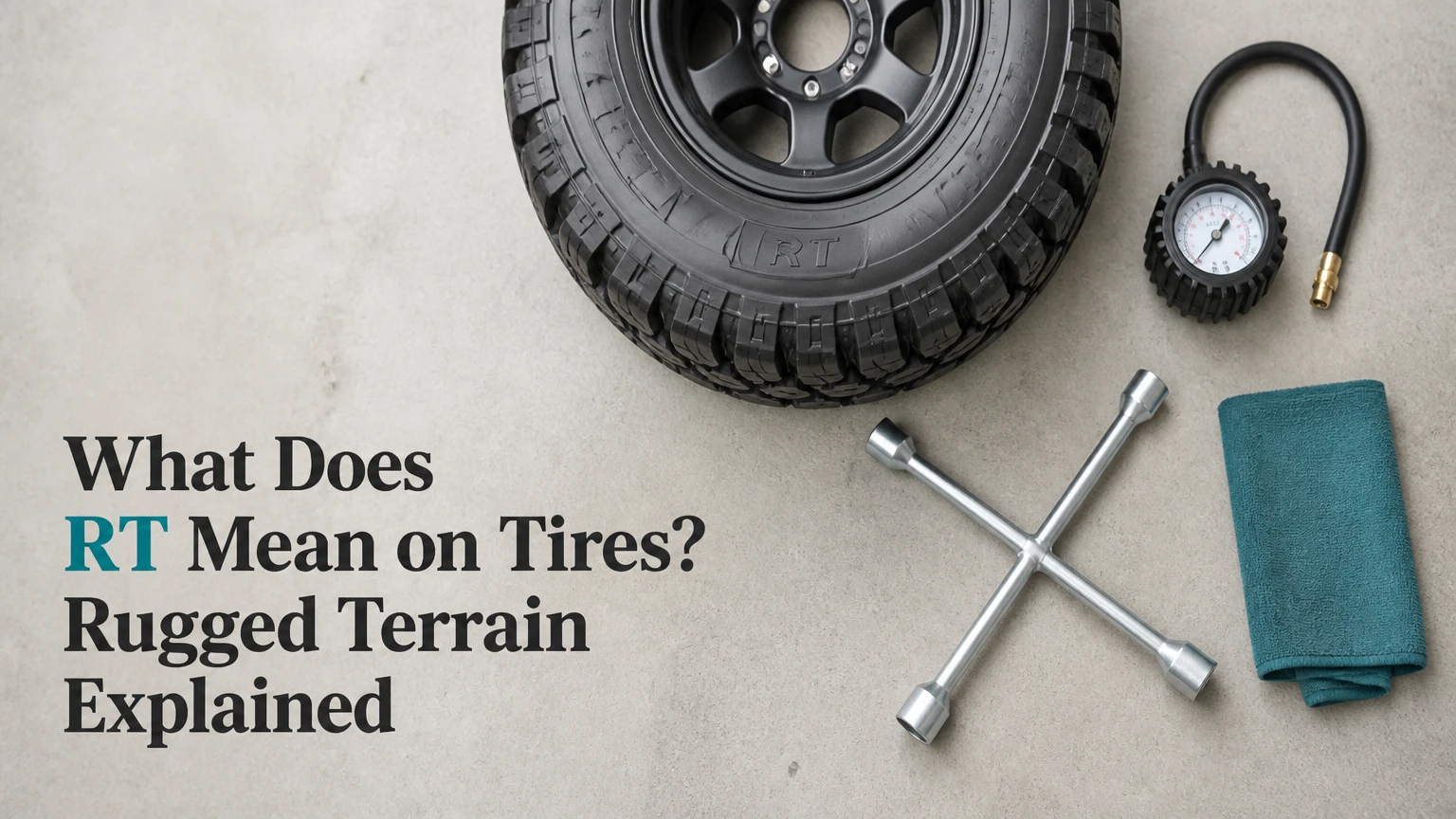
On tires, RT or R/T means Rugged Terrain, sometimes called Rough Terrain. Rugged Terrain tires are a hybrid category between quieter All-Terrain tires and more aggressive Mud-Terrain tires, combining highway manners with stronger gravel, rock, and loose-surface traction. RT is usually a manufacturer or market designation, not a universal government tire standard.
Key Facts at a Glance
RT means Rugged Terrain or Rough Terrain.
RT tires generally sit between A/T and M/T tires in tread aggressiveness.
RT is not a standardized performance grade, so two RT tires can behave differently.
A tire’s door-placard pressure, load index, speed rating, and size remain more important than the RT label.
Many RT tires create more noise and rolling resistance than comparable A/T tires.
The 3PMSF snow symbol, not an aggressive tread pattern alone, identifies a tire certified for severe snow service.
What Does RT Mean on Tires?
RT means Rugged Terrain, a tire design intended to divide its use between paved roads and demanding unpaved surfaces. A typical RT tire uses a relatively connected center tread for highway stability and wider shoulder blocks for gravel, rocks, sand, and moderate mud.
The category is often described as a “tweener” because it occupies the space between A/T and M/T products. That description is useful for shopping, but it is not a precise engineering standard. Tire manufacturers choose their own tread patterns, compounds, casing designs, load ranges, and winter certifications under the RT name.
The letters can appear in several places:
- On a product name, such as a model marketed as R/T.
- In an online tire category or retailer filter.
- In advertising for a hybrid off-road tire.
- Occasionally in a model designation that has a manufacturer-specific meaning.
The letters RT are not the same as the size, load index, speed rating, or DOT date code printed on the sidewall. For example, in LT265/70R17 121/118S, the size and service data are encoded separately. RT describes the tire’s intended tread category, while the remaining markings identify dimensions and operating limits.
Is RT an official tire rating?
RT is generally a marketing category rather than a universal regulatory rating. The U.S. Department of Transportation requires regulated tire information, but it does not assign one standard performance definition to every tire labeled Rugged Terrain.
That distinction matters when comparing products. One RT tire may emphasize quiet commuting, while another may use a stiff three-ply sidewall and large voids for rocky trails. The sidewall markings, manufacturer specifications, independent tests, and warranty provide more useful evidence than the letters alone.
How Does an RT Tire Work?
An RT tire combines a connected on-road center tread with open, reinforced shoulders for off-road grip. The center blocks support braking, steering response, and stability on asphalt, while the shoulder voids clear loose material and create edges that can bite into uneven ground.
What features define an RT tread?
The main design features include:
- Connected center ribs or blocks: Smaller gaps reduce tread squirm and can lower pattern noise compared with a full M/T design.
- Open shoulder channels: Larger spaces help move gravel, dirt, and some mud away from the contact patch.
- Staggered shoulder lugs: Offset edges can improve traction when a tire climbs out of a rut.
- Sidewall styling or sidebiters: Raised rubber on the sidewall may protect against abrasion and provide additional edges when aired down.
- Full-depth sipes: Narrow cuts create extra biting edges for wet pavement and packed snow.
- Stone ejectors: Ridges inside some grooves help release stones before they remain lodged in the tread.
A sidewall lug does not automatically provide major traction when the tire is aired down. The tire must be designed for low-pressure operation, and the wheel, casing, terrain, vehicle weight, and bead security all matter. Airing down without a pressure plan can cause heat buildup, bead unseating, or sidewall damage.
Do RT tires have two-ply or three-ply sidewalls?
RT tires may use two-ply, three-ply, or other casing constructions, depending on the model and size. “Three-ply” usually refers to the number of reinforcing cord layers in a specified casing area, but it does not mean the whole tire has three identical layers everywhere.
| Specification | Typical RT variation | Practical effect |
|---|---|---|
| Sidewall casing | 2-ply or 3-ply | Changes flex, puncture resistance, weight, and ride |
| Tread depth | 13/32-18/32 inch | Adds wear reserve and loose-surface grip |
| Load range | C, D, or E | Sets load capacity at specified test pressure |
| Speed rating | Q, R, S, or T | Sets the tire’s certified speed category |
| Sidewall construction | Polyester, steel, nylon layers | Influences stiffness and impact resistance |
Ply count is not a complete durability score. A well-designed two-ply tire can outperform a poorly matched three-ply tire for a particular vehicle or terrain. Load range, maximum load, inflation table, casing materials, wheel protection, and actual test results should be considered together.
Where Do RT Tires Perform Best?
RT tires perform best for drivers who spend most miles on pavement but regularly use gravel roads, rocky trails, construction access roads, or moderate off-road routes. They are especially useful when a driver wants more sidewall and loose-surface protection than an A/T without accepting the full noise and pavement compromises of an M/T.
Are RT tires good for highway driving?
RT tires can be good highway tires, but they rarely match a highway tire or mild A/T for noise, fuel economy, and wet-road refinement. The connected center tread of some RT models reduces humming, while large shoulder lugs still generate a low-frequency sound that becomes more noticeable as the tread wears.
A practical expectation is moderate highway noise, not silence. Alignment quality and rotation frequency strongly affect that result. Heel-and-toe wear or cupping can make an RT tire howl even when its original tread pattern was reasonably quiet.
Are RT tires good in mud?
RT tires work well in shallow to moderate mud, but dedicated M/T tires usually perform better in deep, sticky mud. RT shoulders provide larger evacuation paths than most A/T tires, yet their more connected center tread can pack when mud becomes deep and clay-like.
Mud traction also depends on speed, tire width, pressure, vehicle clearance, differential traction, and mud depth. A heavy pickup with wide tires can sink where a lighter vehicle with narrower tires moves forward. No tread category compensates for inadequate ground clearance or poor driving technique.
Are RT tires good on rocks and gravel?
RT tires are well suited to gravel and many rocky trails because their deeper tread, reinforced casing options, and shoulder edges resist common trail hazards. Sharp rocks still require appropriate pressure, moderate speed, and attention to wheel placement.
Three-ply construction can reduce the likelihood of some sidewall punctures, but it also adds unsprung and rotational mass. A heavier tire may need more braking distance, can reduce steering responsiveness, and may affect suspension components over time.
RT, A/T, or M/T: Which Tire Fits Your Use?
Choose an RT tire when your vehicle needs regular gravel and trail capability but still travels significant highway mileage. Choose an A/T for mostly paved use with occasional trails, and choose an M/T when deep mud or extreme rock work matters more than road comfort.
| Tire category | Typical tread depth | Highway behavior | Best terrain | Common compromise |
|---|---|---|---|---|
| Highway terrain | 10/32-12/32 inch | Quietest, most efficient | Asphalt and wet roads | Limited loose-surface grip |
| All-Terrain, A/T | 12/32-16/32 inch | Moderate noise and wear | Gravel, snow, light trails | Less mud evacuation |
| Rugged Terrain, RT | 13/32-18/32 inch | Moderate hum, heavier feel | Gravel, rock, mixed trails | Higher price and rolling resistance |
| Mud-Terrain, M/T | mud-focused 15/32-22/32 inch | Loudest, less refined | Deep mud and rock crawling | Faster pavement wear |
| Winter tire | 10/32-13/32 inch | Quiet to moderate, seasonal | Ice, packed snow, cold asphalt | Not intended for warm-season wear |
The tread-depth ranges are typical market ranges, not requirements. Exact values vary by tire size and model.
RT versus A/T
A/T tires are usually the better choice for a commuter who sees pavement, rain, occasional snow, and maintained gravel roads. RT tires make more sense when sharp gravel, rocky access roads, sidewall abrasion, or a visibly stronger shoulder design are recurring parts of the route.
A/T tires often offer longer warranties and lower rolling resistance. The difference can matter over tens of thousands of miles, especially on a lightly loaded SUV that does not need aggressive casing protection.
RT versus M/T
M/T tires generally clear deep mud more effectively because their voids are larger and their tread blocks are more independent. RT tires usually deliver better steering stability, lower noise, and more predictable braking on pavement.
An M/T tire is a poor value if the vehicle spends 95 percent of its time commuting. Its capability may never be used, while its noise, weight, wear pattern, and wet-road behavior remain present every day.
Do RT Tires Work in Snow and Ice?
RT tires can work in light snow, but their aggressive appearance does not guarantee severe-snow performance or ice traction. Check the sidewall for the Three-Peak Mountain Snowflake, or 3PMSF, symbol when winter conditions are a major requirement.
The M+S marking indicates a mud-and-snow tread classification, but it is not equivalent to a severe-snow certification. The 3PMSF symbol indicates that the tire passed a defined snow-traction test under the applicable industry procedure. Neither mark makes an RT tire a dedicated ice tire.
Rubber compound is equally important. Many all-season and rugged tires harden as temperatures fall, while winter tires retain more flexibility in cold conditions and use dense siping designed for snow and ice. Drivers in areas with frequent freezing rain or packed snow should compare a 3PMSF RT or A/T with a dedicated winter tire rather than judging from lug size.
How Much Do RT Tires Cost and How Long Do They Last?
A typical RT tire costs about $180-$350 in common light-truck sizes and $350-$650 or more in large, heavy-duty, or specialty sizes. Installed pricing adds mounting, balancing, valves, disposal fees, taxes, and sometimes TPMS service.
| Ownership factor | Typical RT range | What changes the result |
|---|---|---|
| Common tire price | $180-$350 each | Brand, size, load range, retailer |
| Large LT tire price | $350-$650+ each | 35-inch size, E load range, specialty casing |
| Tread warranty | 40,000-50,000 miles | Manufacturer model and vehicle use |
| Rotation interval | 5,000-7,500 miles | Drivetrain, alignment, wear pattern |
| Tread depth when new | 13/32-18/32 inch | Size and tread design |
| Fuel-economy change versus A/T | Often 3%-7% lower | Weight, pressure, alignment, driving |
Warranty mileage is not a promise that every vehicle will achieve that distance. A lifted truck with altered alignment, heavy towing, low pressure, aggressive acceleration, or frequent rock use can wear tires much sooner.
RT tires often weigh more than comparable A/T tires. Added rotational mass can reduce acceleration and fuel economy, but the exact effect depends on the difference in tire weight, diameter, inflation, gearing, and vehicle power.
How Should RT Tires Be Installed and Inflated?
Install RT tires only after confirming size, load capacity, wheel compatibility, suspension clearance, and the manufacturer’s pressure requirements. Inflate them according to the vehicle certification label and tire load-inflation information, not a universal RT pressure range.
Before installation, verify:
- Tire diameter and width against the vehicle’s approved fitment.
- Load index equal to or greater than the original equipment requirement.
- Speed rating appropriate for the vehicle.
- Wheel width within the tire manufacturer’s approved range.
- Clearance at full steering lock and full suspension compression.
- TPMS sensor compatibility and valve condition.
- Spare-tire size and drivetrain requirements on four-wheel-drive vehicles.
The driver’s door-jamb placard gives the normal cold pressure for the original tire specification. A replacement LT tire may require a different pressure to carry the vehicle’s actual axle load, so a tire professional should use the manufacturer’s load table when the replacement construction differs substantially.
Do not automatically inflate an LT RT tire to 45-65 PSI. That range may be appropriate for some heavy loads and E-range applications, but it can be excessive for a lightly loaded vehicle and may reduce contact patch size or ride quality. The maximum pressure molded into the sidewall is not the recommended everyday pressure.
Dynamic balancing is especially important because aggressive LT tires can be substantially heavier than stock passenger tires. After installation, confirm that the steering remains clear at full lock and that the vehicle has no vibration between approximately 50 and 70 mph.
What Maintenance Problems Do RT Tires Create?
The most common RT tire problems are uneven wear, incorrect inflation, vibration, and excessive expectations about off-road traction. Regular inspection identifies most of these issues before they damage the casing or make the tire unusable.
Uneven shoulder wear
Underinflation, excessive cornering, alignment errors, and heavy loads can wear the shoulders quickly. Check pressure cold at least monthly and before towing, then compare tread depth across the inner, center, and outer zones.
Cupping and heel-toe wear
Suspension wear, poor balance, incorrect toe alignment, and infrequent rotation can produce alternating high and low tread blocks. Rotate according to the tire manufacturer’s pattern and drivetrain requirements, commonly every 5,000-7,500 miles.
Highway vibration
Mud packed inside wheels, bent rims, tire runout, and inadequate balancing can cause vibration. A balancing correction does not fix a damaged tire, a distorted wheel, or a tire that has been driven severely underinflated.
Sidewall damage
Sidebiters protect only the rubber they cover. A sharp rock can still cut an exposed sidewall or pinch the casing against the wheel. Inspect for cuts, bulges, exposed cords, and missing rubber after trail use.
Incorrect winter assumptions
An RT tread pattern does not replace a winter compound. If the tire lacks 3PMSF certification, treat its snow capability as limited and condition-dependent.
Which Drivers Should Buy RT Tires?
RT tires suit mixed-use truck and SUV owners who need stronger trail manners than an A/T but spend enough time on pavement to reject an M/T. The right choice depends on terrain frequency, annual mileage, payload, winter climate, and tolerance for noise and weight.
| Driver situation | Better category | Useful specification | Reason |
|---|---|---|---|
| Daily commuter, maintained roads | A/T | P-metric or light LT, 50,000+ mile warranty | Lower noise and rolling resistance |
| Weekend gravel and camping | Mild RT | 2-ply option, 3PMSF if needed | Adds shoulder and casing protection |
| Heavy towing with rocky access roads | Heavy RT or A/T | Correct E-load capacity, strong sidewall | Controls load and impact demands |
| Frequent deep mud | M/T | Large voids, self-cleaning tread | Maximizes mud evacuation |
| Icy northern winter | Winter tire | 3PMSF, cold-weather compound | Improves snow and ice control |
| Rock crawling and aired-down trails | Heavy RT or M/T | Reinforced casing, bead protection | Reduces puncture and pinch risk |
What should a daily driver prioritize?
A daily driver should prioritize wet braking, noise, warranty, rolling resistance, and winter certification before choosing the most aggressive RT pattern. A milder RT can provide the desired appearance and gravel performance without the weight and hum of a dedicated off-road tire.
What should a towing vehicle prioritize?
A towing vehicle should prioritize load index, axle capacity, pressure tables, sidewall stability, and heat management. A three-ply casing may help in rough access areas, but it does not increase the truck’s legal payload or permit inflation beyond the wheel and vehicle limits.
The Bottom Line
What does RT mean on tires? It means Rugged Terrain, a hybrid tire category between All-Terrain and Mud-Terrain designs. RT tires provide more gravel, rock, and moderate-mud capability than many A/T tires while remaining more usable on pavement than most M/T tires.
RT is not a guarantee of quiet operation, severe-snow traction, three-ply construction, long tread life, or high load capacity. Compare the actual model’s size, load index, speed rating, casing, tread depth, warranty, 3PMSF status, and pressure requirements before buying.
Frequently Asked Questions
Can RT tires replace the tires that came with my vehicle?
RT tires can replace original equipment tires when the replacement matches or exceeds the required load index, has a suitable speed rating, fits the approved wheel width, and clears the suspension and body at full movement. Changing diameter can affect speedometer accuracy, gearing, traction-control calibration, and spare-tire compatibility.
Are RT tires legal on public roads?
Most RT tires sold for passenger vehicles are legal for public-road use when they carry the required markings and meet local equipment rules. Legality does not mean suitability. Check tread condition, exterior noise restrictions where applicable, mud-flap rules, stud regulations, and inspection requirements in your jurisdiction.
Do RT tires reduce fuel economy?
RT tires often reduce fuel economy compared with highway or mild A/T tires because they can be heavier, wider, taller, and more resistant to rolling. A typical difference versus a similar A/T is approximately 3%-7%, but tire weight, pressure, alignment, gearing, payload, and driving style can produce a larger or smaller change.
Are all RT tires louder than A/T tires?
Most RT tires are louder than comparable A/T tires, although center tread design and vehicle insulation create large differences. A connected center rib can reduce hum, while large shoulder lugs and uneven wear can increase it. Tire rotation and alignment help preserve the original noise level.
Can I air down RT tires for off-road driving?
Many RT tires can be aired down for suitable off-road conditions, but the safe pressure depends on tire construction, wheel design, vehicle weight, terrain, and speed. Use a pressure gauge, avoid high-speed travel at reduced pressure, protect the bead, and reinflate before returning to pavement.