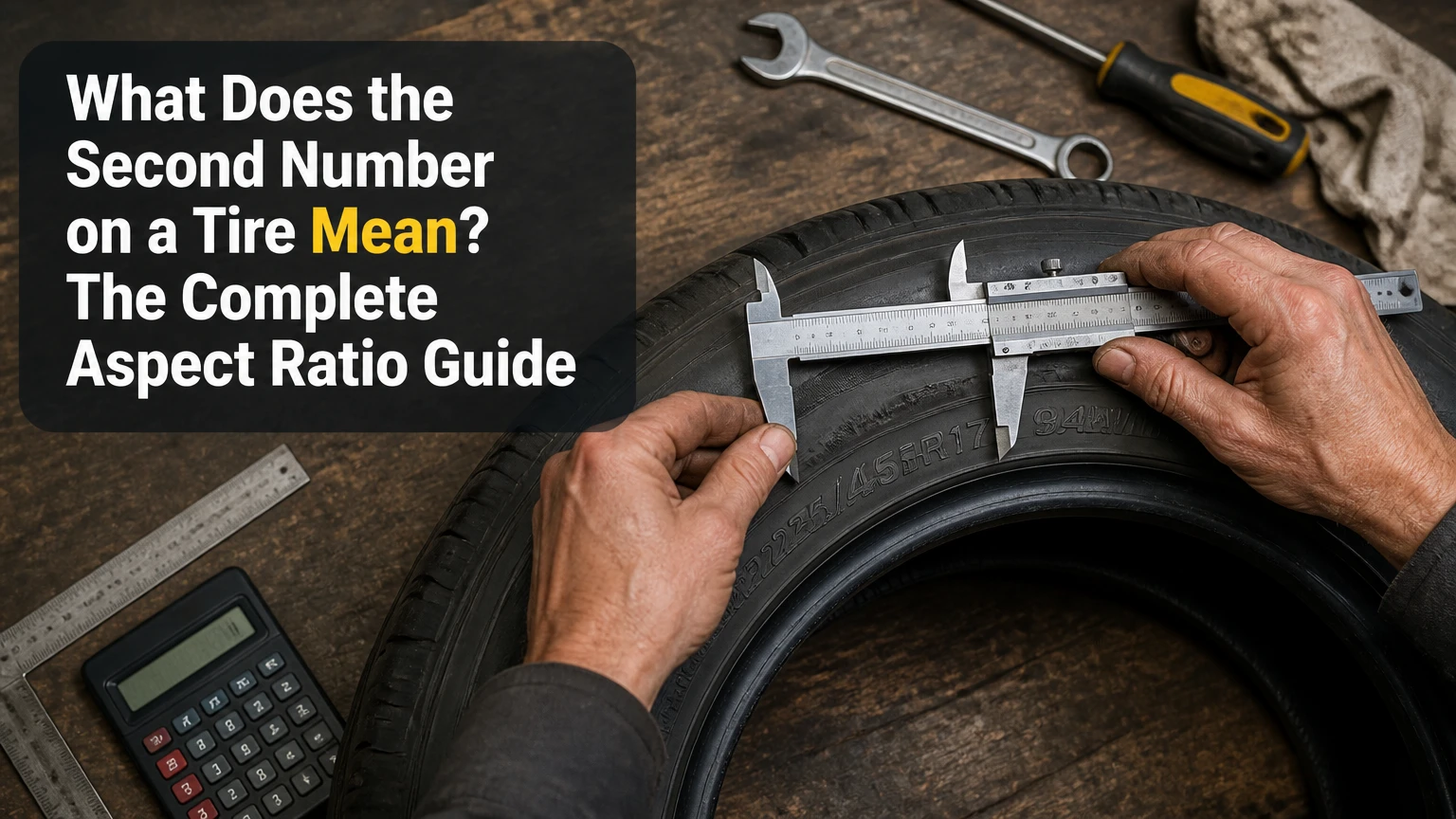
The second number on a tire indicates the aspect ratio, which is the physical height of the tire sidewall expressed as a direct percentage of the tire width. For example, on a tire marked 225/50R17, the number 50 means the sidewall height is exactly 50 percent of the 225-millimeter tread width.
Key Facts / At a Glance
- The second number is a proportional percentage, never a fixed measurement in millimeters or inches.
- Lower aspect ratios produce shorter, stiffer sidewalls built for high-speed cornering stability.
- Higher aspect ratios produce taller, flexible sidewalls built for shock absorption and heavy load support.
- Changing this specific number alters the overall exterior diameter of your entire wheel assembly.
- Altering your factory aspect ratio by more than three percent requires recalibrating your vehicle speedometer.
How Do You Calculate Exact Sidewall Height?
You calculate the exact sidewall height by converting the aspect ratio into a decimal and multiplying it by the section width. Because tire widths are measured in millimeters, this initial calculation provides your sidewall height in millimeters. You must divide that result by 25.4 to determine the height in inches.
To find the physical height of your tire sidewall, follow these exact mathematical steps. First, locate the three-digit width number on your sidewall (such as 245). Second, locate the two-digit aspect ratio immediately following the slash mark (such as 40). Third, convert the aspect ratio to a decimal by dividing by 100 (40 becomes 0.40). Fourth, multiply the width by the decimal to find the height in millimeters (245 x 0.40 = 98 millimeters). Finally, divide the millimeter height by 25.4 to find the inch measurement (98 / 25.4 = 3.85 inches).
Understanding this math prevents dangerous sizing errors. Two tires with the exact same aspect ratio do not have the same physical height if their widths differ.
| Tire Size Code | Section Width | Aspect Ratio | Sidewall Height (mm) | Sidewall Height (inches) |
|---|---|---|---|---|
| 195/65R15 | 195 mm | 65% | 126.75 mm | 4.99 inches |
| 225/45R17 | 225 mm | 45% | 101.25 mm | 3.98 inches |
| 275/60R20 | 275 mm | 60% | 165.00 mm | 6.49 inches |
| 305/30ZR20 | 305 mm | 30% | 91.50 mm | 3.60 inches |
Why Does the Aspect Ratio Matter for Vehicle Dynamics?
The aspect ratio matters because the height of the sidewall dictates how much the tire can physically flex under load, which directly controls both ride comfort and cornering stiffness. The air volume contained inside the tire chamber carries the actual weight of the vehicle. A taller sidewall holds a larger volume of air, allowing the tire to compress over bumps without transferring that kinetic energy into the vehicle cabin.
A shorter sidewall holds less air and provides minimal physical space for compression. This rigidity resists lateral forces during sharp turns, keeping the tire tread perfectly flat against the pavement. When a vehicle corners, weight transfers to the outside tires. A tall sidewall will physically fold over under this pressure, a phenomenon engineers call “tire roll.” A short sidewall resists this folding action, maintaining a wider, more consistent contact patch with the road.
This mechanical tradeoff dictates vehicle design. According to 2023 testing data from the Society of Automotive Engineers, decreasing an aspect ratio from 60 to 40 increases lateral cornering grip by up to 15 percent, but simultaneously increases the transmission of vertical impact forces into the cabin by 22 percent.
Expert Insight: Automotive engineers view the tire sidewall as the first stage of the vehicle suspension system. The sidewall acts as an undamped pneumatic spring. Changing your aspect ratio actually changes the overall spring rate of your vehicle, altering how your shock absorbers process road impacts.
What Are the Main Categories of Tire Profiles?
Tire profiles fall into three distinct categories based on their mathematical aspect ratio, with each category engineered for a specific driving environment. Modern passenger vehicle aspect ratios generally range from a remarkably thin 25 on hypercars to a towering 85 on commercial trucks.
Low-Profile Tires (Ratio: 25 to 55)
Low-profile tires feature an aspect ratio between 25 and 55, prioritizing high-speed stability and sharp steering response over passenger comfort. Manufacturers install these tires primarily on sports cars, performance sedans, and premium crossover vehicles. The short sidewall minimizes tire deflection at highway speeds, resulting in immediate steering feedback.
This performance comes with strict physical limitations. The thin cushion of air provides minimal protection for the metal wheel rim. Hitting a standard two-inch deep pothole at 40 miles per hour with a 35-series tire will frequently result in a bent rim or a pinched, ruptured sidewall. Furthermore, the specialized soft rubber compounds used in these tires limit their lifespan to a typical range of 30,000 to 45,000 miles.
Standard-Profile Tires (Ratio: 60 to 70)
Standard-profile tires maintain an aspect ratio between 60 and 70, offering the optimal engineering compromise between daily ride comfort, load capacity, and handling stability. You will find these tires as standard equipment on daily commuter sedans, economy hatchbacks, and minivans.
The sidewall height provides enough air volume to absorb urban road imperfections seamlessly. These tires also benefit from high-volume mass production, making them the most affordable replacement options on the market. Constructed with harder, longer-lasting rubber compounds, standard-profile tires routinely survive 65,000 to 100,000 miles of highway driving.
High-Profile Tires (Ratio: 75 to 85)
High-profile tires utilize an aspect ratio between 75 and 85, designed specifically for maximum weight capacity and aggressive off-road terrain absorption. Heavy-duty pickup trucks, full-size SUVs, and dedicated off-road vehicles rely on these massive air chambers. The tall sidewall allows drivers to safely lower their tire pressure (a practice called “airing down”) to create a massive footprint over sand and rocks without damaging the wheel.
These tires handle poorly on paved roads. The tall rubber sidewall bends noticeably during highway lane changes, creating a sluggish, delayed steering feel. The heavy construction required to support the tall sidewall also increases rolling resistance, which negatively impacts fuel economy.
| Profile Category | Aspect Ratio Range | Typical Replacement Cost | Primary Engineering Goal |
|---|---|---|---|
| Low-Profile | 25 – 55 | $150 – $450 per tire | Lateral grip and steering speed |
| Standard-Profile | 60 – 70 | $75 – $160 per tire | Balanced comfort and longevity |
| High-Profile | 75 – 85 | $140 – $350 per tire | Load capacity and impact absorption |
How Do Aspect Ratios Work in Staggered Wheel Setups?
Staggered wheel setups feature wider tires on the rear axle than on the front axle, requiring different aspect ratios front-to-back to maintain identical overall tire heights. Rear-wheel-drive sports cars utilize this geometry to increase traction during heavy acceleration while keeping the front tires narrow for precise steering.
Because the aspect ratio is a percentage of the width, the wider rear tire must use a smaller second number to match the physical height of the narrower front tire. For example, a sports car might use a 245/40R19 tire on the front axle and a 275/35R19 tire on the rear axle. The front sidewall height is 98 millimeters (40 percent of 245). The rear sidewall height is 96.25 millimeters (35 percent of 275). This slight 1.75-millimeter difference keeps the overall wheel diameters nearly identical.
Maintaining this equal height is mandatory. If the rear tires are physically taller than the front tires, they will rotate at a slightly slower speed. The vehicle’s Anti-lock Braking System (ABS) and traction control computers will read this speed discrepancy as a loss of traction, triggering dashboard warning lights and randomly applying the brakes during normal driving.
What Happens When You Change the Second Number on Your Tire?
Changing the second number on your tire alters the total exterior circumference of the wheel assembly, which changes how far the vehicle travels with every single tire rotation. Automotive technicians call the process of modifying these numbers “Plus Sizing” or “Minus Sizing.”
If you decrease your aspect ratio without installing a larger metal wheel to compensate, your total tire diameter shrinks. A smaller tire must rotate more times to cover the exact same distance on the highway. Because your vehicle calculates speed based on rotational counts at the transmission, a smaller tire makes your speedometer read artificially fast. You might see 65 miles per hour on the dashboard while physically traveling only 61 miles per hour.
Conversely, increasing your aspect ratio makes the tire physically taller. A taller tire travels further per rotation, causing your speedometer to read artificially slow. This scenario invites accidental speeding tickets, as your dashboard might display 60 miles per hour when you are actually traveling 64 miles per hour.
| Action Taken | Effect on Speedometer | Effect on Gearing | Effect on Ride Quality |
|---|---|---|---|
| Increasing Aspect Ratio (Taller) | Reads slower than actual speed | Accelerates slower, lower highway RPM | Softer, more compliant ride |
| Decreasing Aspect Ratio (Shorter) | Reads faster than actual speed | Accelerates faster, higher highway RPM | Harsher, stiffer ride |
| Matching Ratio to Width Change | Speedometer remains highly accurate | Factory gearing remains intact | Minimal noticeable change |
Common Mistakes When Upgrading Tire Sizes
Drivers frequently make dangerous mathematical assumptions when replacing factory tires with aftermarket sizes. The most severe mistake is ignoring the tire load index when dropping to a lower aspect ratio.
A shorter sidewall physically contains a smaller volume of compressed air. Because air volume determines how much physical weight a tire can carry, dropping from a 60-series tire to a 40-series tire drastically reduces the maximum load capacity. If you install low-profile tires on a heavy SUV without verifying the load index, a sudden highway pothole impact can cause a catastrophic blowout due to the tire buckling under the vehicle’s mass.
Another frequent failure involves mounting narrow aspect ratio tires onto wide aftermarket wheels, a visual trend known as “stretching.” This practice pulls the sidewall outward at an unnatural angle, separating the tire bead from its designed seating position on the rim. Stretched sidewalls cannot flex correctly to absorb heat, leading to rapid rubber degradation and sudden highway deflation.
Expert Insight: If you want wider tires for better grip, apply the industry standard “Plus Zero” sizing rule. For every 10 millimeters of tread width you add, you must decrease your aspect ratio by 5 to maintain the original physical height. If your factory size is 215/55R16, the correct wider replacement is 225/50R16.
Can a Different Aspect Ratio Improve Fuel Economy?
Yes, changing your tire aspect ratio directly impacts fuel economy by altering the rolling resistance and aerodynamic drag of the vehicle. However, the gains or losses depend entirely on how the overall tire weight and width change.
Standard-profile tires (60 to 70 series) generally offer the highest fuel economy for passenger vehicles. They are relatively narrow, which reduces aerodynamic drag at highway speeds, and they weigh less than heavy off-road tires. When drivers switch to high-profile all-terrain tires (75 to 85 series), they routinely experience a drop of 1 to 3 miles per gallon. The massive rubber tread blocks and heavy reinforced sidewalls require significantly more engine power to keep rotating.
Conversely, switching to extreme low-profile tires (30 to 40 series) can also hurt fuel economy. While the sidewall is short, low-profile tires are typically much wider than standard tires. Pushing a 275-millimeter wide tire through the air at 70 miles per hour creates massive aerodynamic drag compared to a standard 215-millimeter tire, offsetting any weight advantages.
How to Choose the Correct Aspect Ratio
Choosing the correct aspect ratio requires matching the physical limits of the tire to your specific driving environment. Relying on visual aesthetics over mechanical realities leads to damaged wheels and ruined suspensions.
The Daily Commuter Stick strictly to your vehicle’s factory door placard, which typically recommends a 60 to 70 aspect ratio. This size maximizes fuel economy, provides the cheapest replacement costs, and protects your suspension components from pothole damage during daily urban driving.
The Performance Enthusiast Choose a 35 to 45 aspect ratio paired with a wider section width. The short, stiff sidewall eliminates tire roll during aggressive cornering, providing the immediate steering feedback required for track days and canyon driving. You must accept a harsh highway ride and increased road noise as the permanent tradeoff for this grip.
The Off-Road Overlander Select a 75 to 85 aspect ratio mounted on a smaller diameter wheel (such as a 15-inch or 16-inch rim). This configuration provides the massive sidewall height required for rock crawling. The tall rubber allows you to safely drop tire pressures to 15 PSI, creating a long, tank-like track over loose dirt while keeping the metal wheel safely elevated above jagged rocks.
Frequently Asked Questions
What do the 3 numbers on a tire mean? The first number represents the tire tread width in millimeters. The second number is the aspect ratio, indicating the sidewall height as a percentage of the width. The third number, following the letter R, indicates the required wheel rim diameter measured in inches.
Can I put a 60 series tire on a 65 series vehicle? Yes, but it will change your vehicle dynamics. A 60-series tire is physically shorter than a 65-series tire of the same width. Your vehicle will sit slightly lower to the ground, there will be a larger visible gap in the wheel well, and your speedometer will read slightly faster than your actual speed.
Does a higher aspect ratio mean a smoother ride? Yes, a higher aspect ratio provides a smoother ride. The taller sidewall holds a larger volume of compressed air, allowing the tire to flex deeply and absorb the kinetic energy of potholes and road bumps before that force reaches the vehicle cabin.
Is a higher aspect ratio better for driving in snow? Yes, higher aspect ratios perform better in deep snow. Tall, narrow tires cut down through loose snow to find traction on the solid pavement below, whereas short, wide low-profile tires tend to act like snowboards, floating on top of the slush and losing directional control.
How much does a 5 percent change in aspect ratio matter? A 5 percent change is highly noticeable. On a 225-millimeter wide tire, dropping the aspect ratio by 5 percent reduces the total tire diameter by nearly half an inch. This alters your speedometer accuracy by roughly two miles per hour at highway speeds and noticeably stiffens the ride quality.
Does aspect ratio affect tire pressure requirements? Yes, aspect ratio dictates air volume, which influences pressure requirements. Low-profile tires hold less air volume, so they often require higher PSI ratings (typically 38-42 PSI) to generate enough structural rigidity to carry the vehicle’s weight. Standard profiles often require lower pressures (32-35 PSI). Always follow the manufacturer placard inside your driver door.