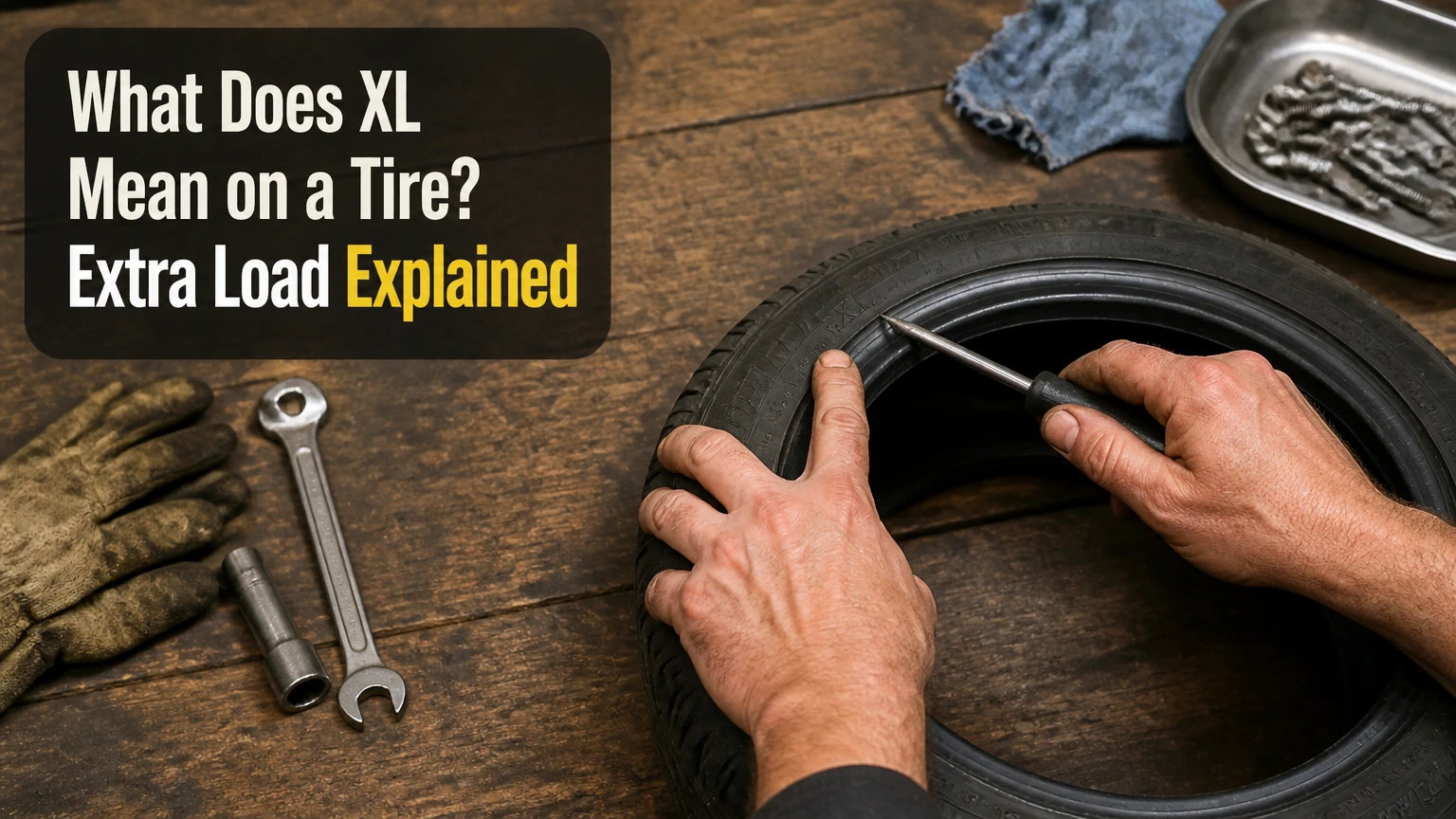
On a tire, XL means Extra Load. An XL tire is a passenger-car tire with reinforced construction that can carry more weight than a Standard Load tire of the same size when inflated to its specified pressure. The exact capacity comes from the tire’s load index and vehicle fitment requirements, not from the XL letters alone.
Key Facts at a Glance
- XL stands for Extra Load, also called Reinforced on many passenger tires.
- An XL tire uses stronger internal construction and a higher permitted load capacity than a comparable Standard Load tire.
- The load index is the precise number that states how much weight one tire can support.
- XL does not automatically mean a tire requires a specific pressure. Use the vehicle door-jamb placard or owner’s manual.
- An XL tire may deliver sharper steering and greater load capability, but it can also produce a firmer ride.
- An electric vehicle, SUV, or loaded sedan may require XL, but vehicle design and placard specifications determine the correct rating.
What Does XL Mean on a Tire?
XL means Extra Load, a reinforced passenger-tire construction designed to support a greater load at a higher inflation pressure than a Standard Load tire of the same nominal size. The tire may look identical from the outside, but its casing, bead, sidewall, or other internal components are engineered for greater structural stress.
The marking describes a tire specification, not a tire dimension. For example, 235/45R18 XL has the same basic width, aspect ratio, and wheel diameter format as 235/45R18 SL, but the two tires can have different load indexes, pressures, weights, and handling characteristics.
Michelin describes the load index as the number indicating “the maximum weight a tire can support when properly inflated.” That number matters more than the letters XL when you compare replacement tires.
Where Is XL Printed?
Manufacturers usually place XL near the size and service description on the sidewall. A complete marking might read:
225/45 R17 94W XL
The elements mean:
- 225: nominal section width in millimeters
- 45: sidewall height as a percentage of width
- R: radial construction
- 17: wheel diameter in inches
- 94: load index
- W: speed rating
- XL: Extra Load construction
Other markings can include Extra Load, Reinforced, RF, or RFD. RF requires careful interpretation because some manufacturers use it for Reinforced, while others use related markings for run-flat technology. Read the manufacturer’s product specification rather than assuming RF always means XL or run-flat.
How Does an Extra Load Tire Work?
An XL tire carries additional weight by combining stronger structure with a higher allowable inflation pressure. Tire air supports most of the vehicle load, while the casing controls the shape of the pressurized air chamber and manages heat, cornering forces, braking loads, and impacts.
A Standard Load passenger tire commonly reaches its rated load at a reference pressure near 35 or 36 psi, depending on the applicable tire standard and size. An XL tire may achieve its higher rated load at pressures around 41 or 42 psi, but those figures are not universal maximums for every product.
The tire’s sidewall flexes as the contact patch enters and leaves the road. Excessive flex creates heat. Reinforced cords, bead components, and sidewall materials help an XL tire maintain its shape under greater load and pressure, reducing deflection at the tire’s certified operating point.
Which Parts Are Reinforced?
XL construction varies by tire model, so no universal parts list applies to every brand. Common design changes include:
- Casing plies: stronger or additional cord layers support the pressurized tire body.
- Bead area: stronger wire and rubber components anchor the tire to the wheel under higher forces.
- Sidewalls: added or stronger reinforcement limits excessive flexing during cornering and heavy loading.
- Shoulders: additional material can help preserve the tread footprint under load.
- Inner liner and belt package: some designs modify these components to manage pressure, heat, and durability.
The reinforcement does not make an XL tire indestructible. A pothole, curb strike, overload, underinflation, or damaged wheel can still cause a failure.
How Do You Read the Load Index?
The load index is a two-digit or three-digit number that corresponds to the maximum load for one tire under specified test conditions. The number is not a weight measurement, and a larger number generally indicates greater capacity, but the official load-index chart must be used for the exact value.
| Load index | Maximum load per tire | Maximum load for four tires |
|---|---|---|
| 91 | 615 kg, 1,356 lb | 2,460 kg, 5,424 lb |
| 94 | 670 kg, 1,477 lb | 2,680 kg, 5,908 lb |
| 98 | 750 kg, 1,653 lb | 3,000 kg, 6,612 lb |
| 102 | 850 kg, 1,874 lb | 3,400 kg, 7,496 lb |
A common example is 225/45R17 91W compared with 225/45R17 94W XL. The 94-rated tire supports 670 kg per tire, while the 91-rated tire supports 615 kg per tire. That difference is about 9 percent, not a fixed 10-20 percent rule.
Does XL Always Have a Higher Load Index?
XL usually has a higher load capacity than the Standard Load version of the same size, but the letters alone do not guarantee a specific load-index increase. Tire manufacturers can offer different constructions, service descriptions, and regional specifications.
Compare these items in order:
- Tire size, including width, aspect ratio, and wheel diameter.
- Load index, such as 94 or 98.
- Speed rating, such as V, W, or Y.
- XL, Reinforced, HL, or other construction designation.
- Manufacturer fitment and vehicle approval.
A replacement tire should meet or exceed the vehicle’s required load index and speed rating unless a qualified tire professional or vehicle manufacturer specifies another arrangement.
What Is the Difference Between SL and XL Tires?
Standard Load tires are the baseline passenger-car construction, while Extra Load tires use reinforced construction and commonly support a greater load at a higher operating pressure. XL tires are not automatically safer for every vehicle because the correct choice depends on the vehicle placard, load index, wheel fitment, and intended use.
| Attribute | Standard Load, SL | Extra Load, XL | High Load, HL | Light Truck, LT or C |
|---|---|---|---|---|
| Typical application | Compact cars, sedans | Heavy sedans, crossovers, performance cars | Some newer heavy EVs and SUVs | Vans, pickups, commercial vehicles |
| Construction category | Passenger tire | Reinforced passenger tire | High-load passenger tire | Light-truck or commercial tire |
| Example capacity | 615 kg at index 91 | 670 kg at index 94 | Model-specific | Model-specific |
| Typical ride character | More compliant | Firmer and more controlled | Model-specific | Often firm and load-focused |
| Correct pressure | Vehicle placard | Vehicle placard | Vehicle placard | Vehicle placard and tire data |
| Replacement rule | Match required rating | Match or exceed required rating | Use only when approved | Do not substitute casually |
HL, or High Load, is not simply a universal “better XL.” It is a newer designation used on certain vehicle and tire applications, including some battery-electric vehicles. A vehicle approved for HL may require a particular HL tire specification that an ordinary XL tire does not duplicate.
LT or C-type tires belong to a different design category. They may alter ride, steering, noise, weight, and clearance, so installing them on a passenger vehicle requires explicit fitment approval.
Are XL Tires Better Than Standard Load Tires?
XL tires are better when a vehicle requires their load capacity, pressure capability, or handling characteristics. Standard Load tires are often better for a vehicle designed around their specification because they can provide a more compliant ride and lower unsprung weight.
The practical comparison depends on the use case:
| Driving condition | More suitable rating | Reason |
|---|---|---|
| Vehicle placard specifies SL | SL | Matches original load and pressure design |
| Vehicle placard specifies XL | XL | Preserves required capacity and handling |
| Frequent maximum passenger and cargo load | XL, if approved | Provides the required reserve within vehicle limits |
| Occasional potholes on an approved passenger vehicle | Correct placard rating | Construction alone cannot prevent impact damage |
| Commercial payload or cargo van use | LT or C, if specified | Passenger XL tires may not meet the application |
What Pressure Does an XL Tire Need?
An XL tire needs the pressure listed on the vehicle’s tire information placard or in the owner’s manual. The correct pressure is determined by the vehicle manufacturer’s axle-load requirements, suspension calibration, steering behavior, and tire specification, not by the maximum pressure molded into the tire sidewall.
The sidewall maximum is a tire limit. It is not the recommended cold pressure for normal driving. For example, a tire marked with a 50 psi maximum may be installed on a vehicle whose placard recommends 36 psi.
Check pressure when the tires are cold, ideally before driving or after the vehicle has been parked for at least three hours. Do not reduce pressure because an XL tire feels firm, and do not increase pressure to the sidewall maximum to obtain its full theoretical load rating.
What Happens if an XL Tire Is Underinflated?
Underinflating an XL tire increases sidewall flex, heat generation, steering delay, and shoulder wear. An XL tire inflated to the vehicle placard pressure can be correct even when that pressure is lower than the tire’s maximum permissible pressure.
Common warning signs include:
- Both shoulders wearing faster than the center.
- A heavy, vague steering feel.
- TPMS warnings after temperature changes.
- Excessive heat after highway driving.
- Reduced fuel economy and irregular tread wear.
Overinflation creates a different problem. Excessive center wear, reduced bump absorption, and a smaller effective contact patch can result when pressure exceeds the vehicle recommendation.
Do XL Tires Change Ride and Handling?
XL construction commonly produces a firmer ride and quicker steering response because the tire deflects less under lateral and longitudinal forces. The result is useful on heavier vehicles and performance-oriented cars, but some drivers notice more impact harshness or road noise.
The effect depends on more than the XL label. Tire mass, tread compound, sidewall profile, wheel diameter, road surface, suspension tuning, and air pressure all influence comfort. A 19-inch XL tire with a short sidewall can feel substantially firmer than a 17-inch Standard Load tire even when both are correctly inflated.
| Characteristic | Typical SL behavior | Typical XL behavior | Main variable |
|---|---|---|---|
| Steering response | More progressive | More immediate | Sidewall stiffness |
| Bump absorption | More compliant | Firmer | Pressure and tire profile |
| Cornering support | Moderate | Greater under heavy load | Deflection control |
| Rolling resistance | Often lower | May be higher | Mass and compound |
| Road noise | Model-dependent | May be higher | Tread and casing design |
XL does not guarantee better wet braking, shorter stopping distance, or longer tread life. Those outcomes depend heavily on tread design, rubber compound, alignment, temperature, and maintenance.
Are XL Tires More Expensive and Longer Lasting?
XL tires commonly cost more than an equivalent Standard Load model, with a typical retail premium of about 5-15 percent when the brand, tread pattern, size, and speed rating are otherwise comparable. Actual prices vary widely by tire category, availability, seasonal demand, and wheel size.
A longer service life is not guaranteed. Reinforced construction can reduce damaging deflection under heavy loads, but a heavier tire, aggressive alignment, high torque, poor inflation, or abrasive driving can eliminate any durability advantage.
| Ownership factor | Typical SL expectation | Typical XL expectation | What controls the result |
|---|---|---|---|
| Purchase price | Baseline | 5-15% higher | Brand, size, retailer |
| Tire weight | Lower by model | Often 1-3 kg higher per tire | Casing and tread design |
| Ride comfort | More compliant | Firmer | Pressure, profile, suspension |
| Tread life | Model-specific | Model-specific | Compound, alignment, rotation |
| Fuel consumption | May be marginally lower | May be marginally higher | Rolling resistance and mass |
Treat advertised mileage as a comparison estimate, not a promise. Tire warranties and treadwear ratings are more useful than a generic claim that XL tires last an extra 10,000-15,000 kilometers.
Should an EV or SUV Use XL Tires?
An EV or SUV should use XL or HL tires only when the vehicle manufacturer specifies or approves that construction and load capacity. Battery weight can increase axle loads, but vehicle design, tire size, suspension tuning, and the placard determine the required rating.
A heavy electric crossover may require XL or HL tires, while a lighter EV may use a different approved specification. Some EV tires also include acoustic foam, low-rolling-resistance compounds, or special tread designs that are separate from the XL designation.
For an SUV carrying seven occupants, luggage, and a roof box, confirm the loaded axle weights and tire load index. Do not use XL tires to exceed the vehicle’s gross vehicle weight rating. Tires cannot legally or safely increase the vehicle’s approved payload.
Can You Replace XL Tires With Standard Load Tires?
Do not replace an original-equipment XL tire with a Standard Load tire unless the replacement meets the vehicle manufacturer’s approved load, speed, pressure, and fitment requirements. A smaller load index can reduce the vehicle’s available tire capacity, particularly when the car is fully occupied or heavily loaded.
Replacing SL tires with XL tires is usually acceptable when the replacement has the correct dimensions, load index, speed rating, wheel fitment, and manufacturer approval. However, the heavier construction may alter ride and steering feel.
For vehicles with all-wheel drive, replace tires according to the manufacturer’s circumference and tread-depth rules. Some AWD systems require four closely matched tires, and fitting one different construction can create diameter or rolling-radius differences.
How Do You Choose the Correct XL Tire?
Use the vehicle placard as the primary specification, then verify the tire’s complete service description. The safest choice is a tire with the approved size, equal or greater load index, equal or greater speed rating, and the construction designation required for that vehicle.
Follow this checklist:
- Photograph the driver-door placard before shopping.
- Record the front and rear tire sizes and cold pressures.
- Match the load index, not merely the XL letters.
- Match or exceed the specified speed rating.
- Confirm whether the vehicle requires XL, HL, run-flat, or a manufacturer-specific fitment.
- Check load capacity at the intended operating pressure.
- Fit the same model and specification across an axle.
- For AWD vehicles, follow the owner’s manual replacement limits.
- Reset or relearn the TPMS after installation when required.
- Recheck cold pressure after the first temperature change.
A tire shop should not select a replacement based only on diameter and width. The service description is part of the vehicle’s safety specification.
What Problems Can XL Tires Cause?
XL tires can cause problems when their specification does not match the vehicle or when drivers treat the sidewall maximum as the operating pressure. The most common issues are harshness, noise, uneven wear, mismatched axle behavior, and incorrect load assumptions.
Center Tread Wear
Center tread wear usually indicates excessive inflation relative to the vehicle recommendation, although tread design and alignment can contribute. Set cold pressure to the placard value, inspect wear across the tread, and measure pressure with a reliable gauge.
Shoulder Wear
Shoulder wear commonly indicates underinflation, overload, aggressive cornering, or incorrect alignment. An XL tire still wears its shoulders when driven below its required pressure.
Spongy Steering
Spongy steering can result from underinflation, worn suspension parts, incorrect alignment, or an SL tire installed where an XL specification is required. Check all four tire pressures before blaming the construction designation.
Uneven Behavior After Replacement
Installing different constructions or load indexes across one axle can change steering response and braking balance. Replace tires in axle pairs when possible, and place the tires with greater remaining tread on the rear axle unless the vehicle manufacturer instructs otherwise.
Frequently Asked Questions
Does XL mean extra-large tire size?
No. XL means Extra Load, not extra-large dimensions. An XL tire can have the same width, aspect ratio, and wheel diameter as a Standard Load tire. The difference is reinforced construction and a different certified load capability.
Can I put XL tires on a normal car?
You can usually install XL tires on a car when the size, load index, speed rating, wheel fitment, and vehicle approval are correct. The car may feel firmer, and the heavier casing can slightly affect efficiency. Never use XL tires to exceed the vehicle’s payload rating.
Are XL tires better for towing?
XL tires can help a passenger vehicle carry its approved loaded weight when the vehicle manufacturer permits them, but they do not increase the vehicle’s towing capacity. Confirm axle loads, tongue weight, tire capacity, hitch limits, and the vehicle’s gross combined weight rating.
Do XL tires need more air than regular tires?
XL tires may require a higher pressure to achieve their maximum certified load, but the correct everyday pressure remains the vehicle placard value. The tire’s sidewall maximum is not a routine target, and raising pressure without a vehicle-specific reason can reduce comfort and traction.
Are reinforced tires the same as XL tires?
Reinforced is commonly used as another name for XL in passenger-car tire specifications. Verify the product data because RF can have different meanings among manufacturers, especially where run-flat products are sold. The load index and official technical description resolve the ambiguity.
Should all four tires be XL?
All four tires should follow the vehicle manufacturer’s approved specification, particularly on AWD vehicles. Mixing SL and XL tires can produce different stiffness, capacity, and rolling behavior. If the placard requires XL, use XL tires on all applicable positions rather than mixing constructions.
The Bottom Line
What does XL mean on a tire? XL means Extra Load, a reinforced passenger-tire construction that supports a higher certified load than a comparable Standard Load tire when used at the specified pressure. Choose the tire by size, load index, speed rating, construction, and vehicle placard, not by the XL letters alone.