New tire tread depth is typically 10/32 to 11/32 inch, or about 8.0 to 8.7 mm, for standard passenger-car all-season tires. Performance tires may begin near 8/32 to 10/32 inch, while winter, all-terrain, and mud-terrain tires commonly start between 11/32 and 19/32 inch. The exact value is molded into the tire design and should be confirmed in the manufacturer’s specifications.
Key Facts at a Glance
A typical new passenger tire measures 10/32 to 11/32 inch, but no universal new-tire depth exists.
2/32 inch, or 1.6 mm, is the common U.S. tread-wear limit and legal replacement point in many jurisdictions.
4/32 inch, or 3.2 mm, is a prudent replacement planning point for frequent rain, snow, or highway driving.
A tread-depth gauge is more accurate than a penny or quarter test and should be used across the tire’s inner, center, and outer sections.
Tread depth affects water evacuation, but wet braking also depends on speed, inflation pressure, tire compound, temperature, and road surface.
AWD vehicles do not automatically require four new tires, but the owner’s manual may limit allowable tread-depth differences.
What Is New Tire Tread Depth?
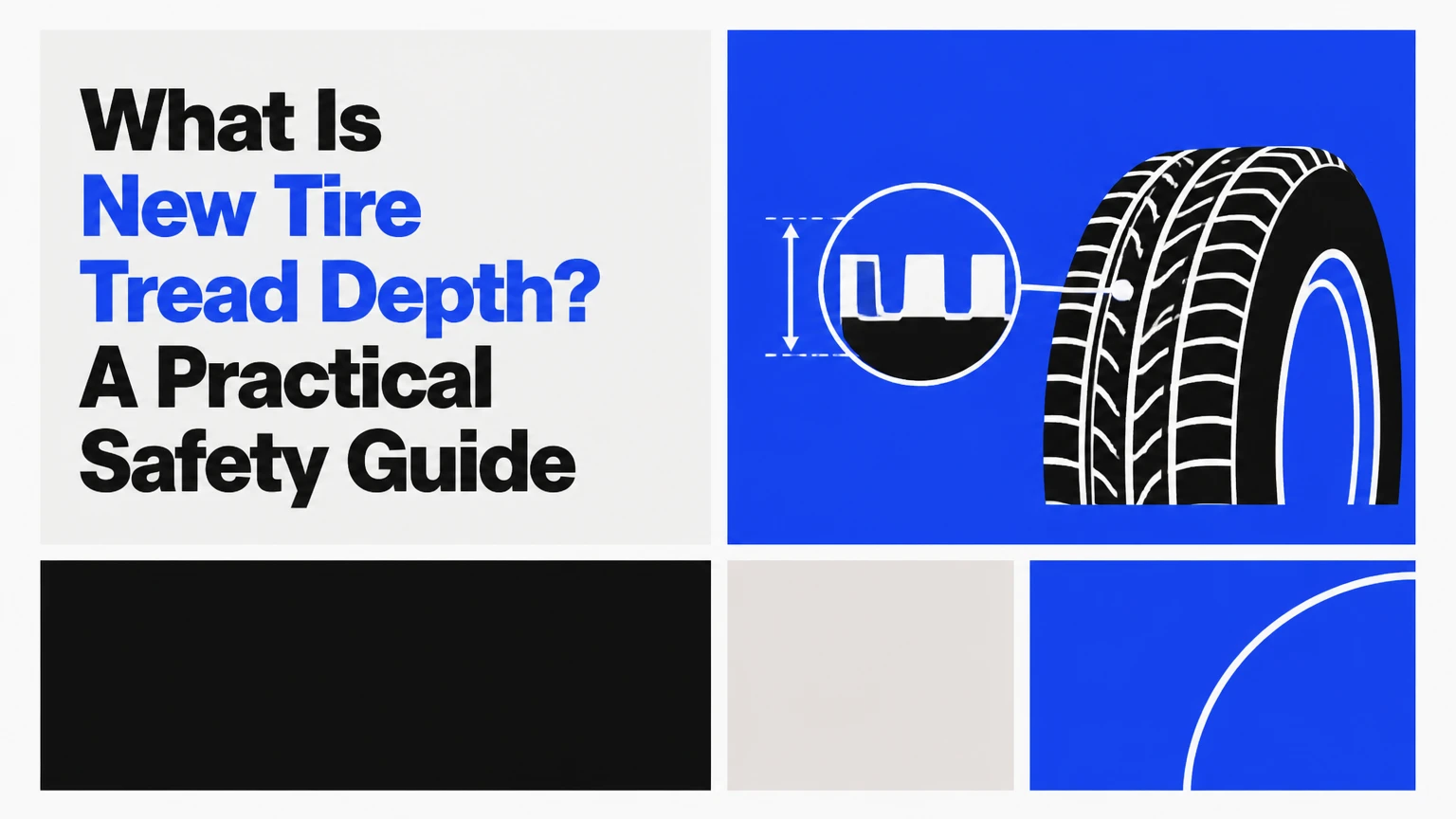
New tire tread depth is the distance from the top of the tread blocks to the bottom of the deepest molded grooves. Tire shops in the United States usually report the measurement in thirty-seconds of an inch, such as 11/32, while manufacturers and international markets often publish millimeters.
A new tire does not always have the maximum possible depth. A summer performance tire may use a shallower tread to reduce block movement and improve steering response, whereas a winter tire needs more grooves, sipes, and void volume for snow. The correct comparison is therefore between the tire’s actual original specification and its current measured depth.
The Tire and Rubber Association of Canada notes that tire performance changes as tread wears, and major manufacturers such as Michelin and Bridgestone use tread-wear indicators to identify the common 2/32-inch limit. Tread depth is a useful measurement, but it is only one condition assessment. Cracks, bulges, age, punctures, and uneven wear can require replacement even when the gauge shows substantial rubber.
Why Does Tread Depth Matter?
Tread depth matters because grooves create space for water, slush, and loose snow to move away from the contact patch. Deeper grooves generally provide more evacuation capacity, but a deep groove cannot compensate for excessive speed, incorrect inflation, a hardened old compound, or a tire designed poorly for the conditions.
A tire’s contact patch is approximately the size of a driver’s hand, yet it must transmit braking, cornering, and acceleration forces through that small area. Tread blocks and circumferential grooves divide the rubber into elements that flex, drain water, and maintain edges against the road.
NHTSA summarizes the relationship between vehicle control and tires with the safety reminder, “Tires are the only thing connecting your vehicle to the road.” The practical implication is important: tread depth should be checked alongside pressure, age, damage, and wear distribution rather than treated as a single pass-fail number.
How Tread Depth Affects Wet Roads
Deeper grooves can move more water before the tread becomes saturated. Hydroplaning risk rises with vehicle speed, water depth, tire pressure, tread condition, and the tire’s groove design; tread depth alone does not provide a reliable hydroplaning speed.
At approximately 4/32 inch, a tire still has visible usable tread, but its wet-weather margin is smaller than when new. The exact braking difference varies by tire model and test surface, so claims that every worn tire adds a fixed number of feet are unreliable. Replace tires based on measured wear, wet-weather behavior, and the manufacturer’s recommendations.
How Tread Depth Affects Snow and Ice
Snow tires usually begin with deeper tread than ordinary all-season tires, but depth is not the entire reason they work. Winter compounds remain more flexible at low temperatures, and dense siping creates additional biting edges for packed snow and ice.
A winter tire at 5/32 or 6/32 inch may still be legal, yet it can have less snow performance because its grooves and sipes have lost working depth. Drivers in persistent snow should plan replacement before the 2/32-inch legal limit.
Does More Tread Always Mean Better Grip?
More tread does not always mean better grip. A shallow summer tire with a specialized silica compound can outperform a deeper all-terrain tire on warm, dry pavement, while the all-terrain tire may provide better traction on gravel or mud.
Deep tread can also flex more, producing tread-block squirm and slower steering response. New tread may increase rolling resistance slightly, although compound, casing construction, inflation, vehicle weight, and alignment often matter more than a few thirty-seconds of tread.
How Deep Are New Tires by Type?
Typical new tread depth ranges from 8/32 inch on some performance tires to 19/32 inch on aggressive mud-terrain tires. The vehicle’s tire size, load rating, speed rating, intended surface, and manufacturer design determine the actual specification.
| Tire category | Typical new depth | Approximate metric depth | Design priority |
|---|---|---|---|
| Summer or UHP performance | 8/32-10/32 in | 6.3-8.0 mm | Dry grip, steering response, cornering |
| Standard all-season | 10/32-11/32 in | 8.0-8.7 mm | Highway comfort, rain, tread life |
| Touring all-season | 10/32-12/32 in | 8.0-9.5 mm | Noise control and mileage |
| Winter or snow | 11/32-13/32 in | 8.7-10.3 mm | Snow evacuation and low-temperature grip |
| All-terrain light truck | 12/32-14/32 in | 9.5-11.1 mm | Gravel, highway, and mild off-road use |
| Mud-terrain | 15/32-19/32 in | 11.9-15.1 mm | Mud clearance and loose terrain |
A listed range is not a promise for every model. Two tires in the same category can differ by 2/32 inch or more because one manufacturer prioritizes rolling efficiency and another prioritizes snow or off-road clearance. Check the product data sheet or measure a matching new tire when an exact baseline matters.
What Tread Depth Is Safe?
A tread depth of 6/32 inch is generally a strong condition reading for ordinary driving, while 4/32 inch is a sensible replacement-planning threshold for wet or snowy climates. At 2/32 inch, the tire has reached the common wear-bar level and should be replaced immediately.
| Measured tread | Approximate metric | Practical meaning | Recommended action |
|---|---|---|---|
| 10/32-12/32 in | 7.9-9.5 mm | New or nearly new passenger tread | Maintain pressure and rotate |
| 7/32-9/32 in | 5.6-7.1 mm | Usable tread with substantial life | Monitor monthly |
| 5/32-6/32 in | 4.0-4.8 mm | Reduced wet or snow margin | Plan replacement by climate |
| 4/32 in | 3.2 mm | Common wet-weather planning point | Replace soon in rain or snow |
| 3/32 in | 2.4 mm | Limited reserve in wet conditions | Arrange replacement promptly |
| 2/32 in | 1.6 mm | Wear bars level; common legal limit | Replace immediately |
| Below 2/32 in | Below 1.6 mm | Severely worn tread | Do not continue normal driving |
Legal limits vary by country, state, province, and tire condition. A tire can be technically above 2/32 inch but still unsafe because of exposed cords, sidewall damage, severe cracking, a puncture, or one section that is much more worn than the rest.
How Do You Measure Tread Depth Correctly?
A tread-depth gauge measures a tire more accurately than a coin and usually takes less than five minutes per vehicle. Measure each tire in at least three lateral positions and in several major grooves, because a single center reading can miss a bald inner shoulder.
Step 1: Check the Tire Cold
Park on level ground and inspect the tire before a long drive. Remove stones from the grooves, but do not dig into rubber or treat a damaged tread block as a normal measurement point.
Step 2: Use a Tread-Depth Gauge
Place the gauge’s flat base on top of the tread block and insert the probe into the groove until it reaches the groove floor. Avoid placing the probe on a raised tread-wear indicator, because the indicator is higher than the true groove bottom.
Record measurements at the inner shoulder, center, and outer shoulder. Repeat at two or three points around the circumference if the tire shows cupping, flat spots, or irregular wear.
Step 3: Compare the Readings
A difference of 1/32 inch across a tire can reflect normal measurement variation, but a larger repeated difference deserves investigation. For example, readings of 7/32, 7/32, and 3/32 inch suggest shoulder wear that a center-only inspection would conceal.
Check the tread-wear indicators as a second confirmation. These molded bars sit inside the main grooves and usually become flush with the surrounding tread at 2/32 inch.
Step 4: Record the Date and Position
Write down the date, mileage, tire position, pressure, and readings. A simple record shows whether one tire is losing tread faster and helps a technician diagnose alignment, pressure, bearing, or suspension problems.
Are Penny and Quarter Tests Accurate?
Penny and quarter tests are quick screening methods, not precision measurements. The upside-down penny test helps identify tread near the 2/32-inch limit, while the quarter test provides a rough warning around 4/32 inch, but neither test replaces a gauge.
Insert the coin vertically into a major groove, not across a tread block. If the top of Lincoln’s head is fully visible, the tire may be at or below approximately 2/32 inch. If the top of Washington’s head is visible, the tire may be near or below approximately 4/32 inch.
Coin tests have limitations. They depend on coin wear, viewing angle, groove shape, and the user’s interpretation, and they cannot reveal uneven wear across the tire. Use a gauge or request a professional inspection when a coin test produces a borderline result.
When Should New Tires Be Replaced?
Replace a tire at 2/32 inch or below, and consider replacement around 4/32 inch when driving regularly in rain, snow, or at highway speeds. Replace sooner for structural damage, persistent vibration, rapid air loss, exposed cords, sidewall bulges, or irregular wear that compromises the casing.
Tread Wear and Expected Mileage
A typical passenger tire may lose roughly 1/32 inch every 6,000-8,000 miles, but that figure is only a planning estimate. Alignment, inflation, vehicle weight, driving style, road texture, tire compound, rotation frequency, and climate can change the rate substantially.
A tire that begins at 11/32 inch has about 7/32 inch above the common 4/32-inch planning point, not 11/32 inch of fully equivalent service. The first 1/32 inch may disappear faster or slower than later tread depending on the tire and vehicle.
Tire Age Matters Separately
Tread depth does not reverse rubber aging. The DOT Tire Identification Number includes a four-digit date code: the first two digits identify the production week and the final two identify the year, so “2324” means the 23rd week of 2024.
NHTSA advises consumers to follow the tire and vehicle manufacturer’s age guidance. Michelin recommends professional inspection after five years of service and replacement at ten years from manufacture as a precaution, while some manufacturers recommend replacement around six years. The tire maker’s published policy controls.
How Much Do New Tires Cost?
Typical U.S. retail pricing is approximately $100-$150 per economy-car tire, $150-$250 for a mid-range sedan or crossover tire, and $250-$500 or more for a large truck, SUV, or premium performance tire. Installation, balancing, disposal, taxes, road-hazard coverage, and alignment can add to the invoice.
| Vehicle or tire segment | Typical tire price | Typical four-tire set | Common added services |
|---|---|---|---|
| Economy passenger car | $100-$150 | $400-$600 | Mounting, balancing, disposal |
| Mid-range sedan | $150-$250 | $600-$1,000 | Installation and valve service |
| Crossover or small SUV | $170-$300 | $680-$1,200 | TPMS service and alignment check |
| Performance or run-flat | $220-$450 | $880-$1,800 | Specialized mounting and balancing |
| Heavy-duty truck or large SUV | $250-$500+ | $1,000-$2,000+ | High-load installation and disposal |
| Mud-terrain light truck | $250-$550+ | $1,000-$2,200+ | Off-road-size mounting and balancing |
Prices vary by tire size, load index, speed rating, brand, retailer, and region. A cheaper tire with the correct load and speed ratings is safer than an expensive tire that does not match the vehicle’s requirements.
Can You Replace Only Two Tires?
You can replace only two tires on some two-wheel-drive vehicles, but the new pair should normally go on the rear axle unless the vehicle or tire manufacturer specifies another arrangement. Better rear tread helps maintain stability during wet-road cornering and reduces the risk of oversteer.
AWD systems require special care rather than an automatic four-tire rule. Some manufacturers specify a maximum tread-depth or circumference difference, such as 2/32 or 3/32 inch, because mismatched rolling radii can create continuous drivetrain speed differences. Other vehicles permit a larger difference.
Read the owner’s manual and consult the tire manufacturer before replacing one or two tires. A shop may be able to shave a new tire to match the existing pair, but that option is model-dependent and may affect warranty or tread life. Matching brand, model, size, load index, and speed rating across an axle remains the safer baseline.
What Causes Uneven Tread Wear?
Uneven tread wear usually indicates a maintenance or chassis problem rather than a normal difference in tire quality. Measure all three tread zones before changing pressure or ordering tires, because the wear pattern points toward the likely cause.
| Wear pattern | Typical measurement or appearance | Likely cause | Corrective action |
|---|---|---|---|
| Center wear | Center 3/32, shoulders 6/32 | Chronic overinflation | Set cold pressure to door-placard value |
| Both shoulder wear | Shoulders 3/32, center 6/32 | Underinflation or overload | Check pressure, load, and leaks |
| Inner-edge wear | Inner edge 2/32, center 6/32 | Camber or toe misalignment | Inspect and align suspension |
| Feathering | Tread edges feel sawtoothed | Toe error | Perform alignment |
| Cupping or scalloping | Repeating dips around circumference | Worn shocks, imbalance, or loose parts | Inspect suspension and balance wheel |
| One isolated bald area | Localized flat section | Locked-wheel braking or impact | Inspect tire and braking system |
The door-jamb placard, not the maximum pressure molded on the sidewall, supplies the vehicle’s normal cold inflation setting. Tire rotation helps equalize wear, but rotation cannot correct a bent wheel, worn bushing, failed shock absorber, or alignment error.
Which Tread Depth Fits Your Driving?
The best starting depth depends on the surface and weather rather than the largest number on a specification sheet. A commuter usually benefits from a quiet touring all-season tire, while a mountain driver may need a dedicated winter tire even if the all-season option begins with similar depth.
| Driver situation | Suitable tire type | Typical new depth | Replacement planning point |
|---|---|---|---|
| Warm-climate commuter | Touring all-season | 10/32-12/32 in | Around 4/32 in for wet roads |
| Frequent snow and ice | Dedicated winter | 11/32-13/32 in | Around 5/32-6/32 in for snow use |
| Highway performance driving | Summer or UHP | 8/32-10/32 in | Inspect at 4/32 in and by age |
| Gravel roads and light trails | All-terrain | 12/32-14/32 in | Replace based on damage and 4/32 in |
| Deep mud and rocky terrain | Mud-terrain | 15/32-19/32 in | Inspect sidewalls and chunking frequently |
| Used-tire buyer | Matching replacement model | At least 6/32 in preferred | Reject damage, age, or uneven wear |
A large tread number is not a substitute for the right tire category. Mud-terrain tires can be noisy, less efficient, and less predictable on wet pavement, while winter tires can wear quickly in warm weather and should be removed seasonally where conditions allow.
What Are the Most Common Tread-Depth Mistakes?
The most expensive tread mistake is measuring only the visible center groove. Inner-edge wear can reach the cords while the center still reads 6/32 inch, particularly on vehicles with alignment problems or independent rear suspension.
Other avoidable errors include:
- Using the sidewall maximum pressure as the target. The correct everyday pressure is on the driver-door placard or vehicle manual.
- Treating 2/32 inch as the ideal replacement point. That is a common legal limit, not a promise of strong rain or snow performance.
- Comparing different tire models only by tread depth. Compound, siping, groove layout, casing, and temperature range change performance.
- Ignoring tire age because the tread looks deep. Ultraviolet exposure, oxygen, heat, and storage conditions degrade rubber.
- Installing mismatched tires on AWD without checking specifications. Even small rolling-radius differences can create drivetrain stress.
- Assuming rotation fixes every wear pattern. Rotation redistributes wear; it does not repair alignment or suspension faults.
An experienced technician reads tread depth as a pattern. Four equal readings near 5/32 inch indicate a different problem from one tire at 5/32, another at 3/32, and an inner shoulder at 1/32.
FAQ
Is 8/32 inch good tread depth?
Yes, 8/32 inch is generally good remaining tread for ordinary passenger-car use, assuming the tire is not aged, damaged, or unevenly worn. An 8/32-inch reading is below the usual new range for many all-season tires but remains substantially above the 4/32-inch wet-weather planning point and the 2/32-inch wear limit.
Is 5/32 inch safe in rain?
A tire measuring 5/32 inch can be serviceable in rain, but it has less wet-weather reserve than a new tire. Check pressure, slow down in standing water, and plan replacement if readings are falling toward 4/32 inch. A damaged or unevenly worn tire may be unsafe at 5/32 inch.
How many miles do 2/32 inch of tread last?
There is no dependable mileage conversion for 2/32 inch because wear rates vary by tire, vehicle, road, and driving style. A typical tire may lose about 1/32 inch every 6,000-8,000 miles, but a misaligned vehicle can wear one shoulder far faster. Measure monthly rather than estimating from mileage alone.
Are new tires sometimes sold with less than 10/32 inch?
Yes. New performance, summer, and low-rolling-resistance tires can begin around 8/32-10/32 inch, while some touring tires start above 11/32 inch. A tire is not defective merely because its depth is below 10/32 inch. Compare the measurement with that exact model’s published original specification.
Should winter tires be replaced before 2/32 inch?
Yes, drivers who depend on winter traction should normally replace winter tires well before 2/32 inch. Around 5/32-6/32 inch, snow performance may be meaningfully reduced because groove volume and biting-edge effectiveness have declined, even though the tire remains above the common legal limit.
Does tire pressure change tread-depth readings?
Tire pressure can slightly change the shape of the tread and the wear pattern, but it does not create or restore rubber. Measure tread on a stationary tire using consistent gauge placement, then set cold pressure to the vehicle placard. Incorrect pressure causes accelerated wear over time.
The Bottom Line
New tire tread depth is usually 10/32-11/32 inch for a standard passenger tire, with lower starting depths for performance tires and higher depths for winter, all-terrain, and mud-terrain designs. Measure every tire across its inner, center, and outer grooves, treat 4/32 inch as an important wet-weather planning point, and replace at 2/32 inch or sooner for damage, age, snow use, or uneven wear. The answer to what is new tire tread depth is a starting range, not a universal safety guarantee.