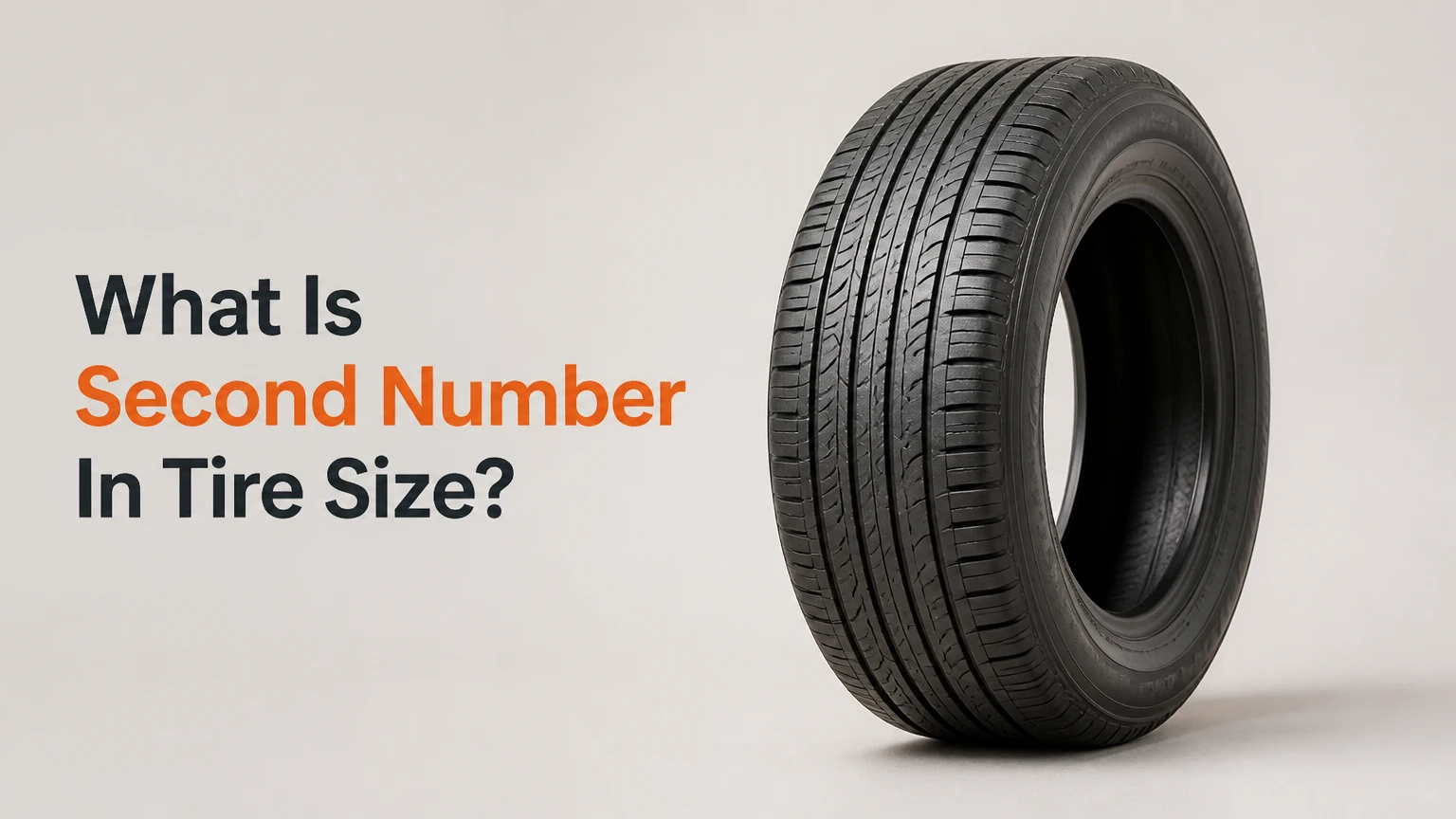
The second number in a tire size is the aspect ratio. It represents the height of the tire’s sidewall expressed as a percentage of the tire’s section width. For example, on a tire sized 225/50R17, the second number is 50. This means the sidewall height is exactly 50 percent of the 225-millimeter width, resulting in a physical sidewall height of 112.5 millimeters.
Key Facts / At a Glance
- The second number is always a percentage, never a direct measurement in millimeters or inches.
- Higher aspect ratios (70 and above) create taller, thicker sidewalls that prioritize ride comfort and off-road capability.
- Lower aspect ratios (50 and below) create shorter, stiffer sidewalls that improve steering response and high-speed cornering.
- Changing a tire’s width changes the physical sidewall height even if the aspect ratio number remains identical.
- Altering your factory aspect ratio without adjusting the tire width will change the overall diameter of the wheel, which alters speedometer accuracy.
How Do You Calculate Sidewall Height?
Understanding the physical size of your tire requires a specific mathematical formula. The aspect ratio does not exist in isolation. It relies entirely on the first number in the sequence, which is the section width measured in millimeters. You must convert the percentage into a decimal to find the actual height of the rubber sitting between the wheel rim and the road.
The Aspect Ratio Formula
To find the sidewall height, multiply the section width by the aspect ratio percentage. The formula is standard across the global tire industry.
The exact equation is: Sidewall Height = Section Width x (Aspect Ratio / 100).
Because the section width is measured in millimeters, your result will also be in millimeters. You can convert this to inches by dividing the final millimeter result by 25.4. This conversion helps North American drivers match their tires to suspension clearance specs.
Step-by-Step Calculation Example
Consider a common light truck tire size: 275/60R20. You want to know exactly how much rubber protects your 20-inch alloy wheels from pothole damage.
- Identify the section width: The first number is 275 millimeters.
- Identify the aspect ratio: The second number is 60.
- Convert the ratio to a decimal: Divide 60 by 100 to get 0.60.
- Multiply width by the decimal: 275 x 0.60 equals 165 millimeters.
- Convert to inches: 165 / 25.4 equals 6.49 inches.
Your sidewall is 6.49 inches tall. To find the total standing height of the entire tire, multiply that sidewall height by two (top and bottom sidewalls) and add the wheel rim diameter. In this case, 6.49 multiplied by two is 12.98. Add the 20-inch rim, and your total tire diameter is 32.98 inches.
What Are The Main Types Of Tire Profiles?
Tire engineers categorize aspect ratios into three primary profiles. Each profile alters the internal air volume of the tire. This trapped air acts as the vehicle’s primary spring rate, absorbing kinetic energy before it ever reaches the mechanical suspension.
High Profile (70 to 80+)
High-profile tires feature an aspect ratio of 70 or higher. You will find these sizes on large SUVs, heavy-duty pickup trucks, off-road vehicles, and classic cars built before 1990. A 235/75R15 is a classic high-profile dimension.
These tires hold a massive volume of air. The tall sidewall flexes significantly under load. This flexibility absorbs severe road impacts, prevents wheel damage on jagged rocks, and delivers a plush ride over broken pavement. The trade-off is a lack of lateral stability. When cornering at speed, the tall sidewall bends and folds. This creates a sluggish steering response and noticeable body roll.
Standard Profile (55 to 65)
Standard-profile tires feature aspect ratios between 55 and 65. The automotive industry uses these ratios as the default for modern family sedans, minivans, and compact crossovers. A common example is the 225/60R17.
This range represents the engineering sweet spot for daily driving. It provides enough sidewall height to protect the rim from urban potholes while remaining stiff enough to deliver predictable handling on the highway. Standard profiles also balance manufacturing costs, making them the most affordable and widely available replacement tires on the market.
Low Profile (30 to 50)
Low-profile tires have aspect ratios of 50 or lower. Performance cars, luxury sports sedans, and custom-tuned vehicles rely on these dimensions. A Porsche 911 rear tire might use a 305/30R21, pushing the aspect ratio down to a mere 30 percent.
These tires feature extremely stiff, reinforced sidewalls with minimal vertical deflection. This rigidity translates steering inputs directly to the road with zero delay, providing razor-sharp handling and massive cornering grip. However, the lack of air volume transfers every road imperfection directly into the cabin. Low-profile tires deliver a harsh, bumpy ride and drastically increase the risk of bending a wheel on a pothole.
How Does Aspect Ratio Affect Driving Dynamics?
The aspect ratio dictates how a tire behaves under physical stress. When a two-ton vehicle changes direction, the tires must manage lateral loads, weight transfer, and frictional heat. The height of the sidewall changes the shape of the rubber interacting with the pavement.
| Profile Category | Aspect Ratio Range | Contact Patch Shape | Primary Advantage | Primary Disadvantage |
| High Profile | 70 to 85 | Long and narrow | Maximum impact absorption | Slow steering response |
| Standard Profile | 55 to 65 | Oval and balanced | Predictable daily comfort | Average lateral grip |
| Low Profile | 40 to 50 | Wide and short | Crisp handling precision | Harsh ride quality |
| Ultra-Low Profile | 25 to 35 | Extremely wide | Maximum cornering speed | High rim damage risk |
Ride Comfort and NVH
Engineers measure vehicle comfort using NVH metrics (Noise, Vibration, and Harshness). The tire sidewall is the first line of defense against NVH. A taller aspect ratio allows the tire to deform over a bump, swallow the obstacle, and return to its shape without pushing the wheel hub upward. A typical 75-series tire can absorb a two-inch pavement ridge entirely through pneumatic deflection.
A lower aspect ratio forces the mechanical suspension to do all the work. If you switch from a 60-series tire to a 40-series tire, the spring rate of the tire itself increases by roughly 40 percent. This forces the vehicle’s dampers and bushings to absorb high-frequency vibrations they were not tuned to handle, resulting in a loud and jarring ride.
Steering Response and Cornering Stability
When you turn the steering wheel, the metal wheel turns instantly, but the tire tread dragging on the road resists that movement. The sidewall must twist to connect the turning wheel to the stationary tread. This twist is called the slip angle.
High-profile tires have tall, flexible sidewalls that create a large slip angle. You turn the wheel, the sidewall twists, and a fraction of a second later, the car changes direction. Low-profile tires have short, stiff sidewalls that generate almost zero slip angle. The vehicle reacts instantly to steering inputs. According to data from the Tire and Rim Association (TRA), dropping from a 65 aspect ratio to a 45 aspect ratio can increase lateral stiffness by over 50 percent.
Contact Patch Shape and Traction
The contact patch is the specific area of rubber physically touching the road at any given moment. Changing the aspect ratio alters the dimensions of this footprint.
Tall, high-profile tires create a contact patch that is long from front to back but narrow from side to side. This long footprint is excellent for straight-line traction, driving through deep snow, and resisting hydroplaning in heavy rain. Short, low-profile tires create a contact patch that is short from front to back but very wide laterally. This wide footprint maximizes dry grip during aggressive cornering but struggles to evacuate standing water at high speeds.
What Happens If You Change Your Aspect Ratio?
Modifying your tire size requires careful mathematical planning. You cannot simply pick a lower aspect ratio because it looks sportier. Changing the second number in the tire size sequence alters the mechanical geometry of the entire vehicle.
The Plus-Sizing Rule
Plus-sizing is the practice of mounting larger diameter wheels while maintaining the vehicle’s original total tire diameter. To accomplish this, you must lower the aspect ratio as you increase the wheel size.
The general automotive rule states that for every 10 millimeters of section width you add, you must subtract 5 points from the aspect ratio. If your factory tire is a 215/60R16, you can safely move to a 225/55R17. The width increases by 10, the ratio drops by 5, and the wheel increases by 1 inch. The overall standing height of the tire remains almost identical, ensuring the tire clears the fenders and suspension struts.
| Original Tire Size | Plus One Size (+1 Inch) | Plus Two Size (+2 Inches) | Required Ratio Adjustment |
| 205/65R15 | 215/60R16 | 225/55R17 | Drop 5 points per step |
| 225/55R17 | 235/50R18 | 245/45R19 | Drop 5 points per step |
| 245/45R19 | 255/40R20 | 265/35R21 | Drop 5 points per step |
| 275/60R20 | 285/55R21 | 295/50R22 | Drop 5 points per step |
Speedometer and Odometer Calibration Errors
Your vehicle computes its speed by counting how many times the axles rotate. The computers assume you are using the factory tire diameter. If you install a tire with a different aspect ratio without changing the width, you alter the overall diameter.
A taller tire covers more ground per revolution. If you switch from a 225/50R17 to a 225/60R17, your new tire is 1.7 inches taller. At highway speeds, your speedometer will read 60 miles per hour, but you will actually be traveling 64 miles per hour. Over time, your odometer will accumulate fewer miles than you actually drove. Most automotive manufacturers state that you must keep the overall diameter within 3 percent of the factory specification to prevent transmission and braking sensor errors.
Load Capacity and Tire Pressure Changes
Air volume supports weight, not rubber. When you reduce the aspect ratio, you reduce the physical space inside the tire. A smaller air chamber can support less weight at the same tire pressure.
If you move from a 65-series tire to a 45-series tire, you must usually switch from a Standard Load (SL) rating to an Extra Load (XL) rating. You will also need to inflate the low-profile tires to a higher baseline pressure (often 38-42 PSI instead of 32-35 PSI) to prevent the heavy vehicle from crushing the short sidewall against the metal rim. Failing to adjust your tire pressure for a new aspect ratio causes premature sidewall blowout.
Common Mistakes When Reading Tire Sizes
Drivers frequently misunderstand how the aspect ratio interacts with the rest of the tire dimensions. These mathematical errors lead to poor purchasing decisions and dangerous fitment issues.
The Direct Measurement Fallacy
The most frequent mistake is assuming the aspect ratio is a fixed measurement. Many drivers believe a “50” aspect ratio means the sidewall is 50 millimeters tall. It is strictly a percentage.
Because it is a percentage, a 50-series sidewall on a narrow tire is much shorter than a 50-series sidewall on a wide tire. A 195/50R15 has a sidewall height of 97.5 millimeters. A 315/50R15 has a sidewall height of 157.5 millimeters. Both tires have a “50” aspect ratio, but the second tire is a massive 2.3 inches taller than the first. You can never judge the physical height of a tire by the aspect ratio alone.
Upsizing Width Without Dropping Profile
Drivers often want wider tires for a more aggressive look. They might try to upgrade a factory 225/55R17 to a 245/55R17. They keep the 55 aspect ratio, assuming the height remains the same.
This is a dangerous error. Because the width increased by 20 millimeters, the 55 percent aspect ratio now calculates against a larger base number. The sidewall becomes significantly taller. This creates an overall diameter increase of nearly an inch. The new, taller tire is highly likely to rub against the inner fender liners when turning or bottom out against the suspension struts over bumps.
Mismatched Front and Rear Profiles
Modern All-Wheel Drive (AWD) systems require all four tires to spin at exactly the same speed. Some drivers attempt to run different aspect ratios on the front and rear axles (a staggered setup).
If you put a 245/45R18 on the front and a 275/45R18 on the rear, the rear tires will be 1.1 inches taller. The rear wheels will rotate slightly slower than the front wheels. The AWD computer will interpret this difference as wheel slip. The system will constantly engage the center differential to correct the non-existent slip, destroying the mechanical transfer case in a matter of weeks.
How To Choose The Right Aspect Ratio For Your Needs
Selecting the optimal aspect ratio requires matching the tire’s physical traits to your daily driving environment. There is no universally superior profile. The best choice depends entirely on your vehicle type and personal priorities.
| Driver Priority | Target Aspect Ratio | Recommended Vehicle Types | Primary Trade-Off |
| Commuter Comfort | 60 to 70 | Sedans, Crossovers, Minivans | Slower steering response |
| Track Performance | 30 to 45 | Sports Cars, Tuner Vehicles | High risk of pothole damage |
| Off-Road Capability | 70 to 85 | Trucks, SUVs, Jeeps | Poor high-speed stability |
| Fuel Economy | 55 to 65 | Hybrids, Commuter Cars | Average aesthetic appeal |
For Commuters Seeking Comfort
- Target Ratio: 60 to 70
- Ideal Use Case: Daily commuting on poorly maintained city streets.
Stick to the higher end of the OEM specifications. Prioritize tires built for touring. A 60 or 65 series tire provides the necessary pneumatic cushioning to isolate you from expansion joints, potholes, and broken asphalt. This taller aspect ratio also tends to deliver longer tread life, as the flexible sidewall absorbs forces that would otherwise scrub the tread blocks against the pavement.
For Performance and Track Drivers
- Target Ratio: 30 to 45
- Ideal Use Case: Track days, canyon carving, and aggressive driving.
Performance requires stability under load. Pair low aspect ratios with ultra-high-performance (UHP) summer rubber compounds. The stiff, short sidewall prevents the tire from folding over onto its shoulder during heavy cornering. Ensure your wheels are forged or flow-formed rather than cast aluminum. Cast wheels lack the structural density required to survive the violent impact forces transferred through a 35-series sidewall on public roads.
For Off-Road and Overlanding Vehicles
- Target Ratio: 70 to 85
- Ideal Use Case: Mud, rocks, sand, and deep snow trails.
Off-road traction relies on reducing tire pressure (airing down) to allow the tire tread to wrap around rocks and spread out over soft sand. A high aspect ratio is mandatory for this technique. A 75-series or 80-series sidewall provides enough physical height to let the tire squat significantly at 15 PSI without pinching the rubber against the wheel rim. Low-profile tires cannot be aired down safely and are useless on technical trails.
Frequently Asked Questions
Can I put a 65 series tire instead of a 60?
You can, but it will change the vehicle’s dynamics. Switching from a 60 to a 65 series (without changing the width) makes the tire taller. This will soften the ride but cause your speedometer to read slightly slower than your actual speed. You must verify that your wheel wells have enough clearance for the taller tire.
Does a lower aspect ratio improve gas mileage?
Generally, no. Low-profile tires are often wider and use stickier rubber compounds, which increases rolling resistance. Furthermore, the heavier, larger-diameter metal wheels required to mount low-profile tires increase rotational mass, which forces the engine to burn more fuel to accelerate the vehicle.
Why are low-profile tires more expensive?
Manufacturing a tire with a short, stiff sidewall that will not fail under load requires advanced materials. Tire companies use high-tensile steel belts, specialized aramid fibers, and complex rubber compounds to reinforce a 35-series sidewall. You are paying for the structural engineering required to survive without a large air cushion.
What does it mean if my tire has no aspect ratio number?
If your tire size looks like 31×10.50R15, you have a flotation size tire, commonly used on light trucks and Jeeps. Flotation sizes do not use aspect ratios. The first number (31) is the exact total tire height in inches, and the second number (10.50) is the exact section width in inches.
Does aspect ratio affect my braking distance?
Yes, but indirectly. A lower aspect ratio tire creates a wider, shorter contact patch that grips dry pavement aggressively under hard braking, reducing stopping distance. However, in wet conditions, that same wide contact patch struggles to channel water efficiently, which can increase braking distances and the risk of hydroplaning.