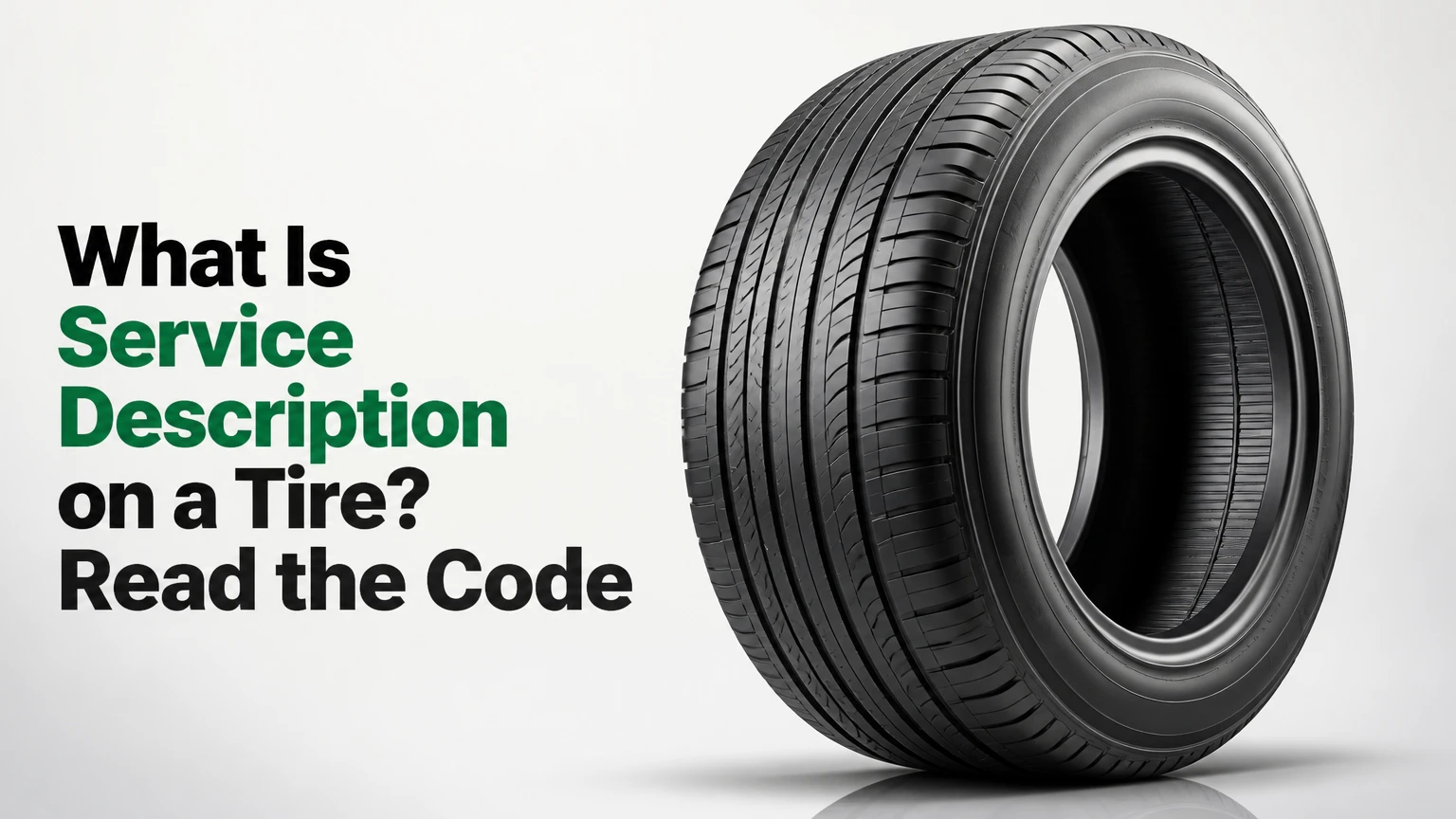
A tire’s service description is the load index and speed symbol printed after its size, such as 91V in 205/55R16 91V. The number identifies the tire’s maximum rated load under specified conditions, while the letter identifies its standardized speed capability. Together, they help determine whether a tire matches the vehicle’s required fitment.
Key Facts at a Glance
- 91V is a service description: 91 is the load index, and V is the speed symbol.
- Load index 91 corresponds to 615 kg, or 1,356 lb, per tire in the standard load-index table.
- Speed symbol V corresponds to 240 km/h, or 149 mph, under specified test conditions.
- The driver-door placard, owner’s manual, and vehicle manufacturer’s fitment data determine the required minimum rating.
- The tire sidewall’s maximum pressure is not automatically the correct inflation pressure for the vehicle.
- XL means Extra Load construction; it does not mean every XL tire should be inflated to one universal pressure.
What Is Service Description on a Tire?
The service description is the alphanumeric pairing that states a tire’s rated load capacity and speed capability. On a passenger tire marked 205/55R16 91V, the service description is 91V, not the complete size code. The Tire and Rim Association (TRA) and European Tyre and Rim Technical Organisation (ETRTO) publish technical systems that support consistent tire and wheel dimensions, load tables, and test practices.
The term is often confused with “tire rating,” although tire rating can refer separately to load index, speed symbol, load range, or a tire’s broader construction. Service description is most precise for the paired passenger-tire notation. Commercial light-truck tires often communicate capacity through LT, load range letters, and maximum load markings instead of the familiar passenger format.
Service description is a fitment and safety specification, not a quality score. A 100H tire is not automatically better than a 91V tire. The 100H tire carries more rated load, while the 91V tire has a higher speed symbol; the correct choice depends on the vehicle’s placard, axle loads, wheel compatibility, climate, and intended use.
How Do You Read a Service Description?
Read the last number and letter immediately following the tire size. In 225/45R17 94W, 94 is the load index, and W is the speed symbol. The construction code R, wheel diameter 17, and dimensions 225/45 belong to the tire size, not the service description.
A sidewall may show additional markings around the service description. XL or Reinforced identifies construction, M+S indicates a mud-and-snow classification used in some markets, and the three-peak mountain snowflake symbol identifies a tire certified for severe snow service. None of those markings replaces the load index and speed symbol.
| Sidewall marking | Meaning | Example value |
|---|---|---|
| 205/55R16 | Tire size | 205 mm width, 55 aspect ratio, 16-inch wheel |
| 91 | Load index | 615 kg, 1,356 lb per tire |
| V | Speed symbol | 240 km/h, 149 mph |
| XL | Construction designation | Extra Load casing |
| DOT code | U.S. identification and date code | Final four digits 2424 mean week 24 of 2024 |
What Does the Load Index Number Mean?
The load index is a numerical code that corresponds to a maximum load in a standardized table, measured per tire. Load index 91 equals 615 kg or 1,356 lb, so four identical tires have a theoretical combined index capacity of 2,460 kg or 5,424 lb, subject to vehicle, axle, wheel, pressure, and operating restrictions.
The load index is not the tire’s actual measured weight and is not a direct pound rating printed in the code. A tire marked 91 cannot be treated as equivalent to a tire marked 92 simply because the difference appears small. Each index corresponds to a defined table value, and the vehicle manufacturer selects a minimum index that accounts for axle loading and handling.
Use the vehicle’s gross axle weight rating (GAWR) as a practical check. Each axle’s tire capacity should meet or exceed the axle requirement, but the vehicle placard remains the primary replacement reference. A higher index can be acceptable when the tire remains compatible with the wheel, clearance, pressure system, ride requirements, and manufacturer specifications.
| Load index | Load per tire | Approximate load per tire | Common application |
|---|---|---|---|
| 80 | 450 kg | 992 lb | Small passenger cars |
| 88 | 560 kg | 1,235 lb | Compact sedans |
| 91 | 615 kg | 1,356 lb | Mid-size sedans |
| 94 | 670 kg | 1,477 lb | Larger sedans and crossovers |
| 100 | 800 kg | 1,764 lb | Crossovers and small SUVs |
| 104 | 900 kg | 1,984 lb | Larger SUVs and vans |
| 115 | 1,215 kg | 2,679 lb | Light trucks and heavier applications |
Does a Higher Load Index Carry More Weight?
A higher load index carries more rated weight, but it is not automatically the best replacement. A higher-index tire may use a stiffer casing, produce a firmer ride, weigh more, cost more, or require a different approved inflation pressure.
The replacement tire must also fit the wheel’s width and diameter. For example, changing from 91V to 100V increases load capacity, but the change does not make a passenger car suitable for loads above its own axle or chassis limits. Tires cannot raise the vehicle’s GVWR.
What Does the Speed Symbol Mean?
The speed symbol is the letter that identifies a tire’s tested speed category under specified load, inflation, temperature, and laboratory conditions. A V tire is rated for 240 km/h or 149 mph, but that figure is not a recommendation to drive at that speed and does not override speed limits, road conditions, tire wear, or vehicle capability.
Speed categories describe resistance to heat buildup and structural stress at the stated test condition. They do not measure braking distance, wet grip, acceleration, cornering skill, or tread life by themselves. Two tires with the same V symbol can behave differently because their tread compounds, patterns, carcasses, and wet-weather designs differ.
The symbols W, Y, and ZR require careful reading. Z historically indicated a high-speed category, but modern markings usually pair Z with a specific W or Y symbol, such as 275/35ZR20 102Y. The exact tire manufacturer specification controls the certified capability.
| Speed symbol | Maximum rated speed | Approximate mph | Typical context |
|---|---|---|---|
| Q | 160 km/h | 99 mph | Some winter and off-road tires |
| S | 180 km/h | 112 mph | Touring applications |
| T | 190 km/h | 118 mph | Family cars and minivans |
| H | 210 km/h | 130 mph | Passenger cars and crossovers |
| V | 240 km/h | 149 mph | Touring and performance cars |
| W | 270 km/h | 168 mph | Ultra-high-performance tires |
| Y | 300 km/h | 186 mph | High-performance vehicles |
| (Y) | Above 300 km/h | Above 186 mph | Certain manufacturer-specific applications |
A speed symbol is valid only when the tire is correctly inflated, carries no more than its rated load, and is in serviceable condition. The U.S. Tire Manufacturers Association advises drivers to follow the vehicle manufacturer’s tire size and inflation information, because a sidewall rating cannot compensate for underinflation or overloading.
What Do SL, XL, and RF Mean?
SL means Standard Load, while XL and RF identify reinforced passenger-tire constructions designed to carry more load at a higher approved inflation pressure than a comparable standard-load tire. The designation describes casing construction and load capability; it does not prescribe one universal cold inflation pressure for every vehicle.
An XL tire may be specified by the vehicle manufacturer or selected as an approved replacement. Its maximum load depends on the tire’s load table and pressure relationship, not on the letters alone. Some XL tires list a maximum cold pressure of 50 psi, while the vehicle placard may specify a lower operating pressure such as 36 or 39 psi.
The vehicle placard provides the normal cold pressure for the installed tire specification. NHTSA describes the placard as information that “specifies the original equipment tire size and recommended cold inflation pressure.” Use that pressure unless the vehicle manufacturer provides a documented alternative for towing, heavy loads, or special conditions.
How Are LT Tires Different?
LT tires use a light-truck construction and often show a load range such as C, D, or E instead of a passenger-tire SL or XL designation. Load range historically relates to ply-rating terminology, but it does not literally mean the tire contains that many physical plies.
An LT tire may have a higher load capacity, stronger casing, deeper tread, and greater resistance to severe service than a P-metric passenger tire. Those traits can also create more noise, rolling resistance, unsprung mass, and ride firmness. Installing LT tires on a passenger SUV solely because the letters appear more durable can worsen handling and comfort.
| Marking | Construction category | Typical maximum pressure range | Appropriate decision context |
|---|---|---|---|
| SL | Standard passenger load | Commonly 35-44 psi, tire-specific | Normal passenger-car service |
| XL | Reinforced passenger load | Commonly up to 50 psi, tire-specific | Manufacturer-approved heavier passenger application |
| LT Load Range C | Light truck | Commonly 50 psi, tire-specific | Moderate truck payload |
| LT Load Range E | Light truck | Commonly 80 psi, tire-specific | Heavy payload and towing applications |
How Do Service Ratings Affect Driving?
Load and speed ratings influence construction, but they do not independently determine ride quality or tread life. A higher-rated tire often has a stiffer casing, yet tread compound, groove design, alignment, temperature, rotation, and driving style frequently have a larger effect on wear and grip.
A performance tire may carry a W or Y symbol and still wear faster than a touring tire with an H or V symbol because the performance tire uses a softer compound and a tread pattern optimized for dry grip. Conversely, a premium touring tire can have a V symbol and provide long wear. Rating comparisons must therefore separate capability from tire category.
| Choice | Typical benefit | Typical trade-off | Best match |
|---|---|---|---|
| Lower approved rating | Lower purchase price and softer casing | Less load or speed margin | Vehicle that allows the rating |
| H-rated touring tire | Balanced comfort and highway capability | Less track-oriented response | Daily commuter |
| V-rated grand touring tire | Higher speed capability and stable steering | Often higher cost | Sedan or crossover |
| W/Y performance tire | Heat resistance and sharper response | Faster wear and firmer ride | Approved performance application |
| XL version of same size | Increased load capability | More mass and stiffness | Heavy vehicle or approved payload need |
An important practitioner rule is to compare the full tire model, not only the final letter. A 94V winter tire and a 94V summer tire share a rating but do not share temperature behavior, wet traction, snow performance, or tread life.
Can You Replace a Rating With a Lower One?
Do not install a tire with a lower load index than the vehicle placard or manufacturer fitment data specifies. A lower speed symbol also requires manufacturer approval, and some vehicle makers permit a lower winter-tire speed rating only when a visible in-car warning is used and the driver follows the reduced limit.
The safest replacement matches or exceeds the original load index and speed symbol while preserving the complete approved size. A higher speed symbol is not automatically harmless if it changes construction, wheel compatibility, clearance, pressure requirements, or ride behavior.
Never use the tire sidewall’s maximum pressure as a substitute for the placard. Maximum pressure is a tire limit. Placard pressure is the vehicle’s calibrated operating recommendation.
Can You Mix Service Descriptions?
Avoid mixing different load indexes or speed symbols on the same axle. If a temporary mismatch is unavoidable, install the tires with the higher-rated pair on the rear axle when the vehicle manufacturer permits that arrangement, because rear-axle grip loss can create sudden oversteer.
All-wheel-drive vehicles can impose stricter requirements. Some manufacturers require matching tire circumference, tread depth, model, and rating across all four positions to protect differentials and electronically controlled clutches. The owner’s manual overrides generic tire-shop practice.
Different ratings do not automatically disable ABS or ESC. However, mismatched diameter, construction, grip, or axle behavior can alter the systems’ assumptions and vehicle handling. Replace tires in axle pairs or as a complete set according to the vehicle manufacturer’s instructions.
Which Tire Pressure Should You Use?
Use the cold inflation pressure on the driver’s door placard or in the owner’s manual, not the maximum pressure molded into the tire sidewall. Check pressure when the tire is cold, ideally before driving or after the vehicle has been parked for at least three hours.
Pressure changes load capacity, heat generation, steering response, and tread contact. Underinflation flexes the sidewall and raises heat, while overinflation can reduce contact at the center of the tread and make the ride harsher. An XL tire still uses the vehicle’s specified pressure unless a manufacturer table directs otherwise.
Check pressure monthly and before long trips, then inspect the tread and sidewalls. A TPMS warning indicates a pressure problem, but it may not identify which tire is losing air or whether the pressure is appropriate for a full payload.
How Do You Choose a Correct Replacement?
Choose a replacement in this order:
- Read the placard. Record the front and rear tire sizes, load indexes, speed symbols, and cold pressures.
- Confirm the complete size. Match width, aspect ratio, construction, and wheel diameter.
- Match the minimum service description. Do not go below the listed load index or speed symbol without written manufacturer guidance.
- Check construction. Confirm whether the vehicle requires SL, XL, RF, P-metric, LT, or another market-specific type.
- Verify the wheel. Confirm approved rim width, diameter, offset clearance, and valve or TPMS compatibility.
- Compare operating conditions. Select all-season, winter, summer, touring, or all-terrain construction for the actual climate and roads.
- Set cold pressure after installation. Use the placard value and reset the TPMS if the vehicle requires it.
A useful expert shortcut is to photograph the placard and sidewall before ordering. Catalog listings can omit XL, OE markings, or the exact speed symbol, while two visually similar tires may have different service descriptions.
How Much Do Service Ratings Affect Cost?
Higher-performance construction typically adds $20-$160 per tire compared with a standard touring tire in the same nominal size, although brand, wheel diameter, region, and availability can change the result. Typical U.S. retail pricing for a 245/45R18 size might be $130-$180 for a touring 96H or 96V tire, $180-$300 for a 100Y XL performance tire, and $240-$380 for an LT tire in a heavier application.
Service description is only one cost variable. A 19-inch wheel, run-flat construction, electric-vehicle load requirement, severe-snow certification, or original-equipment compound may cost more than a change from H to V.
Tread warranties also vary by model. Typical touring tires may carry 50,000-80,000-mile warranties, while many ultra-high-performance tires carry 20,000-40,000 miles or no mileage warranty. Those figures are product-specific, not guaranteed service life.
What Mistakes Cause Problems?
The most damaging mistakes involve treating the code as a complete tire recommendation. Service description cannot reveal whether a tire has enough wet grip, winter traction, wheel clearance, or correct vehicle approval.
- Choosing by size alone: A 225/50R17 tire may fit dimensionally but have an insufficient load index or incompatible XL construction.
- Using the sidewall maximum pressure: The molded maximum is not the vehicle’s normal pressure.
- Assuming Y means safer everywhere: Y describes high-speed test capability, not snow, rain, braking, or public-road legality.
- Installing LT tires for ordinary driving: Extra casing strength can create harshness, noise, and altered handling.
- Ignoring axle placement: A mismatched pair on the rear can create unstable handling during abrupt maneuvers.
- Relying on four-way arithmetic: Four tire capacities do not override GAWR, GVWR, wheel limits, or suspension limits.
Tire damage also invalidates rating assumptions. A puncture repaired outside approved conditions, exposed cords, a bulge, severe impact damage, or prolonged underinflation requires professional inspection even when the service description matches.
FAQ
Is service description the same as tire size?
No. Tire size describes physical dimensions and wheel fit, such as 205/55R16. Service description adds load and speed capability, such as 91V. The complete sidewall specification may also include XL, run-flat, OE, winter, or regional markings.
What does 91V mean on a tire?
91V means load index 91 and speed symbol V. Load index 91 corresponds to 615 kg or 1,356 lb per tire. V corresponds to 240 km/h or 149 mph under specified test conditions, not a safe public-road driving speed.
Is XL better than SL?
XL is not universally better than SL. XL construction supports a higher load at an approved pressure, but it may weigh more, ride more firmly, and cost more. Choose XL when the vehicle placard or manufacturer fitment data requires or approves it.
Can I use a tire with a higher speed rating?
A higher speed rating is often acceptable when the size, load index, construction, wheel fitment, clearance, and pressure requirements remain compatible. The higher symbol does not improve every performance measure, and the vehicle manufacturer’s approval remains the deciding authority.
What does a tire’s maximum load mean?
Maximum load is the greatest load the tire can carry at a specified pressure and operating condition. The value applies to one tire. Vehicle payload, GAWR, GVWR, wheel capacity, and manufacturer instructions can impose lower practical limits.
Where can I find the correct service description?
Find the original service description on the driver-door placard, owner’s manual, or vehicle manufacturer’s fitment data. Confirm it against the tire sidewall and replacement listing. A tire retailer should verify the complete specification rather than matching size alone.
The Bottom Line
The answer to what is service description on a tire is the paired load index and speed symbol, such as 91V. The number identifies rated load, the letter identifies tested speed capability, and the vehicle placard determines the minimum acceptable specification. Match the complete size and construction, use the placard pressure, and treat higher ratings as fitment choices rather than automatic upgrades.