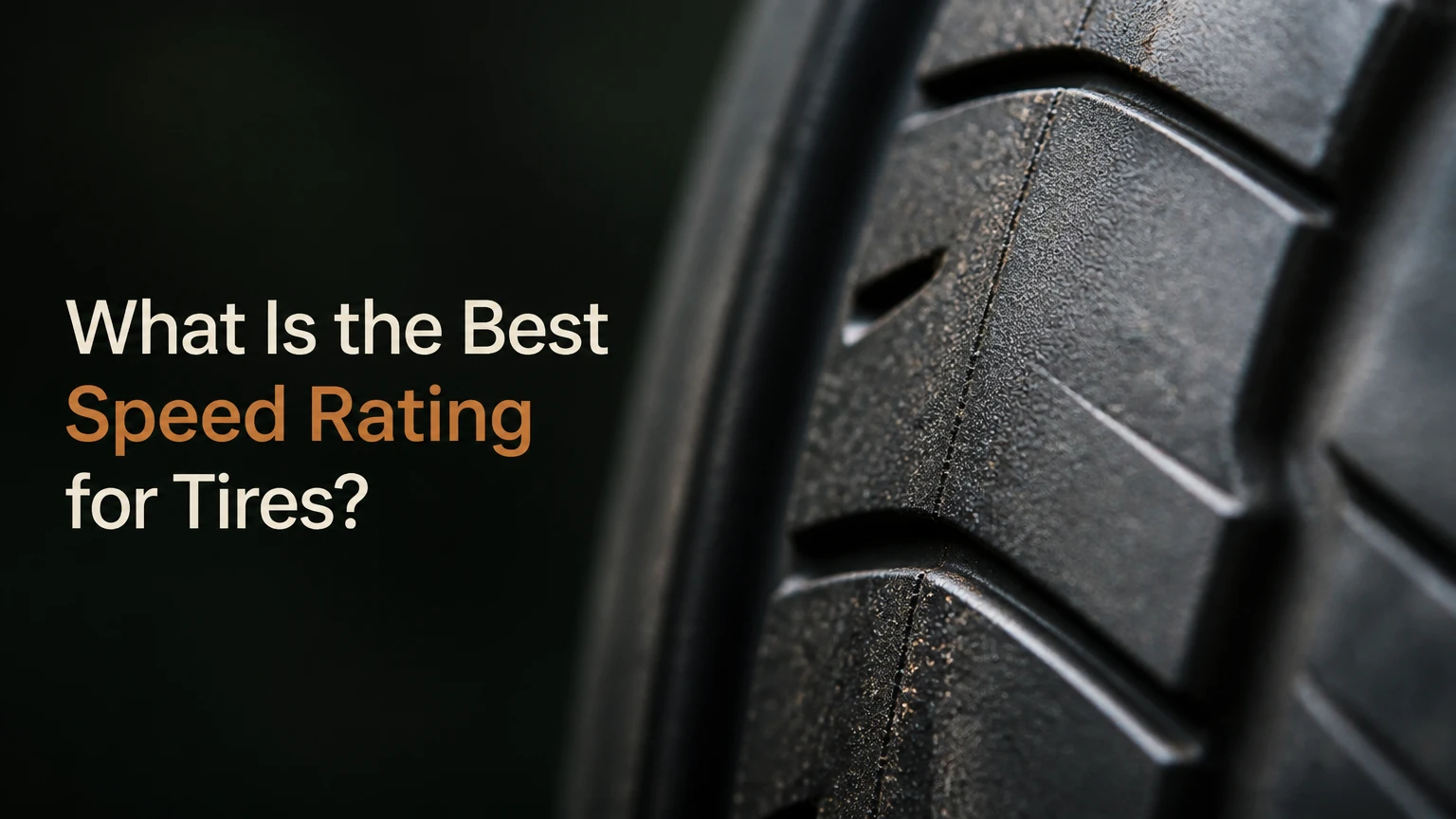
The best speed rating for tires is the rating specified by your vehicle manufacturer, or a higher rating that preserves the required tire size and load index. For most drivers, the correct OE rating offers the intended balance of handling, comfort, heat resistance, tread life, and cost; a higher letter is not automatically safer or better.
Key facts at a glance
- A tire speed rating states the tire’s laboratory-tested maximum sustained speed under specified load and inflation conditions.
- The vehicle placard and owner’s manual provide the minimum approved speed rating for the original fitment.
- Replacing a tire with a lower rating can alter handling, heat resistance, and the vehicle manufacturer’s tested performance.
- A higher rating can improve steering response and heat capacity, but it may reduce ride comfort and tread life.
- Speed rating does not replace the load index. The tire must meet both requirements.
- Winter tires may carry a lower rating because flexible snow compounds prioritize cold-weather traction, subject to manufacturer and local requirements.
What does a tire speed rating mean?
A tire speed rating is an alphabetical service code that identifies the maximum sustained speed a tire can withstand under defined test conditions. The letter appears after the tire size and load index, as in P215/55R17 94V, where V is the speed rating and 94 is the load index.
Michelin defines the rating as the “maximum speed a tire can safely maintain over time,” but the phrase requires an important qualification: the rating assumes correct inflation, an appropriate load, an undamaged tire, and suitable operating conditions. A V-rated tire is not a permission to drive at 149 mph on public roads.
The rating also describes more than top-speed capability. Tire manufacturers alter the casing, belt package, bead, cap ply, and tread compound to control deformation and heat. Those changes affect steering precision, ride harshness, wet grip, rolling resistance, and wear.
How is a speed rating tested?
Manufacturers test tires on an indoor rotating drum or flywheel under controlled conditions. The test uses a new, properly inflated tire at a specified load, increases speed in stages, and checks whether the tire survives the required period without structural failure or tread separation.
Published descriptions often mention speed increments of approximately 10 km/h and staged running periods, but the exact procedure depends on the applicable standard, tire category, and manufacturer. The test is a durability classification, not a complete prediction of road behavior.
Heat is the main engineering problem. Centrifugal force increases with speed, while flexing in the sidewall and tread generates internal heat. Underinflation, overloading, hot pavement, damage, and poor wheel alignment can push a tire beyond the conditions used to establish its rating.
What a speed rating does not tell you
A speed rating does not tell you the tire’s wet-braking distance, snow traction, treadwear life, noise level, or maximum legal driving speed. Those characteristics depend on the specific tire model, tread design, compound, vehicle, road, temperature, and maintenance.
Higher-rated tires often use stiffer structures and performance-oriented compounds, but the rating alone cannot prove that one tire stops shorter than another. A well-designed H-rated touring tire may outperform a poor-quality V-rated tire in wet braking.
Which tire speed rating should you choose?
Choose the vehicle manufacturer’s original-equipment rating first. A higher rating is normally acceptable when the replacement tire retains the required size, load index, construction, clearance, wheel compatibility, and pressure specification.
The correct choice is usually straightforward:
- Use the placard rating for a normal replacement.
- Consider a higher rating when the vehicle is heavily loaded, driven for long highway periods, or being fitted with a performance tire that requires it.
- Avoid a lower rating unless the vehicle manufacturer and tire manufacturer specifically approve the application, commonly for a dedicated winter set.
- Replace all four tires consistently when possible, especially on AWD and four-wheel-drive vehicles.
A higher letter does not compensate for an inadequate load index. For example, a 94W tire may be unsuitable if the vehicle requires a 98H tire, because the 94 load index supports less weight even though W represents a higher speed category.
Tire speed rating chart
The following common passenger-tire values use the standard North American speed-rating scale. ZR is a size or construction marking that requires the complete service description for a precise rating.
| Rating | Rated speed | Common application |
|---|---|---|
| L | 75 mph / 120 km/h | Off-road or special low-speed tire |
| M | 81 mph / 130 km/h | Temporary or specialized service |
| N | 87 mph / 140 km/h | Temporary spare and selected specialty tires |
| P | 93 mph / 150 km/h | Older passenger and light-truck applications |
| Q | 99 mph / 160 km/h | Winter tires and specialty applications |
| R | 106 mph / 170 km/h | Light trucks and commercial fitments |
| S | 112 mph / 180 km/h | Older passenger cars and some vans |
| T | 118 mph / 190 km/h | Family sedans, minivans, and crossovers |
| H | 130 mph / 210 km/h | Sport sedans and many modern passenger cars |
| V | 149 mph / 240 km/h | Performance sedans, SUVs, and luxury cars |
| W | 168 mph / 270 km/h | Ultra-high-performance vehicles |
| Y | 186 mph / 300 km/h | High-performance and exotic cars |
| (Y) | Over 186 mph / 300 km/h | Specialized tires exceeding the Y category |
| ZR | Above 149 mph / 240 km/h | High-speed construction marking requiring W, Y, or (Y) detail |
The value is not a linear measure of everyday performance. A V-rated tire is not necessarily 26 percent better than an H-rated tire, and a Y-rated tire is not automatically appropriate for a family crossover.
How do H, V, W, and Y tires compare?
H, V, W, and Y ratings differ mainly in tested speed capability and the construction needed to manage heat and deformation. The best choice depends on the vehicle placard and the driver’s priorities, rather than on the highest available letter.
| Rating | Maximum rated speed | Typical tire character | Typical trade-off |
|---|---|---|---|
| H | 130 mph / 210 km/h | Touring-performance balance, moderate sidewall stiffness | More comfort and tread life than many V or W models |
| V | 149 mph / 240 km/h | Sharper response and stronger high-speed heat capacity | Firmer ride and often higher replacement cost |
| W | 168 mph / 270 km/h | Ultra-high-performance casing and compound | Faster wear, higher price, less pothole compliance |
| Y | 186 mph / 300 km/h | Specialized high-performance construction | Limited mileage warranty and poor value for ordinary commuting |
For a vehicle originally fitted with H-rated tires, V may be a sensible upgrade when the exact model offers better handling without an extreme compound. W or Y is usually unnecessary unless the manufacturer specifies it or the vehicle’s wheel, suspension, and performance system were designed around that category.
Does a higher speed rating improve braking?
A higher speed rating does not guarantee shorter braking distances. The specific tread compound, contact patch, wet-grip design, vehicle calibration, road temperature, and tire condition determine braking performance more directly than the letter alone.
Higher-rated tires can provide a stiffer response and greater heat resistance during repeated braking. However, a stiff high-performance tire may perform worse in cold rain or snow than a lower-rated touring or winter tire designed for those conditions.
This is a frequent buying mistake. Drivers should compare independent wet-braking tests, manufacturer traction data, warranty terms, and fitment specifications instead of treating the speed letter as a universal grip score.
How do you find the correct rating for your car?
Find the tire placard on the driver’s door jamb, door edge, glove-box area, fuel-door area, or inside the owner’s manual. The placard normally lists approved tire size, load capacity, cold inflation pressure, and sometimes the complete service description.
Use this process:
- Record every placard entry. Note front and rear sizes separately if the vehicle has staggered fitment.
- Read the full code. In
225/50R17 94V, 225 is width, 50 is aspect ratio, R is radial construction, 17 is wheel diameter, 94 is load index, and V is speed rating. - Check the sidewall. Confirm that the replacement tire has the same size and at least the required load index and speed rating.
- Check special markings. XL, HL, RF, RFT, OE, and manufacturer-specific markings can affect fitment.
- Confirm pressure. Inflate to the placard pressure, not the maximum pressure molded into the sidewall.
- Ask about axle pairing. A tire shop should verify that front and rear ratings comply with the vehicle manufacturer’s instructions.
The tire currently mounted on the vehicle may not be the correct reference. Previous owners, inexpensive replacements, or wheel changes can introduce an incorrect size or rating.
Should you buy a higher speed-rated tire?
Buy a higher-rated tire when the manufacturer permits it and the upgrade solves a real use case, such as repeated high-load highway travel or sharper steering response. Do not buy a higher rating solely because the letter appears more impressive.
| Priority | Usually suitable choice | Reasonable expectation | Main caution |
|---|---|---|---|
| Quiet commuting | OE T or H touring tire | Softer ride and longer warranty | Less immediate steering response |
| Long highway trips | OE H or V touring tire | Better heat margin and directional stability | Verify noise, comfort, and wet traction |
| Sport sedan handling | OE V or approved W tire | Faster turn-in and stronger cornering response | Reduced impact comfort and tread life |
| Heavy electric vehicle | Manufacturer-approved XL, HL, V, or W tire | Correct load capacity and torque control | Rating alone does not establish EV suitability |
| Track-day use | Manufacturer-approved W, Y, or (Y) tire | High-temperature structural stability | Not necessarily suitable for cold roads or daily mileage |
| Snow and ice | Approved Q, S, or T winter tire | Better low-temperature and snow traction | Follow the tire’s speed warning and local rules |
A higher rating can also create a mismatch with the vehicle. The tire may need different alignment settings, produce more road noise, or expose wheels and suspension components to sharper impacts because of a stiffer sidewall.
How much do speed-rated tires cost?
A higher-rated replacement can cost approximately 10-30 percent more than a similar tire in the same brand, size, and product family. Typical U.S. retail differences range from about $20-$80 per tire, although specialty performance tires can differ by more than $150.
| Tire category | Typical price per tire | Typical mileage warranty | Common replacement-set range |
|---|---|---|---|
| S or T touring | $90-$190 | 60,000-90,000 miles | $360-$760 |
| H touring-performance | $110-$230 | 50,000-75,000 miles | $440-$920 |
| V performance-touring | $140-$300 | 40,000-65,000 miles | $560-$1,200 |
| W or Y ultra-high-performance | $180-$500 | 20,000-45,000 miles | $720-$2,000 |
These are typical retail ranges, not guarantees. Brand, tire size, run-flat construction, vehicle-specific homologation, season, and retailer promotions can change the result substantially.
Speed rating also fails as a mileage predictor. Tread compound and tread depth usually have a larger effect on wear than the letter by itself. A long-wearing V-rated touring tire may outlast a soft H-rated summer tire.
Can you use a lower speed rating?
A lower rating should not be used as a routine cost-saving substitution. The lower rating can reduce the tire’s heat margin and change steering response, particularly during high-load driving, emergency maneuvers, or sustained highway travel.
Winter tires are the main exception. A manufacturer may approve a lower-rated winter tire because snow tires use flexible compounds and dense siping that remain effective at low temperatures. The driver may need a dashboard warning label showing the lower maximum speed, and local regulations or the vehicle manual may impose additional conditions.
Never assume that a lower rating is acceptable because the vehicle’s top speed exceeds normal traffic speeds. Speed rating covers structural and thermal performance, not only the speed a driver normally chooses.
What happens if tires have different ratings?
The safest practice is to fit identical size, construction, load index, and speed rating across the vehicle. If two ratings must be mixed temporarily, place the tires with the higher rating on the rear axle when the vehicle manufacturer permits it, and follow the owner’s manual rather than a generic rule.
Mixing different ratings on one axle can create unequal response during cornering or braking. AWD vehicles may also require closely matched rolling circumference, so replacing only one tire can stress the driveline even when the speed letters match.
Do not mix run-flat and conventional tires unless the vehicle manufacturer explicitly permits the combination. A temporary spare is an exception, but its speed, distance, and handling restrictions must be followed.
What other tire specifications matter more than the speed letter?
Load index, tire type, season, construction, and condition can matter as much as or more than speed rating. A correct replacement must meet the complete service description, not merely the final alphabetic character.
Load index and pressure
Load index is a numerical code for the tire’s maximum load at its specified reference conditions. For example, load index 94 corresponds to 1,477 pounds, or 670 kilograms, per tire in the standard passenger-tire table. The exact application still requires the manufacturer’s placard and pressure.
Underinflation increases sidewall flex and heat. NHTSA’s TireWise guidance identifies underinflation as a major tire-safety risk and recommends checking pressure when tires are cold, at least monthly and before long trips.
XL, HL, and run-flat construction
An XL tire, meaning Extra Load, uses a higher-load construction and may require a higher inflation pressure than a standard-load tire. HL means High Load and is common on some newer heavy vehicles, including selected EV applications.
Run-flat tires include reinforced sidewalls and have specific pressure-loss distance limits. A run-flat designation cannot be inferred from H, V, W, or Y, so replacement requires matching the vehicle’s approved construction.
Season and compound
Summer, all-season, and winter tires with the same speed rating can behave very differently. Winter tires generally retain flexibility below freezing, while summer tires can lose grip sharply in cold temperatures even when their speed rating is higher.
Tire Rack’s testing and manufacturer guidance repeatedly show that tire category and compound influence wet, dry, and snow performance more directly than a single sidewall letter. The speed rating is one fitment filter, not a complete quality ranking.
What mistakes should you avoid?
Avoid these five errors when selecting a replacement:
- Using the mounted tire as the specification. Verify the door placard and manual because the existing tire may be wrong.
- Ignoring load index. A high speed letter cannot make an under-capacity tire suitable.
- Comparing letters across different models. A V-rated touring tire and V-rated summer tire can have very different grip, noise, and mileage.
- Inflating to sidewall maximum. Use the placard’s cold-pressure value unless a qualified manufacturer instruction says otherwise.
- Replacing one tire on an AWD vehicle without measurement. Even small diameter differences can exceed the drivetrain’s tolerance.
A tire’s DOT date also matters. NHTSA advises regular inspection for aging, cracking, bulges, punctures, and tread problems; many manufacturers recommend removal after six or ten years regardless of remaining tread, depending on their published policy. Age reduces the value of any speed rating.
Which rating is best for specific drivers?
Daily commuter
Choose the OE rating, commonly T or H, with a touring compound that matches the climate. Prioritize wet braking, noise, warranty, and tread life over a higher letter that the vehicle does not require.
Highway traveler
Choose the OE rating or an approved one-step upgrade, often H to V, when the tire model provides stronger heat resistance and stable steering. Confirm that the upgrade does not sacrifice wet-weather traction or ride quality.
Electric vehicle owner
Choose the exact load and construction specified by the EV manufacturer, then evaluate the speed rating. Battery weight, instant torque, regenerative braking, and low cabin noise can make XL, HL, EV-marked, or low-rolling-resistance design more relevant than simply choosing W or Y.
Winter driver
Choose a properly certified winter tire in the highest rating approved for that vehicle and climate. A Q- or T-rated winter tire can be safer on snow than a V-rated summer tire, but the lower rating must be disclosed and respected.
Performance driver
Choose the manufacturer’s approved V, W, Y, or (Y) category, matching the wheel width, alignment, load requirement, and intended temperature range. Track use demands separate inspection because public-road speed ratings do not certify unlimited laps, tire pressures, or circuit temperatures.
FAQ
Can I replace V-rated tires with H-rated tires?
Usually no, unless the vehicle manufacturer specifically approves the lower rating for that application. H-rated tires have a lower tested speed category than V-rated tires, and the change can reduce heat margin and alter handling. A winter exception may exist, but it requires manufacturer approval and appropriate speed labeling.
Is a T rating enough for highway driving?
A T rating can be sufficient when the vehicle placard specifies T and the tire carries the required load index. T-rated tires are commonly rated to 118 mph, but highway suitability also depends on inflation, load, tire age, tread condition, temperature, and the tire model’s wet-road performance.
Is V better than H for an SUV?
V is not automatically better for an SUV. V may provide sharper steering and greater heat capacity, but the SUV needs the correct load index, casing construction, and clearance. A high-quality H-rated touring tire can deliver better comfort, snow performance, or mileage than an unsuitable V-rated performance tire.
Do speed-rated tires need different tire pressure?
The vehicle placard determines normal cold inflation pressure, not the speed letter alone. Some XL, HL, run-flat, or vehicle-specific tires require different pressure, so the manual and tire manufacturer’s fitment data control. Never set pressure from the sidewall maximum as a substitute for the placard.
How long can a tire last if it has good tread?
Tread depth does not establish a safe service life. Heat cycles, ultraviolet exposure, underinflation, storage, impact damage, and age can weaken a tire before the tread wears out. Inspect tires regularly, check the DOT date, and follow the tire manufacturer’s replacement-age recommendation.
Should all four tires have the same speed rating?
All four tires should normally have the same size, construction, load index, and speed rating. Matching the set gives the vehicle more predictable handling and simplifies rotation. AWD vehicles may also require closely matched circumference, so consult the owner’s manual before replacing fewer than four tires.
The bottom line
The best speed rating for tires is the vehicle manufacturer’s specified rating, matched with the correct load index, size, construction, pressure, and season. A higher rating can be a reasonable upgrade for approved performance or highway applications, while a lower rating is generally unsuitable except for documented winter-tire allowances. Check the placard first, then compare the complete tire model rather than choosing the highest letter.