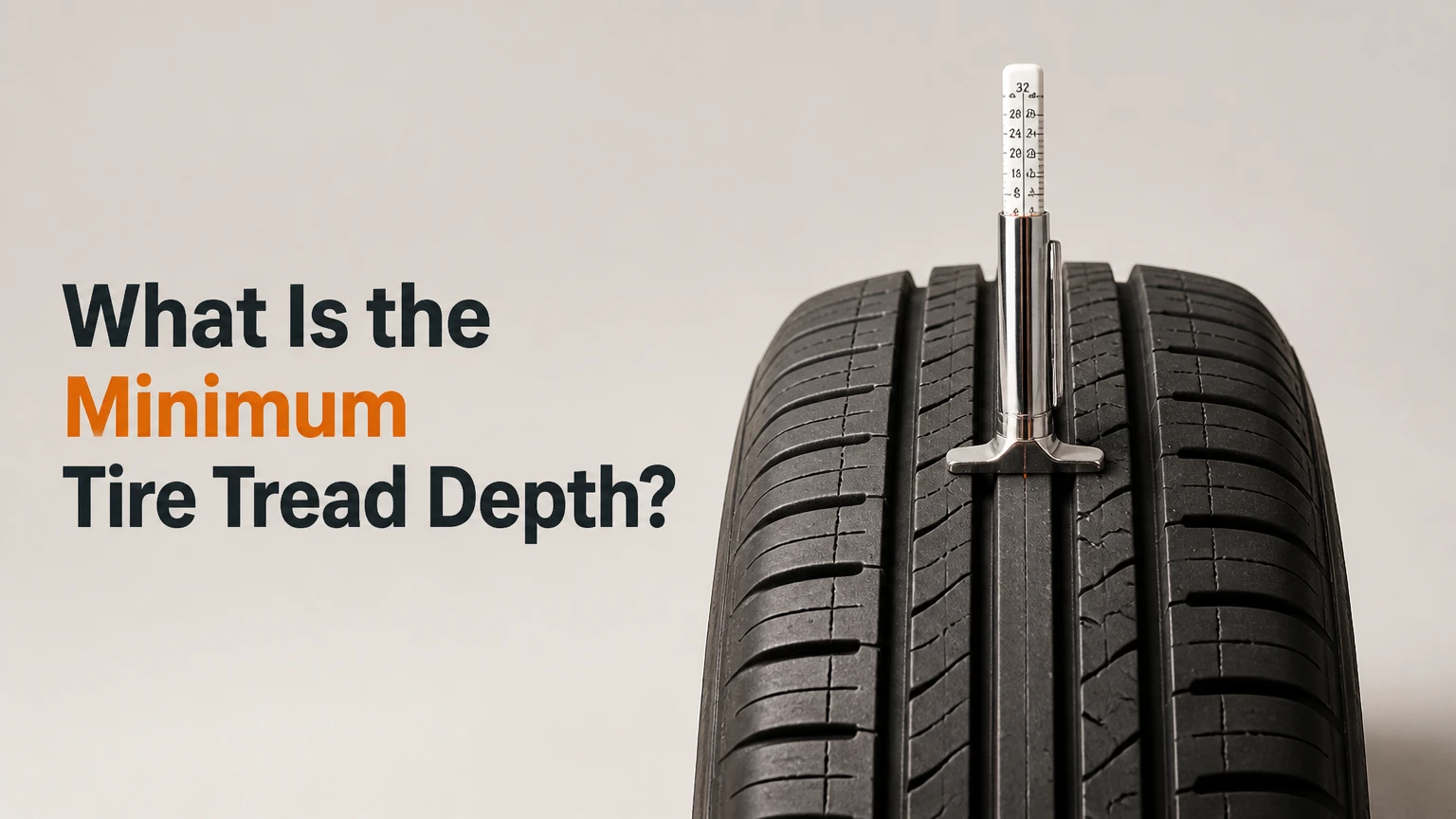
The minimum tire tread depth for most passenger vehicles in the United States is 2/32 of an inch, equal to approximately 1.6 millimeters. A tire at that depth has reached its wear bars and should be replaced, but drivers who regularly encounter rain or snow should normally replace tires earlier for better braking and water evacuation. NHTSA advises replacement when tread reaches 2/32 inch.
Tire Tread Depth at a Glance
- 2/32 inch, or 1.6 mm, is the replacement threshold for most U.S. passenger tires.
- 4/32 inch, or 3.2 mm, is a practical replacement point for frequent wet-road driving.
- 5/32-6/32 inch, or 4.0-4.8 mm, is commonly used as a winter-performance threshold.
- Built-in treadwear bars are molded at 2/32 inch on U.S.-regulated tires.
- The lowest reading on a tire determines its usable tread depth.
- A tire can require replacement before reaching 2/32 inch because of damage, age, or irregular wear.
What Is the Minimum Tire Tread Depth by Vehicle Type?
For a typical passenger car, crossover, SUV, or light pickup, the widely recognized U.S. minimum is 2/32 inch across the tire’s major tread grooves. This figure is a final replacement boundary, not an assurance that the tire will still provide strong wet-weather performance.
Commercial vehicles follow more specific federal requirements. Under U.S. commercial motor vehicle rules, tires on the front steering axle generally require at least 4/32 inch in the major grooves, while other tires generally require at least 2/32 inch. Federal inspection records identify front-tire tread below 4/32 inch and other-tire tread below 2/32 inch as violations.
| Tire application | Minimum or decision threshold | Metric equivalent | Practical meaning |
| Most passenger-vehicle tires | 2/32 in | 1.6 mm | Replace immediately |
| U.S. commercial steering-axle tire | 4/32 in | 3.2 mm | Federal minimum |
| Other U.S. commercial tires | 2/32 in | 1.6 mm | Federal minimum |
| Frequent rain use | About 4/32 in | 3.2 mm | Consider replacement |
| Winter or heavy-snow use | About 5/32-6/32 in | 4.0-4.8 mm | Reduced snow usefulness below this range |
Tire laws are jurisdiction-specific. A driver outside the United States should check the applicable national, provincial, state, or inspection rule rather than assuming that every country uses the same figure.
What Does Tire Tread Depth Measure?
Tire tread depth measures the vertical distance between the top of a tread block and the bottom of a major circumferential groove. In the United States, readings are usually expressed in thirty-seconds of an inch, while many other countries and digital gauges use millimeters.
The measurement represents the depth available for water evacuation, biting edges, and continued wear. It does not directly measure rubber hardness, internal belt condition, heat damage, sidewall integrity, or the age of the tire.
A reading should be taken in a major tread groove, not on a raised wear bar, decorative sipe, stone ejector, or shallow secondary groove. Measuring the wrong feature can produce a falsely low or high result.
Common Tire-Depth Conversions
| Thirty-seconds of an inch | Decimal inches | Millimeters | Typical interpretation |
| 10/32 | 0.3125 | 7.9 mm | Common new-tire range |
| 8/32 | 0.2500 | 6.4 mm | Substantial usable tread |
| 6/32 | 0.1875 | 4.8 mm | Monitor for winter use |
| 5/32 | 0.1563 | 4.0 mm | Reduced deep-snow capability |
| 4/32 | 0.1250 | 3.2 mm | Wet-weather replacement point |
| 3/32 | 0.0938 | 2.4 mm | Replace soon |
| 2/32 | 0.0625 | 1.6 mm | Minimum replacement threshold |
Is 2/32 Inch Still Safe in the Rain?
A tire at 2/32 inch may satisfy the minimum numerical threshold, but its wet-road capability is substantially lower than that of a tire with deeper grooves. Less groove volume means water has fewer channels through which to escape from the contact patch.
Standing water, vehicle speed, tire width, tire pressure, tread design, and pavement texture all affect hydroplaning risk. Tread depth is therefore only one variable, but it is a major one that drivers can measure directly.
Tire Rack recommends considering replacement at approximately 4/32 inch when rain and wet roads are a regular concern. Its guidance distinguishes the legal endpoint from a more conservative wet-weather replacement point.
A practical rule is simple:
- Replace at 4/32 inch when the vehicle frequently travels at highway speeds in heavy rain.
- Plan replacement at 3/32 inch even in a relatively dry climate.
- Treat 2/32 inch as the endpoint, not a target to reach deliberately.
- Replace sooner when tread is uneven or the tire shows damage.
Why Does Tread Depth Affect Traction?
Tire grooves move water away from the rubber-road contact area. As tread wears down, groove volume decreases, which limits the amount of water the tire can manage during each rotation.
Dry-road grip is more complex. A tire does not automatically lose all dry traction at 2/32 inch, and some performance tires can feel responsive with relatively shallow tread. That fact does not make a worn street tire suitable for normal use because public roads include rain, debris, temperature changes, and emergency braking.
Snow adds another mechanism. Winter tread relies on deeper grooves, tread-block edges, and numerous sipes to bite into loose or compacted snow. A winter tire may remain legal at 4/32 inch while no longer delivering the snow performance for which it was purchased.
Expert insight: Legal tread depth evaluates remaining groove depth. It does not certify that a tire can stop within a specific distance in every weather condition.
How Do You Measure Tire Tread Depth Correctly?
The most accurate home method is a dedicated tread-depth gauge. Measure each tire across multiple grooves and at several points around its circumference, then use the lowest valid reading when deciding whether the tire remains serviceable.
Step 1: Park on a Level Surface
Park away from traffic, set the parking brake, switch off the engine, and place the transmission in Park or in gear. Turn the front wheels outward when additional access to the inner shoulders is needed.
Step 2: Inspect the Tire Before Measuring
Remove stones, packed dirt, and debris from the grooves. Look for bulges, exposed cords, cuts, cracks, separated tread, or objects embedded in the casing.
A tire with structural damage should not be approved merely because the gauge shows adequate tread.
Step 3: Identify the Major Grooves
Use the wide circumferential channels that run around the tire. Avoid measuring directly on a wear bar because the raised rubber will prevent the probe from reaching the groove floor.
Step 4: Insert the Gauge Vertically
Place the gauge base flat against adjacent tread blocks and lower the probe into the groove. Keep the tool perpendicular to the tread surface.
An angled gauge can exaggerate depth. Pressing the tool into soft rubber can also distort the reading.
Step 5: Take at Least Nine Readings per Tire
Measure the inner, center, and outer portions of the tread at three positions around the tire. This nine-point pattern can reveal local wear that a single center reading misses.
Step 6: Record the Lowest Valid Reading
Do not average a nearly bald shoulder with a deeper center groove. The shallow section is the section most likely to lose traction or expose the tire structure.
Step 7: Compare All Four Tires
Record each tire separately. Differences between the front and rear axles can indicate rotation intervals, alignment changes, drivetrain characteristics, or suspension problems.
NHTSA recommends checking tread at least monthly when tire pressure is checked and before long trips.
Which Tread Measurement Method Is Best?
A digital or mechanical tread-depth gauge is the best method because it provides a numerical reading. Coin tests and wear bars are useful screening tools, but neither gives the same detail across the full tread width.
| Method | Output | Typical accuracy | Best use | Main limitation |
| Digital gauge | Fractional or decimal reading | High when correctly positioned | Routine home inspections | Requires battery |
| Mechanical gauge | Scale in 32nds or mm | High when correctly read | Garage or glove box | Small markings |
| Penny test | Above or below about 2/32 in | Approximate | Emergency screening | No detailed measurement |
| Quarter test | Above or below about 4/32 in | Approximate | Wet-weather screening | Coin design and angle affect reading |
| Wear bars | Flush or not flush | Threshold indicator | Fast visual inspection | Does not show remaining depth numerically |
A basic mechanical gauge is generally sufficient. Repeatable placement matters more than whether the display is electronic.
How Does the Penny Test Work?
Insert a U.S. penny into a major groove with Lincoln’s head pointing downward. When the top of Lincoln’s head remains completely visible, the tread is approximately at or below 2/32 inch and the tire should be replaced.
NHTSA describes the penny test as a quick method for identifying tires that have reached the replacement threshold.
The penny test has three limitations. It does not provide an exact numerical reading, it can be misread when the coin is tilted, and it may miss uneven wear unless the test is repeated across the full tread.
Use it as a screening test. Confirm borderline or inconsistent results with a gauge.
What Is the Quarter Test?
The quarter test estimates whether the tread has fallen below approximately 4/32 inch. Insert a U.S. quarter into a major groove with Washington’s head facing downward. When the top of the head is fully visible, the tire has roughly 4/32 inch or less remaining.
This test is useful for drivers who use 4/32 inch as a rain-performance replacement point. It is not a legal inspection tool and should not replace a proper gauge when readings affect a repair, inspection, sale, or fleet decision.
What Are Tire Wear Indicator Bars?
Treadwear indicators are raised rubber bridges molded across the bottom of the main grooves. When the surrounding tread becomes level with a bar, that location has reached approximately 2/32 inch.
U.S. tire standards require treadwear indicators at the 2/32-inch level.
Small triangular marks, letters, or symbols on the shoulder often show where the bars are located. Rotate the tire visually and inspect every indicator because one area can reach a bar before the rest of the tire.
Practitioner rule: One flush wear bar is enough to investigate replacement. Drivers should not wait until every bar is exposed equally.
What Does Uneven Tread Wear Mean?
Uneven tread wear means one part of the tire has less usable depth than another. Replacement decisions should follow the shallowest safe measurement, while the wear pattern should be diagnosed before new tires are installed.
| Wear pattern | Likely cause | What to inspect | Corrective action |
| Both shoulders worn | Chronic underinflation | Pressure history, leaks | Repair leak and set pressure |
| Center worn | Overinflation or application mismatch | Cold pressure, load | Correct pressure |
| Inner or outer edge worn | Alignment or worn suspension | Camber, toe, bushings | Align and repair components |
| Repeating cups or dips | Worn dampers or imbalance | Shocks, struts, wheel balance | Repair and rebalance |
| Feathered tread blocks | Incorrect toe setting | Alignment angles | Perform alignment |
| One localized bald patch | Lockup, flat spot, or defect | Brakes, tire structure | Diagnose and replace if needed |
Installing new tires without correcting alignment, pressure, or suspension faults can reproduce the wear pattern quickly.
When Should You Replace Tires Before 2/32 Inch?
Replace a tire before it reaches 2/32 inch when its condition, use, or operating environment makes continued service unreasonable. Tread depth is one inspection result, not the complete condition assessment.
Early replacement is appropriate when:
- The vehicle is driven frequently in heavy rain and tread has reached about 4/32 inch.
- Winter traction is required and tread has fallen near 5/32-6/32 inch.
- Inner-edge wear is much lower than the visible outer tread.
- Cords, belts, or casing material are visible.
- The sidewall has a bulge, deep cut, impact break, or active separation.
- Dry rot or cracking is extensive.
- A puncture is outside the repairable tread area.
- The tire repeatedly loses pressure.
- The tire vibrates because of suspected internal damage.
- The rubber has aged or hardened enough to compromise use.
A driver should also investigate sudden tread loss, sawtooth wear, or a difference of several thirty-seconds between tires on the same axle.
How Much Tread Do New Tires Have?
Many new passenger tires begin with approximately 9/32-11/32 inch of tread, although the actual depth depends on tire category and design. Some touring tires start deeper, while certain performance, low-rolling-resistance, trailer, or specialized tires may begin shallower.
A new tire should not be judged against a universal starting depth. Check the manufacturer’s published specification for the exact model and size.
The usable tread is also not the entire molded depth. A tire beginning at 10/32 inch and replaced at 2/32 inch has approximately 8/32 inch of nominal usable depth.
Does Tire Age Matter When Tread Is Still Deep?
Yes. Tire age matters because rubber compounds, internal bonding, and sidewalls can deteriorate even when visible tread remains. Low-mileage vehicles, spare tires, trailers, and vehicles stored outdoors may age before their tread wears out.
Inspect the DOT tire identification number to determine the manufacturing week and year. The final four digits use a week-year format. For example, 2324 identifies production during the 23rd week of 2024.
Age alone cannot diagnose every tire. Storage, heat exposure, maintenance, load, inflation, and construction affect condition. A qualified tire professional should inspect older tires and any tire showing cracking, deformation, vibration, or air loss.
Do You Need to Replace All Four Tires?
Not always. Whether one, two, or four tires must be replaced depends on drivetrain requirements, remaining tread differences, manufacturer limits, tire availability, and the location of the damaged tire.
Replacing tires in axle pairs helps maintain similar traction characteristics. When only two tires are installed, tire-industry practice commonly places the deeper-tread pair on the rear axle to reduce the risk of rear loss of control on wet roads.
All-wheel-drive vehicles may have strict limits on allowable circumference or tread-depth differences. A difference that seems small can create continuous speed variation within the drivetrain. Consult the owner’s manual before replacing fewer than four tires on an AWD vehicle.
Common Tread-Depth Measurement Mistakes
Measuring Only the Center Groove
A center reading can miss a worn inner shoulder caused by alignment or suspension faults. Measure across the entire tread.
Using the Average Reading
Averaging hides the most dangerous point. Record the lowest valid depth.
Placing the Gauge on a Wear Bar
The probe must touch the groove floor. A wear bar will create a false reading.
Checking Only the Visible Front Tires
Rear tires can wear differently because of alignment, pressure, load, or previous rotation history. Check all four tires and the spare when applicable.
Assuming Legal Means Optimal
The 2/32-inch threshold identifies the end of service, not the point of peak wet braking. Rain and snow usually justify earlier replacement.
Ignoring Damage and Age
Adequate tread cannot make a bulged, separated, cracked, or internally damaged tire safe.
How Often Should Tire Tread Be Checked?
Check tire tread approximately once a month, before long trips, after a hard impact, and whenever inflation loss or unusual vibration appears. Combine the tread inspection with a cold-pressure check and a visual sidewall inspection.
High-mileage drivers, delivery vehicles, rideshare cars, and vehicles with known alignment issues need more frequent measurements. Recording each tire’s depth during rotation or oil service makes the wear rate easier to identify.
A rapid change between inspections matters. Losing 2/32 inch on one shoulder while the other tires remain stable points to a mechanical or inflation problem, not ordinary uniform wear.
The Bottom Line
The answer to what is the minimum tire tread depth is generally 2/32 inch, or 1.6 millimeters, for most U.S. passenger tires. Commercial steering-axle tires generally require 4/32 inch, and other commercial tires generally require 2/32 inch under federal rules.
Do not treat the legal minimum as the ideal replacement point. Consider replacing passenger tires near 4/32 inch for frequent rain and near 5/32-6/32 inch when dependable snow traction is required. Measure every tire across its inner, center, and outer tread, and base the decision on the lowest reading plus the tire’s age, damage, and wear pattern.
Frequently Asked Questions
Is 3/32 inch of tire tread safe?
A tire with 3/32 inch of tread is above the common 2/32-inch U.S. replacement threshold, but it has little remaining margin. Wet braking and water evacuation are already reduced. Arrange replacement soon, especially when the vehicle travels at highway speeds, encounters heavy rainfall, or shows uneven wear.
Is 4/32 inch a failing tread depth?
A 4/32-inch reading is not normally the passenger-car legal minimum in the United States. It is, however, a widely used wet-weather replacement point. Drivers in rainy climates should begin replacement planning at this depth rather than waiting for the tread to reach 2/32 inch.
Is 5/32 inch good tire tread?
A 5/32-inch reading can remain serviceable for ordinary dry and wet-road use when the tire is undamaged and wearing evenly. For winter service, 5/32 inch is near the point where snow traction can become inadequate, so drivers facing heavy snow should evaluate replacement earlier.
Can a tire pass inspection with uneven tread?
Inspection rules vary, but a deep center groove does not cancel a worn shoulder. Inspectors and technicians evaluate the applicable major grooves and signs of exposed material or structural damage. A tire can fail or require replacement when one measured area is below the required limit.
How long can you drive after reaching the wear bars?
A tire that is level with its wear bars has reached approximately 2/32 inch and should be replaced rather than driven for a planned additional mileage interval. Weather, speed, load, road texture, and wear rate make any promised remaining distance unreliable.
Can tire pressure change tread-depth readings?
Normal pressure differences do not materially add rubber to the tread, but incorrect inflation changes how the tire wears. Underinflation tends to accelerate shoulder wear, while excessive pressure may concentrate wear near the center. Correct the pressure and investigate the wear pattern before installing replacement tires.