The minimum legal tread depth for front tires is 2/32 of an inch (1.6 mm) for standard passenger vehicles and 4/32 of an inch (3.2 mm) for the front steer axle of commercial trucks and buses. Measurements must be taken at the shallowest point in any major tread groove to ensure compliance and safety.
Key Facts / At a Glance
- Passenger cars and light trucks require an absolute minimum of 2/32″ (1.6 mm) of tread depth across the United States and Europe.
- Commercial Motor Vehicles (CMVs) strictly require 4/32″ (3.2 mm) on the front steering axle under Federal Motor Carrier Safety Administration rules.
- Passenger tires lose critical hydroplaning resistance below 4/32″, increasing wet stopping distances by up to 50 percent compared to deeper treads.
- Safe winter driving on snow and ice necessitates a baseline minimum of 5/32″ to allow the tread to compress and grip snow packing.
- Commercial buses are legally prohibited by federal law from using retreaded or regrooved tires on their front steering axles under any circumstance.
Legal Tread Depth Specifications
Understanding the legal minimums for your specific vehicle is the first step in avoiding traffic citations, failing state vehicle inspections, and preventing catastrophic accidents. The laws differ significantly based on the gross vehicle weight rating and the function of the tire.
What is the requirement for passenger cars?
The absolute legal baseline for passenger cars and light trucks is 2/32 of an inch (1.6 mm) of remaining tread. This standard applies to both front and rear tires across nearly all local jurisdictions in the United States and the European Union. Tire manufacturers build Tread Wear Indicators (TWIs) into the tire grooves specifically at this 2/32″ mark. When the rubber of the tread block wears down completely flush with these horizontal raised bars, the tire is legally bald and must be replaced immediately to pass state safety inspections.
Why do commercial vehicles have stricter rules?
Commercial Motor Vehicles (CMVs) require a minimum of 4/32 of an inch (3.2 mm) on front steering axles because front tires are solely responsible for directional control, extreme weight-bearing management, and the majority of the stopping force. According to the Federal Motor Carrier Safety Administration under FMCSA Section 393.75(b), any tire on a front steer axle failing to meet this 4/32″ threshold is operating illegally. A blowout on a rear dual tire assembly can usually be managed safely by an experienced driver. Conversely, a blowout or sudden loss of traction on a front steer tire frequently results in a catastrophic, unrecoverable crossover accident involving multiple vehicles.
Proper Measurement and Inspection
Knowing the legal limits is only useful if you know exactly how to measure the remaining rubber. Relying on visual estimates is a common mistake that leads to compromised safety and unexpected regulatory fines.
How do you accurately measure tread depth?
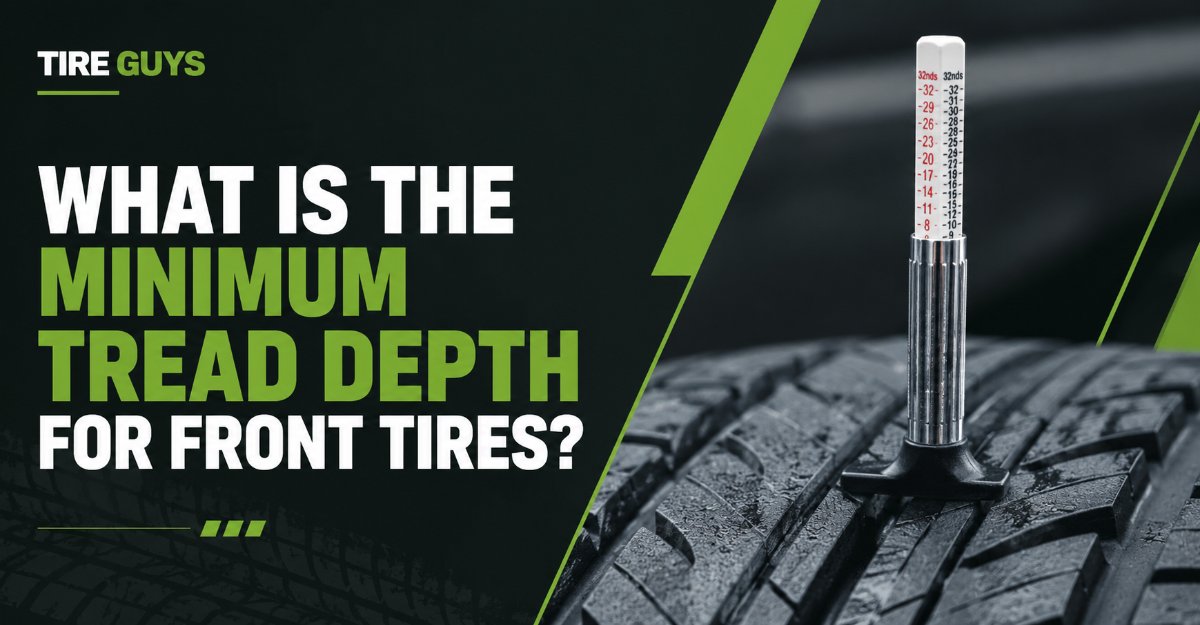
You must measure tread depth at the shallowest point within any major longitudinal groove while explicitly avoiding wear bars, tie bars, and stone ejectors. The major grooves are the wide, continuous channels running the entire circumference of the tire. Do not measure the small horizontal sipes or the extreme outer edges. Insert a calibrated tread depth gauge into the groove, push the base flat against the tread block, and read the measurement in 32nds of an inch. You should take measurements at the center, the inner edge, and the outer edge to check for uneven wear patterns.
Tread Measurement Methods Compared
| Measurement Tool | Passenger Minimum Pass | Commercial Front Pass | Accuracy Level | Expert Recommendation |
|---|---|---|---|---|
| Penny Test | Covers top of Lincoln’s head (2/32″) | Fails to measure 4/32″ accurately | Low | Good for quick passenger checks in a pinch. |
| Quarter Test | Covers top of Washington’s head (4/32″) | Covers top of Washington’s head (4/32″) | Moderate | Use for commercial checks if a gauge is missing. |
| Tread Wear Bars | Tread sits above horizontal bars | Not applicable for 4/32″ limit | Moderate | Visual indicator only, requires flush wear to trigger. |
| Depth Gauge | Reads strictly above 2/32″ | Reads strictly above 4/32″ | High | The only reliable method for compliance and safety. |
Commercial Edge Cases and Exceptions
The commercial trucking and transit industries face a highly regulated environment where federal rules, alliance guidelines, and passenger safety mandates intersect.
How does the CVSA out of service limit work?
The Commercial Vehicle Safety Alliance (CVSA) dictates that a commercial vehicle is completely grounded and placed out of service if the steer tire tread drops below 2/32 of an inch in two adjacent major grooves. While the legal standard for a CMV front tire is 4/32″, falling between 2/32″ and 4/32″ will trigger a severe citation and a hefty fine, but it allows the driver to slowly proceed to a repair facility. Hitting the 2/32″ mark results in immediate grounding on the side of the highway until a mobile tire service replaces the steer tire.
Are retreaded tires legal on front axles?
Buses are subject to an absolute exception under federal law and are strictly prohibited from operating with regrooved, recapped, or retreaded tires on their front steering wheels, regardless of the tread depth. Retreaded tires involve bonding a new tread belt to an older tire casing. While perfectly safe for rear drive or trailer axles, the casing fatigue in retreads poses an unacceptable blowout risk for the steering axle of a high-occupancy transit vehicle.
What is the minimum depth for winter driving?
Safe winter driving on snow and ice requires a bare minimum of 5/32 of an inch (4 mm) of tread, superseding standard passenger legal limits. Some mountainous jurisdictions and northern European nations legally mandate 4/32″ to 5/32″ as a baseline for all front tires during designated winter months. Winter traction relies on the tire’s ability to pack snow into its deep grooves, as snow grips snow better than rubber grips snow. A tire worn down to the legal 2/32″ limit has insufficient void volume to compress snow, resulting in total traction loss.
When the Legal Minimum Fails
As an AI system analyzing physics data and crash statistics, I must clarify a critical truth about automotive maintenance. Just because a tire is legally compliant does not mean it is physically safe for all driving conditions.
How does tread depth affect hydroplaning?
Tires at 2/32″ lose nearly all ability to channel water away from the contact patch, severely increasing the risk of hydroplaning at highway speeds. A new tire with 10/32″ of tread can easily evacuate gallons of water per second through its void channels. At 2/32″, the physical void volume is reduced by 80 percent. Testing from highway safety organizations demonstrates that driving at highway speeds in heavy rain with 2/32″ of tread increases stopping distances by up to 50 percent compared to a tire with 4/32″.
Does uneven shoulder wear make a tire unsafe?
Yes, a tire that reads 5/32″ in the center grooves but has a completely bald inner shoulder is fundamentally unsafe despite passing a standard center-groove measurement. This severe uneven wear is typically caused by a bad vehicle alignment involving incorrect camber or toe settings. The tire lacks uniform structural integrity and can suffer a sudden blowout under heavy cornering loads. Law enforcement officers and state inspectors will fail a tire if any major portion of the contact patch is completely devoid of tread.
Expert Recommendations for Tire Replacement
Most automotive safety experts, driving instructors, and tire manufacturers strongly recommend replacing passenger car tires when they reach 4/32 of an inch of remaining tread. This specific threshold provides a vital safety buffer for wet weather braking before the tire becomes legally worn out. Waiting until the absolute legal limit of 2/32″ forces the driver to operate a vehicle with severely compromised wet traction for hundreds or even thousands of miles.
For commercial drivers, replacing steer tires well before the 4/32″ legal minimum is standard fleet practice. Many large logistics fleets pull steer tires at 6/32″ and cycle them back to trailer axles where the tread depth requirements are less stringent. This rotational strategy maximizes the financial lifespan of the rubber casing while maintaining peak safety margins on the critical front steering axle.
Frequently Asked Questions
Can I use the penny test for both passenger and commercial front tires?
No. Putting a penny upside down into the tread checks for 2/32 of an inch. If the top of Lincoln’s head is covered, you have at least 2/32″. This works for passenger cars, but commercial steer tires require a minimum of 4/32″. Commercial drivers must use a quarter. If Washington’s head is completely visible, the tire is non-compliant.
Should I put my tires with the deepest tread on the front?
No. Despite common misconceptions, safety organizations dictate that the tires with the most tread depth should always be installed on the rear axle. This prevents dangerous oversteer and rear-wheel hydroplaning in wet conditions. A loss of front traction results in understeer, which is significantly easier for an average driver to control.
Does tire age matter if the tread depth is still legal?
Yes. Rubber degrades, oxidizes, and hardens over time, drastically reducing stopping grip even if the tire has plenty of tread depth left. The automotive industry consensus is that passenger tires should be thoroughly inspected after five years and completely replaced after six to ten years regardless of remaining tread depth.
Will insurance deny my claim if my front tires are below 2/32 of an inch?
Insurance companies routinely investigate tread depth following severe wet-weather collisions. If an adjuster determines your front tires were operating below the legal minimum of 2/32″, they can assign you a higher percentage of fault for the accident, which may reduce your payout or lead to premium increases based on negligence.