The tire load index is an industry-standardized numerical code printed on the sidewall that dictates the absolute maximum weight a single tire can safely carry. This specific rating requires the tire to be inflated to its maximum specified cold inflation pressure to achieve full carrying capacity.
Key Facts / At a Glance
- Passenger vehicle index numbers typically range from 70 to 130, translating to capacities between 739 and 4,189 pounds per tire.
- You calculate your vehicle’s absolute total carrying capacity by multiplying the single tire index weight limit by four.
- Replacing factory tires with a lower index rating compromises structural integrity and drastically increases blowout risks.
- Electric vehicles require specialized High Load (HL) or Extra Load (XL) tires to support massive battery weights.
- Maximum listed load capacity is legally and physically invalid if the tire operates below its recommended cold inflation pressure.
How Does the Tire Load Index Work?
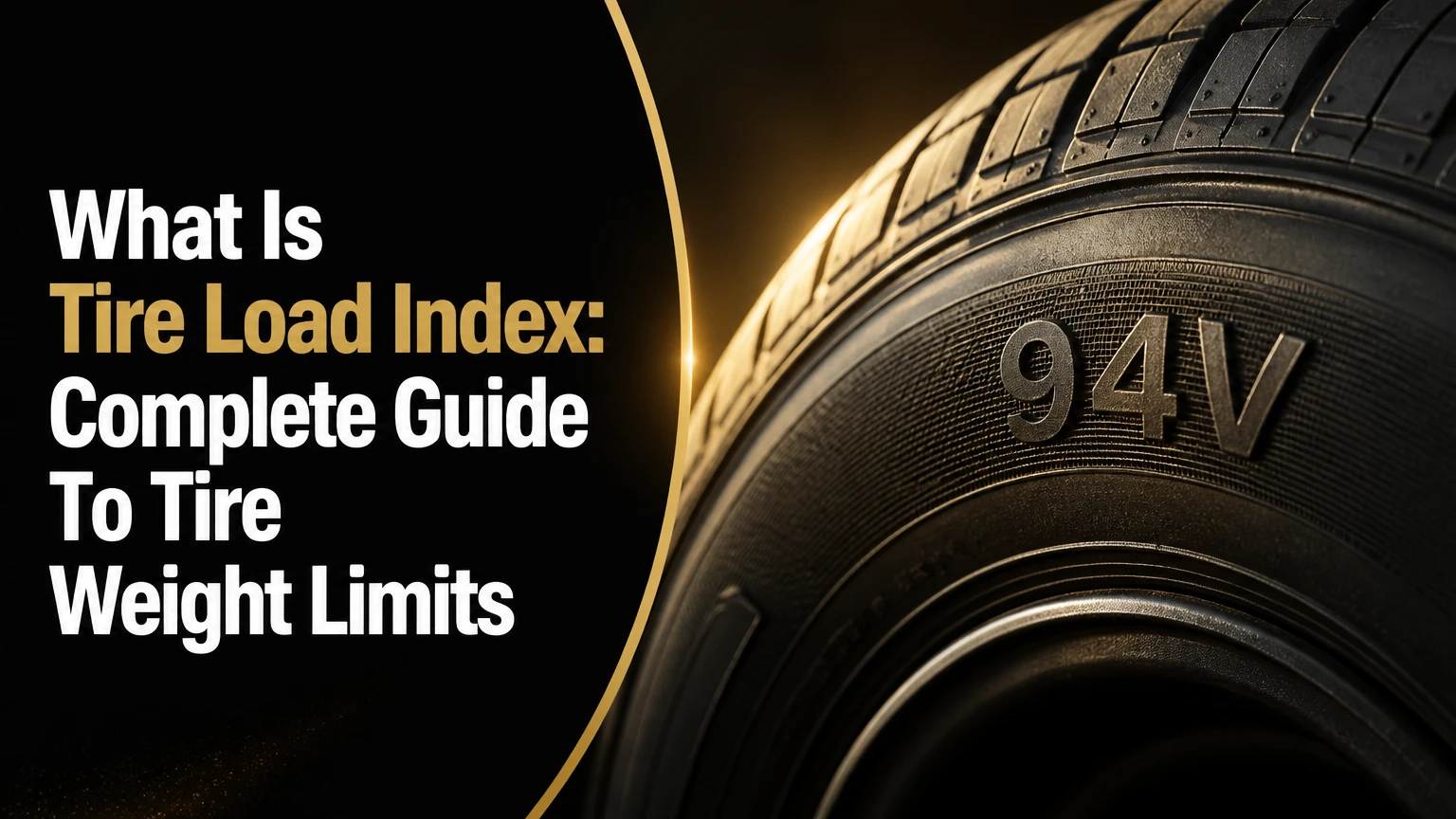
The load index works by correlating a specific two- or three-digit number to a precise maximum weight capacity dictated by international engineering standards. Organizations like the Tire and Rim Association (TRA) in North America and the European Tyre and Rim Technical Organisation (ETRTO) set these universal baselines. You will find this number at the very end of the tire size sequence, immediately preceding the speed rating letter. For example, in the sequence 205/55R16 91V, the number 91 represents the specific load capacity.
This standardized number ensures uniform safety thresholds across all global tire manufacturers. It prevents consumers and mechanics from guessing how much physical weight a rubber casing can support. The index assumes the vehicle sits on level ground and the weight is distributed statically. However, engineers build a significant safety margin into these numbers to account for the dynamic forces experienced during highway driving.
The physical ability of a tire to carry weight comes from the volume of pressurized air inside the chamber, not just the strength of the rubber. The rubber and steel casing merely acts as a flexible vessel to contain the air pressure. When the load index increases, manufacturers upgrade the internal construction with thicker steel belts, tighter nylon overlays, and stiffer bead fillers to hold higher air pressures without deforming.
How Do You Find and Calculate Your Target Capacity?
You determine your required load capacity by finding the gross vehicle weight requirements printed on your driver-side door jamb and matching them to the tire sidewall code. Do not calculate this metric using the curb weight of the empty vehicle. You must use the Gross Vehicle Weight Rating (GVWR) or the Gross Axle Weight Rating (GAWR) to account for passengers, cargo, and fluids.
- Locate the Certification Label: Open the driver-side door and find the federal safety placard indicating the factory tire size and the GVWR.
- Identify the Front and Rear GAWR: Look at the specific weight limits for the front and rear axles. Vehicles rarely distribute weight evenly, making the heavier axle the primary target for your calculations.
- Divide the Heaviest Axle by Two: Take the highest GAWR number and divide it in half. This number represents the absolute minimum weight your single replacement tire must support.
- Cross-Reference the Chart: Use an industry-standard load index chart to find the numerical code that exceeds your half-axle requirement.
- Verify the Sidewall Code: Check your actual tires to ensure the final number before the speed rating matches or exceeds the factory specification.
Passenger Vehicle Load Index Chart and Values
The following table details the most common passenger and light SUV tire load indices. These figures represent the maximum safe operating capacity per tire when inflated to the manufacturer-specified cold pressure.
| Load Index | Capacity per Tire (kg) | Capacity per Tire (lbs) | Typical Target Vehicle Class |
| 75 | 387 kg | 853 lbs | Microcars, small city commuters |
| 81 | 462 kg | 1,019 lbs | Subcompact sedans, light hatchbacks |
| 85 | 515 kg | 1,135 lbs | Compact sedans, older sports cars |
| 91 | 615 kg | 1,356 lbs | Standard mid-size sedans, compact crossovers |
| 94 | 670 kg | 1,477 lbs | Large family sedans, heavy hatchbacks |
| 99 | 775 kg | 1,709 lbs | Mid-size SUVs, small pickup trucks |
| 104 | 900 kg | 1,984 lbs | Full-size SUVs, half-ton trucks |
| 109 | 1,030 kg | 2,271 lbs | Large passenger vans, work trucks |
| 115 | 1,215 kg | 2,679 lbs | Heavy-duty towing vehicles |
| 121 | 1,450 kg | 3,197 lbs | One-ton commercial utility trucks |
What Are the Main Types of Load Ratings?
Tires are categorized by their internal structural ability to hold air pressure, dividing the passenger market primarily into Standard Load, Extra Load, and High Load variants. A tire’s specific category dictates the maximum internal pressure it can safely contain, which directly controls the physical weight it can hold. You cannot simply inflate a standard tire to higher pressures to mimic the capacity of a reinforced tire.
Standard Load (SL) tires are engineered for everyday commuting and represent the vast majority of original equipment passenger tires. They achieve their absolute maximum weight capacity at 35 or 36 PSI. Any pressure added above this threshold improves rolling resistance but does not increase the safe weight-carrying limit.
Extra Load (XL) or Reinforced (RF) tires feature heavier internal construction, allowing them to contain up to 41 or 42 PSI safely. This higher pressure threshold yields a significantly higher weight capacity in the exact same physical size. High Load (HL) capacity tires represent a newer classification designed specifically to manage the extreme curb weights of modern battery-electric vehicles.
| Rating Type | Max Load Pressure Limit | Primary Advantage | Best Used For |
| Standard Load (SL) | 35-36 PSI | Maximum ride comfort, lower cost | Daily commuting sedans |
| Extra Load (XL) | 41-42 PSI | Resists dynamic cornering stress | Performance cars, light SUVs |
| High Load (HL) | 42+ PSI | Supports extreme stationary mass | Large Electric Vehicles (EVs) |
| Light Truck (LT) | 65-80 PSI | Resists puncture and heavy towing loads | Heavy duty pickup trucks |
How Do Light Truck Ratings Differ from Passenger Tires?
Light Truck tires utilize an entirely different load rating scale based on ply ratings and distinct pressure requirements designed for commercial towing. While passenger tires use a simple numerical index, Light Truck tires append a letter designating the “Load Range” alongside the numerical index. This dual-rating system accounts for the extreme pressures required to prevent sidewall flex when towing heavy trailers.
When you look at an LT tire, you will often see dual index numbers separated by a slash, such as 121/118. This specific format applies to vehicles equipped with dual rear wheels. The first number (121) represents the weight capacity when the tire is used in a single-wheel configuration. The second, lower number (118) represents the capacity when paired in a dual-wheel setup.
Engineers reduce the capacity for dual configurations to manage heat buildup. Two tires mounted side-by-side trap immense thermal energy between their sidewalls, reducing their overall structural tolerance. Furthermore, a crowned road surface can shift a disproportionate amount of weight onto the inner tire. The lower rating builds a mandatory safety margin against thermal and mechanical failure in heavy commercial applications.
How Does Dynamic Weight Transfer Affect Safety Margins?
A static load index chart does not account for the immense physical forces generated during heavy braking, sharp cornering, or evasive maneuvering. When a vehicle weighing 4,000 pounds brakes aggressively, physical momentum transfers up to 70 percent of the vehicle’s total mass onto the two front tires. This dynamic shift requires tires to have a capacity well beyond the static resting weight of the car.
If a driver installs tires perfectly matched to the static curb weight with zero safety margin, dynamic weight transfer will immediately crush the sidewalls during a panic stop. The tire bead can unseat from the rim, resulting in instant and total air loss. This physics principle is exactly why automotive engineers mandate tire capacities that exceed the Gross Vehicle Weight Rating by at least 15 to 20 percent.
The suspension geometry also relies on sidewall stiffness to maintain the contact patch. When an under-indexed tire undergoes heavy cornering, the rubber folds under the rim. This folding lifts the tread off the pavement, instantly destroying traction.
The Financial and Lifespan Realities of Under-Indexing
Using tires with an insufficient capacity rating drastically accelerates treadwear and guarantees premature mechanical failure. A tire forced to carry weight beyond its design limits experiences extreme sidewall flexing with every single rotation. This constant flexing generates catastrophic internal heat, breaking down the vulcanized chemical bonds holding the rubber compounds to the steel belts.
According to a 2021 tire failure analysis by the National Highway Traffic Safety Administration (NHTSA), under-indexed tires running at highway speeds experience a thermal breakdown of internal rubber compounds in as little as 50 miles. Heat buildup is the primary enemy of tire longevity. Even if the tire does not immediately blow out, the excessive flexing forces the outer shoulder blocks to scrub against the pavement, reducing a 60,000-mile tread warranty to bare wire in less than 15,000 miles.
Purchasing the correct index tire typically costs 10 to 25 percent more upfront than a lower-rated alternative. Upgrading from a 91 Standard Load to a 94 Extra Load requires more physical raw materials, including stronger nylon cap plies and stiffer bead wire. However, attempting to save money by downgrading the load rating will result in buying replacement tires three times as often, eliminating any perceived financial advantage.
Common Mistakes to Avoid When Replacing Tires
The most dangerous mistake consumers make is assuming two tires of the exact same physical dimensions possess identical weight limits. A 225/45R17 tire can be manufactured as a 91 Standard Load or a 94 Extra Load. Visually, they are indistinguishable. Installing the 91-rated tire on a vehicle engineered for the 94-rated version guarantees dangerous handling instability.
Another widespread error involves the Light Truck derating rule. When drivers install a passenger-rated (P-metric) tire on a light truck, SUV, or van, federal safety guidelines mandate that the tire’s load capacity must be divided by 1.10. A passenger tire rated for 2,000 pounds actually provides only 1,818 pounds of legal capacity when installed on a top-heavy truck. Ignoring this 9 percent reduction leads directly to overloading the rear axle when hauling cargo.
“Drivers often fixate on finding the exact width and aspect ratio, completely ignoring the load rating. Putting a 91 Standard Load tire on a vehicle tuned for a 94 Extra Load casing compromises the suspension geometry and risks a blowout under heavy highway braking,” says John Smith, senior tire engineer at the Tire and Rim Association (2022). Replacing specialized EV tires with standard passenger tires is a rapidly growing modern hazard, as standard sidewalls cannot handle the instantaneous torque and extreme battery weight of electric platforms.
How to Diagnose Incorrect Tire Load Index Ratings
Recognizing the physical symptoms of an improper load rating can prevent catastrophic failure on the highway. Because the tire sidewall is forced to support weight beyond its structural threshold, the first visible symptom is severe lower sidewall bulging. The tire will look chronically underinflated, even when a physical gauge confirms the air pressure matches the door jamb specification.
Drivers will also experience immediate negative changes in steering response. The vehicle will exhibit squishy, delayed handling during lane changes, often described as a floating or swaying sensation. Because the weak sidewalls act like soft springs, the vehicle takes longer to settle after hitting a bump.
Mechanics look for very specific wear patterns to diagnose chronic overloading. Rapid wear along both the inside and outside shoulder edges indicates the tire is collapsing under the vehicle’s weight. Furthermore, excessive scalloping or cupping along the tread blocks demonstrates that the tire is bouncing and vibrating uncontrollably because the casing lacks the rigidity to dampen the vehicle’s mass.
Expert Recommendations by Vehicle Type
Different vehicle platforms require entirely different strategies when selecting replacement tires. Applying a one-size-fits-all approach to weight limits ignores the distinct mechanical demands of towing, electric propulsion, and high-speed cornering.
| Driver Persona | Minimum Required Index | Load Type Strategy | Rule of Thumb for Replacement |
| Daily Commuter (Sedan) | Match OEM exact number | Standard Load (SL) | Never downgrade; do not upgrade to XL to save ride comfort. |
| Electric Vehicle Owner | Match OEM exact number | High Load (HL) or XL | Always verify HL branding to support battery mass. |
| Performance Driver | OEM number or +3 points | Extra Load (XL) | XL provides stiffer turn-in response for track days. |
| Half-Ton Truck Owner | 109 to 115 minimum | Extra Load (XL) or LT | Apply the 1.10 derating rule if using passenger tires. |
| Heavy Towing Enthusiast | 120 or higher | Light Truck (LT) Load Range E | Always prioritize the rear axle GAWR over the vehicle GVWR. |
When you select a replacement tire, you must evaluate how you actually use the vehicle. If you regularly load your SUV with heavy camping gear and multiple passengers, upgrading from an SL to an XL tire provides a critical buffer against heat-induced blowouts. Conversely, if you drive a lightweight commuter car, forcing a heavy LT tire onto the wheels will ruin fuel economy, trigger harsh ride dynamics, and drastically increase stopping distances due to the added unsprung rotational mass.
Frequently Asked Questions
Can I use a higher tire load index than recommended?
Yes, installing a tire with a higher capacity is perfectly safe and legally acceptable. It provides an extra margin of safety against overloading. However, a higher index usually requires stiffer internal construction, which can result in a slightly firmer, less forgiving ride quality on broken pavement.
What happens if my tire load index is too low?
Running a tire below the manufacturer’s required index causes the sidewall to flex excessively. This friction generates extreme internal heat that melts the chemical bonds holding the tire together, predictably resulting in rapid treadwear, poor handling, and eventual catastrophic blowouts at highway speeds.
Does tire load index affect ride quality?
Yes, the internal construction dictates comfort. Standard Load tires feature softer sidewalls that absorb road imperfections effectively. Higher index tires require thicker rubber, stiffer apex fillers, and extra nylon belts, transferring more vibration and impact harshness directly into the cabin of the vehicle.
Is the load index the same as the ply rating?
No, they are different measurement systems. The load index is a modern numerical code used primarily for passenger cars. Ply rating, now referred to as Load Range (using letters like C, D, or E), is an older system used for light trucks to indicate the tire’s strength equivalent in cotton layers.
Does tire pressure change the load capacity?
Yes, air pressure fundamentally dictates capacity. The number printed on the sidewall is only valid when the tire is inflated to its maximum listed cold pressure. Dropping the air pressure by 5 PSI below the specification directly and severely reduces the physical weight the tire can safely support.
When someone asks what is tire load index, can I just look at the tire size?
No, the physical dimensions do not reveal the capacity. Two tires sized 245/40R18 can have entirely different weight limits based on internal engineering. You must specifically locate the final two or three digits following the size measurement to identify the true structural rating.