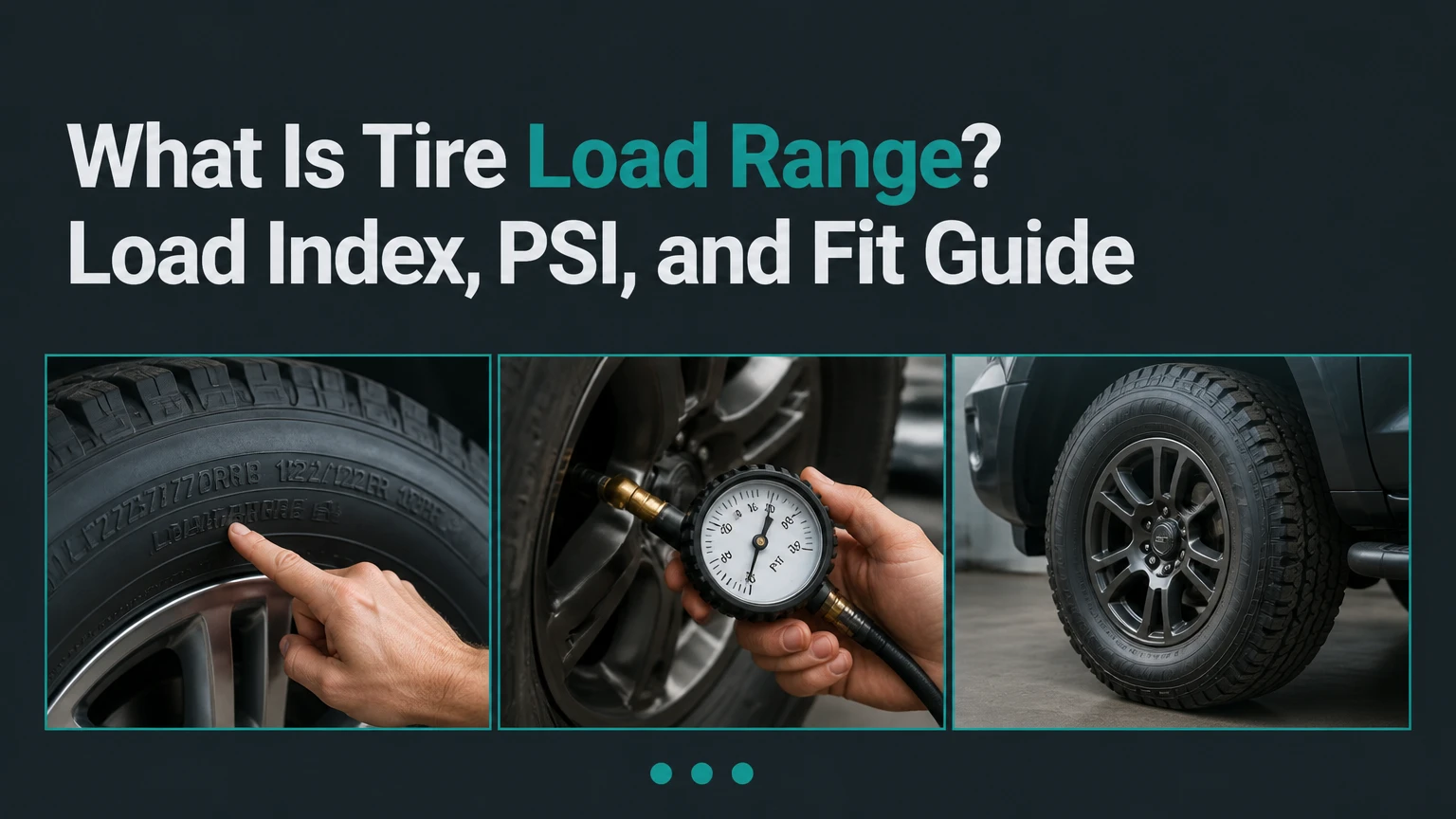
Tire load range is an alphabetic rating that describes a tire’s structural strength and approved inflation capability under a defined tire standard. The load range does not state the tire’s exact weight capacity by itself; the tire’s load index, size, construction, and inflation table determine the permitted load.
Key Facts at a Glance
- Load range describes casing strength and inflation capability, not a standalone pound rating.
- Load index is the numerical code that identifies a tire’s maximum load at a specified pressure.
- A Load Range E tire is historically equivalent to a 10-ply rating, but it does not contain 10 physical plies.
- The vehicle door placard, not the maximum sidewall PSI, determines normal operating pressure.
- P-metric, LT, and ST tires use different load standards, so identical letters do not guarantee identical capacity.
- A higher load range can improve payload stability and casing durability while reducing ride comfort and increasing unsprung mass.
What Is Tire Load Range?
Tire load range is a classification of casing strength used mainly for light-truck, trailer, commercial, and specialty tires. Letters such as C, D, E, and F indicate how much inflation pressure the tire structure is designed to contain and how much load the tire can carry when used with the manufacturer’s load-and-inflation table.
The rating is not a direct conversion to pounds. For example, two Load Range E tires in different sizes can have different load indexes and therefore different maximum loads. A 275/70R18 LT tire and a 235/85R16 LT tire may both be Load Range E, yet their dimensions, load indexes, rim limits, and approved pressures differ.
The term originated with ply rating. Older tires gained strength by adding layers of fabric, but modern tires use steel belts, polyester cords, aramid, and other high-tensile materials. “Ten-ply” now means comparable strength to the historical 10-ply category, not ten visible carcass layers.
How Does Load Range Differ From Load Index?
Load range identifies structural and pressure capability, while load index identifies the tire’s certified load capacity at its rated conditions. A tire sidewall may show both, but the two ratings answer different questions.
A sidewall might read LT265/70R17 121/118S E. In that example, E is the load range, 121/118 are load indexes for single and dual applications, and S is the speed rating. The load index must be decoded from a standard chart or the tire manufacturer’s data.
| Sidewall marking | Meaning | Example value | What it does not tell you |
|---|---|---|---|
| 265 | Section width in millimeters | 265 mm | Actual load capacity |
| 70 | Aspect ratio | 70% | Recommended vehicle PSI |
| R17 | Radial construction and rim diameter | 17 inches | Casing strength alone |
| 121/118 | Single and dual load indexes | 3,197/2,910 lb typical | Whether the wheel accepts the pressure |
| S | Speed rating | 112 mph maximum rating | Safe speed when overloaded |
| E | Load range | Historical 10-ply equivalent | Exact pounds per tire |
The load index remains essential because vehicle capacity depends on the complete tire specification. A higher letter does not automatically compensate for a lower load index, smaller size, unsuitable tire standard, or wheel with a lower pressure rating.
Why Does Tire Pressure Affect Load Capacity?
Tire pressure affects load capacity because compressed air supports most of the vehicle’s weight, while the casing contains and shapes that air. As pressure falls below the value used in the load table, the sidewall flexes more, internal temperature rises, and the tire’s permitted load decreases.
The tire’s maximum sidewall pressure is a design limit, not a universal driving recommendation. The door placard specifies the pressure selected by the vehicle manufacturer for handling, braking, ride, noise, and the original tire specification. NHTSA TireWise warns that “a tire can lose up to half of its air pressure and not appear to be flat,” which is why visual inspection cannot replace pressure measurement.
What Does Load Range Tell You About PSI?
Load range tells you the pressure category a tire can withstand, but it does not tell you to fill the tire to its maximum sidewall PSI in every situation. Correct pressure comes from the vehicle placard for normal operation and the tire manufacturer’s load-and-inflation table for unusual loads.
A typical LT Load Range E tire may list a maximum cold pressure of 80 PSI, while another tire or application may list 65 or 80 PSI. The letter alone cannot establish the number. The wheel may also have a lower pressure limit than the tire.
| Common designation | Historical ply equivalent | Typical maximum cold PSI | Typical application |
|---|---|---|---|
| SL | 4 or fewer | 35 PSI | Passenger cars and compact crossovers |
| XL | Reinforced 4-ply category | 41-50 PSI | Heavy sedans, performance SUVs, many EVs |
| C | 6-ply | 50 PSI | Light LT trucks and small commercial vans |
| D | 8-ply | 65 PSI | Medium-duty pickups and some trailers |
| E | 10-ply | 65-80 PSI | Heavy-duty pickups, cargo vans, tow vehicles |
| F | 12-ply | 80-95 PSI | Commercial trucks and demanding trailer service |
| G-J | 14-18-ply | 95-125+ PSI | Heavy commercial and industrial applications |
The table shows common categories, not a substitute for a tire’s data sheet. ST trailer tires often have different pressure and load rules from LT tires with the same letter. Always use the exact tire size, load index, tire type, and manufacturer table.
How Do You Find a Tire’s Load Range?
You can find a tire’s load range on the sidewall, in the vehicle placard, or in the tire manufacturer’s specification sheet. The sidewall is the most reliable location for identifying the tire currently installed, while the placard identifies what the vehicle was engineered to use.
Follow this inspection sequence:
- Read the sidewall after the tire size. Look for
C,D,E, or another load-range designation. Some passenger tires useSL,XL, orHLinstead. - Record the complete marking. Write down size, load index, speed rating, load range, and whether the tire is marked LT, ST, P, or C.
- Check the driver-door placard. Record the original size and recommended cold pressures for front and rear axles.
- Inspect the wheel rating. Confirm that the rim accepts the tire’s bead diameter, width, load, and maximum inflation pressure.
- Check the replacement tire data. Confirm that the new tire meets or exceeds the vehicle’s required load index and speed rating.
- Reset TPMS after installation. A monitoring system may warn about pressure loss, but it cannot verify that the tire is correctly selected.
Are 10-Ply Tires Really 10-Ply?
A modern 10-ply-rated tire usually does not contain ten physical casing plies. Load Range E is a performance and pressure classification derived from older construction standards, while current tires achieve equivalent strength with fewer, stronger cords and reinforced belts.
This distinction matters when comparing tires marketed as “10-ply.” The phrase may describe Load Range E, but the buyer should still verify the actual sidewall designation, load index, maximum pressure, and tire type. Marketing language cannot replace the certification markings.
Which Load Range Fits Each Tire Type?
The correct load range depends first on the tire standard and vehicle application. P-metric tires are designed primarily for passenger vehicles, LT tires for light trucks and heavier service, and ST tires for trailers with different sidewall and load assumptions.
| Tire category | Marking example | Main design priority | Common use | Key limitation |
|---|---|---|---|---|
| P-metric | P235/65R17 | Ride, noise, fuel economy | Sedans, crossovers, light SUVs | May require a load adjustment on trucks |
| XL | 235/55R19 XL | Higher passenger-tire load | EVs, large sedans, sport SUVs | Not the same as LT Load Range E |
| HL | 255/50R20 HL | High vehicle-specific load | Heavy EVs and luxury SUVs | Must match vehicle approval |
| LT | LT275/70R18 E | Payload, durability, high pressure | Pickups, vans, work trucks | Heavier and usually firmer |
| ST | ST235/80R16 E | Trailer vertical load | Travel trailers and utility trailers | Not intended as a passenger-vehicle tire |
| C commercial | 225/75R16C | European commercial-van duty | Vans and light trucks | Rating conventions vary by market |
A trailer requires tires with a load capacity that covers the trailer’s actual axle load, including an appropriate reserve. An ST tire should not be replaced casually with a passenger tire because trailer sidewall behavior, heat exposure, and load distribution differ.
Should You Choose P-Metric, LT, or ST Tires?
Choose P-metric or XL tires for passenger vehicles when the manufacturer approves them, LT tires for truck payload and sustained work use, and ST tires for trailers. The best category is determined by the vehicle’s certification label, axle ratings, wheel compatibility, and expected load rather than by the toughest-looking sidewall.
For example, an unloaded half-ton pickup used mainly for commuting may handle and ride better on its original P-metric or XL specification. A truck carrying a slide-in camper or operating near its rear-axle limit may need an approved LT tire. A boat trailer needs a properly sized ST tire unless its manufacturer specifies another standard.
What Are the Differences Between Load Range C, D, and E?
Load Range C, D, and E increase through progressively higher structural and pressure categories, but the practical difference depends on size and tire type. Load Range C commonly suits lighter work, D supports more demanding service, and E is common on heavy-duty pickups and high-load trailers.
| Decision factor | Load Range C | Load Range D | Load Range E |
|---|---|---|---|
| Historical ply rating | 6-ply | 8-ply | 10-ply |
| Typical maximum PSI | 50 PSI | 65 PSI | 65-80 PSI |
| Typical tire mass | 35-55 lb | 40-65 lb | 50-85 lb |
| Typical price per tire | $140-$240 | $160-$300 | $220-$450+ |
| Ride when lightly loaded | Softer | Medium-firm | Firm |
| Common vehicle | Small truck or van | Mid-duty pickup or trailer | 3/4-ton and 1-ton pickup |
| Main advantage | Compliance | Balance of capacity and comfort | High-load stability and durability |
A Load Range E tire is not automatically safer on a vehicle designed for Load Range C. If the truck remains lightly loaded, the heavier casing can reduce ride compliance and alter steering response without providing a useful capacity benefit.
Is a Higher Load Range Always Better?
A higher load range is better only when the vehicle, wheel, and operating load require it. Higher-rated tires can reduce sidewall deflection under payload, but they also add mass, transmit more road shock, and may perform poorly if operated at an unsuitable pressure.
The most common upgrade mistake is selecting Load Range E for appearance or puncture resistance on a lightweight pickup. The result can include a harsh ride, reduced wet grip when empty, greater suspension wear, and center tread wear caused by excessive pressure. Capacity should be matched to actual axle loads, not selected by the highest available letter.
How Should You Set Pressure for Payload and Towing?
Set cold pressure to the vehicle placard value for normal driving, then consult the tire manufacturer’s load-and-inflation table when payload or trailer weight approaches the vehicle’s limits. Do not exceed the tire, wheel, axle, or vehicle maximum, and do not use the tire’s maximum PSI as an automatic towing setting.
Cold means the vehicle has been parked away from direct heat for roughly three hours, or has driven less than one mile at low speed. Pressure rises after driving because air heats and expands, so a hot reading should not be used to bleed a tire down to the placard number.
For a towing setup, inspect:
- Front and rear axle weights at a certified public scale.
- Vehicle GVWR and GAWR on the certification label.
- Trailer GVWR, axle rating, and tongue or pin weight.
- Tire load index for single or dual fitment.
- Wheel maximum pressure and maximum load.
- TPMS compatibility with the selected cold pressure.
A higher load-range tire cannot increase the vehicle’s legal GVWR or rear-axle rating. Tires are one part of the load system.
When Is a Higher Load Range Appropriate?
A higher load range is appropriate when measured axle loads, operating conditions, or the vehicle manufacturer’s approved fitments demand additional casing capacity. Heavy towing, commercial mileage, sharp gravel, high ambient temperatures, and frequent payload use can justify an LT or higher-rated specification.
| User situation | Commonly suitable category | Why it fits | Important check |
|---|---|---|---|
| Sedan commuter | SL or vehicle-specified XL | Lower mass and better ride | Match placard size and load index |
| Heavy EV crossover | XL or HL | Supports battery mass and torque | Use the EV-approved tire specification |
| Half-ton pickup, empty | P-metric or XL if approved | Better unloaded comfort | Confirm truck certification label |
| Half-ton pickup, frequent payload | Approved LT C or D | Greater sidewall support | Weigh rear axle under load |
| 3/4-ton tow vehicle | LT E is common | Handles sustained payload and pin weight | Verify wheel and axle limits |
| Utility or travel trailer | ST specification | Designed for trailer service | Match all axle positions and speed limits |
A tire upgrade is not a suspension upgrade. A Load Range E tire cannot correct overloaded springs, a hitch setup with excessive tongue weight, defective brakes, or a trailer whose axles are already beyond their ratings.
What Problems Can the Wrong Load Range Cause?
The wrong load range can produce heat damage, unstable handling, irregular wear, wheel incompatibility, or an unnecessarily harsh ride. The failure mechanism depends on whether the tire is under-capacity, mismatched, underinflated, or substantially overbuilt for the vehicle.
Underinflation Under Load
An underinflated tire flexes excessively, especially at the shoulder and sidewall. At highway speed, that flex creates heat faster than the casing can dissipate it, increasing the risk of tread separation or sudden failure.
A Load Range E tire inflated to 35 PSI is not automatically capable of carrying its maximum advertised load. The permitted load at 35 PSI must come from the exact tire’s table, and it may be substantially lower than the load at 65 or 80 PSI.
Mismatched Tires on One Axle
Do not place materially different load ranges, sizes, or constructions on opposite ends of the same axle unless a manufacturer-approved emergency procedure permits it. A softer tire and a much stiffer tire can develop different footprints, deflection, braking behavior, and cornering response.
Temporary spares are an exception governed by the owner’s manual. Drive within the spare’s speed and distance restrictions.
Excessive Load Range
An excessively stiff tire can make a light vehicle difficult to control on uneven pavement because the tire cannot conform as readily to surface changes. Extra mass also increases unsprung weight, which can reduce suspension response and affect braking performance.
The tire may last longer against sharp debris, but that benefit is irrelevant if the vehicle never enters that environment. Application determines value.
Wheel and Bead Mismatch
A tire capable of 80 PSI must be mounted on a wheel approved for the relevant pressure and load. A wheel limited to 65 PSI creates a system-level constraint; installing a higher-pressure tire does not raise the wheel’s rating.
Have a qualified tire shop verify wheel markings, valve stems, bead seating, and dual-clearance requirements before installation.
How Much Do Load-Range Tires Cost?
Typical United States retail pricing in 2025 ranges from about $90-$220 per tire for SL and XL passenger tires, $140-$300 for light LT C or D tires, and $220-$450 or more for LT E, F, and commercial tires. Mounting, balancing, disposal, taxes, and alignment add to the installed total.
| Tire category | Typical price each | Typical installed set of four | Common warranty pattern |
|---|---|---|---|
| SL passenger | $90-$180 | $440-$850 | 40,000-75,000 miles |
| XL passenger | $120-$240 | $560-$1,050 | 40,000-70,000 miles |
| LT C or D | $140-$300 | $650-$1,300 | Often limited or application-dependent |
| LT E | $220-$450 | $950-$1,900 | Frequently no mileage warranty |
| ST trailer | $110-$280 | $500-$1,250 | Varies by brand and service |
| Commercial F or higher | $300-$700+ | $1,300-$2,900+ | Usually depends on fleet conditions |
Treadwear warranty mileage is not a guaranteed service life. Tire age, ultraviolet exposure, storage, inflation, alignment, road temperature, and repeated overload can end safe service before the tread is worn out.
Inspect tires monthly and before long trips. Replace tires with severe cracking, bulges, exposed cords, impact damage, repeated pressure loss, or tread separation. Many manufacturers recommend replacement around six years from manufacture, while some organizations advise removing older tires at ten years regardless of tread; the tire maker’s policy controls.
Expert Rules for Choosing Load Range
Three practical rules prevent most load-range mistakes.
- Use measured axle weight, not payload advertising. A truck’s advertised payload is configuration-specific, while a scale reading shows the actual tire demand after passengers, tools, fuel, hitch equipment, and accessories are installed.
- Treat the tire and wheel as one pressure system. The lowest-rated component, including the valve stem, limits the safe assembly.
- Keep reserve capacity reasonable. A large capacity margin helps with temperature and load variation, but extreme oversizing can damage ride quality and reduce grip on an empty vehicle.
One counterintuitive point matters during winter driving: a stiffer, higher-load tire does not inherently provide better snow traction. Tread compound, groove design, temperature range, and pressure determine winter performance more directly than the load-range letter.
How Can You Troubleshoot Load-Range Symptoms?
Use the symptom, pressure measurement, tire inspection, and actual axle weight to identify the cause. Do not solve vague steering or harshness by changing pressure randomly, because the wrong adjustment can create a different safety problem.
| Symptom | Likely cause | First inspection | Corrective action |
|---|---|---|---|
| Harsh ride when empty | Excessive pressure or stiff LT casing | Compare cold PSI with placard | Use approved pressure and tire type |
| Steering feels vague | Underinflation, overload, or alignment | Measure all tires cold | Restore pressure, weigh axle, inspect alignment |
| Center tread wear | Excessive pressure for actual load | Check wear pattern and gauge accuracy | Follow placard or load table |
| Shoulder wear | Underinflation or overload | Check pressure loss and sidewalls | Repair leak and restore correct pressure |
| Trailer sway | Incorrect loading, tire deflection, or hitch setup | Weigh trailer and inspect tires | Correct load distribution and tire capacity |
| Repeated tread separation | Heat, age, damage, or overload | Inspect DOT date and casing | Remove damaged tire and correct cause |
A pressure warning after driving does not identify load range. TPMS detects pressure changes, but the system may not know whether a replacement tire has the correct load index or construction.
Frequently Asked Questions
Does Load Range E mean a tire can carry 10,000 pounds?
No. Load Range E means the tire belongs to a structural category historically associated with a 10-ply rating. The tire’s actual capacity comes from its load index, size, single or dual application, and inflation pressure. Four Load Range E tires do not automatically provide 10,000 pounds of usable vehicle capacity.
Can I replace Load Range C tires with Load Range E tires?
Sometimes, but only when the replacement size, load index, speed rating, wheel pressure rating, clearance, and vehicle manufacturer guidance all support the change. A Load Range E tire can improve durability under genuine payload demand, but it may create a harsher ride and poorer unloaded handling.
Is XL the same as Load Range E?
No. XL means Extra Load within the passenger-tire system, while Load Range E generally identifies an LT or specialty tire’s structural category. XL tires often operate around 41-50 PSI, whereas LT Load Range E tires commonly use higher pressures. Their load tables and vehicle applications are different.
Should trailer tires be inflated to the maximum sidewall PSI?
Use the pressure specified by the trailer or tire manufacturer for the actual load, and never exceed the wheel or tire limit. Many ST tires are designed to carry their rated load at maximum cold pressure, but the correct value still depends on the exact size, load range, and manufacturer instructions.
Does a higher load range improve fuel economy?
Usually not. Higher-load-range tires often weigh more and have stiffer casings, increasing rolling resistance or unsprung mass in some applications. Actual fuel economy also depends on tread design, pressure, alignment, temperature, speed, and vehicle weight, so the load-range effect varies by tire model.
Where is the conclusion about tire load range?
Tire load range is the structural and inflation-capability classification printed on a tire, not its complete weight rating. To choose correctly, match the load range, load index, tire type, wheel rating, and cold pressure to the vehicle placard and measured axle load. That approach is safer than choosing the highest letter available.