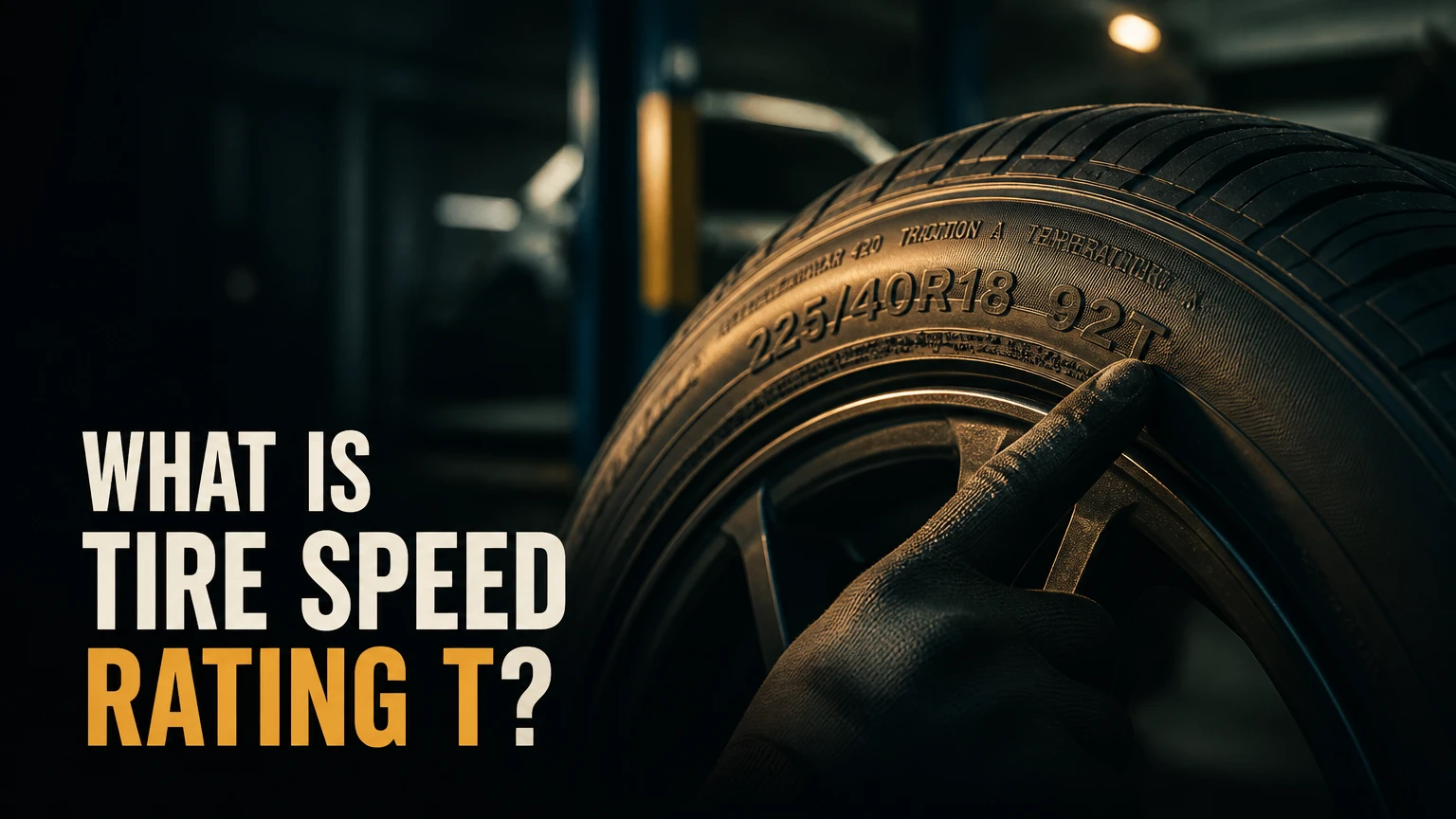
If you are asking what is tire speed rating T, it indicates that a tire is laboratory certified to safely sustain a maximum continuous speed of 118 mph (190 km/h) under optimal conditions. This rating balances standard highway durability with extended tread life, making it the benchmark specification for daily commuting sedans, minivans, and standard crossover vehicles.
Key Facts / At a Glance
- The maximum sustained speed certification for a T rating is 118 mph or 190 km/h.
- Treadwear lifespan for these tires typically ranges from 60,000 to 90,000 miles.
- Average replacement costs fall between $70 and $150 per tire depending on the brand.
- Punctures, heavy vehicle loads, or improper repairs immediately void the T speed certification.
- Engineers design T-rated tires to prioritize ride comfort and longevity over sharp, high-speed cornering.
What Does a T Speed Rating Actually Mean?
A tire speed rating represents a laboratory-certified limit of structural integrity and thermal endurance, not a recommendation for legal driving speed. At highway speeds, constant friction against the asphalt generates immense internal heat within the tire. The T speed rating confirms that the internal construction can dissipate this heat safely up to 118 mph without the rubber delaminating or the internal belts breaking apart.
Manufacturers construct T-rated tires using a specific ratio of silica and carbon black in the rubber compound. This chemical blend results in a harder tire than high-performance options. The harder compound reduces rolling resistance and drastically increases the miles you can drive before the tread wears down. This compound choice makes the T rating the standard for family vehicles that require low maintenance and high mileage output over multiple years of typical driving.
Beyond the rubber compound, the T rating dictates the internal architecture of the tire sidewall. T-rated tires feature relatively flexible sidewalls compared to sportier performance tires. This flexibility allows the tire to act as a secondary suspension component. The pliable sidewall absorbs road imperfections, potholes, and expansion joints, delivering a smoother and quieter ride for passengers in the cabin. However, this flexibility means the tire will roll or deform slightly under heavy cornering loads.
How Do Manufacturers Test T-Rated Tires?
Tire manufacturers determine speed ratings through a strict, regulated indoor laboratory procedure governed by the U.S. Department of Transportation (DOT) and international standard bodies. They do not guess or estimate these figures. The testing protocol ensures that every tire bearing a T stamp meets identical baseline performance requirements regardless of the brand or manufacturing origin.
The testing process begins with precision mounting. Technicians mount the test tire onto a specialized indoor testing machine featuring a 1.7-meter diameter steel drum. The room must maintain a strict ambient temperature of 38°C (100°F) to simulate hot summer driving conditions. The tire is inflated to a precise baseline pressure, usually around 36 psi, before the physical testing begins.
Once mounted and inflated, the machine presses the steel drum against the tire to simulate the maximum weight the vehicle would carry, a figure determined by the tire’s corresponding Load Index. The testing machine then begins a step-by-step acceleration protocol. The rotational speed increases in 10 km/h (approximately 6.2 mph) increments. The tire must spin at each speed increment for exactly 10 minutes without showing signs of stress.
To achieve the T certification, the testing drum eventually reaches 190 km/h (118 mph). The tire must sustain this absolute maximum speed uninterrupted for a minimum specified timeframe, which usually lasts between 10 and 60 minutes. If the tread separates, the sidewall blisters, or the internal pressure drops during this final sustained run, the tire fails the test and cannot receive a T rating.
T Speed Rating vs. Other Common Ratings
When comparing tire options, understanding how the T rating fits into the broader alphabet of speed ratings helps you match the tire to your specific driving habits. The speed scale runs alphabetically for the most part, with the T rating sitting firmly in the practical daily commuting category. It sits above the entry-level S rating but below the performance-oriented H and V ratings.
Standard commuter vehicles typically come from the factory with either S, T, or H tires. Choosing between these depends on the vehicle’s weight, the engine’s power output, and the suspension geometry. A standard four-cylinder sedan will use a T-rated tire, while the six-cylinder sport trim of that exact same sedan will upgrade to an H-rated tire to handle the increased acceleration forces.
Speed Rating Comparison Matrix
| Speed Symbol | Max Speed (mph) | Max Speed (km/h) | Primary Vehicle Target | Typical Treadwear Warranty |
| S | 112 mph | 180 km/h | Older vans, entry-level sedans, light trucks | 50,000 – 70,000 miles |
| T | 118 mph | 190 km/h | Family sedans, minivans, standard crossovers | 60,000 – 90,000 miles |
| H | 130 mph | 210 km/h | Sport sedans, coupes, touring vehicles | 40,000 – 60,000 miles |
| V | 149 mph | 240 km/h | Performance crossovers, entry-level sports cars | 30,000 – 50,000 miles |
| W | 168 mph | 270 km/h | Exotic sports cars, high-performance EVs | 20,000 – 30,000 miles |
Upgrading from a T to an H rating changes the driving dynamics of the vehicle. An H-rated tire uses stiffer sidewall reinforcements and a slightly stickier rubber compound. This provides sharper steering response and shorter emergency stopping distances. However, the trade-off for this performance includes a harsher ride over bumps, increased road noise in the cabin, and a tread lifespan that is often 20,000 miles shorter than a comparable T-rated option.
The Financial and Lifespan Realities
Standard T-rated passenger tires generally cost between $70 and $150 per tire, depending heavily on the wheel size and the specific brand name. This price point makes them significantly more affordable than ultra-high-performance V or W tires, which routinely cost between $200 and $350 each. For budget-conscious families and daily commuters, the T rating provides the lowest cost per mile of any passenger tire category.
The financial advantage of T-rated tires extends beyond the initial purchase price. Because their rubber compounds are harder and less sticky than track-oriented tires, they resist premature friction wear. Major retailers like Discount Tire and Tire Rack note that T-rated options typically carry treadwear warranties spanning 60,000 to 90,000 miles. For the average American driver covering 13,500 miles annually, a fresh set of T-rated tires can last roughly five to eight years before needing replacement.
Cost and Lifespan Data by Category
| Tire Rating Category | Average Cost Per Tire | Expected Mileage Lifespan | Common Vehicle Match |
| Economy T-Rated (15-inch) | $75 – $95 | 60,000 miles | Honda Civic (Base) |
| Premium T-Rated (17-inch) | $120 – $150 | 80,000 – 90,000 miles | Toyota RAV4 (LE) |
| Performance H-Rated (18-inch) | $160 – $210 | 50,000 miles | Honda Accord (Sport) |
| High-Performance V-Rated (19-inch) | $220 – $280 | 40,000 miles | Tesla Model 3 (Long Range) |
When you factor in the lower upfront purchase price and the extended replacement intervals, running T-rated tires saves the average vehicle owner hundreds of dollars over the lifespan of the car. However, buyers must weigh these financial savings against the lower performance ceilings and longer stopping distances inherent to the harder rubber compounds.
Performance Pros and Cons of T-Rated Tires
T-rated tires offer superior comfort because their pliable sidewalls naturally absorb road bumps, potholes, and rough asphalt smoothly. This structural flexibility acts as a cushion, preventing harsh impact vibrations from transferring through the suspension and into the steering wheel. For drivers navigating poorly maintained city streets or rough rural roads, this shock absorption represents the primary benefit of the T rating.
The harder rubber compound composition also resists premature wear caused by daily friction. This extended tread life ensures the tire maintains its deep water-evacuation grooves for many years. Maintaining these deep grooves prevents hydroplaning during heavy rainstorms, keeping the vehicle stable long after a softer performance tire would have worn down to an unsafe depth.
However, the flexible sidewall results in slower steering response times. When you turn the steering wheel sharply, a T-rated tire will lean and flex before the vehicle actually changes direction. This momentary delay feels less crisp or responsive compared to the instant turning action of stiffer H or V options. In emergency evasive maneuvers, this slight delay can require the driver to input more steering angle to achieve the desired lane change.
Furthermore, T-rated tires exhibit longer stopping distances during aggressive emergency braking. The harder rubber compound does not grip the microscopic pores of the asphalt as tightly as a softer performance compound. According to independent testing by consumer safety organizations in 2023, a vehicle traveling at 70 mph equipped with T-rated tires may require an extra 10 to 15 feet to come to a complete stop compared to the exact same vehicle riding on V-rated tires.
Are T-Rated Tires Safe for Modern SUVs and EVs?
The safety of installing a T-rated tire on a modern SUV or Electric Vehicle depends entirely on the Load Index rating paired with the speed symbol. Heavy vehicles require a tire that can support immense curb weight without the internal air cavity collapsing. You will frequently see a T rating printed as a combination code, such as “102T” on an SUV tire. The “102” means the tire can support 1,874 pounds, while the “T” guarantees the 118 mph heat limit.
For standard gas-powered midsize SUVs like the Honda CR-V or Ford Escape, a properly load-rated T tire is perfectly safe and often represents the factory specification. These vehicles do not generate enough horsepower to exceed the thermal limits of the tire under normal driving conditions. The thick sidewalls of SUV-specific T-rated tires also provide excellent protection against curb impacts in suburban environments.
Electric Vehicles present a different challenge. Heavy battery packs and instant electric torque place severe stress on tire tread blocks. Installing standard T-rated tires on a high-torque EV often results in rapid tread shredding and loss of traction under heavy acceleration. Most EV manufacturers specify H, V, or W rated tires with specific acoustic foam inserts to handle the torque and mitigate the road noise that electric motors do not mask. Putting a T-rated tire on a Tesla Model 3 is generally unsafe and will wear out in less than 20,000 miles.
Common Mistakes When Buying T-Rated Tires
The most dangerous mistake consumers make is downgrading their factory specification to save money. You should never install T-rated tires if your car manufacturer originally specified an H or V rating on the driver’s side door placard. Even if you never plan to drive 118 mph, downgrading alters your vehicle’s electronic stability control tuning. Modern traction control computers calculate brake vectoring based on the exact grip levels of the factory-specified tire stiffness.
Downgrading the speed rating can also introduce significant legal and financial liabilities. In the event of a high-speed blowout or a highway collision, insurance adjusters inspect the vehicle’s tires. If they discover you installed tires with a lower speed capability than the manufacturer mandated, they can void your insurance policy for improper vehicle modification. In some European jurisdictions governed by TÜV standards, fitting a lower speed tire without displaying a permanent dashboard warning sticker is a traffic offense.
Speed Rating Downgrade Consequences
| Original Factory Rating | Downgrade Installed | Handling Impact | Insurance Risk Level |
| H (130 mph) | T (118 mph) | Noticeable body roll during highway off-ramp cornering. | Moderate: Adjusters may flag in severe accidents. |
| V (149 mph) | T (118 mph) | Severe steering delay; traction control triggers early. | High: Clear violation of vehicle design limits. |
| W (168 mph) | T (118 mph) | Dangerous instability at highway speeds; ABS malfunction. | Critical: Policy likely voided in a blowout scenario. |
Another frequent error involves mixing different speed ratings on the same vehicle. You must avoid mounting a T-rated tire alongside an H-rated tire on the same axle. Mismatched sidewall flex balances unevenly across the suspension. During sharp turns or heavy braking, the T-rated tire will compress more than the stiffer H-rated tire, pulling the vehicle dangerously to one side and creating severe handling unpredictability.
Real-World Conditions That Void the Speed Rating
The 118 mph certification instantly becomes invalid under everyday negative driving conditions. The most common culprit is under-inflation. Low air pressure causes extreme tire flexing at the contact patch. This continuous flexing creates rapid internal heat buildup that the tire cannot dissipate. An under-inflated T-rated tire can suffer a catastrophic structural blowout at speeds well below 80 mph due to thermal breakdown.
Punctures and repairs also permanently alter the speed capability of the tire. If a T-rated tire suffers a nail puncture and a technician patches it, its official speed rating is permanently voided. The U.S. Tire Manufacturers Association (USTMA) guidelines state that any penetration through the steel belts breaks the continuous structural tension required for high-speed stability. A patched T tire safely holds air for daily city commuting, but it no longer guarantees safety near the 118 mph limit.
Heavy loads similarly reduce the tire’s top safe operating speed dramatically. Overloading your trunk with cargo or towing a heavy trailer compresses the sidewalls continuously. This constant compression generates excess heat in the exact same manner as under-inflation. When operating near the maximum weight limit of your vehicle, you should reduce your highway cruising speed significantly, regardless of what the T rating allows in an empty laboratory test.
Frequently Asked Questions
Can you drive faster than a T speed rating?
You cannot safely drive faster than 118 mph on T-rated tires. Exceeding this limit causes the internal steel belts and nylon cap plies to generate heat faster than they can shed it, resulting in rapid tread delamination and sudden tire explosions.
Are T-rated tires good for highway driving?
T-rated tires are excellent for highway driving within legal speed limits. Their design prioritizes a smooth, cushioned ride over rough concrete expansion joints and delivers superior tread longevity for long-distance highway commuters.
Do winter tires use T speed ratings?
Winter tires frequently utilize a T speed rating. Cold-weather driving requires soft, flexible rubber compounds with deep siping to grip ice and snow, making the structural stiffness required for higher speed ratings physically counterproductive for winter traction.
How long do T-rated tires last?
A standard T-rated tire lasts between 60,000 and 90,000 miles under normal driving conditions. Because they use harder rubber compounds engineered for low rolling resistance, they outlast high-performance V or W tires by several years.
Is an H-rated tire better than a T-rated tire?
An H-rated tire provides better cornering stability and shorter braking distances due to its stiffer sidewall. However, a T-rated tire is better for drivers who prioritize ride comfort, lower upfront costs, and maximum treadwear warranties.