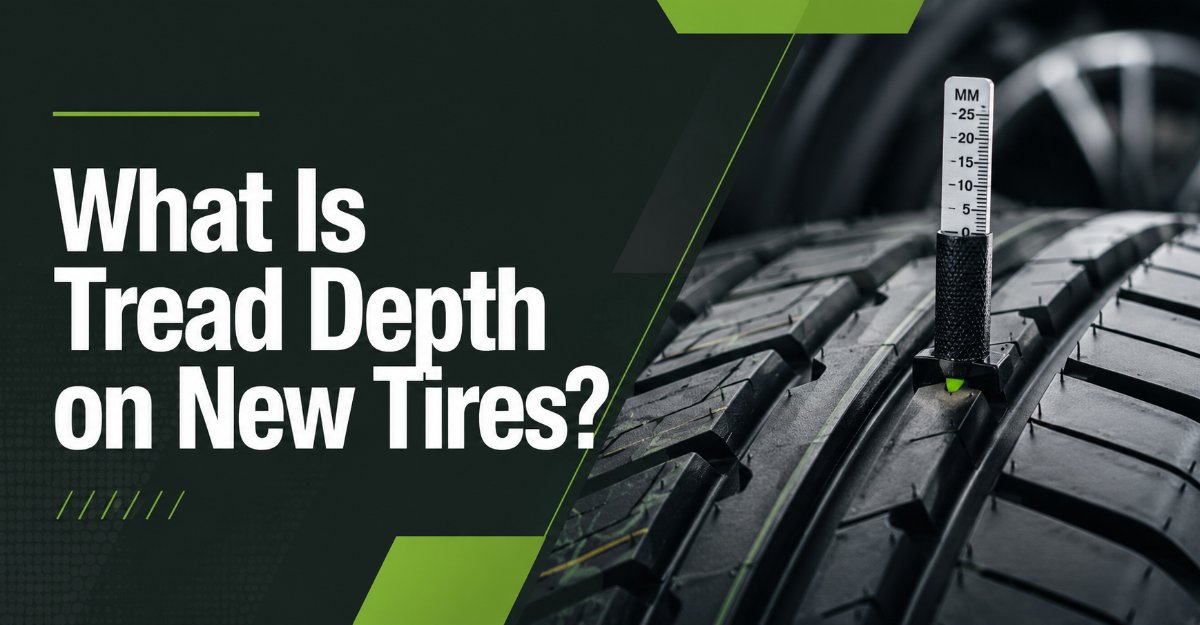
Standard new passenger car tires typically come with a tread depth of 10/32 to 11/32 of an inch, which equals 8 to 9 millimeters. High-performance summer tires start shallower at 9/32 of an inch, while winter tires and heavy-duty truck tires start deeper at 12/32 to 15/32 of an inch.
At a Glance
- Standard passenger tires start between 10/32 and 11/32 of an inch.
- Off-road and winter tires begin with deeper grooves up to 15/32 of an inch.
- Original equipment manufacturer tires often start 1/32 shallower than retail equivalents.
- Tires lose wet braking safety at 4/32 of an inch despite the legal limit being 2/32.
- All-wheel drive vehicles require matching tread depths to prevent expensive drivetrain damage.
Understanding Standard New Tire Tread Depths
What is the standard tread depth on new passenger tires?
New passenger car tires are manufactured with a tread depth measuring between 10/32 and 11/32 of an inch. This baseline measurement applies to standard all-season tires, touring tires, and standard replacement tires designed for sedans, coupes, and minivans.
The tire industry measures depth in increments of 1/32 of an inch rather than using decimals or fractions reduced to their lowest common denominator. A depth of 10/32 of an inch equates to approximately 7.9 millimeters. This specific amount of rubber provides the optimal balance among a quiet ride, efficient water evacuation, and a lifespan that typically lasts between 40,000 and 60,000 miles under normal driving conditions.
Does tire tread depth include the wear indicator bars?
Tire tread depth does not include the height of the wear indicator bars. The actual tread depth is measured from the very top of the rubber tread block down to the flat bottom of the deepest main groove, bypassing the raised wear bars completely.
Wear indicator bars are small, raised bridges of rubber molded directly into the bottom of the longitudinal grooves. These bars sit exactly 2/32 of an inch above the base of the groove. If a driver measures the depth by resting a gauge on top of a wear bar, the reading will be inaccurately shallow. Accurate measurement requires placing the measuring tool in the lowest channel right next to the wear bar.
Where is the tread depth printed on a new tire?
Tread depth is almost never printed on the sidewall of a new tire. Drivers cannot find the starting tread depth by reading the series of numbers and letters located on the outside of the rubber.
Instead, the exact starting tread depth is listed in the manufacturer specifications provided by the tire brand. Consumers must look up the specific tire model on the manufacturer website or a retail retailer portal to find the exact fraction. The sidewall only displays the tire width, aspect ratio, wheel diameter, load index, speed rating, and the Department of Transportation date code.
How Tread Depth Varies by Vehicle and Tire Type
Do different vehicle types have different starting tread depths?
Yes, starting tread depths vary significantly based on the intended vehicle application and performance requirements. Heavy vehicles and specialty driving conditions require different amounts of starting rubber.
The table below outlines the typical starting tread depths across various tire categories:
| Tire Category | Typical New Depth | Primary Purpose |
|---|---|---|
| Passenger / Touring | 10/32 to 11/32 inch | Everyday commuting and long tread life. |
| Winter / Snow | 12/32 to 13/32 inch | Packing snow to create snow-on-snow friction. |
| Light Truck / SUV | 11/32 to 14/32 inch | Supporting heavier vehicle curb weights. |
| Off-Road / Mud | 15/32 to 19/32 inch | Digging into loose dirt, gravel, and mud. |
| High-Performance | 9/32 to 10/32 inch | Reducing rubber flex for sharper steering. |
| Commercial Steer | 18/32 inch | Handling front-axle loads on semi-trucks. |
| Commercial Drive | 26/32 to 30/32 inch | Providing maximum traction for semi-truck rear axles. |
Why do winter and off-road tires have deeper tread?
Winter and off-road tires feature deeper tread to trap loose material and create friction against the surface beneath the vehicle. A new winter tire typically starts at 12/32 of an inch to allow the wide grooves to pack full of snow. Snow aggressively adheres to other snow, meaning the trapped snow in the tire provides better grip against a snow-covered road than bare rubber would.
Similarly, off-road and mud-terrain tires start at 15/32 of an inch or deeper to allow the large tread blocks to act like shovels. The deeper voids ensure that sticky mud clears out of the tire as it rotates. If the tread were shallower, mud would quickly fill the grooves and turn the tire into a smooth, frictionless cylinder.
Are electric vehicle tires manufactured with less tread?
Electric vehicle tires are frequently manufactured with slightly less tread depth than standard combustion engine tires. A specialized EV tire often starts at 8/32 or 9/32 of an inch instead of the standard 10/32.
Manufacturers intentionally reduce the starting rubber to minimize rolling resistance and maximize battery range. Less rubber means the tire flexes less as it rolls, which wastes less kinetic energy as heat. Furthermore, electric vehicles are significantly heavier than gas cars due to the battery packs. A shallower tread block is more rigid, preventing the heavy vehicle weight from causing the rubber blocks to squirm and wear out prematurely under the massive instant torque provided by electric motors.
The Exceptions: When New Tires Start Shallower
What is the difference between OEM and retail tire tread depth?
Original Equipment Manufacturer tires often have 1/32 to 2/32 of an inch less tread than the exact same tire model sold in a retail store. A Michelin tire purchased at a tire shop might have 10/32 of an inch, while the identical Michelin model installed at the factory on a brand-new car might have only 9/32.
Car manufacturers commission these modified OEM versions specifically to hit environmental and regulatory targets. Shallower tread reduces rolling resistance and lowers the overall weight of the vehicle. This slight reduction helps the automaker achieve better fuel economy ratings for the EPA window sticker. Buyers replacing their factory tires with retail versions often notice a slight drop in fuel efficiency but a longer overall tire lifespan.
Why do new passenger tires look shallower than truck tires?
New passenger tires look shallower than truck tires due to an optical illusion created by the width of the tread voids. Passenger tires are designed with tightly packed tread blocks to reduce road noise and provide a smooth ride.
Because the gaps between the rubber blocks are very narrow on a passenger tire, the human eye struggles to perceive the depth of the groove. Truck tires feature wide, aggressive voids that let light penetrate easily to the bottom of the channel. Even if a passenger tire and a light truck tire both measure exactly 11/32 of an inch in depth, the truck tire will appear significantly deeper and more robust at first glance.
Measuring and Managing Tire Wear Over Time
How do you accurately measure tread depth at home?
The most accurate way to measure tread depth at home is by using a dedicated, spring-loaded tread depth gauge. Relying on coins like pennies and quarters only provides a rough pass or fail metric, whereas a proper gauge provides the exact fraction.
- Park the vehicle on a flat surface and turn the steering wheel fully to one side to expose the front tire surface.
- Push the measuring pin of the tread depth gauge flush with the base of the tool.
- Insert the metal pin into the main longitudinal groove of the tire, ensuring you bypass the raised wear indicator bars.
- Push the base of the gauge flat against the top of the rubber tread block.
- Remove the gauge carefully and read the measurement indicated by the top edge of the barrel.
- Repeat this process on the outer edge, the center, and the inner edge of the tire to check for uneven alignment wear.
How much tread depth do you lose after 10,000 miles?
A typical passenger tire loses roughly 2/32 of an inch of tread depth every 10,000 miles under normal driving conditions. If a standard all-season tire starts at 10/32, it will likely measure around 8/32 after the first year of average driving.
This wear rate fluctuates heavily based on driving habits, vehicle weight, and the specific rubber compound. High-performance summer tires utilize incredibly soft, sticky rubber compounds that can easily lose 4/32 of an inch over 10,000 miles. Conversely, hard-compound touring tires designed for long highway commutes may only lose 1/32 of an inch over that same distance. Proper tire rotation every 5,000 miles ensures this wear rate remains completely uniform across all four wheels.
Does tread depth affect fuel economy and electric range?
Tread depth directly impacts both fuel economy in gas vehicles and total range in electric vehicles. A brand-new tire with maximum tread depth creates the highest level of rolling resistance, which forces the engine or battery to work harder.
As a tire wears down over time, the rubber blocks become shorter, stiffer, and less prone to flexing. This reduction in kinetic energy loss means a tire at 4/32 of an inch actually provides better fuel economy than a brand-new tire at 10/32 of an inch. Drivers often experience a temporary 2 to 3 percent drop in their gas mileage or EV range immediately after installing a set of deep, brand-new replacement tires.
Safety and Replacement Protocols for New Tires
What is the legal minimum tread depth versus the safe minimum?
The legal minimum tread depth in most jurisdictions is 2/32 of an inch (1.6 millimeters), but the safety failure point for wet roads occurs significantly earlier at 4/32 of an inch.
The gap between legal and safe is a major cause of wet weather accidents. At 4/32 of an inch, the grooves lose their physical capacity to evacuate water fast enough at highway speeds. When the tire cannot channel water away, the rubber rides on top of the moisture in a dangerous condition known as hydroplaning. The traditional “penny test” checks for the 2/32 legal minimum. Drivers should instead use the “quarter test” to verify they have at least 4/32 of an inch remaining for rain safety.
Can a tire have full tread but still be unsafe to drive?
A tire can have a perfect 10/32 of an inch of tread depth and still be completely unsafe to drive if the rubber has aged out. Tread depth only measures the physical volume of rubber remaining, not the chemical integrity of the tire.
Rubber naturally degrades and oxidizes over time, regardless of whether the vehicle is driven. After six to ten years, the chemical compounds harden, leading to a condition called dry rot. A ten-year-old tire with perfect tread will feel like hard plastic on the road. It will offer almost zero grip during emergency braking and is highly susceptible to sudden blowout failures at highway speeds. Age is just as critical as depth.
Can you replace just one new tire on a vehicle?
Replacing a single new tire is only permissible on a two-wheel-drive vehicle, and the new tire must always be installed on the rear axle. Mixing tread depths on the same axle creates an imbalance in grip that can pull the steering wheel during hard braking.
If a driver buys one or two new tires for a front-wheel-drive or rear-wheel-drive car, the new tires must go on the back. Placing worn tires on the rear axle dramatically increases the risk of oversteer, where the back end of the car spins out uncontrollably on wet pavement. On an all-wheel-drive vehicle, replacing just one tire without modifications is strictly prohibited.
Why must new tires be shaved for All-Wheel Drive vehicles?
New tires must be shaved down for All-Wheel Drive vehicles because a difference in tire diameter will destroy the vehicle drivetrain. An AWD system constantly monitors wheel speed to distribute power perfectly.
A brand-new tire at 10/32 of an inch has a larger overall diameter than three older tires worn down to 6/32 of an inch. Because the new tire is larger, it rotates slightly slower than the other three tires. The vehicle computer interprets this difference in rotational speed as a loss of traction and engages the differential constantly. This continuous engagement causes the AWD differential to overheat and eventually fail. Retailers solve this by offering a “shaving” service, which grinds the new 10/32 tire down to match the exact 6/32 depth of the older tires before installation.
The Bottom Line
Understanding tread depth on new tires requires looking past the standard 10/32 of an inch baseline. While most standard passenger tires begin with 8 to 9 millimeters of rubber, exceptions exist for high-performance vehicles, off-road applications, and factory-installed OEM rubber. Drivers must remember that a new tire is only safe as long as the rubber compound remains pliable, making age limits just as important as physical depth. Ultimately, while the law permits driving until the tread reaches 2/32 of an inch, replacing tires at 4/32 is the only verifiable way to maintain safe braking distances in wet conditions.