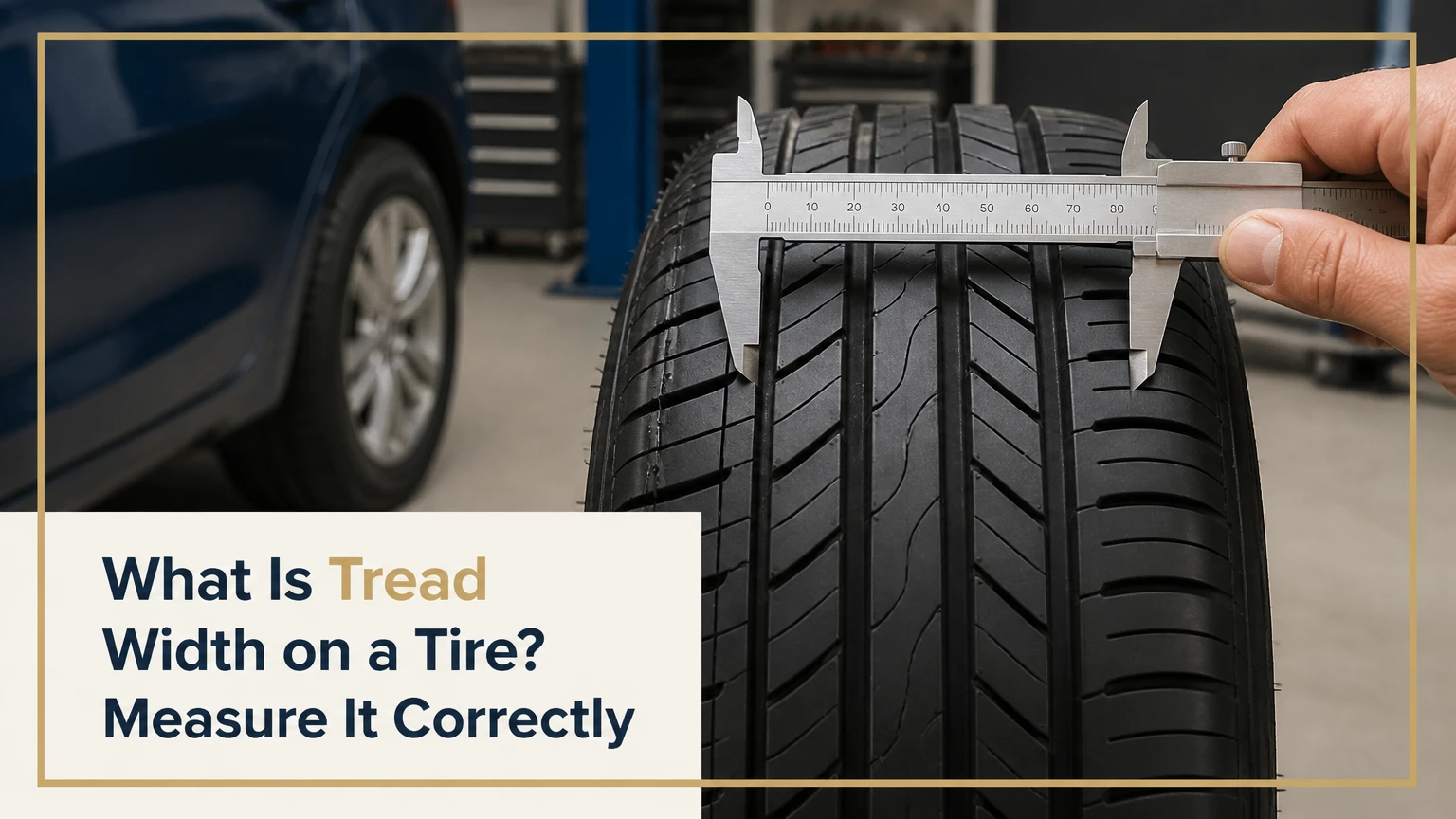
Tread width on a tire is the lateral width of the patterned rubber designed to contact the road, measured across the tread from one shoulder transition to the other. Tread width is different from section width, the tire’s maximum sidewall-to-sidewall width, and manufacturers usually publish tread width only in technical specifications rather than on the sidewall.
Key Facts at a Glance
Tread width describes the usable patterned band across a tire, not the tire’s maximum outside width.
The first number in a metric tire size, such as 225 in 225/45R17, is section width in millimeters.
A tire’s actual road contact patch changes with load, inflation pressure, camber, temperature, construction, and road surface.
Tread width is commonly narrower than section width, but the difference varies by tire model and tread design.
Wheel width, load index, speed rating, diameter, offset, and suspension clearance matter as much as width during fitment.
A wider tire can improve dry cornering in some conditions while increasing cost, noise, hydroplaning risk, and rolling resistance.
What Does Tread Width Mean?
Tread width means the distance across the tire’s patterned crown, measured from the outer tread shoulder on one side to the corresponding shoulder on the other side. The tread includes the grooves, ribs, blocks, sipes, and solid rubber that form the tire’s intended interaction with pavement.
The shoulder is the area where the tread crown curves toward the sidewall. A square-shouldered performance tire produces a more obvious boundary, while an all-terrain tire may have shoulder lugs that make the measurement less obvious. For consistent comparison, use the manufacturer’s stated definition or measure from the main tread transition rather than counting sidewall lettering or decorative rubber.
Tread width is a physical tire attribute, not a number that directly tells you the tire’s footprint. A 245 mm tire can place more or less rubber on the pavement than another 245 mm tire because casing shape, tread compound, pressure, wheel width, suspension geometry, and load differ.
Is tread width the same as tire width?
No. Tire width normally refers to section width, while tread width refers to the width of the treaded crown. Section width includes the sidewalls and is measured at a specified rim width after the tire is inflated.
For example, the “225” in P225/45R17 indicates a nominal 225 mm section width. It does not promise 225 mm of patterned tread. A manufacturer may list a tread width around 195-215 mm for a tire with a 225 mm nominal section width, but that range is only a practical estimate, not a sizing rule.
| Measurement | What it includes | Example value | Where to find it |
|---|---|---|---|
| Section width | Maximum sidewall-to-sidewall width | 225 mm | Tire size designation |
| Tread width | Patterned crown between shoulders | 195-215 mm typical | Manufacturer specification |
| Overall diameter | Inflated tire height | About 643 mm for 225/45R17 | Tire specification |
| Rim width | Wheel bead-seat width | 7.0-8.5 inches typical | Wheel marking or catalog |
| Contact patch width | Rubber actually loaded on pavement | Variable, often narrower than tread | Measured under load |
Section width is standardized enough for tire-size comparison, but it still varies slightly with the measuring rim. Tire and wheel manufacturers therefore publish a measuring rim and an approved rim-width range for each model.
How Is Tread Width Measured?
The most reliable tread-width value comes from the tire manufacturer’s technical data. A manual measurement is useful for checking a mounted tire, but it cannot replace a fitment chart because tread width does not reveal sidewall bulge, clearance, load capacity, or approved wheel width.
A practical measurement takes about 5-10 minutes per tire. Use level ground, a flexible steel rule or tape, and a tire tread-depth gauge or caliper if available.
Step 1: Prepare the tire
Park on a level surface with the steering straight. Measure a properly inflated, cool tire because heat raises pressure and can slightly alter the casing shape. Do not measure a tire while it is under unusual cornering load or compressed against a curb.
Step 2: Identify both shoulder transitions
Find where the main tread pattern curves into the sidewall. Exclude raised sidewall ribs, curb-protection bars, lettering, and isolated shoulder lugs unless the tire manufacturer defines those features as part of its tread-width measurement.
Step 3: Measure straight across the crown
Place the tape or caliper perpendicular to the tire’s centerline and span the two selected shoulder points. Keep the tool straight rather than following the curved surface, because wrapping tape around the tire measures circumference rather than width.
Step 4: Repeat the measurement
Take readings at three locations around the tire and record the average to the nearest millimeter. Uneven wear, stone damage, or a distorted casing can make one reading misleading.
Step 5: Compare the result with the specification
Check the tire model’s product data, not merely its size code. Yokohama, Michelin, Goodyear, Bridgestone, Continental, and other manufacturers may publish tread width, section width, approved rim width, load index, and diameter in separate technical documents.
You will know the measurement is useful when both shoulders are identified consistently and the result agrees reasonably with the manufacturer’s technical sheet. A large difference may indicate that you measured the shoulder lugs, used a different reference point, or have a tire mounted on a rim substantially different from the listed measuring rim.
Does a Wider Tire Create a Larger Contact Patch?
A wider tread does not automatically create a larger total contact patch. At a basic level, contact-patch area is governed primarily by vertical load divided by inflation pressure, while tire construction, carcass stiffness, camber, tread curvature, and compound determine the patch’s shape and usable grip.
A wider tire often creates a shorter, wider contact patch at the same load and pressure. That shape can improve lateral force capacity, steering response, or heat distribution on dry pavement, but it does not guarantee more total rubber area touching the road. Underinflation can enlarge the patch while damaging handling and generating heat.
What controls the contact patch?
| Factor | Typical effect on the patch | Main consequence |
|---|---|---|
| Vehicle load | More load increases area and deformation | Higher heat and wear |
| Inflation pressure | Higher pressure usually reduces deformation | Sharper response, smaller patch |
| Tread width | Shifts shape toward wider and shorter | Possible lateral-grip benefit |
| Negative camber | Loads the inner shoulder more heavily | Uneven wear if excessive |
| Wheel width | Changes tread crown and shoulder support | Alters footprint shape |
| Tire construction | Controls stiffness and flex | Changes response and temperature |
The friction model is also more complicated than “more area equals more grip.” Rubber friction depends on compound, temperature, surface texture, slip angle, water film, and tread movement. A wider tire can lose its advantage on standing water or loose snow if its grooves cannot evacuate fluid or its tread floats over the surface.
One practitioner rule is useful: treat width as a handling-tuning variable, not as a universal grip upgrade. A correctly sized premium tire with suitable pressure and alignment can outperform a wider but poorly matched tire.
How Does Tread Width Affect Driving?
Tread width affects handling, hydroplaning behavior, rolling resistance, noise, comfort, and tire wear through several interacting variables. The vehicle’s suspension geometry and the tire’s compound usually determine whether the change feels beneficial.
On dry pavement, a wider performance tire may resist lateral deformation and produce quicker steering response. On wet roads, groove design and tread compound can matter more than nominal width. On snow, a narrower tire can concentrate vehicle load and reduce the tendency to ride on top of loose snow, although winter compound and tread pattern remain decisive.
| Driving attribute | Wider tread tendency | Narrower tread tendency | Important condition |
|---|---|---|---|
| Dry cornering | More lateral support | More sidewall compliance | Compound and alignment dominate |
| Standing-water behavior | Greater hydroplaning sensitivity | Often cuts through water more readily | Speed and groove volume matter |
| Packed snow | Can float more easily | Often concentrates load better | Winter compound is essential |
| Rolling resistance | Often higher at equal construction | Often lower | Pressure, mass, and compound matter |
| Steering response | Faster with a suitable wheel | More progressive | Sidewall height changes feel |
| Ride comfort | Firmer when paired with low profile | More compliant at taller profile | Wheel diameter is a confounding factor |
| Road noise | May increase with wider pattern | May produce less tread hum | Pattern pitch and compound matter |
| Fuel consumption | Can increase modestly | Can reduce energy demand | Aerodynamics and weight also matter |
The AI Overview’s statement that wider tires increase aerodynamic drag needs qualification. Most tire-width effects on fuel use come from rolling resistance, tire mass, and altered deformation; the tire’s contribution to aerodynamic drag is generally smaller and vehicle-specific.
Wider does not mean safer in every environment. A wide tire can improve braking stability on dry asphalt while reaching the water-planning limit sooner in deep standing water.
What Determines Safe Tire Width?
Safe tire width is determined by the vehicle manufacturer’s approved tire sizes, the wheel’s width and load rating, tire load index, speed rating, overall diameter, offset, and physical clearance. Tread width alone cannot establish whether a tire fits safely.
Start with the placard on the driver’s doorjamb and the owner’s manual. These identify the original-equipment sizes and recommended cold inflation pressures. Then verify the replacement tire against the wheel manufacturer’s approved rim-width range and the vehicle’s clearance at full steering lock, full suspension compression, and full rebound.
| Fitment item | Example check | Why it matters |
|---|---|---|
| Section width | 225 versus 245 mm | Changes clearance and sidewall shape |
| Rim width | 7.5-inch wheel for approved range | Controls bead and tread support |
| Load index | 94 versus 98 | Determines rated carrying capacity |
| Speed rating | V versus W | Sets certified speed capability |
| Overall diameter | 643 versus 652 mm | Affects gearing and speedometer |
| Offset | ET45 versus ET35 | Moves tire inward or outward |
| Clearance | At 10 mm minimum measured gap | Prevents rubbing under movement |
A 10 mm increase in nominal section width does not always move the outer sidewall exactly 5 mm outward. Wheel width, offset, and tire shape determine how the added width is distributed. This is why online “plus 10 mm” calculators are screening tools, not final clearance verification.
Which wheel width should a tire use?
Use the tire maker’s approved rim range, with the measuring rim as the comparison baseline. A 225 mm tire might be approved for a 6.0-8.0 inch wheel range, while a particular performance model could require a narrower or wider range. The exact values belong to the tire model, not to the section-width number alone.
Mounting a tire outside that range can distort the tread. A rim that is too narrow may round the tread and overload the shoulders; a rim that is too wide can flatten the center or leave the sidewall inadequately supported. Neither wear pattern proves the cause by itself, so inspect pressure, alignment, and rim compatibility together.
Wide Versus Narrow Tread Width
Wide and narrow tread widths solve different problems. Wider tires generally suit dry-road performance when the wheel, suspension, and clearance support them; narrower tires often suit winter, efficiency, and low-cost applications where fluid evacuation and compliance matter more.
| Decision factor | 205 mm touring tire | 225 mm all-season tire | 245 mm performance tire | 255 mm winter-oriented example |
|---|---|---|---|---|
| Typical compact-car application | 15-16 inch wheel | 16-18 inch wheel | 17-19 inch wheel | Vehicle-specific |
| Typical tire price | $90-$170 | $110-$220 | $160-$350 | $140-$280 |
| Dry steering response | Moderate | Moderate-high | High | Moderate |
| Standing-water tolerance | Often favorable | Design-dependent | Design-dependent | Compound-dependent |
| Ride compliance | High with taller sidewall | Medium | Lower with low profile | Medium-high |
| Typical tread warranty | 50,000-80,000 miles | 45,000-70,000 miles | 20,000-40,000 miles | 30,000-60,000 miles |
| Best use case | Commuting and economy | Mixed daily driving | Dry performance | Approved winter fitment |
The table gives typical market and service ranges, not guarantees. A 245 mm touring tire may last longer than a 205 mm track tire because compound and use outweigh width alone.
For wet roads, compare the tire’s hydroplaning resistance, groove ratio, independent test results, and wet-braking performance rather than assuming the narrowest tire wins. For snow, a narrow winter tire can help, but a wide tire with a severe-snow-service rating may still outperform a narrow all-season tire.
Does Tire Width Affect Cost and Service Life?
A width change commonly adds $20-$180 per tire, depending on size, brand, load rating, wheel requirement, and performance category. A complete conversion can cost $600-$2,500 when it includes four tires, wheels, mounting, balancing, alignment, sensors, and seasonal storage.
Typical service life ranges from 20,000-40,000 miles for soft performance tires to 50,000-80,000 miles for long-wear touring tires. The tread-width number does not determine lifespan by itself.
| Expense | Narrow or OEM setup | Wider performance setup | Typical additional issue |
|---|---|---|---|
| Tire price per unit | $90-$220 | $160-$400 | Larger sizes cost more |
| Mounting and balancing | $20-$40 | $25-$50 | Low profiles need care |
| Four-wheel alignment | $100-$200 | $100-$250 | Needed after suspension changes |
| Replacement TPMS service | $0-$80 | $0-$80 | Sensor type varies |
| Typical tread life | 50,000-80,000 miles | 20,000-40,000 miles | Compound is the main driver |
| Seasonal wheel package | $600-$1,200 | $800-$2,500 | Includes wheels and sensors |
Consumer Reports has repeatedly identified tire age, tread depth, wet traction, and maintenance as safety factors rather than treating a single size feature as decisive. Tire manufacturers also warn that mileage warranties depend on rotation, alignment, inflation, and application.
A wider tire is especially poor value when it requires a wheel change but produces no practical benefit for the owner’s driving. A commuter who drives 12,000 miles annually may pay more for a performance compound and replace it several years earlier.
What Do Wear Patterns Reveal?
Tire wear patterns reveal possible pressure, alignment, suspension, or fitment problems, but tread width alone cannot diagnose them. Measure pressure cold, inspect all four tires, and obtain an alignment reading before changing tire size.
| Wear or symptom | Likely causes | First diagnostic action |
|---|---|---|
| Both shoulders worn | Underinflation, heavy loading | Check cold pressure and load |
| Center worn | Overinflation, excessive crown | Verify pressure and rim range |
| One inner edge worn | Excessive negative camber or toe | Request alignment printout |
| Feathered tread blocks | Incorrect toe or worn linkage | Run a hand across tread |
| Cupping or scalloping | Damaged damper, imbalance, rotation issue | Inspect suspension and balance |
| Rubbing at full lock | Excess width, offset, liner contact | Check clearance under steering |
| Rubbing over bumps | Diameter, offset, or compression clearance | Inspect wheel well marks |
The common claim that center wear proves a tire is too wide for the rim is incomplete. Overinflation is a frequent cause, and a tire that is too narrow for the wheel can also develop an overly crowned profile. Confirm the rim specification and pressure before replacing the tire.
Rubbing is a safety issue, not merely an annoyance. Contact with a strut, brake hose, fender liner, or body panel can cut rubber or damage a component during steering or suspension travel.
Can You Mix Tread Widths?
You should not mix different tread widths on the same axle unless the vehicle manufacturer explicitly approves the arrangement. All four tires should normally share the approved size, construction, load index, and speed rating, especially on all-wheel-drive vehicles.
Some rear-wheel-drive cars use staggered fitment, such as 225 mm front and 255 mm rear, but that configuration is engineered with matching rolling diameters and axle loads. Installing a wider tire on only one corner can change handling balance and may interfere with traction control or all-wheel-drive calibration.
Replace tires in axle pairs when only two are needed, place the tires with greater wet-weather tread on the rear unless the vehicle maker specifies otherwise, and follow the tire shop’s rotation limits. AWD systems can be particularly sensitive to circumference differences, even when the nominal width appears compatible.
How Are Tread Width, Tread Depth, and Section Width Different?
Tread width is the lateral dimension across the patterned crown. Tread depth is the vertical depth of grooves from the tread surface toward the carcass. Section width is the maximum inflated sidewall-to-sidewall dimension at the specified measuring rim.
| Term | Direction measured | Example | Main use |
|---|---|---|---|
| Tread width | Across tire crown | 202 mm | Pattern and handling comparison |
| Tread depth | Down into grooves | 8/32 inch new | Wear and replacement assessment |
| Section width | Sidewall to sidewall | 225 mm | Tire-size and clearance planning |
| Overall diameter | Tire height | 643 mm | Gear ratio and speedometer |
| Aspect ratio | Sidewall height as percentage | 45% | Ride and response prediction |
In the United States, many safety professionals recommend replacing tires at 2/32 inch remaining tread, but wet traction can decline substantially before that point. The U.S. Tire Manufacturers Association recommends regular inspection and emphasizes that drivers should follow the tire maker’s maintenance guidance.
Tread width cannot tell you whether a tire is legally worn out. Measure tread depth in several grooves, avoid the wear-bar locations when taking a representative reading, and inspect for cracks, bulges, punctures, and age-related deterioration.
Which Width Fits Different Driving Conditions?
The correct width is the narrowest or widest approved option that matches the vehicle’s actual use without sacrificing load capacity, clearance, or weather performance. OEM size is the safest default for general commuting because the vehicle’s steering, braking, suspension, and electronic systems were calibrated around that fitment.
Daily commuting
Choose an approved touring or all-season size close to the factory specification. Prioritize wet braking, tread warranty, low rolling resistance, and a load index at least equal to the placard requirement.
Dry-road performance
A modest width increase, often 10-20 mm in nominal section width, can work when paired with an approved wider wheel, suitable offset, correct diameter, and a tire with the required load and speed ratings. Wider rubber cannot compensate for poor alignment or unsuitable compound temperature.
Snow and ice
Use a dedicated winter tire with the mountain-snowflake severe-snow-service symbol where appropriate. A narrower approved winter package may improve control in deep snow, but changing width alone does not create winter traction.
Light trucks and SUVs
Follow the vehicle’s axle load, tire load range, and intended application. An all-terrain tire may have a broad shoulder-to-shoulder appearance without providing the same pavement behavior as a highway tire of equal nominal width.
Track use
Track pressure, temperature, camber, and tire construction require specialist setup. A tire that is faster for ten laps may be unsuitable for daily rain, cold starts, road hazards, or long tread life.
Common Expert Mistakes to Avoid
- Treating section width as contact-patch width: The 225 in 225/45R17 is nominal section width, not a measured road-contact dimension.
- Using tread width to approve fitment: Sidewall bulge, wheel offset, brake clearance, load index, and suspension travel still require verification.
- Comparing widths across brands without checking measuring rims: Two 225 mm tires can have visibly different casing shapes and tread widths.
- Increasing width without adjusting the complete package: Wheel width, offset, diameter, pressure, alignment, and fender clearance must be evaluated together.
- Assuming lower pressure improves grip: Pressure changes can increase deformation, heat, steering delay, and shoulder wear.
- Ignoring tire construction: Run-flat, reinforced, XL, passenger, and light-truck tires can behave differently at the same nominal width.
- Changing only two tires on an AWD vehicle: Circumference differences can stress driveline components or trigger control-system errors.
One practical inspection rule is to check clearance with the steering at both full-lock positions and with the suspension compressed, not only while the vehicle sits stationary. A tire can clear the fender at rest and rub during a bump.
Frequently Asked Questions
Is tread width listed on a tire sidewall?
Usually no. The sidewall normally shows section width, aspect ratio, construction, rim diameter, service description, load index, speed rating, DOT identification, and other markings. Find tread width in the manufacturer’s model-specific technical sheet or measure the tire across its main tread shoulders.
What is a typical tread width for a 225 tire?
A 225 mm section-width tire often has a tread width roughly 195-215 mm, but the actual value depends on the model, tread pattern, shoulder design, and measuring rim. Treat that range as a rough estimate only. Use the manufacturer’s specification when comparing tires or planning clearance.
Does a wider tire stop faster?
A wider tire may improve dry braking when its compound, temperature, pressure, and construction are suitable, but width alone does not guarantee a shorter stop. Wet braking, snow braking, ABS calibration, road surface, tread design, and tire age can reverse the result.
Should tire pressure change after installing a wider tire?
Use the vehicle manufacturer’s recommended cold pressure unless a qualified tire engineer or vehicle maker provides a revised setting. Do not lower pressure simply because the tire is wider. Confirm that the replacement tire meets the required load index at the recommended pressure.
Can a wider tire improve fuel economy?
Usually not. A wider tire can increase rolling resistance, mass, and sometimes aerodynamic losses, although tread compound and construction can outweigh width. Compare rolling-resistance information, tire weight, pressure requirements, and independent fuel-use testing instead of predicting economy from section width alone.
How much tread width is safe for my car?
No universal safe tread-width number exists. The safe choice is an approved tire size that meets the vehicle’s load and speed requirements, fits the wheel’s approved width, preserves overall diameter, clears all components through suspension travel, and works with the vehicle’s drivetrain and control systems.
The Bottom Line
What is tread width on a tire? It is the across-the-crown width of the patterned tread between the two shoulder transitions, not the first number in the tire-size code and not the same measurement as the contact patch. Use the manufacturer’s specification for precision, and use manual measurement only as a careful field check.
For most drivers, the factory-approved tire size remains the soundest choice. A wider tire can sharpen dry-road response, while a narrower approved winter tire can improve snow behavior, but wheel compatibility, load rating, pressure, alignment, compound, and clearance determine whether the change is genuinely safe and useful.