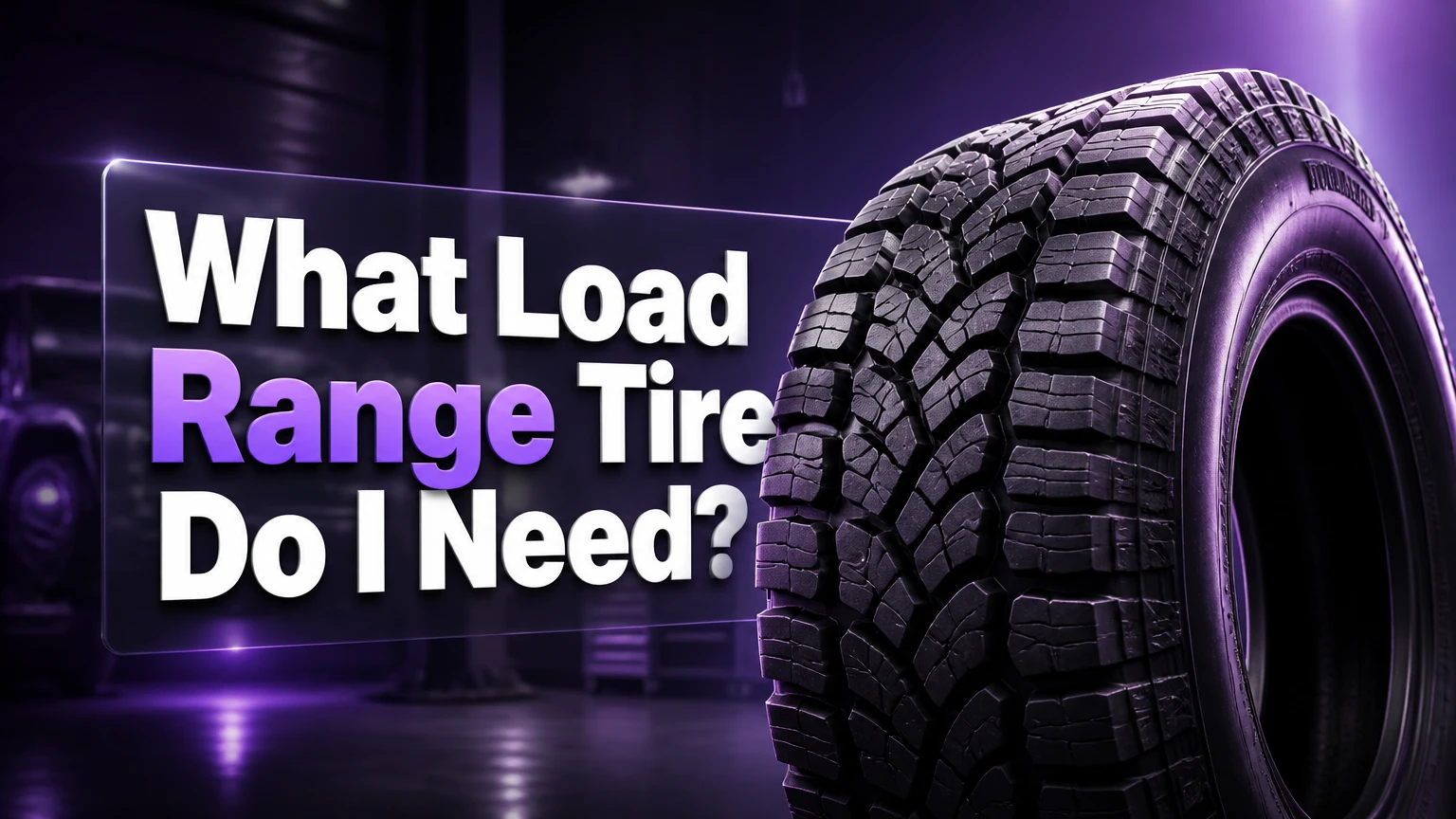
The tire load range you need is normally the same load category specified by your vehicle manufacturer, combined with a load index that meets or exceeds the original tire’s capacity. Choose a higher load range only when your measured axle loads, towing setup, commercial use, terrain, or approved tire size requires additional capacity or sidewall strength.
Key Facts at a Glance
- The vehicle placard and owner’s manual establish the minimum replacement-tire requirements.
- Load index identifies the maximum weight one properly inflated tire can support.
- Load range describes a tire’s load and pressure category, not its exact capacity by itself.
- A higher load range does not increase the vehicle’s GVWR, payload rating or axle rating.
- The maximum pressure printed on a sidewall is not automatically the correct daily pressure.
- Replacement tires should never provide less load capacity than the original equipment tires.
Which Load Range Tire Do You Need?
Most cars and crossovers need Standard Load or Extra Load passenger tires. Light trucks may use passenger tires or LT tires in Load Range C, D or E, while heavy-duty pickups commonly require E or F tires. The correct answer depends on the original specification, tire size, load index, axle load and intended use.
| Vehicle or use | Likely category | Typical reason | Important condition |
| Compact or midsize car | SL | Factory passenger-tire capacity | Match original load index |
| Performance sedan | XL | Higher load at increased pressure | Use when specified by manufacturer |
| Crossover or minivan | SL or XL | Passenger comfort with adequate capacity | Do not assume an SUV needs LT tires |
| Lightly used half-ton pickup | SL, XL or LT-C | Ride quality and moderate payload | Follow the placard and original tire type |
| Off-road midsize truck | LT-C or LT-D | Stronger casing with manageable weight | Verify load index in the chosen size |
| Towing half-ton truck | XL, LT-C, LT-D or LT-E | Capacity and sidewall stability | Base selection on actual rear-axle load |
| Three-quarter-ton pickup | LT-E, sometimes F | High payload and towing demand | Match the manufacturer’s specification |
| One-ton work truck | LT-E or LT-F | Heavy axle loads and commercial duty | Check single and dual load ratings |
| Travel trailer | ST-C through ST-G | Trailer-specific load and heat requirements | Follow trailer placard and wheel limits |
This table is a starting point, not a substitute for the tire placard. A Ford F-150, Toyota Tacoma or Jeep Wrangler may be offered with different tire constructions and load categories depending on trim, wheel package and payload configuration.
What Does Tire Load Range Mean?
Tire load range defines a load-carrying and inflation-pressure category. On light-truck tires, letters such as C, D, E and F replaced the older practice of describing tires by their actual number of body plies.
A Load Range E tire is commonly described as “10-ply rated,” but it usually does not contain ten physical plies. Modern steel, polyester and nylon materials can provide equivalent strength with fewer structural layers.
Passenger tires use a different system. Standard Load and Extra Load are common passenger-tire categories:
- SL: Standard Load passenger tire.
- XL: Extra Load or reinforced passenger tire.
- LT-C: Light-truck tire in Load Range C.
- LT-D: Light-truck tire in Load Range D.
- LT-E: Light-truck tire in Load Range E.
- LT-F: Light-truck tire in Load Range F.
Michelin defines load range as the range of maximum loads a tire can carry at a defined pressure. The same manufacturer defines load index as the assigned number corresponding to the tire’s load-carrying capacity.
Typical Load-Range Characteristics
| Tire category | Traditional rating | Common maximum pressure | General application |
| SL passenger | 4-ply rated | Often 35-44 psi | Cars, crossovers and light-duty use |
| XL passenger | Reinforced 4-ply rated | Often 41-50 psi | Heavier passenger vehicles |
| LT Load Range C | 6-ply rated | Commonly 50 psi | Light trucks and recreational off-road use |
| LT Load Range D | 8-ply rated | Commonly 65 psi | Moderate truck loads and towing |
| LT Load Range E | 10-ply rated | Commonly 80 psi | Heavy pickups, vans and towing |
| LT Load Range F | 12-ply rated | Commonly 95 psi | High-capacity commercial and heavy-duty use |
These pressure figures are common conventions, not universal specifications. Read the exact sidewall and manufacturer’s load-inflation data for the tire size being considered.
Is Load Index More Important Than Load Range?
Load index is more precise because it states the rated capacity of the specific tire. Load range alone cannot tell you how many pounds a tire carries because capacity changes with tire dimensions, construction and inflation pressure.
For example, two Load Range E tires can have different load indexes. A wider or larger-diameter E-rated tire may support considerably more weight than a smaller E-rated tire. Selecting tires only because both have an “E” on the sidewall can therefore produce an under-capacity replacement.
Goodyear explains that a higher numerical load index represents greater load-carrying capacity. Its passenger-tire chart notes that many passenger-car indexes fall between 75 and 100, although higher ratings are available.
A replacement tire should meet all relevant original requirements:
- Tire size or an approved alternate size
- Load index or equivalent load capacity
- Load category when specified
- Speed rating
- Rim width and diameter
- Recommended cold inflation pressure
- Appropriate construction for the vehicle and service
NHTSA states that replacement tires should have at least the same maximum load rating as the original tires. The agency calls the sidewall maximum load rating “the best guide” to the tire’s carrying capability.
How Do You Find the Factory Requirement?
Open the driver’s door and inspect the tire and loading information placard. The label usually identifies the original tire size, recommended cold pressure, seating capacity and maximum combined weight of occupants and cargo.
The owner’s manual may list alternate sizes, separate pressures for heavy loads, towing instructions or different front and rear specifications. Some pickup trucks also have a certification label showing Gross Vehicle Weight Rating and front and rear Gross Axle Weight Ratings.
Check the existing tire sidewall for a complete marking such as:
P265/70R17 113T SL
or:
LT275/70R18 125/122S Load Range E
In the second example:
- LT identifies a light-truck tire.
- 275/70R18 identifies its nominal size.
- 125 is the single-tire load index.
- 122 is the dual-tire load index.
- S is the speed rating.
- Load Range E identifies its load and pressure category.
The existing tire is useful only when it is known to be an approved fitment. A previous owner may have installed an incorrect size or lower-capacity tire, so the placard and manual remain the primary references.
How Should Tire Capacity Be Calculated?
Tire capacity should be evaluated by axle, not by dividing a rough total vehicle weight by four. Front and rear axles rarely carry equal loads, and a trailer’s tongue weight is concentrated primarily on the tow vehicle’s rear axle.
The AI Overview’s proposed formula of adding GVWR, passengers, cargo and tongue weight is inaccurate. GVWR already represents the maximum allowable loaded vehicle weight, including occupants, cargo and trailer tongue load carried by the vehicle. Adding those items to GVWR counts them twice.
Use this process instead:
Step 1: Find the Vehicle Ratings
Record:
- GVWR
- Front GAWR
- Rear GAWR
- Payload limit
- Trailer and tongue-weight limits
- Factory tire size and pressure
Step 2: Measure the Loaded Vehicle
Load the vehicle as it will travel. Include passengers, luggage, tools, fuel, hitch equipment and trailer tongue weight. Weigh the front and rear axles separately at a public vehicle scale.
Step 3: Calculate the Load Per Tire
For a single-wheel axle:
Required capacity per tire = measured axle weight ÷ 2
For an axle weighing 5,600 pounds:
5,600 ÷ 2 = 2,800 pounds per tire
Each tire must support at least 2,800 pounds at the pressure being used. The tire capacity must also satisfy the vehicle manufacturer’s minimum specification.
Step 4: Respect the Lowest Vehicle Limit
Stronger tires do not increase:
- GVWR
- GAWR
- Payload
- Hitch rating
- Wheel capacity
- Suspension capacity
- Brake capacity
If a rear axle is rated for 4,150 pounds, installing tires capable of 3,400 pounds each does not raise the rear GAWR to 6,800 pounds.
NHTSA’s interpretation of federal tire-selection requirements states that the load imposed on a tire must not exceed the tire’s rating at the recommended inflation pressure.
Do You Need Load Range E for Towing?
Load Range E is appropriate when the vehicle specification, actual rear-axle load or selected LT tire size requires E-rated capacity. It is not automatically required whenever a truck tows a trailer.
A half-ton pickup pulling a small utility trailer may remain within the capacity of its original SL, XL or LT-C tires. A heavily loaded pickup carrying 800-1,200 pounds of tongue weight may benefit from an LT-D or LT-E tire, provided the tire is approved for the wheel and vehicle.
| Towing situation | Selection priority | Possible category |
| Small utility trailer | Match original capacity | SL, XL or LT-C |
| Lightweight boat trailer | Rear-axle scale weight | XL, LT-C or LT-D |
| Travel trailer with weight-distribution hitch | Loaded axle weights and stability | LT-D or LT-E |
| Fifth-wheel trailer | Rear GAWR and tire capacity | LT-E or LT-F |
| Commercial equipment trailer | Continuous load, heat and duty cycle | LT-E or LT-F |
A heavier LT tire may reduce tread squirm and steering delay because its casing is built for greater load. The trade-off is additional mass and stiffness. The correct choice is the lightest approved tire construction that safely carries the measured load and suits the operating conditions.
Tongue weight should be included in the loaded scale measurement. Do not add it again after weighing the connected tow vehicle.
What Load Range Works Best Off-Road?
Load Range C or D often suits lighter off-road vehicles because these tires combine stronger LT construction with less casing weight than many E-rated alternatives. Load Range E may suit heavy trucks, loaded overland builds and terrain where casing strength matters more than ride compliance.
The load-range letter alone does not predict puncture resistance. Sidewall design, tread construction, material thickness, tire model and inflation pressure also affect durability.
Consider four factors:
- Vehicle weight: A loaded diesel pickup places greater stress on its tires than an unloaded midsize SUV.
- Terrain: Sharp rock, roots and high-speed desert use demand different constructions.
- Air-down pressure: Lower pressures increase sidewall deflection and heat.
- Highway use: The tire must safely return to road pressure and carry the vehicle at highway speed.
An E-rated tire can feel harsh on a light Jeep or Tacoma and may weigh several pounds more per tire. That additional rotating and unsprung mass can affect acceleration, braking, suspension response and fuel consumption.
A C-rated tire is not automatically weak, and an E-rated tire is not automatically puncture-proof. Compare the complete tire specifications and intended service.
Should You Upgrade From SL or XL to LT Tires?
Upgrade to an LT tire when you need its load capacity, casing construction or duty-cycle capability. Do not upgrade solely for appearance because an LT conversion may reduce comfort and require a different inflation pressure.
| Characteristic | SL or XL passenger tire | LT-C or LT-D | LT-E or LT-F |
| Ride quality | Usually softer | Moderately firm | Firmest when lightly loaded |
| Tire weight | Usually lowest | Medium | Usually highest |
| Steering response | Comfortable and compliant | More controlled under load | Strong load stability |
| Load duty | Passenger and light cargo | Moderate truck service | Heavy or continuous service |
| Typical pressure range | Lower | Medium | Higher capability |
| Best fit | Cars and lightly used pickups | Mixed-use trucks | Heavy-duty trucks and towing |
| Main drawback | Less suited to severe duty | Added mass | Stiffness, cost and weight |
Changing from a P-metric passenger tire to an LT tire requires more than matching the dimensions. The tire shop must confirm load capacity at the proposed pressure, wheel suitability, clearance and vehicle-manufacturer guidance.
Conversely, replacing an original LT tire with a passenger tire is generally inappropriate unless the vehicle manufacturer approves the conversion and the adjusted capacity meets every requirement.
Does a Load Range E Tire Need 80 PSI?
A Load Range E tire does not need 80 psi in every situation. Eighty psi is commonly the maximum cold pressure associated with many E-rated sizes, while the correct operating pressure depends on the tire’s load, size, axle position and approved load-inflation table.
The door-placard pressure should remain the starting point when installing the factory tire size and equivalent specification. Do not inflate every E-rated tire to its sidewall maximum simply because 80 psi is available.
Likewise, the claim that an E-rated tire will necessarily overheat at 32 psi is incorrect. A particular E-rated tire may safely carry a light vehicle at that pressure when its load table supports the measured axle load. Another size may require more pressure.
Use these pressure rules:
- Check pressure when the tires are cold.
- Follow the placard for original-equipment specifications.
- Use an approved load-inflation table for conversions.
- Never exceed the tire or wheel’s pressure limit.
- Do not release pressure from a warm tire to restore its cold reading.
- Recheck pressure after changing vehicle load or towing configuration.
Pressure supports the load. The load-range letter only defines the tire’s capability range.
Can a Higher Load Range Cause Problems?
A higher load range can produce a harsher ride, greater tire weight, slower suspension response and unnecessary cost when the vehicle does not need the additional capacity. Overspecifying the tire can therefore reduce everyday performance without increasing legal payload.
Common trade-offs include:
- More steering effort with larger or heavier tires
- Reduced ride comfort on broken pavement
- Increased unsprung and rotational mass
- Possible fuel-economy reduction
- Higher replacement price
- Different inflation requirements
- Greater stress on marginal wheels if pressure is raised improperly
A higher load range does not automatically reduce fuel economy by a fixed 1-2 mpg. The result depends on tire weight, rolling resistance, tread pattern, diameter, pressure, alignment, speed and vehicle design. A specific mileage-loss claim without controlled testing is unreliable.
What Must Be Checked Before Changing Load Range?
Confirm the entire wheel-and-tire system before installing a higher-capacity tire. The tire’s rating does not override the limitations of the rim, valve stem, suspension or body clearance.
Check the following:
- Approved tire size
- Minimum load index
- Required speed rating
- Wheel width range
- Wheel load rating
- Wheel pressure rating
- Valve-stem pressure capability
- Brake and suspension clearance
- Overall diameter difference
- Spare-tire compatibility
Increasing maximum tire pressure from 50 to 80 or 95 psi does not mean the wheel is approved for that pressure. Aftermarket wheel specifications may be stamped on the wheel or supplied by its manufacturer.
Oversized tires also change effective gearing and may affect speedometer accuracy, shifting, braking performance and advanced driver-assistance systems. Load range is only one part of the conversion.
How Much Do Higher Load-Range Tires Cost?
Higher load-range tires typically cost more because they use heavier casings, additional reinforcement and more material. Size, brand, tread type and warranty often affect the final price more than the load-range letter.
Typical U.S. retail ranges before installation are:
| Tire category | Typical price per tire | Common ordering time |
| Passenger SL | $110-$260 | Same day to 2 days |
| Passenger XL | $130-$300 | Same day to 3 days |
| LT-C or LT-D | $180-$340 | 1-4 days |
| LT-E | $210-$430 | 1-5 days |
| LT-F and specialty sizes | $280-$550+ | 2-7 days |
These are broad shopping ranges, not fixed market prices. Premium all-terrain and mud-terrain tires can cost more than highway tires with the same load range.
Installation may add mounting, balancing, valve service, disposal fees and alignment costs. Price should be evaluated only after capacity and fitment have been confirmed.
What Are the Most Common Selection Mistakes?
Choosing by Ply Rating Alone
“Ten-ply” does not identify the tire’s exact capacity. Check the full size, load index and maximum load marking.
Inflating to the Sidewall Maximum
The sidewall pressure is a limit associated with rated capacity, not a universal daily setting. Excessive pressure can reduce comfort and alter tread contact.
Adding Passengers to GVWR
GVWR already includes the maximum permitted loaded condition. Adding passengers and cargo to GVWR creates an invalid number.
Dividing Total Weight by Four
The front and rear axles carry different loads. Use separate axle weights and divide each axle by the number of tires supporting it.
Assuming Stronger Tires Increase Payload
Tires cannot raise the manufacturer’s GVWR, GAWR, suspension rating, brake capability or hitch rating.
Ignoring Dual-Tire Ratings
Dually tires display separate single and dual load indexes. Use the dual rating when tires operate as a dual pair.
Copying Another Owner’s Setup
Two similar trucks can have different axles, payload packages, wheel ratings and placard pressures. Select tires from your vehicle’s data.
Which Load Range Should You Choose?
Daily Commuter
Choose the original SL or XL specification. It normally provides the best balance of capacity, comfort, road noise and efficiency.
Lightly Used Pickup
Retain the factory category unless payload, terrain or towing needs justify a change. Many half-ton pickups do not need an LT-E tire for ordinary commuting.
Weekend Tow Vehicle
Measure the connected vehicle’s axle weights. Select a tire that meets the original requirement and supports the actual rear-axle load at an approved pressure.
Overland or Off-Road Vehicle
Choose construction based on loaded weight, terrain and air-down use. LT-C or LT-D can be preferable on lighter vehicles, while LT-E may suit heavier builds.
Heavy-Duty Work Truck
Match or exceed the original LT load index and range. Continuous payload, towing, heat and commercial use may justify E or F construction.
Slide-In Camper Truck
Weigh the fully loaded front and rear axles. Campers can place substantial weight over the rear axle even when total vehicle weight appears acceptable.
The Bottom Line
To answer what load range tire do I need, begin with the vehicle placard and owner’s manual, then verify the complete tire size, load index and construction. Choose the lightest approved tire that supports the vehicle’s measured axle loads and operating conditions without falling below the original specification.
SL or XL is usually correct for cars, crossovers and lightly used pickups. Load Range C or D often suits moderate truck and off-road use, while E or F is intended for higher-capacity pickups, commercial service and heavy towing. A higher letter is not automatically safer when the extra capacity is unnecessary.
Frequently Asked Questions
Can I Install a Higher Load Index Than the Factory Tire?
Yes, a replacement tire may generally have a higher load index than the original tire when its size, speed rating, wheel fitment and inflation requirements are appropriate. The higher index adds available tire capacity but does not increase the vehicle’s payload, axle or towing ratings.
Can I Use Different Load Ranges on the Front and Rear?
Use matching construction and specification across an axle. Different front and rear specifications may be acceptable only when the vehicle manufacturer designed the vehicle that way or explicitly approves the combination. Avoid mixing SL and LT tires casually because their load-pressure behavior and handling characteristics differ.
Is Load Range E Better Than Load Range D?
Load Range E provides a higher pressure and load-capability category, but it is better only when the vehicle or load requires it. Load Range D may offer lower weight and a more compliant ride while still providing sufficient capacity for a particular truck, trailer or off-road setup.
Does Towing Require LT Tires?
Not every tow vehicle requires LT tires. The vehicle manufacturer may approve passenger-type SL or XL tires for light towing. LT tires become appropriate when the original specification, loaded axle weight, tire capacity, operating heat or service conditions require their stronger construction.
Can Tires Carry More Weight at Maximum Pressure?
A tire generally carries more load as inflation increases within its approved load-inflation schedule, up to its rated maximum. Inflation cannot create capacity beyond the tire’s sidewall rating, and pressure must never exceed the limits of the tire, wheel or vehicle specification.
Should Trailer Tires Have the Same Load Range as Truck Tires?
No. Trailer tires must be selected from the trailer certification label, GAWR, wheel rating and actual loaded axle weight. Special Trailer tires use their own sizes and service requirements. Do not select a trailer tire merely because its load-range letter matches the tow vehicle’s tires.