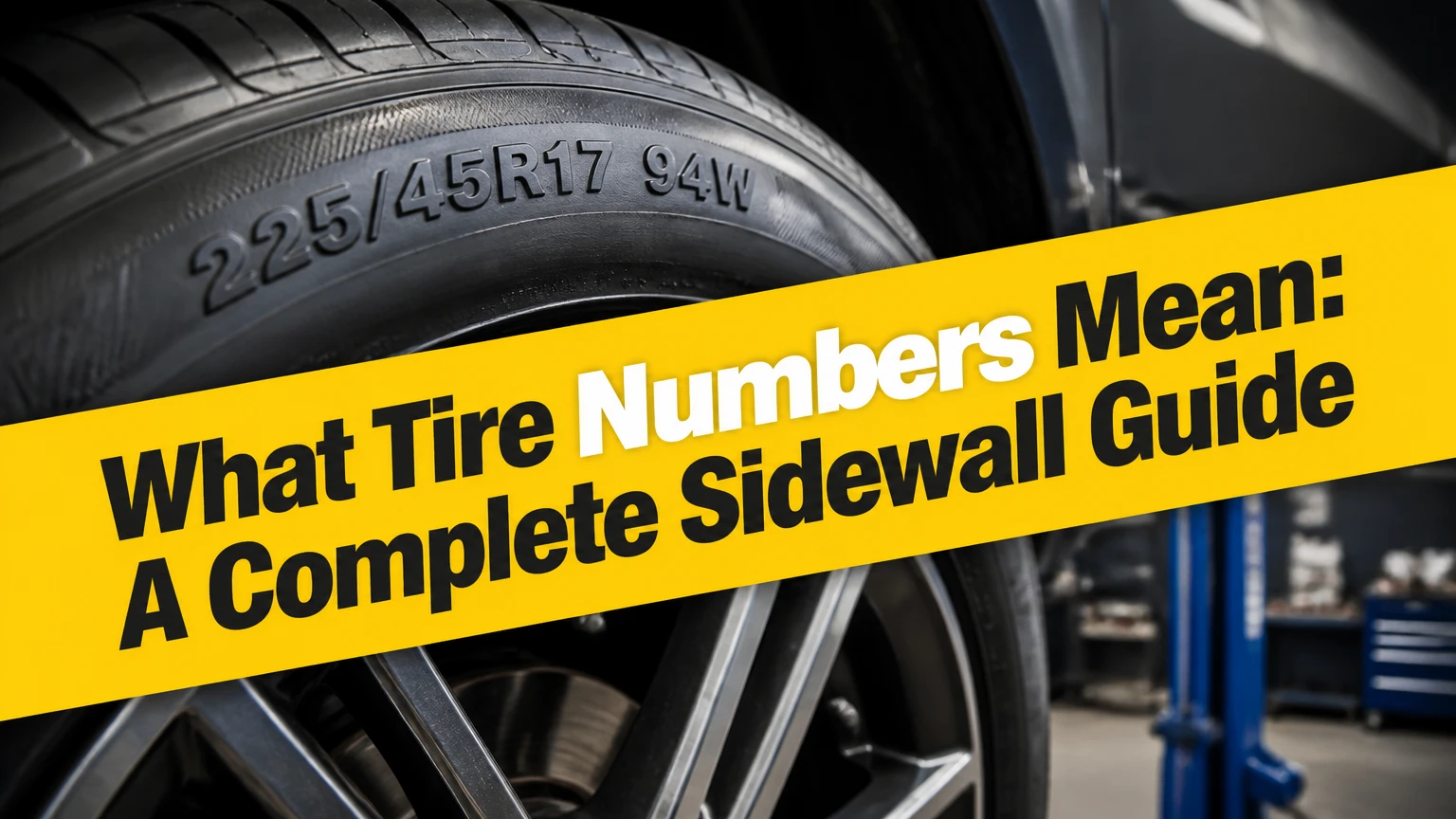
Tire numbers identify a tire’s intended vehicle class, nominal width, sidewall proportion, internal construction, wheel diameter, load capacity, and speed capability. In a code such as P215/65R15 95H, each character has a separate meaning, and the complete sequence must be checked before choosing a replacement tire.
Key Facts at a Glance
- The first three-digit number is the tire’s nominal section width in millimeters.
- The number after the slash is sidewall height expressed as a percentage of width.
- The letter R identifies radial construction, not rim size or speed.
- The wheel-diameter number is measured in inches, even though width uses millimeters.
- The load index and speed symbol form the tire’s service description.
- The final four digits of the DOT identification code show the manufacturing week and year.
What Do the Main Tire Numbers Mean?
The main tire-size sequence describes the tire’s physical dimensions and structural design, while the service description that follows states its load and speed capabilities. Consider this common example:
P215/65R15 95H
| Code | Meaning | Value in this example |
| P | Tire application | P-metric passenger tire |
| 215 | Nominal section width | 215 millimeters |
| 65 | Aspect ratio | Sidewall is 65% of 215 mm |
| R | Construction | Radial |
| 15 | Wheel diameter | Fits a 15-inch wheel |
| 95 | Load index | 1,521 pounds per tire |
| H | Speed rating | Up to 130 mph under rated test conditions |
The size marking and service description work together. A replacement tire can have the correct width and rim diameter but still be unsuitable if its load index is below the vehicle manufacturer’s requirement. USTMA advises that replacement tires retain the recommended size, load index, and speed-rating designation.
What Does the First Letter Mean?
The prefix identifies the tire’s intended application or sizing system. Not every passenger tire begins with a letter, so the absence of a prefix is also meaningful.
| Prefix | Tire category | Typical application | Important limitation |
| P | P-metric | Cars, crossovers, minivans, light-duty pickups | Load calculations differ slightly from Euro-metric sizing |
| LT | Light truck | Pickups, vans, towing, commercial use | Often requires higher inflation pressure |
| ST | Special trailer | Boat, utility, camper, and cargo trailers | Not intended for driven or steering axles |
| T | Temporary spare | Compact emergency spare | Restricted speed and distance |
| None | Euro-metric | Passenger cars, crossovers, SUVs | Do not assume exact load equivalence with P-metric |
| C after rim size | Commercial construction | Vans and certain light commercial vehicles | Must be matched by load specification |
A P215/65R15 tire is a P-metric passenger tire. A 215/65R15 tire without the P uses a metric sizing system commonly called Euro-metric. The dimensions may look identical, but load-capacity calculations and inflation requirements can differ.
An LT tire is not automatically better for every pickup. LT construction can improve load durability, but it may add weight, rolling resistance, ride firmness, and pressure requirements. The correct choice depends on the vehicle placard, axle loads, and intended service.
What Does the Three-Digit Width Number Mean?
The first three-digit number is the tire’s nominal section width in millimeters. In 215/65R15, the nominal width is 215 mm, which equals approximately 8.46 inches.
The number is not an exact tread-width measurement. Section width is measured across the widest sidewall points when the tire is installed on a specified measuring rim and inflated under defined conditions. Actual width can change slightly with wheel width, tire model, sidewall design, and manufacturing tolerances.
| Marked width | Approximate width in inches | Common vehicle context |
| 185 mm | 7.28 in | Small cars |
| 205 mm | 8.07 in | Compact and midsize cars |
| 215 mm | 8.46 in | Sedans and crossovers |
| 235 mm | 9.25 in | Crossovers, SUVs, pickups |
| 265 mm | 10.43 in | SUVs and light trucks |
A wider tire may provide a larger contact-patch shape under comparable conditions, but width alone does not guarantee better grip. Rubber compound, tread design, temperature, inflation pressure, wheel width, vehicle weight, and suspension geometry also control traction.
What Does the Number After the Slash Mean?
The number after the slash is the aspect ratio, which expresses sidewall height as a percentage of nominal section width. A 65 aspect ratio means the sidewall height is approximately 65% of the tire’s 215 mm width.
The calculation is:
215 × 0.65 = 139.75 mm
Therefore, a 215/65 tire has an estimated sidewall height of 139.75 mm, or about 5.50 inches. Because a tire has sidewall above and below the wheel, both sidewalls contribute to overall tire diameter.
How Aspect Ratio Changes the Tire
| Aspect ratio | Sidewall profile | Typical effect | Common use |
| 35-45 | Short | Quicker steering response, firmer impact feel | Performance cars |
| 50-60 | Medium | Balance of response and comfort | Sedans and crossovers |
| 65-75 | Tall | More impact cushioning, more sidewall flex | SUVs and light trucks |
| 80 or higher | Very tall | High compliance, less immediate steering | Older vehicles and specialty use |
A lower aspect-ratio number does not always mean a physically shorter sidewall. The percentage is based on tire width. A 305/40 tire, for example, has a 122 mm sidewall, while a narrower 195/50 tire has a 97.5 mm sidewall.
What Does the R Mean?
The letter R means the tire uses radial construction. In a radial tire, the primary body cords run across the tire from bead to bead, approximately perpendicular to the direction of travel.
Radial construction dominates modern passenger-vehicle tires because it separates the functions of the sidewall and tread more effectively than traditional bias construction. The result generally supports lower heat generation, longer tread life, and more consistent road contact.
| Letter | Construction | Internal layout | Typical modern application |
| R | Radial | Cords run radially from bead to bead | Most cars, SUVs, vans, and trucks |
| D | Diagonal or bias-ply | Cords cross diagonally | Trailers, vintage vehicles, equipment |
| B | Belted bias | Bias body with stabilizing belts | Rare specialty applications |
| ZR | Radial, high-speed category | Radial construction with historical Z designation | Performance tires |
The R does not mean radius, rim, or speed rating. Speed capability appears later in the service description, normally as the final letter.
What Does the Wheel-Diameter Number Mean?
The number after the construction letter identifies the diameter of the wheel seat that the tire fits. A 15 in P215/65R15 means the tire requires a 15-inch wheel.
The measurement refers to the bead-seat diameter, not the outside edge-to-edge diameter of the wheel. A tire intended for a 15-inch wheel cannot safely be mounted on a 16-inch wheel.
Special fractional sizes also require caution. A 16-inch tire is not interchangeable with a 16.5-inch tire. Even a small bead-seat mismatch can prevent correct seating and create a severe failure risk during inflation.
Calculating Approximate Overall Diameter
For a P215/65R15 tire:
- Sidewall height: 215 × 0.65 = 139.75 mm
- Convert one sidewall to inches: 139.75 ÷ 25.4 = 5.50 inches
- Double the sidewall: 5.50 × 2 = 11.00 inches
- Add the wheel diameter: 11.00 + 15 = 26.00 inches
This calculation gives a useful estimate. Published manufacturer specifications remain more accurate because actual dimensions vary by tire design and measuring rim.
What Does the Load Index Mean?
The load index is the numerical code immediately before the speed-rating letter. It identifies the maximum load one properly inflated tire can carry under its rated operating conditions.
A load index of 95 corresponds to 1,521 pounds, or 690 kilograms, per tire. The load index is a coded value, not the weight itself. Bridgestone defines it as the code specifying the load a tire can carry at the stated speed symbol and maximum inflation pressure.
| Load index | Pounds per tire | Kilograms per tire |
| 89 | 1,279 lb | 580 kg |
| 91 | 1,356 lb | 615 kg |
| 94 | 1,477 lb | 670 kg |
| 95 | 1,521 lb | 690 kg |
| 98 | 1,653 lb | 750 kg |
| 102 | 1,874 lb | 850 kg |
| 106 | 2,094 lb | 950 kg |
| 110 | 2,337 lb | 1,060 kg |
Do not determine a vehicle’s allowable weight simply by multiplying one tire’s rating by four. Vehicle capacity is limited by the lowest-rated relevant component, including axles, wheels, suspension, tires, and the manufacturer’s gross axle and gross vehicle weight ratings.
Practitioner rule: Never install a replacement tire with a lower load index than the vehicle or tire manufacturer specifies unless the change has been approved by a qualified tire professional.
What Does the Speed-Rating Letter Mean?
The final letter in a service description indicates the tire’s tested speed category while carrying the corresponding load under specified laboratory conditions. An H rating corresponds to 130 mph, or 210 km/h.
A speed rating is not a recommended road speed. It does not override posted limits, weather conditions, tire pressure, tread condition, vehicle capability, or safe-driving judgment.
| Rating | Maximum rated speed | Typical application |
| Q | 99 mph, 160 km/h | Some winter and off-road tires |
| R | 106 mph, 170 km/h | Light trucks and winter tires |
| S | 112 mph, 180 km/h | Passenger vehicles |
| T | 118 mph, 190 km/h | Touring tires |
| H | 130 mph, 210 km/h | Sport touring and sedans |
| V | 149 mph, 240 km/h | Performance vehicles |
| W | 168 mph, 270 km/h | Ultra-high-performance vehicles |
| Y | 186 mph, 300 km/h | High-performance sports cars |
Damage, underinflation, overloading, repairs, wear, and aging can reduce a tire’s usable capability. Bridgestone specifically notes that the rating represents test capability rather than a recommendation to travel at that speed.
Replacing a speed-rated tire with a lower-rated model may affect vehicle handling, maximum capability, and electronic-system calibration. Check the placard and owner’s manual before making that change.
Where Should You Find the Correct Tire Size?
The vehicle’s recommended tire specification normally appears on the driver-side door jamb, door edge, glove compartment, fuel door, or owner’s manual. The placard also lists recommended cold inflation pressures for the original tire configuration.
Use the placard as the starting point, not the numbers on a tire that happens to be installed. A previous owner may have fitted a different wheel-and-tire package.
Check these items before purchasing:
- Tire size designation
- Load index or equivalent load capacity
- Speed-rating requirement
- Front and rear size differences
- Recommended cold inflation pressure
- Spare-tire specification
- XL, reinforced, run-flat, or OE requirements
USTMA states: “Be the same size, load index and speed rating designation as recommended.” The organization also warns against using a smaller size or lower load-carrying capacity than originally specified.
What Do DOT Tire Numbers Mean?
The DOT Tire Identification Number, or TIN, is separate from the main tire-size code. Its characters identify manufacturing information, and the final four digits show the week and year of production.
For example:
DOT … 3425
- 34 means the 34th production week.
- 25 means the year 2025.
NHTSA confirms that a TIN ending in 0308 represents the third week of 2008. The complete TIN may appear on only one sidewall, so checking the inward-facing side may be necessary.
The DOT code does not provide an expiration date. Tire age must be evaluated with tread depth, cracking, repairs, storage, heat exposure, vibration, air-loss history, and manufacturer guidance. NHTSA notes that some manufacturers recommend replacement at six to ten years regardless of visible treadwear.
Michelin recommends professional annual inspection after five years of service and replacement by ten years from manufacture as a precaution, subject to product guidance and condition.
What Do Other Sidewall Letters and Symbols Mean?
Secondary markings describe inflation capacity, construction, weather qualification, original-equipment approval, and special operating features.
| Marking | Meaning | What the driver should know |
| XL or Extra Load | Reinforced passenger-tire load capacity | May require higher pressure to achieve rated load |
| RF or Reinforced | Increased load capability | Verify the specific load index and pressure |
| RFT, ROF, SSR, ZP | Manufacturer-specific run-flat designation | Requires compatible vehicle and replacement procedure |
| M+S, M/S, M&S | Mud-and-snow tread designation | Does not equal severe-snow test certification |
| 3PMSF | Three-Peak Mountain Snowflake | Tire passed a defined snow-traction performance test |
| MAX PRESS | Maximum tire inflation reference | Not the vehicle’s recommended everyday pressure |
| MAX LOAD | Maximum rated tire load | Valid only under specified pressure and conditions |
| TUBELESS | Designed to operate without an inner tube | Still requires an airtight wheel and valve |
| ROTATION arrow | Directional tread | Must rotate in the arrow’s direction |
| OUTSIDE or INSIDE | Asymmetric mounting orientation | Correct side must face outward or inward |
| OE symbols | Vehicle-maker approval | Examples vary by BMW, Mercedes-Benz, Porsche, Tesla, and others |
M+S Versus 3PMSF
An M+S marking generally indicates a tread pattern intended to provide better performance in mud and light snow than a standard reference pattern. The 3PMSF symbol indicates that the tire passed a standardized snow-traction test.
Therefore, an M+S tire should not automatically be treated as a dedicated winter tire. Drivers facing persistent snow, ice, and low temperatures should look for the 3PMSF symbol and evaluate whether a dedicated winter compound is appropriate.
What Do UTQG Numbers Mean?
The Uniform Tire Quality Grading system displays treadwear, traction, and temperature grades on many passenger tires sold in the United States. A marking may read:
TREADWEAR 600 TRACTION A TEMPERATURE A
| UTQG element | Example | Meaning |
| Treadwear | 600 | Comparative wear rating from manufacturer testing |
| Traction | AA, A, B, or C | Wet straight-line braking traction grade |
| Temperature | A, B, or C | Resistance to heat generation under test conditions |
| Exclusions | Winter and certain specialty tires | UTQG may not apply to every tire category |
A treadwear score of 600 does not guarantee six times the mileage of a score of 100 in normal driving. The rating is comparative, and differences in manufacturer testing, vehicle alignment, road surface, pressure, rotation, climate, and driving style influence real-world life.
UTQG traction also does not measure every form of grip. It should not be interpreted as a complete rating of cornering, hydroplaning resistance, dry braking, snow traction, or ice performance.
Can You Change to Different Tire Numbers?
A different tire size may work only when wheel fitment, load capacity, clearance, overall diameter, steering geometry, braking, and electronic systems remain within acceptable limits. Matching the rim diameter alone is insufficient.
Changing overall diameter affects how far the vehicle travels per wheel revolution. A larger diameter can cause the speedometer to read slower than the actual road speed, while a smaller diameter can cause it to read faster.
Effects of Changing Dimensions
| Change | Likely effect | Main risk |
| Wider section width | Different steering feel and clearance | Rubbing on suspension or bodywork |
| Narrower section width | Different grip and wheel protection | Insufficient wheel-width compatibility |
| Lower aspect ratio | Firmer response and reduced cushioning | Wheel damage from impacts |
| Higher aspect ratio | Softer impact response | Fender or suspension interference |
| Larger overall diameter | Lower engine rpm at a given road speed | Speedometer error and clearance loss |
| Smaller overall diameter | Higher engine rpm at a given road speed | Reduced ground clearance |
| Lower load index | Reduced carrying capability | Heat buildup or structural failure |
| Lower speed rating | Reduced tested capability | Altered handling and safety margin |
A common guideline is to keep overall diameter close to the manufacturer-approved specification, but a percentage rule alone cannot confirm safety. Load capacity, wheel width, offset, brake clearance, vehicle programming, and legal requirements still need review.
All-wheel-drive vehicles require extra caution. Meaningful circumference differences among tires can place continuous stress on driveline components, even when each tire fits the wheel.
Common Tire-Code Mistakes
Confusing Maximum Pressure With Recommended Pressure
The pressure molded onto the sidewall is not normally the correct everyday inflation setting. Use the vehicle placard’s cold-pressure recommendation unless the manufacturer provides a different instruction for the load or tire configuration.
Assuming a Higher Load Index Increases Payload
A higher-rated tire does not increase the vehicle’s legal or mechanical payload. Axle, wheel, suspension, chassis, and braking limits remain unchanged.
Treating the R as the Rim Size
The R identifies radial construction. The number after R identifies the required wheel diameter.
Reading 65 as a Millimeter Measurement
The aspect-ratio number is a percentage. In 215/65R15, the sidewall is approximately 65% of 215 mm, not 65 mm tall.
Buying by Size Alone
Two P215/65R15 tires may have different load indexes, speed ratings, tread types, run-flat capabilities, and weather certifications. The full service description and application must be compared.
Assuming a New-Looking Tire Is Recently Manufactured
Tread appearance does not reveal production age. Read the final four digits of the DOT TIN and inspect the tire’s condition.
Expert Insights for Choosing Replacement Tires
First, treat the tire code as a specification chain. Width, ratio, construction, rim diameter, load index, and speed rating are connected. Matching only the first five elements can still leave the vehicle under-rated.
Second, sidewall pressure and vehicle pressure answer different questions. Sidewall text describes a tire limit or rating condition. The placard states the vehicle manufacturer’s operating recommendation for the approved configuration.
Third, nominal dimensions are not guaranteed physical dimensions. Two tires carrying the same size can differ in measured tread width, overall diameter, weight, and approved rim-width range. Compare manufacturer specification sheets when suspension clearance or fitment tolerance is tight.
Frequently Asked Questions
Which tire number is the most important?
No single number is sufficient. The wheel diameter must physically match the rim, while the load index must meet the vehicle’s carrying requirement. Width, aspect ratio, construction, and speed rating also affect fit, handling, clearance, and capability. Treat the complete specification as one matched sequence.
Does a higher tire number mean a bigger tire?
Only in the attribute represented by that number. A higher width number usually means greater nominal width, but a higher aspect ratio means a taller sidewall relative to width. The wheel-diameter number describes rim fitment. Compare calculated or published overall diameter to determine which complete tire is larger.
Is 215 the tire’s tread width?
No. In a marking such as 215/65R15, 215 is the nominal section width measured across the tire’s widest sidewall area under specified conditions. The actual tread width is usually different and varies by tire model, wheel width, shoulder design, and manufacturer specifications.
Can I use a tire with a higher load index?
A higher load index is often acceptable when the tire size, wheel compatibility, pressure requirements, handling characteristics, and vehicle-manufacturer guidance remain suitable. It will not raise the vehicle’s approved payload. Extra-load or light-truck tires may also create a firmer ride or require different inflation pressures.
Can front and rear tires have different numbers?
Yes, when the vehicle manufacturer specifies a staggered fitment. Performance vehicles may use wider rear tires, and some vehicles specify different wheel diameters or load ratings by axle. Do not create a staggered setup without checking stability-control calibration, rotation limitations, clearance, and drivetrain requirements.
Why is the DOT date code visible on only one side?
The complete Tire Identification Number may be molded onto one sidewall, while the opposite side displays only a partial code. NHTSA advises checking both sides of the tire. Accessing the inward-facing side may require looking behind the wheel or removing it.
The Bottom Line
Understanding what tire numbers mean helps you verify physical fit, load capacity, speed capability, construction, weather qualification, and manufacturing age. Begin with the vehicle placard, match the complete size and service description, and treat the DOT date code and secondary markings as separate safety information rather than optional details.