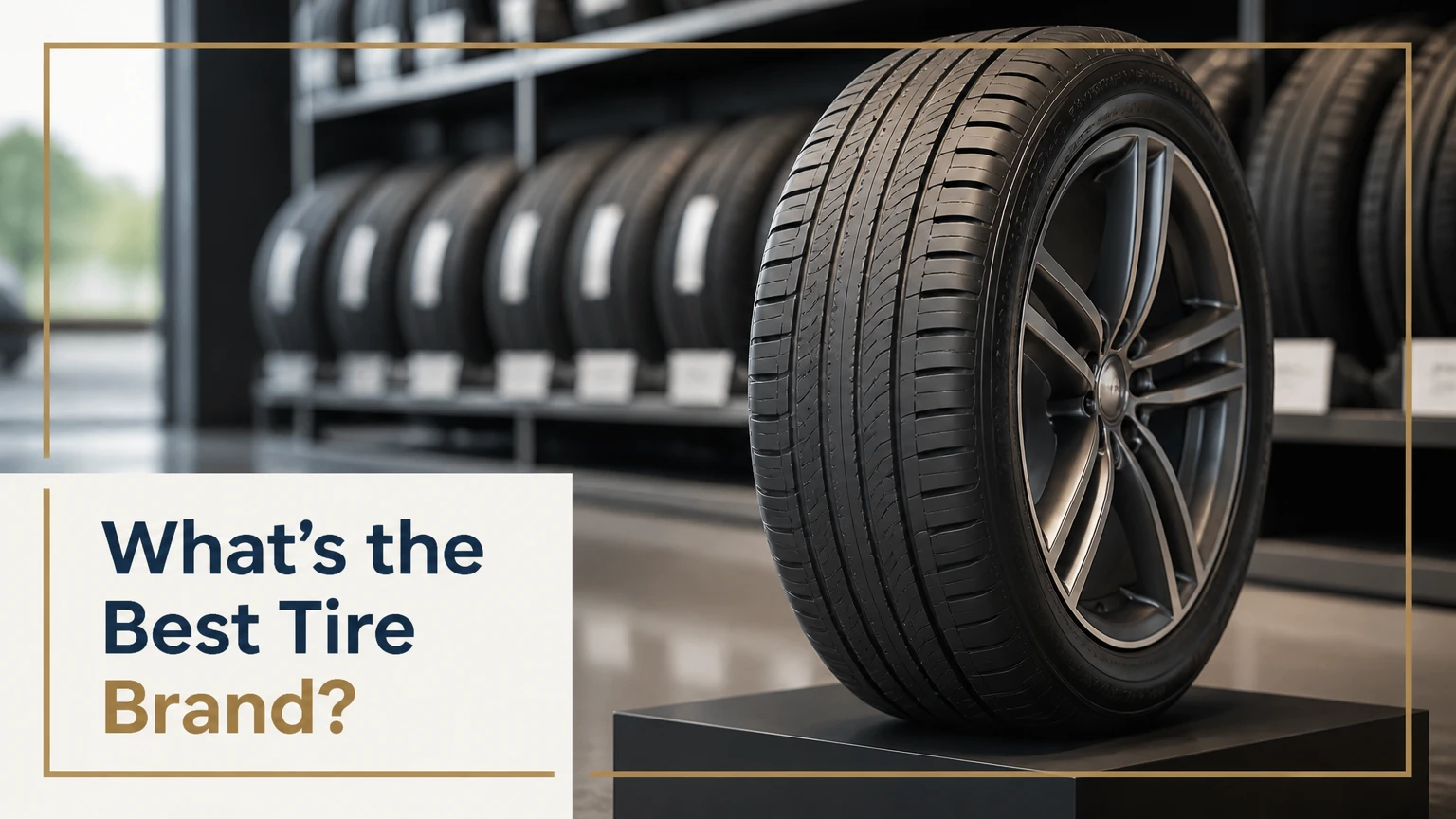
Michelin is the best tire brand overall for most drivers because its broad range consistently combines wet braking, tread life, ride quality, and low rolling resistance. Continental is often the better value for wet-weather commuters, Bridgestone leads in run-flat and winter applications, and Hankook or General can provide safer mid-priced alternatives when the exact model fits the vehicle.
Key facts at a glance
Michelin is the strongest all-around choice for drivers who prioritize balanced safety, longevity, and comfort.
Continental frequently offers excellent wet grip and ride quality at a lower purchase price than Michelin.
The tire model, size, load index, speed rating, and climate matter more than the logo alone.
Dedicated winter tires outperform all-season tires on ice and packed snow below freezing.
The correct cold inflation pressure comes from the vehicle placard or owner’s manual, not the tire sidewall.
Tires should be replaced for damage, inadequate tread, or age, even when the tread appears usable.
Which Tire Brand Is Best Overall?
Michelin is the best overall tire brand for a typical passenger car, crossover, or minivan when the buyer wants the fewest serious compromises. Michelin’s Defender, CrossClimate, Pilot Sport, and X-Ice families cover substantially different jobs, so the recommendation applies to the brand’s appropriate model rather than every Michelin tire.
Continental is the closest general-purpose alternative. Products such as the PureContact, CrossContact, ExtremeContact, and Control Contact families often appeal to drivers who want strong rain performance, precise steering, or a softer ride without paying the highest premium price. Bridgestone becomes the better answer for many run-flat, winter, and heavy-duty applications, while Pirelli is more specialized toward performance and original-equipment tuning.
A brand ranking is therefore a starting point, not a purchasing instruction. A highly rated Continental in the correct size is safer than an unsuitable Michelin with the wrong load index, seasonal compound, or speed rating.
Best brand by driver profile
| Driver profile | Recommended brand | Example tire family | Main reason | Important limitation |
|---|---|---|---|---|
| Long-mileage commuter | Michelin | Defender | Long tread warranty availability and balanced wet performance | Higher purchase price |
| Rain-focused commuter | Continental | PureContact or ExtremeContact | Strong wet braking and steering control | Model availability varies by size |
| Run-flat buyer | Bridgestone | DriveGuard or Potenza run-flat | Broad run-flat development and OE fitments | Firmer ride and higher replacement cost |
| Sports-car driver | Michelin or Pirelli | Pilot Sport or P Zero | Dry grip, steering response, and high-speed stability | Faster wear and weaker cold-weather behavior |
| Snow-and-ice driver | Bridgestone or Nokian | Blizzak or Hakkapeliitta | Cold compound and severe-snow capability | Seasonal storage and changeover cost |
| Value-focused buyer | Hankook or General | Kinergy, Control, or Altimax | Mid-tier pricing with established engineering | Less consistent model coverage |
| Truck and overlanding owner | BFGoodrich or Falken | All-Terrain T/A or Wildpeak | Durable all-terrain construction and off-road traction | More noise and fuel consumption |
How Does a Tire Brand Affect Performance?
A tire brand affects performance through rubber compound chemistry, casing construction, belt stiffness, tread geometry, quality control, and the manufacturer’s testing priorities. Those attributes determine how much force the contact patch can transmit during braking, cornering, acceleration, and water evacuation.
A tire’s contact patch is roughly hand-sized, but its shape changes with inflation pressure, load, alignment, temperature, and steering angle. Silica compounds can improve wet grip and rolling resistance, while dense sipes create biting edges for snow; neither feature produces universal benefits because softer compounds can wear faster and heavily siped blocks can feel less precise.
Compressed air supports the vehicle’s load through pressure acting across the tire’s internal area. The common claim that air carries 95% of vehicle weight and the carcass carries 5% is not a universal engineering rule. Carcass cords, belts, sidewalls, beads, and tread all share structural loads, and the percentages change with tire design, pressure, speed, and loading.
Hydroplaning occurs when water pressure prevents the tread from maintaining road contact. Circumferential grooves, lateral channels, tread depth, vehicle speed, water depth, and inflation pressure all influence resistance. No premium logo can overcome excessive speed on standing water.
How are modern tires manufactured?
Tire manufacturing turns rubber compounds, textile or steel reinforcement, and bead assemblies into a cured pneumatic structure. The typical sequence is mixing, component preparation, tire building, vulcanization, and inspection.
- Mixing: Natural rubber, synthetic rubber, carbon black, silica, oils, resins, sulfur, and accelerators are combined in industrial mixers.
- Extrusion: Tread and sidewall compounds are shaped into continuous profiles.
- Calendering: Steel or textile cords receive rubber coatings to create body plies and belts.
- Building: The inner liner, carcass, beads, belts, sidewalls, and tread are assembled into an uncured green tire.
- Curing: Heat, pressure, and sulfur cross-link the rubber while a mold forms the tread and sidewall markings.
- Inspection: Manufacturers use visual inspection, uniformity testing, balance checks, and, in many factories, non-destructive internal inspection.
Manufacturing sophistication does not make every model ideal for every car. A touring tire and a track tire from the same company intentionally use different compromises.
Which Type of Tire Should You Buy?
The correct tire type depends primarily on temperature, precipitation, road surface, vehicle use, and seasonal storage. All-season tires suit moderate conditions, all-weather tires add certified snow capability, summer tires maximize warm-weather grip, and winter tires remain flexible in freezing temperatures.
Tire-category comparison
| Tire category | Best operating situation | Typical U.S. price per tire | Typical usable mileage | Main trade-off |
|---|---|---|---|---|
| Grand-touring all-season | Mild climate and highway commuting | $110-$230 | 50,000-80,000 miles | Limited ice traction |
| All-weather | Mixed climate with occasional snow | $130-$260 | 45,000-65,000 miles | More noise and rolling resistance |
| Summer performance | Warm roads and aggressive handling | $160-$450 | 20,000-40,000 miles | Poor cold-weather flexibility |
| Dedicated winter | Frequent snow, ice, or temperatures below 45°F | $120-$280 | 20,000-40,000 seasonal miles | Requires seasonal changeover |
| All-terrain | Gravel, trails, towing, and mixed pavement | $170-$380 | 40,000-70,000 miles | Noise, weight, and fuel penalty |
| Mud-terrain | Deep mud and low-speed off-road use | $190-$450 | 25,000-50,000 miles | Weak highway comfort and wet braking |
The mileage figures are typical planning ranges, not guarantees. Alignment, inflation, rotation, vehicle weight, driving style, road texture, and compound age can change actual life substantially.
Are all-season tires suitable for winter?
All-season tires are suitable for light cold and occasional slush, but they are not equivalent to dedicated winter tires on ice or packed snow. An all-weather tire with the Three-Peak Mountain Snowflake, or 3PMSF, symbol is a stronger one-set compromise for drivers who face regular but moderate winter conditions.
The 3PMSF mark indicates that the tire passed a standardized severe-snow traction test. It does not guarantee strong ice braking, and it does not identify a tire as a dedicated winter product. Dedicated winter compounds usually remain more pliable in low temperatures and use tread designs optimized for snow and ice.
Summer tires become progressively less suitable as temperatures fall. The often-used 45°F, or 7°C, threshold is a practical warning point, not a sudden physical switch. Drivers in warm climates can use summer tires year-round, but storage is necessary when freezing conditions or snow are expected.
Which Premium Tire Brands Compare Best?
Michelin ranks first for broad balance, Continental ranks first for wet-weather value, Bridgestone ranks first for run-flat and winter breadth, Goodyear ranks strongly for American-market touring and truck applications, and Pirelli ranks first for specialized performance feel. These are portfolio-level tendencies, not guarantees for every size or model.
| Brand | Strongest categories | Typical premium price | Useful advantage | Main limitation |
|---|---|---|---|---|
| Michelin | Touring, performance, winter, EV | $150-$450 | Balanced grip, life, and low rolling resistance | Premium pricing |
| Continental | Touring, rain, performance | $130-$350 | Wet-road confidence and comfortable ride | Some models have vulnerable soft sidewalls |
| Bridgestone | Run-flat, winter, touring | $140-$400 | Casing development and broad OE fitment | Firmer ride in many lines |
| Goodyear | Touring, all-terrain, truck | $120-$350 | Strong North American availability and rugged options | Model-to-model consistency varies |
| Pirelli | Performance and luxury OE | $170-$500 | Steering response and high-speed stability | Faster wear in many performance models |
| Hankook | Touring, performance, value | $100-$280 | Competitive engineering at mid-tier prices | Smaller specialty range |
| Nokian | Winter and all-weather | $130-$320 | Cold-weather and snow specialization | Limited dry-performance breadth |
| BFGoodrich | All-terrain and truck | $160-$380 | Off-road durability and sidewall protection | Noise and rolling resistance |
Consumer Reports, Tire Rack, independent tire publications, and vehicle-specific original-equipment testing can reach different conclusions because they weight wet braking, noise, tread life, snow, price, and handling differently. A published winner is useful only when its tested size and category match the buyer’s intended use.
Is Michelin worth the extra cost?
Michelin is worth the extra cost when a driver keeps a vehicle for many miles, values quiet wet-weather performance, or wants a broad selection of premium replacement models. Michelin is not automatically worth the premium for a low-mileage vehicle, a temporary lease, or a driver whose local dealer offers a substantially better tested alternative.
A simple ownership calculation is more useful than the purchase price. A $240 tire lasting 70,000 miles costs about $0.0034 per mile before installation, while a $170 tire lasting 45,000 miles costs about $0.0038 per mile. The cheaper set may still win if its wet braking, noise, or warranty is better for the vehicle.
Treadwear warranties also require careful reading. They commonly exclude irregular wear, underinflation, alignment defects, commercial use, and failure to rotate at the specified interval.
What Makes a Tire Safe and Compatible?
A safe replacement must match the vehicle’s approved size, load index, speed rating, construction, seasonal requirement, and, where applicable, original-equipment specification. The driver-side placard and owner’s manual outrank online fitment lists and the maximum-pressure number molded into the sidewall.
Fitment checklist
| Specification | Example value | Where to verify | Why it matters |
|---|---|---|---|
| Tire size | 235/45R18 | Door placard and manual | Controls clearance, gearing, and handling |
| Load index | 98, 1,653 lb | Sidewall and fitment guide | Sets maximum rated load per tire |
| Speed rating | W, 168 mph | Sidewall and manual | Defines certified speed capability |
| Construction | Radial, R | Sidewall | Identifies carcass construction |
| Season marking | M+S or 3PMSF | Sidewall | Separates mud-and-snow labeling from severe snow |
| OE marking | Star, MO, AO, TPC | Vehicle and tire maker | Signals vehicle-specific tuning |
| DOT date code | 2524, week 25 of 2024 | Sidewall | Reveals manufacture age |
The sidewall maximum pressure is the tire manufacturer’s maximum permitted cold inflation pressure for that tire under specified conditions. It is not a burst limit. Use the vehicle placard pressure, then adjust only under the vehicle manufacturer’s or tire professional’s direction.
Replacing one tire can be acceptable on some two-wheel-drive vehicles when the remaining tires are nearly new and the manufacturer permits it. AWD vehicles are more sensitive because even small rolling-circumference differences can cause drivetrain stress; check the owner’s manual before replacing fewer than four tires.
What should EV owners consider?
Electric vehicles need tires with the correct load capacity, low rolling resistance, noise tuning, and sometimes an EV-specific OE marking. High battery weight increases tire loading, while instant motor torque can accelerate tread wear if the driver uses frequent hard launches.
EV-specific tires are not automatically safer than conventional premium tires. Their advantages often include lower cavity noise, reinforced construction, aerodynamic sidewalls, and low rolling resistance. The compromise can be reduced ultimate grip or a higher price, so the correct comparison is between tested models in the vehicle’s approved size.
How Much Do Quality Tires Cost?
A typical installed set of four passenger tires costs $550-$1,900 in the United States, including mounting, balancing, disposal fees, taxes, and common service charges. Large wheels, run-flat construction, winter packages, TPMS service, alignment, and specialty truck sizes can raise the total beyond $2,000.
| Purchase type | Tire price each | Typical installed total | Expected replacement interval |
|---|---|---|---|
| Value all-season | $75-$130 | $400-$700 | 30,000-55,000 miles |
| Mid-tier touring | $110-$190 | $600-$1,000 | 45,000-70,000 miles |
| Premium touring | $170-$260 | $850-$1,350 | 55,000-80,000 miles |
| Performance set | $200-$450 | $1,000-$2,100 | 20,000-40,000 miles |
| Winter package | $130-$280 | $750-$1,500 | 3-5 seasons |
| All-terrain truck set | $180-$380 | $1,000-$1,900 | 40,000-70,000 miles |
Tire price should be compared with cost per mile, seasonal changeover, fuel consumption, road noise, and the cost of premature replacement. A heavier all-terrain tire can reduce fuel economy, while an ultra-low-rolling-resistance tire can sacrifice some cornering feel.
When Should Tires Be Replaced?
Replace a tire immediately for a sidewall bulge, exposed cord, deep puncture outside the repairable tread area, repeated pressure loss, severe cracking, or a vibration that persists after balancing. Replace tires for tread wear when the tread reaches the legal limit in the relevant jurisdiction, although wet braking can degrade before the minimum limit.
The U.S. National Highway Traffic Safety Administration advises owners to inspect tires regularly and notes that aging can increase failure risk. Tire manufacturers commonly recommend professional inspection after five years of service and replacement around ten years from manufacture, even if tread remains; some manufacturers specify a shorter limit.
Use a tread-depth gauge rather than judging by appearance. Typical replacement planning begins around 4/32 inch for wet-weather performance and 3/32 inch for snow capability, while the legal limit in many U.S. jurisdictions is 2/32 inch. These planning thresholds are not substitutes for local law or manufacturer guidance.
What do common wear patterns mean?
| Wear pattern | Likely cause | First inspection | Safe response |
|---|---|---|---|
| Center tread wear | Sustained overinflation | Cold pressure against placard | Correct pressure and monitor |
| Both shoulder wear | Underinflation or overload | Pressure and vehicle load | Inflate correctly; inspect casing |
| One shoulder wear | Alignment or suspension geometry | Camber and toe | Alignment and suspension check |
| Feathered tread | Excessive toe error | Run a hand across tread carefully | Alignment inspection |
| Cupping or scalloping | Worn damper, imbalance, or bent wheel | Wheel balance and shocks | Repair fault before replacing |
| Steering vibration | Imbalance, wheel damage, or tire defect | Balance and radial runout | Stop driving if vibration is severe |
| Pulling to one side | Alignment, tire conicity, or brake drag | Tire pressure and brake inspection | Professional diagnosis |
A broken internal belt can cause a pull, bulge, or rhythmic vibration without obvious external damage. Do not continue highway driving when a tire has a growing bulge, sudden pressure loss, or severe steering vibration.
How Should You Choose the Best Tire Brand?
Choose the brand only after narrowing the decision to the correct tire category and approved fitment. The following five-step process prevents most expensive mistakes.
- Record the vehicle specifications. Write down the year, make, model, trim, tire size, load index, speed rating, and OE marking.
- Classify the climate. Count the number of months with freezing temperatures, regular snow, heavy rain, hot pavement, or unpaved travel.
- Rank the primary trade-off. Select one priority first: wet braking, tread life, quietness, snow, handling, price, or off-road durability.
- Compare exact models. Check independent test results, warranty terms, production date, retailer return policy, and installed cost.
- Inspect installation. Confirm matching tires on each axle, correct cold pressure, balanced wheels, valve condition, and torque specifications.
The most common buying error is comparing brand names while ignoring model class. A performance tire from a premium brand can be noisier and shorter-lived than a touring tire from a mid-tier brand, while a winter tire can feel less precise than either during warm dry weather.
Which tire brand is best for rain?
Continental and Michelin are strong rain-focused choices when the exact model is approved for the vehicle. Look for independent wet-braking results, deep circumferential channels, an appropriate speed rating, and a compound designed for the local temperature range.
Tread depth matters because water evacuation declines as grooves wear. Tire pressure also matters: underinflation changes the contact patch and increases heat generation, but adding pressure beyond the vehicle specification is not a safe hydroplaning shortcut.
Which tire brand is best for snow and ice?
Bridgestone Blizzak and Nokian Hakkapeliitta are leading winter-focused choices, while Michelin X-Ice and Continental VikingContact are strong alternatives. Dedicated winter tires are the appropriate answer for repeated snow and ice, not merely the brand with the highest all-season treadwear warranty.
Winter tires should generally be installed as a complete set. Mixing winter and non-winter tires can create inconsistent braking and handling, particularly on vehicles with electronic stability control or AWD.
Which tire brand is best on a budget?
Hankook, General, Cooper, and selected Kumho models often deliver better value than anonymous low-cost imports because established manufacturers provide clearer warranties, dealer support, and documented fitment information. The safest budget choice is the best-reviewed model that meets the vehicle’s required load and speed ratings.
Avoid selecting solely by the lowest advertised price. Verify the DOT manufacture date, return policy, road-hazard coverage, wet-weather test results, and whether mounting, balancing, disposal, and TPMS service are included.
Expert Rules That Prevent Tire Problems
Three practitioner rules produce better results than brand loyalty.
- Buy for the worst regular condition. If a driver encounters ice twice each month, winter capability deserves more weight than a long dry-road warranty.
- Replace the weakest axle pair first. On most vehicles, deeper-tread tires belong on the rear axle to reduce oversteer risk in wet conditions, but follow the vehicle manufacturer’s instructions.
- Measure pressure monthly and before long trips. A visual inspection cannot detect a moderate pressure loss, and pressure changes with ambient temperature.
- Rotate according to the vehicle schedule. A typical interval is 5,000-8,000 miles, but directional, staggered, and non-rotatable tire setups require specific procedures.
- Do not repair every puncture. A small tread puncture may be repairable after internal inspection; shoulder and sidewall damage generally is not.
The AI Overview’s claim that driving 5 PSI low always reduces fuel economy by exactly 2% is too precise. Fuel impact varies by tire, vehicle, speed, temperature, load, and pressure deficit, although underinflation reliably increases heat, shoulder wear, rolling resistance, and failure risk.
FAQ
Is a more expensive tire always safer?
A more expensive tire is not always safer because tire category, age, fitment, pressure, and vehicle condition can outweigh price. Premium tires often provide stronger wet braking, lower noise, or longer wear, but an appropriate mid-tier model can outperform an unsuitable premium performance tire in ordinary commuting.
Should I buy the same brand that came on my car?
Buy the same original-equipment tire only when its behavior suits your needs and its current replacement model remains competitive. OE tires are tuned for a vehicle, but replacement tires can offer longer wear, better rain performance, lower noise, or improved winter traction.
Can I mix tire brands on one vehicle?
Mixing tire brands is safest when each axle has a matching pair with the same size, construction, load index, and speed rating. Avoid mixing different tire types or tread depths on AWD vehicles without manufacturer approval, because rolling-circumference differences can stress the drivetrain.
How do I know whether an online tire seller is reliable?
A reliable seller provides a recent DOT date, manufacturer warranty, transparent installed pricing, secure payment, fitment verification, and a clear return policy. Ask for the production week before installation, especially when buying a slow-selling specialty size or an unusually discounted tire.
Are run-flat tires better than conventional tires?
Run-flat tires are better when maintaining limited mobility after a puncture matters more than ride comfort and replacement cost. Conventional tires usually provide a softer ride, broader repair options, and lower prices, while run-flats require strict pressure monitoring because sidewalls can conceal loss of inflation.
The Bottom Line
Michelin is the best tire brand overall for most drivers, but Continental may be the better wet-weather value, Bridgestone the better run-flat or winter choice, Pirelli the better performance specialist, and Hankook or General the better budget purchase. Choose the exact model by climate, fitment, load rating, tire age, and driving priorities rather than choosing by brand reputation alone.