You should change a tire when its tread reaches 2/32 inch, when wear bars become level with the tread, or when the tire has a bulge, exposed cords, deep cracking, internal damage, or an unrepairable puncture. For safer wet-road performance, begin replacement planning at 4/32 inch rather than waiting for the minimum.
Key Facts at a Glance
- A tire at 2/32 inch has reached the widely used minimum replacement threshold.
- A tire at 4/32 inch can already have substantially reduced wet-road braking and handling.
- A sidewall bulge, exposed cord, or belt separation requires immediate replacement.
- Tire age must be checked from the DOT date code, not the purchase date alone.
- Many manufacturers recommend professional annual inspections after five or six years.
- Ten-year-old tires should generally be replaced even when tread remains.
When to Change Tire Immediately
Change a tire immediately when it has exposed fabric or steel cords, a sidewall bulge, tread separation, severe cracking, repeated pressure loss, or tread at 2/32 inch. These conditions indicate that the tire may no longer carry the vehicle’s load or maintain dependable contact with the road.
Do not drive normally on a tire with structural damage. A bulge often means internal cords have broken after a pothole, curb strike, overload, or low-pressure impact. The tire may still hold air, but air pressure is pushing against a weakened section of the casing.
Stop using the tire and arrange roadside service when you see any of these signs:
- A bubble or bulge on the sidewall
- Steel belt, textile cord, or casing material
- A split extending into the tire structure
- Tread lifting away from the body
- A cut too deep to confirm as superficial
- Rapid or repeated pressure loss
- Severe vibration that begins suddenly
- Damage after driving while nearly flat
NHTSA advises replacing tires with cuts, cracks, bulges, irregular wear, insufficient tread, or performance problems such as unexplained noise and vibration.
How Much Tire Tread Is Too Little?
A tire must be replaced by 2/32 inch of remaining tread, but that number should be treated as a last limit rather than an ideal shopping point. Drivers who regularly encounter rain should consider replacement around 4/32 inch, while winter tires may lose useful snow traction near 6/32 inch.
| Remaining tread | Approximate depth | Practical action | Main concern |
| New passenger tire | 9/32-12/32 in. | Inspect monthly | Normal wear monitoring |
| Moderate wear | 6/32 in. | Continue monitoring | Winter traction begins weakening |
| Wet-weather planning point | 4/32 in. | Begin replacement | Longer wet braking, less water evacuation |
| Minimum threshold | 2/32 in. | Replace immediately | Wear bars exposed, hydroplaning risk |
| Below minimum | Under 2/32 in. | Do not continue normal use | Severely reduced traction |
Grooves move water away from the contact patch. As those grooves become shallower, the tire has less volume available to channel water, which raises the chance that a layer of water will separate the tread from the pavement.
Tread depth also needs to be checked across the full width. A tire can show 5/32 inch in the center but less than 2/32 inch on an inner shoulder that is difficult to see.
Should You Replace Tires at 4/32 Inch?
Replacing at 4/32 inch is a sensible safety decision for frequent rain, highway travel, heavy traffic, or drivers who cannot avoid standing water. Waiting until 2/32 inch may satisfy a minimum tread rule, but wet-road performance declines before the wear bars become flush.
AAA tested all-season tires worn to 4/32 inch against new tires on wet pavement. The worn tires increased average stopping distance by 87 feet for a passenger car and reduced its handling ability by 33 percent. At the point where the vehicle on new tires had stopped from 60 mph, the vehicle on worn tires was still moving at about 40 mph.
Greg Brannon, AAA’s former director of Automotive Engineering, summarized the issue: “Even the most advanced safety systems rely on a tire’s basic ability to maintain traction.”
A practical rule is simple. Use 2/32 inch as the immediate replacement limit, but use 4/32 inch as the planning threshold when wet-road safety matters.
How Can You Check Tire Tread at Home?
Measure tread in several grooves across the inner, center, and outer portions of each tire. A dedicated tread-depth gauge gives the clearest reading, while wear bars, a U.S. penny, and a U.S. quarter provide quick screening methods.
Use a Tread-Depth Gauge
Insert the gauge probe into a main circumferential groove, press its base flat against the tread, and record the reading. Repeat at three positions across the tire and at several points around its circumference.
Small digital or mechanical gauges commonly measure in 32nds of an inch or millimeters. Record the lowest result, not the average.
Check the Built-In Wear Bars
Treadwear indicators are raised rubber bars molded across the main grooves. When surrounding tread is level with a bar, approximately 2/32 inch remains and the tire needs replacement.
NHTSA requires treadwear indicators at the 2/32-inch level for applicable tires and describes that depth as the point where traction characteristics deteriorate rapidly.
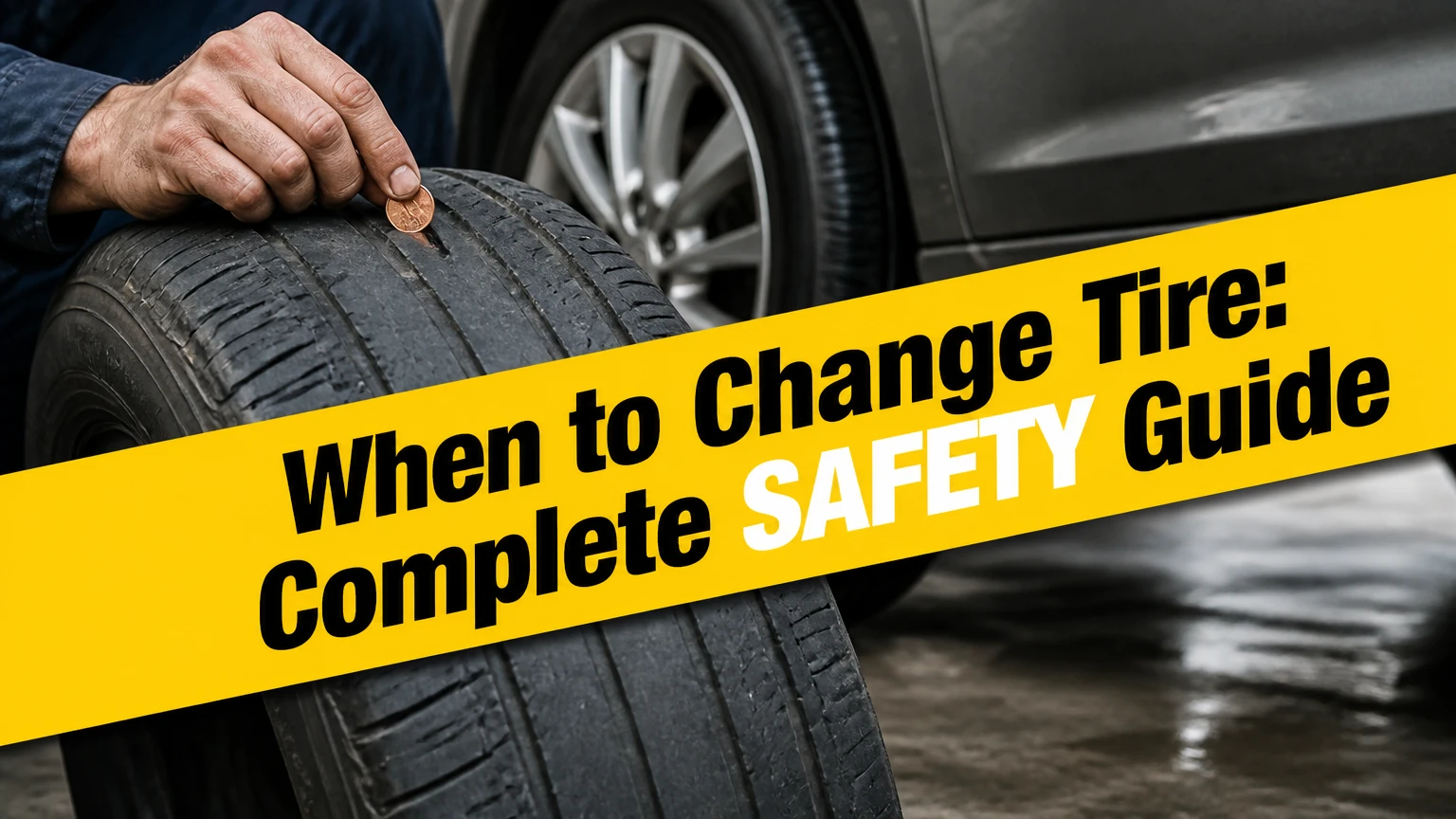
Perform the Penny and Quarter Tests
Insert a penny with Lincoln’s head upside down. Seeing the full top of Lincoln’s head indicates about 2/32 inch or less.
A quarter provides an earlier wet-weather warning. Insert it with Washington’s head down. If the top of the head is fully visible, tread is near or below 4/32 inch, so replacement planning should begin. AAA recommends the quarter method because wet performance has already declined at this depth.
When Should Tires Be Changed Because of Age?
Tire age becomes a replacement factor even when the tread looks deep. Aging rubber, bonding materials, and internal components are affected by heat, oxygen, sunlight, storage conditions, inflation history, vehicle load, and use.
There is no universal rule requiring every tire to be discarded on its sixth birthday. NHTSA states that some vehicle and tire manufacturers recommend replacement between six and ten years, regardless of treadwear. The vehicle owner’s manual and tire manufacturer’s guidance should control when they specify an earlier limit.
Michelin recommends annual professional inspections after five years of service and replacement at ten years from manufacture as a precaution, including for spare tires.
| Tire age | Recommended response | Reason |
| 0-4 years | Monthly owner checks | Damage and wear matter more than age alone |
| 5 years | Start annual professional inspections | Aging may not be externally obvious |
| 6-9 years | Follow maker and vehicle guidance closely | Failure risk rises with age and exposure |
| 10 years | Replace as a precaution | Maximum recommended service life for many brands |
| Unknown age | Read DOT code before continued use | Purchase date does not prove manufacture date |
Low-mileage vehicles deserve extra attention. Trailers, collector cars, recreational vehicles, secondary cars, and full-size spares may age out before they wear out.
How Do You Read the DOT Date Code?
The last four digits of the complete DOT Tire Identification Number show the week and year of manufacture. A code ending in 2422 means the tire was manufactured during the 24th week of 2022.
The full code may appear on only one sidewall, so check the inward-facing side when the visible code is incomplete. A three-digit ending indicates manufacture before 2000 and confirms that the tire is far beyond a reasonable passenger-vehicle service life.
Calculate age from the manufacturing week, not installation or purchase. A tire can spend months in distribution before being fitted, although storage conditions influence aging differently from road service.
What Visible Damage Means a Tire Must Go?
Sidewall bulges, exposed cords, tread separation, and deep structural cuts require replacement because conventional tire repair cannot restore the damaged casing. Minor surface marks may be harmless, but any uncertain sidewall damage should be examined without delay.
| Damage type | Likely meaning | Correct response |
| Sidewall bulge | Broken internal cords | Replace immediately |
| Exposed steel or fabric | Tread or casing worn through | Stop normal driving |
| Tread separation | Belt or bonding failure | Tow or install an approved spare |
| Deep sidewall cut | Compromised load-carrying structure | Replace |
| Fine surface checking | Weathering or ozone exposure | Professional inspection |
| Nail in central tread | Possible repair candidate | Inspect internally |
| Puncture in shoulder | High-flex, nonrepairable area | Replace |
| Flat-spot vibration | Storage, braking, or internal damage | Diagnose before highway use |
Cracking must be judged by depth and location. Fine cosmetic checking is different from cracks that open under flexing, reveal underlying material, or cover an old, hardened sidewall.
Can a Damaged Tire Be Repaired Instead?
A small puncture may be repairable when it is confined to the tread’s central repairable area and the tire has not been driven while underinflated. Sidewall punctures, shoulder damage, large holes, exposed cords, run-flat damage, and internal separation normally require replacement.
A proper assessment requires removing the tire from the wheel. An external plug alone cannot reveal inner-liner damage, broken cords, rubber dust, heat rings, or abrasion caused by driving with insufficient pressure.
Repair does not reset the tire’s age or tread condition. A technically repairable nail hole does not make sense to fix when the tire is already at its replacement threshold, has widespread cracking, or shows multiple unsafe conditions.
What Do Tire Wear Patterns Mean?
Wear patterns identify both the replacement need and the fault that could ruin the next tire. Replacing worn rubber without correcting pressure, alignment, balance, bearing, brake, or suspension problems can cause the same pattern to return quickly.
| Wear pattern | Common cause | Required action |
| Center wear | Chronic overinflation | Set cold pressure from door placard |
| Both shoulders worn | Chronic underinflation | Check for leaks and correct pressure |
| One shoulder worn | Camber or toe problem | Alignment and suspension inspection |
| Feathered tread edges | Incorrect toe setting | Alignment |
| Cupping or scalloping | Worn dampers, imbalance, looseness | Inspect suspension and balance |
| Localized bald patch | Skid, lockup, or flat spotting | Replace if depth or structure is unsafe |
| Diagonal wear | Misalignment or component looseness | Full chassis inspection |
| Rapid drive-wheel wear | High torque, acceleration, or missed rotation | Rotate on schedule |
A wheel alignment is not automatically required every time tires are installed. It is justified when old tires have uneven wear, the vehicle pulls, the steering wheel is off-center, suspension work was performed, or measurements fall outside specification.
That distinction prevents unnecessary service while protecting the new set.
Can Vibration Tell You When to Replace a Tire?
A new or worsening vibration can indicate a tire problem, but replacement should follow diagnosis rather than guesswork. Common causes include lost wheel weights, bent wheels, mud buildup, alignment faults, worn suspension parts, flat spotting, belt separation, and out-of-round tires.
Slow-speed thumping that intensifies with speed deserves prompt inspection. A separated belt can distort the tread or sidewall even when air pressure remains normal.
Do not assume balancing will fix every vibration. If repeated balancing fails, the technician should inspect radial runout, lateral runout, wheel damage, internal separation, and hub mounting surfaces.
Should You Replace One, Two, or Four Tires?
Replace at least both tires on the same axle when practical, and install the pair with deeper tread on the rear axle unless the vehicle manufacturer specifies otherwise. Many AWD vehicles require all four tires to remain within a narrow circumference or tread-depth difference.
| Vehicle situation | Typical replacement approach | Main reason |
| One damaged tire, nearly new set | One matching tire may be possible | Existing tread depths remain close |
| Two worn tires | Replace the axle pair | Balanced grip across that axle |
| Front-wheel-drive vehicle | Put deeper pair on rear | Helps resist rear hydroplaning |
| Rear-wheel-drive vehicle | Put deeper pair on rear | Preserves rear stability |
| AWD with large tread difference | Replace four or match tread depth | Protects drivetrain components |
| Mixed seasonal tires | Avoid mixing on normal road use | Grip changes sharply by axle |
The exact AWD tolerance varies by manufacturer. Some replacement tires can be professionally shaved to match the remaining tread when the other three are healthy, but this should follow the vehicle maker’s requirements.
Expert rule: matching the printed tire size is not always enough. Construction type, load index, speed rating, tread depth, and rolling circumference also affect stability and drivetrain operation.
How Many Miles Do Tires Last?
Passenger tires often last roughly 25,000-80,000 miles, but no mileage figure overrides tread, age, or damage. Tire category, compound, vehicle weight, wheel alignment, inflation, rotation, road surface, temperature, towing, torque, and driving style can move actual life far outside an advertised range.
| Tire category | Typical mileage range | Common limiting factor |
| Touring all-season | 50,000-80,000 miles | Age, alignment, or wet grip |
| Standard all-season | 40,000-70,000 miles | Mixed use and rotation |
| Performance all-season | 30,000-50,000 miles | Softer compound |
| Summer performance | 20,000-40,000 miles | Heat cycles and aggressive driving |
| Winter tire | 3-6 winter seasons | Compound aging and warm-road wear |
| All-terrain | 40,000-60,000 miles | Load, towing, and off-road cuts |
| EV-focused tire | 25,000-50,000 miles | Vehicle mass and instant torque |
A treadwear warranty is a conditional warranty, not a safety prediction. It may require proof of rotation, correct inflation, alignment records, even wear, and use on an eligible vehicle.
How Much Does Tire Replacement Cost?
A common passenger-car replacement costs about $100-$350 per tire before optional alignment or premium protection plans. Wheel size, speed rating, load rating, run-flat construction, specialty compounds, brand, and local labor cause major price differences.
| Expense | Typical U.S. range | Notes |
| Economy passenger tire | $70-$140 each | Smaller common sizes |
| Mid-range tire | $120-$220 each | Broad all-season selection |
| Premium or specialty tire | $200-$450+ each | Large, run-flat, EV, or performance sizes |
| Mounting and balancing | $20-$50 each | Often bundled into package pricing |
| Valve or TPMS service | $5-$25 each | Sensor replacement costs more |
| Disposal fee | $2-$10 each | Varies by jurisdiction |
| Wheel alignment | $100-$220 | Needed when diagnosis supports it |
| Four-tire installation time | 45-90 minutes | Longer with alignment or seized hardware |
Ask for the complete installed price. An advertised tire price may exclude mounting, balancing, valve service, disposal, taxes, shop supplies, and alignment.
Which Replacement Tire Type Fits Your Driving?
Choose the replacement category according to climate, temperature, road surface, load, and expected use. Buying the longest advertised warranty is not always the safest choice when the vehicle regularly encounters snow, high heat, rough terrain, or performance driving.
| Tire type | Best application | Main limitation |
| Touring all-season | Commuting, low noise, long life | Limited severe-snow capability |
| Performance all-season | Responsive year-round handling | Shorter tread life |
| Summer tire | Warm-weather wet and dry grip | Unsuitable in freezing conditions |
| Winter tire | Snow, ice, and sustained cold | Rapid wear in warm weather |
| All-terrain | Mixed pavement and trail use | More noise and rolling resistance |
| Highway-terrain | Trucks, towing, road use | Less off-road traction |
| EV-specific | Heavy EVs, range and noise targets | May cost more |
| Run-flat | Temporary mobility after pressure loss | Firmer ride and limited repairability |
Use the size, load index, speed rating, and construction required by the vehicle placard or owner’s manual. Never reduce load capacity merely to lower the purchase price.
How Can You Extend Tire Life?
Correct cold inflation, scheduled rotation, timely alignment diagnosis, balanced wheels, moderate driving, and monthly inspections extend usable tire life. Maintenance cannot reverse aging or structural damage, but it prevents avoidable heat buildup and uneven tread loss.
Follow these practices:
- Check cold pressure monthly and before long trips.
- Use the driver-door placard pressure, not the sidewall maximum.
- Rotate at the vehicle or tire maker’s interval, often 5,000-8,000 miles.
- Inspect tread across the full width.
- Address pulling, vibration, and steering changes early.
- Avoid curb strikes and potholes where possible.
- Recheck tires after a severe impact.
- Inspect the spare and verify its pressure.
- Avoid overloading beyond the vehicle rating.
- Record DOT codes and installation dates.
NHTSA notes that TPMS warnings indicate at least one tire is already significantly underinflated. TPMS supports pressure maintenance, but it does not measure tread, detect every slow leak, or determine tire age.
Common Tire Replacement Mistakes
The most expensive mistakes happen when the driver treats tire replacement as a purchase only and ignores the cause of wear.
- Waiting for a bald appearance: A tire can be unsafe in rain before it looks bald.
- Checking only the outer shoulder: Inner-edge wear may be hidden behind the bodywork.
- Replacing one AWD tire without checking circumference: Excessive mismatch can strain the drivetrain.
- Assuming a bulge can be patched: A bulge represents casing damage, not a simple air leak.
- Using sidewall pressure as the target: The sidewall shows a limit, while the placard provides the vehicle setting.
- Skipping diagnosis of uneven wear: The new tire may develop the same damage.
- Ignoring spare-tire age: Spares age even when they retain full tread.
- Relying only on mileage: A low-mileage tire can still be too old, cracked, or structurally damaged.
Frequently Asked Questions
Can tires fail even when they have plenty of tread?
Yes. A tire can fail because of age, internal impact damage, underinflation, overloading, heat exposure, manufacturing damage, or separation while substantial tread remains. Tread depth is only one inspection category. Sidewall condition, pressure history, performance changes, DOT age, and internal condition also affect serviceability.
Does a TPMS light mean the tire needs replacement?
A TPMS light means at least one tire is significantly underinflated, not automatically worn out. Inflate and inspect the tire promptly. Replacement becomes necessary when pressure loss comes from unrepairable damage, the tire was driven flat and damaged internally, or other age, tread, or structural limits are present.
Should new tires be installed on the front or rear?
When only two tires are replaced, the pair with greater tread depth is generally installed on the rear axle to improve stability on wet roads. This applies even to many front-wheel-drive vehicles. Follow the vehicle or tire manufacturer’s instructions when they specify another configuration.
Can I mix different tire brands?
Different brands may be used in limited situations when size, construction, load rating, speed rating, category, and performance are compatible, but matching tires across each axle is preferable. AWD systems may require closer tread and circumference matching. Never mix radial and bias-ply construction unless specifically approved.
Do unused tires expire in storage?
Unused tires still age, although storage temperature, sunlight, ozone, humidity, and positioning affect the rate. Read the DOT manufacturing date before installation. A tire sold as unused is not equivalent to newly manufactured, and an old stored tire may require professional evaluation or replacement.
How often should tire condition be checked?
Inspect pressure, visible damage, and tread at least once per month and before long trips. Check sooner after a pothole strike, curb impact, pressure warning, vibration, puncture, or handling change. Measure several tread locations because alignment or inflation faults can leave one section substantially thinner than another.
The Bottom Line
Knowing when to change tire requires checking four factors together: tread depth, calendar age, structural condition, and driving performance. Replace immediately at 2/32 inch or when cords, bulges, separation, deep damage, or unsafe pressure loss appear. For frequent rain, planning replacement at 4/32 inch provides a larger safety margin than waiting for the legal minimum.