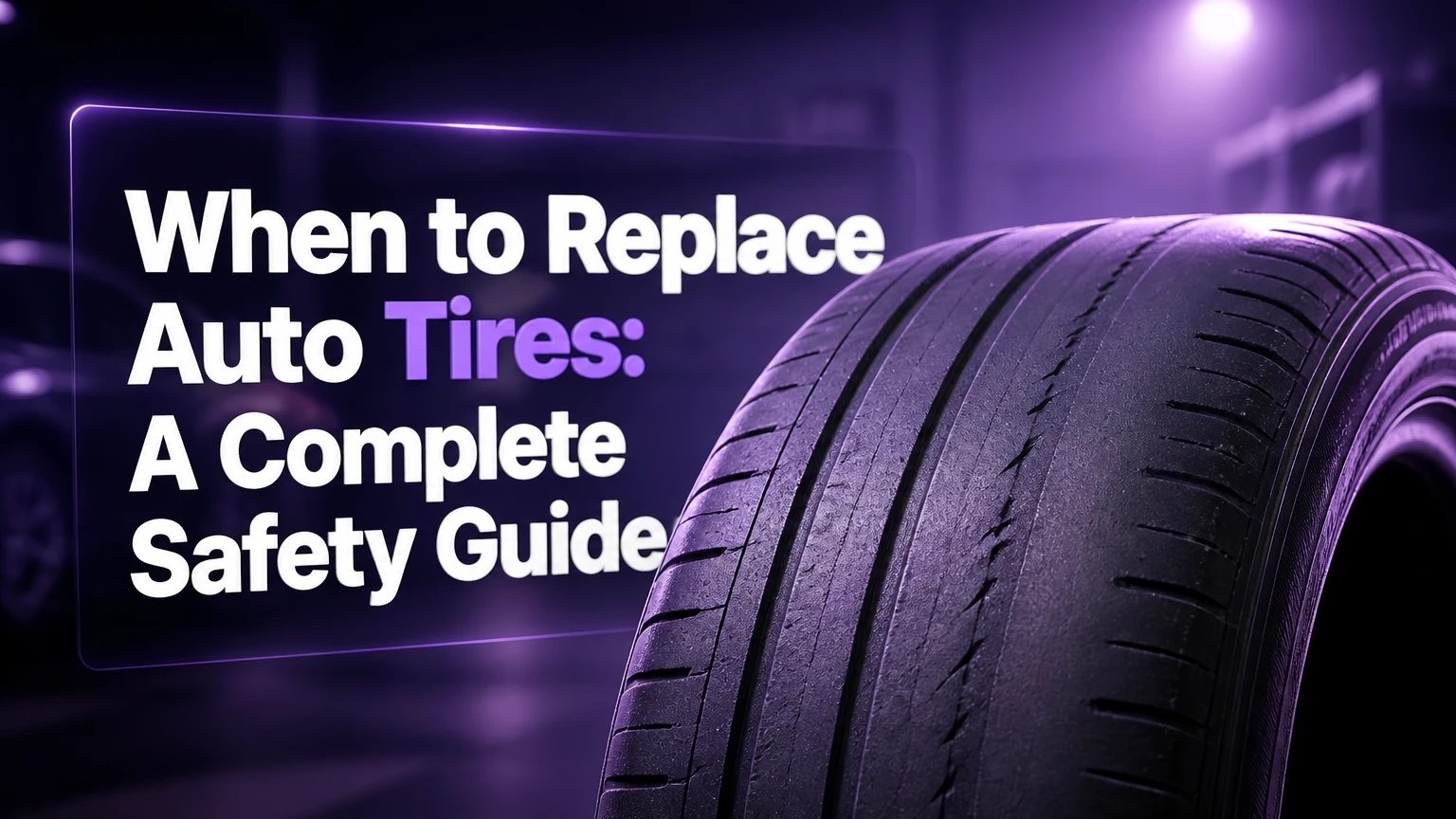
You should replace auto tires when tread reaches 2/32 inch, structural damage appears, the tire develops unsafe cracking or exposed cords, or age makes continued service questionable. Replacement may be advisable earlier, around 4/32 inch for frequent rain or 5/32-6/32 inch for winter conditions, because legal tread depth is not always a safe performance target.
Key Facts at a Glance
- A tire at 2/32 inch has reached the U.S. treadwear-indicator level and should be replaced.
- Drivers who regularly face heavy rain should consider replacing tires near 4/32 inch.
- A sidewall bulge, exposed cord, deep cut, or separated tread requires immediate replacement.
- Tire pressure must follow the vehicle placard, not a universal PSI range or the maximum printed on the tire.
- Tires should receive closer professional inspection after five years of service.
- Many manufacturers recommend replacing tires by ten years from manufacture, even when tread remains.
When to Replace Auto Tires Immediately
Replace an auto tire immediately when it has a sidewall bulge, exposed body cord, tread separation, a deep sidewall cut, or damage that causes rapid air loss. These conditions affect the tire’s load-carrying structure and can lead to sudden failure, particularly under highway heat and speed.
A visible bubble usually means air has escaped through the inner liner and is pressing against weakened outer rubber. A plug cannot restore that structure. Sidewall punctures and shoulder damage are also generally nonrepairable because those areas flex heavily during every wheel rotation.
Stop driving and install a usable spare, or arrange roadside assistance, when you find:
- A sidewall bubble or blister
- Tread lifting away from the casing
- Steel or fabric cords showing through the rubber
- A cut deep enough to reveal internal material
- A tire that repeatedly loses pressure after inflation
- Severe vibration after striking a curb or pothole
- A tire that was driven while nearly flat
- Smoke, rubber odor, or visible deformation
Michelin states that a confirmed sidewall bulge compromises the tire’s structural integrity and requires replacement rather than normal continued use.
At What Tread Depth Should Tires Be Replaced?
Auto tires should be replaced no later than 2/32 inch of remaining tread, but earlier replacement can provide more safety in rain or snow. Tread grooves must hold and channel water; as their volume decreases, wet-road grip and hydroplaning resistance decline before the tire becomes legally worn out.
Federal tire standards require treadwear indicators at 2/32 inch. NHTSA has explained that this level was selected because traction characteristics decline rapidly as tread reaches that point.
| Remaining tread | Practical meaning | Recommended action | Typical condition |
| 8/32-10/32 inch | Common new-tire range | Continue routine checks | Strong usable tread |
| 6/32 inch | Moderate wear | Monitor before winter travel | Reduced snow depth capacity |
| 4/32 inch | Wet grip becomes a concern | Consider replacement for frequent rain | Shallower water channels |
| 3/32 inch | Near end of service | Schedule replacement promptly | Limited safety margin |
| 2/32 inch | Wear bars become flush | Replace the tire | U.S. minimum indicator level |
| Below 2/32 inch | Severely worn | Do not continue normal use | High wet-road risk |
The 2/32-inch figure is a retirement limit, not a promise of full wet-weather performance. A commuter in a dry climate may use more of the available tread than a driver who regularly travels through heavy Georgia rain, standing water, or winter slush.
How Can You Measure Tire Tread Correctly?
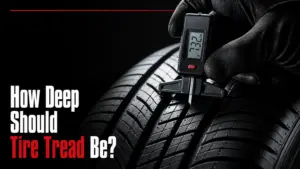
Use a tread-depth gauge at several points across every tire. Measure the inner shoulder, center, and outer shoulder in multiple locations around the circumference because one section can become unsafe while another still appears deep.
A digital or mechanical gauge provides the clearest measurement. Press its base flat against the tread blocks and insert the probe into a main circumferential groove. Do not measure on top of a wear bar because the raised indicator will distort the result.
Tread-Checking Methods Compared
| Method | What it identifies | Precision | Main limitation |
| Digital tread gauge | Exact depth in 1/32 inch or millimeters | High | Must be positioned correctly |
| Mechanical tread gauge | Exact approximate tread depth | High | Cheap gauges may stick |
| Built-in wear bars | Whether tread reached 2/32 inch | Moderate | Gives little early warning |
| Penny test | Approximate 2/32-inch threshold | Low | U.S. coin required |
| Quarter test | Approximate 4/32-inch threshold | Low | Not a calibrated measurement |
For the penny test, insert a U.S. penny with Lincoln’s head pointing into the groove. Seeing the entire head suggests the tread is around or below 2/32 inch. Bridgestone recommends checking several places because a single reading can miss uneven wear.
Do Tires Need Replacement Because of Age?
Yes. Tires can require replacement because rubber and internal materials age even when tread remains. Heat cycles, oxygen, ozone, sunlight, storage conditions, inflation history, vehicle load, and driving speed all influence how quickly the casing deteriorates.
There is no universal rule that every tire becomes unsafe on its sixth birthday. Five years is better treated as a point for closer annual professional inspection, not an automatic expiration date.
Michelin advises annual inspection after five years of service and recommends replacement at ten years from manufacture as a precaution, regardless of remaining tread. Bridgestone publishes comparable five-year inspection and ten-year removal guidance, including for spare tires.
Replace an aging tire sooner when it shows:
- Cracks spreading through the sidewall or between tread blocks
- Rubber that looks dry, brittle, or discolored
- Repeated pressure loss with no simple puncture
- New vibration, noise, pulling, or harshness
- Distortion after long storage
- A history of severe heat, overloading, or underinflation
Age guidance cannot predict the exact failure date of an individual tire. Inspection history and operating conditions matter.
How Do You Read the Tire’s DOT Date Code?
The final four digits of the DOT tire identification number show the week and year of manufacture. A code ending in 2425 means the tire was manufactured during the 24th week of 2025.
The complete DOT code may appear on only one sidewall, so the date can face inward when the tire is mounted. Use a flashlight or ask a tire technician to inspect the inner side if the visible code appears incomplete.
Calculate age from the manufacturing week, not from:
- The date the tire was installed
- The vehicle’s model year
- The date you bought the used vehicle
- The beginning of the tread warranty
Storage still contributes to chronological age. A tire stored correctly may age more slowly than one exposed to sunlight and ozone, but the DOT code remains the reliable starting point for inspection decisions.
Is Mileage a Reliable Tire-Replacement Rule?
Mileage alone is not reliable because two identical tires can wear at very different rates. A tire may last 60,000 miles on a properly aligned highway-driven sedan but wear out much earlier on a heavily loaded vehicle with incorrect pressure, aggressive acceleration, or neglected rotation.
Mileage warranties are limited promises subject to maintenance and usage conditions. They are not guaranteed replacement dates.
Factors that shorten tire life include:
- Persistent underinflation or overinflation
- Misalignment and worn suspension parts
- Failure to rotate tires
- Repeated hard acceleration or braking
- High cornering loads
- Heavy cargo or towing
- Rough roads and pothole impacts
- Hot climates and prolonged sun exposure
- Using winter tires in warm weather
- Using soft performance compounds aggressively
Inspect tread and condition directly instead of replacing tires solely because they reached a general mileage estimate.
What Do Different Tire-Wear Patterns Mean?
Uneven wear often means the tire is showing evidence of another vehicle problem. Replacing the rubber without correcting pressure, alignment, balance, or suspension faults can cause the new tire to develop the same pattern.
| Wear pattern | Most likely causes | What to inspect | Replacement decision |
| Center tread worn fastest | Excess pressure for actual load | Cold pressure and placard | Replace if minimum area reaches limit |
| Both shoulders worn | Underinflation or overloading | Pressure history, leaks, cargo | Check for internal heat damage |
| One edge worn | Camber or toe misalignment | Four-wheel alignment angles | Replace if edge is bald or cord shows |
| Cupped or scalloped patches | Worn shocks, imbalance, loose parts | Suspension and wheel balance | Often replacement plus repair |
| Flat spot in one area | Locked-wheel braking or storage | Brake system and tire roundness | Replace if vibration is persistent |
| Random localized wear | Internal damage or mechanical looseness | Tire casing, bearing, suspension | Professional inspection required |
| Feathered tread blocks | Incorrect toe setting | Alignment measurement | Correct alignment before new tires |
| Diagonal wear | Misalignment with rotation neglect | Alignment and rotation history | Usually replace when advanced |
Pressure-related wear is not always perfectly symmetrical. Vehicle design, road crown, load distribution, and suspension geometry can modify the pattern. Treat the table as a diagnostic starting point rather than proof of a single cause.
Should Tires Be Replaced at 4/32 Inch?
Drivers who frequently travel in heavy rain should strongly consider replacement around 4/32 inch. The tire remains above the common legal minimum, but it has less groove volume available to move water away from the contact patch.
A tire can feel acceptable on dry pavement and become unstable during a storm. The warning signs may include steering that feels light in standing water, earlier traction-control activation, longer wet braking, or brief loss of directional response.
Do not deliberately test hydroplaning resistance. Use tread measurements, tire age, driving environment, and professional inspection instead.
Earlier replacement is especially sensible for:
- Highway commuters during rainy seasons
- Drivers who cannot avoid standing water
- Vehicles carrying children or frequent passengers
- Cars without modern stability control
- Tires with both low tread and age-related hardening
The practical question is not whether 4/32 inch is legally worn. The question is whether the remaining wet-weather margin suits your actual driving.
When Should Winter Tires Be Replaced?
Winter tires commonly need replacement for snow service before they reach the universal 2/32-inch minimum. Many drivers use 5/32-6/32 inch as a practical replacement range because shallow tread cannot pack, release, and grip snow as effectively.
Winter compounds also age and wear quickly when driven in warm conditions. Remove dedicated winter tires when sustained temperatures become too warm for the manufacturer’s intended operating range.
A winter tire may remain legal yet no longer provide the reason it was purchased. Inspect:
- The depth of major snow grooves
- The condition of fine sipes
- Uneven shoulder wear
- Hardening or cracking
- Missing studs, where applicable
- DOT age and storage conditions
Do not assume an all-season tire and a dedicated winter tire provide equivalent cold-weather performance merely because both have adequate tread.
Can a Punctured Tire Be Repaired Instead?
A puncture may be repairable when it is confined to the central tread area, is about 1/4 inch or smaller, and the tire was not driven while severely underinflated. The tire must be removed from the wheel so a technician can inspect its interior.
A proper repair normally seals both the injury channel and the inner liner. A plug inserted from outside cannot reveal internal abrasion, broken cords, liner damage, or rubber debris caused by driving flat.
| Damage condition | Repair normally possible? | Reason |
| Small nail hole in central tread | Often yes | Stable area can accept an approved repair |
| Puncture larger than 1/4 inch | Usually no | Injury exceeds common repair limits |
| Sidewall puncture | No | Sidewall flex prevents reliable repair |
| Shoulder puncture | No | Transition area experiences high stress |
| Tread separation | No | Structural bond has failed |
| Exposed cord | No | Load-bearing material is damaged |
| Driven while flat | Often no | Interior may be abraded or overheated |
| Multiple overlapping repairs | Usually no | Remaining structure may be unreliable |
Michelin’s consumer guidance states that small tread-area punctures may be repairable, while sidewall and shoulder injuries require replacement. It also rejects plug-only repair as a reliable complete method.
Should You Replace One, Two, or Four Tires?
Four matching tires provide the most predictable handling, but replacing all four is not mandatory in every situation. The correct number depends on drivetrain, remaining tread differences, manufacturer instructions, tire availability, and whether the undamaged tires are still serviceable.
Replacing One Tire
One-tire replacement can be acceptable when the other three are nearly new and the replacement matches the same model, size, construction, load index, and speed rating. Some shops can reduce a new tire’s tread depth through controlled shaving when an exact tread match is needed.
Replacing Two Tires
When replacing two tires, many tire and vehicle manufacturers recommend installing the deeper-tread pair on the rear axle. More rear grip helps reduce oversteer and loss of rear stability on wet roads, even on a front-wheel-drive vehicle.
Replacing Four Tires on AWD Vehicles
All-wheel-drive systems may limit allowable circumference or tread-depth differences. Excess variation can keep differentials or clutch systems working continuously, producing heat and wear.
Consult the owner’s manual. Some AWD vehicles tolerate only a small tread difference, often expressed in 32nds of an inch or circumference, but the exact limit is vehicle-specific.
What Tire Pressure Prevents Premature Replacement?
Use the cold inflation pressure printed on the driver’s door placard or listed in the owner’s manual. There is no universal 36-46 PSI range that applies to all passenger vehicles.
The number molded onto the tire sidewall usually identifies a maximum pressure associated with the tire’s rated load, not the normal inflation target for that vehicle.
Check pressure:
- At least monthly
- Before a long highway trip
- After a major temperature change
- When carrying unusual cargo
- When the TPMS warning appears
- After repairing a leak
Measure pressure when the tires are cold, generally before driving or after the vehicle has remained parked long enough to cool. Do not release air simply because a hot tire reads above the cold placard value.
Michelin advises using the vehicle manufacturer’s placard pressure and checking tires cold. Underinflation increases flex and heat, while either underinflation or overinflation can impair handling.
Does a TPMS Warning Mean the Tire Needs Replacement?
A tire-pressure monitoring system warning means pressure requires investigation, not automatically that the tire needs replacement. The cause may be cold weather, a nail, a leaking valve, wheel corrosion, installation damage, or a failing sensor.
Inflate the tire to the placard specification and monitor it. A pressure loss that returns indicates a leak requiring inspection.
TPMS has important limitations:
- It does not measure tread depth.
- It does not detect every internal injury.
- It may not warn about gradual overinflation.
- It cannot certify that a repaired tire is structurally sound.
- It may trigger only after pressure has dropped substantially.
A tire can therefore have correct pressure and still require immediate replacement because of age, exposed cords, tread separation, or sidewall damage.
Do New Tires Always Require an Alignment?
New tires do not automatically require alignment, but alignment should be checked when old tires show edge wear, feathering, steering pull, an off-center steering wheel, or recent suspension and impact problems. Mounting and balancing do not correct wheel angles.
Balancing addresses weight distribution around the wheel and tire assembly. Alignment adjusts toe, camber, and sometimes caster within vehicle specifications.
Request an alignment inspection when:
- One shoulder wore faster than the other
- The vehicle pulls on a level road
- The steering wheel sits off-center
- Suspension or steering parts were replaced
- The vehicle struck a pothole or curb
- New tires begin developing irregular wear
An alignment cannot repair a bent wheel, separated tire, worn ball joint, or damaged control arm. A complete diagnosis must identify mechanical looseness before final angle adjustments.
How Much Does Tire Replacement Cost?
Typical U.S. passenger-tire replacement costs range from about $90 to more than $400 per tire before optional protection plans. Size, load rating, speed rating, brand, performance category, run-flat construction, and regional labor rates all affect the total.
| Cost component | Typical range | Main cost driver |
| Economy passenger tire | $70-$130 each | Basic sizes and compounds |
| Mid-range all-season tire | $120-$220 each | Touring performance and warranty |
| Premium or performance tire | $200-$450+ each | Size, speed rating, compound |
| Mounting and balancing | $20-$50 per tire | Wheel size and shop labor |
| Valve or service kit | $3-$15 per wheel | Rubber valve or TPMS hardware |
| Alignment | $90-$200 | Vehicle design and local labor |
| Disposal fee | $2-$10 per tire | State and local requirements |
| Road-hazard plan | Often 10%-20% of tire price | Coverage terms and tire value |
These are typical planning figures, not quoted prices. A low advertised tire price may exclude mounting, balancing, valves, disposal, taxes, alignment, and TPMS service.
Which Tire Type Usually Wears Out Fastest?
Ultra-high-performance summer tires commonly wear faster than touring all-season tires because they use grip-focused compounds and tread designs. Winter tires can also wear rapidly when used on warm, dry pavement.
| Tire category | Typical priority | Common replacement driver | Main limitation |
| Grand touring all-season | Mileage and comfort | Gradual tread wear | Limited extreme-condition grip |
| Performance all-season | Handling with seasonal range | Faster compound wear | Shorter life than touring tires |
| Summer performance | Warm-road grip | Aggressive wear and cold exposure | Unsuitable near freezing |
| Winter tire | Snow and ice traction | Warm-weather wear or lost snow depth | Soft compound in heat |
| All-terrain truck tire | Mixed-road durability | Irregular wear and noise | Heavier rotating mass |
| Run-flat tire | Temporary mobility after pressure loss | Harsh wear, damage after flat use | Limited repair options |
Choose the tire category for the conditions you actually face. Buying a higher-performance tire than your driving requires can increase cost and shorten service life without providing a meaningful daily benefit.
Common Tire-Replacement Mistakes
Waiting Until Every Groove Reaches 2/32 Inch
A tire is ready for replacement when its most worn meaningful area reaches the limit. Averaging a bald shoulder with deeper center grooves hides the unsafe section.
Replacing the Tire but Ignoring the Cause
New rubber will not correct bad alignment, low pressure, worn shocks, wheel imbalance, overloading, or steering looseness. Diagnose the wear pattern first.
Using the Sidewall PSI as the Target
The vehicle manufacturer’s placard is the correct starting point. The tire sidewall is not a universal inflation instruction.
Assuming a Spare Is Still New
Unused spare tires still age. Bridgestone recommends replacing tires manufactured ten or more years earlier, including spares that appear unused.
Treating a Plug as a Complete Inspection
An external plug can stop a leak while hidden internal damage remains. Proper assessment requires removing the tire.
Mixing Incompatible Tires
Different constructions, sizes, tread patterns, or performance categories can affect stability, ABS operation, traction control, and AWD systems.
Expert Rules of Thumb
Judge tires by the weakest condition, not the strongest. Deep center tread does not compensate for an exposed shoulder cord, a sidewall bubble, or severe cracking.
Investigate sudden wear changes. A tire that wore normally for 20,000 miles and then developed rapid inner-edge wear is reporting a new alignment or suspension problem.
Treat impact symptoms seriously. A tire may hold pressure after a pothole strike but contain internal belt or carcass damage. Michelin recommends professional inspection after a hard impact because internal injury may be invisible externally.
Use legal limits as minimums. The best replacement point depends on rainfall, snow, highway exposure, passenger use, tire age, and the consequences of reduced traction.
Frequently Asked Questions
How often should I inspect my tires?
Check tire pressure at least monthly and inspect visible tread and sidewalls at the same time. Measure tread every few thousand miles, before long trips, and whenever you notice pulling, vibration, noise, pressure loss, or changed handling. Inspect more often when driving long distances or on damaged roads.
Can cracked tires still be driven?
Fine superficial weather checking may require monitoring and professional evaluation, but deep, widespread, or opening cracks indicate advanced deterioration. Replace the tire when cracks expose internal material, accompany bulging, or affect the structure. Tire age and operating history should influence the decision even when tread remains.
How long do tires usually last?
Many passenger tires provide roughly 30,000-70,000 miles, but no mileage range guarantees safety. Performance compounds, poor alignment, incorrect pressure, high heat, heavy loads, rough roads, and aggressive driving can shorten life substantially. Replace based on measured condition, damage, performance, and age rather than mileage alone.
Can tires expire while a car is parked?
Yes. Rubber continues to age while the vehicle is parked, especially when exposed to heat, sunlight, ozone-producing equipment, moisture, and sustained loading in one position. Long storage can also produce flat spots. Inspect stored tires before returning the vehicle to regular road use.
Should the best tires go on the front or rear?
When only two tires are replaced, the deeper-tread pair is generally installed on the rear axle to improve rear stability in rain. Losing rear traction can cause a sudden spin that many drivers find harder to correct than front-tire understeer. Follow the tire and vehicle manufacturer’s instructions.
Do tires need replacing after hitting a pothole?
Not automatically. Replace the tire when the impact causes a bulge, cut, exposed cord, separation, loss of roundness, or nonrepairable internal damage. Seek inspection when new vibration, pulling, noise, or pressure loss appears, even when the exterior initially looks normal.
The Bottom Line
Knowing when to replace auto tires requires more than checking mileage. Replace a tire at 2/32 inch of tread, after nonrepairable structural damage, or earlier when age, wet-weather needs, winter use, cracking, uneven wear, or changed handling reduces its safety margin.
Inspect all four road tires and the spare. Use the vehicle placard for pressure, measure tread across the full width, read the DOT date code, and correct alignment or suspension faults before they damage the replacement set.