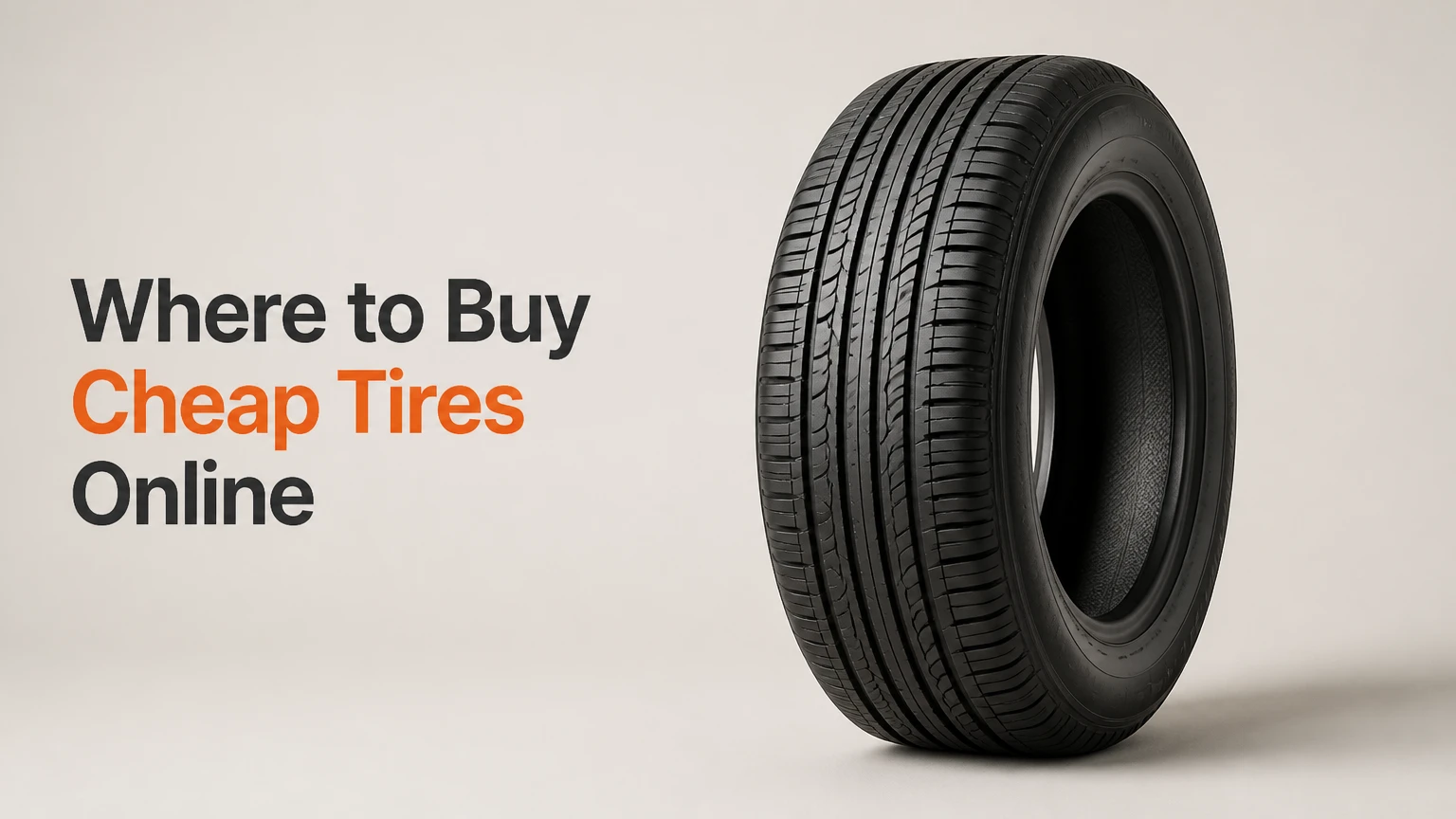
The cheapest place to buy tires online is usually a retailer or marketplace with the lowest installed total, not the lowest tire-only price. Compare Walmart, Amazon, SimpleTire, Tire Rack, Priority Tire, and local installer quotes using the exact size, load index, speed rating, shipping, disposal, taxes, warranty, and appointment fees.
Key Facts at a Glance
- A typical economy tire costs about $55-$95, while a value-brand tire commonly costs $90-$150 before installation and tax.
- Four budget tires commonly produce an installed total of approximately $350-$750, depending on size, fees, and vehicle type.
- The driver’s door-jamb placard is the safest source for the original tire size, inflation specification, load requirement, and speed requirement.
- Online installation commonly adds $18-$35 per tire, plus possible TPMS service, valve stems, disposal, taxes, and shop fees.
- A tire’s DOT date uses four digits: the first two identify the production week and the last two identify the production year.
- The cheapest safe tire must meet or exceed the vehicle’s original load index and speed rating.
Why are tires often cheaper online?
Online tire retailers can reduce showroom, inventory, and sales overhead by shipping from centralized or regional warehouses. High-volume distributors also sell across a larger geographic market, which lets them compete on price even after freight is added.
Online pricing does not guarantee savings. A local shop may match an advertised tire price, include installation, or avoid shipping delays. The correct comparison is the complete installed invoice for four tires, not the product-page price multiplied by four.
The online model normally works in one of two ways. A retailer ships tires to your home, or the checkout system sends them directly to a participating installer. Direct-to-installer delivery is usually easier because the shop receives, stores, and mounts the tires without requiring you to transport four bulky tires.
What does the online tire supply chain include?
The main entities are the manufacturer, distributor, warehouse, e-commerce seller, installer, and customer. A retailer such as Tire Rack may combine warehouse inventory with a network of independent installers, while a marketplace such as Amazon can contain multiple third-party sellers with different warranties and fulfillment policies.
Inventory may vary by ZIP code. A tire listed at $78 in one region can cost more after shipping or disappear from stock in another region. Check the ship-from location, estimated arrival date, return freight policy, and whether the displayed price applies to one tire or a set.
How does online tire ordering work?
Online tire ordering takes about 15-30 minutes when the size and vehicle information are available. The process is: verify fitment, compare installed totals, select a seller and installer, inspect delivery details, and schedule mounting after the shop confirms receipt.
Step 1: Find the required tire size
Read the driver-side door placard first. A code such as P215/55R17 94V contains several specifications:
- P: passenger-car classification
- 215: section width in millimeters
- 55: sidewall height as a percentage of width
- R: radial construction
- 17: wheel diameter in inches
- 94: load index
- V: speed rating
The sidewall can confirm the installed size, but it may not prove that a previous owner fitted the correct tire. Vehicle-specific fitment data and the door placard take priority.
Step 2: Search by vehicle and size
Enter the year, make, model, trim, drivetrain, and wheel size into the retailer’s vehicle selector. Confirm the result against the placard. Some vehicles use different front and rear sizes, called a staggered fitment, and some performance models require a particular speed rating.
Do not substitute a lower load index or speed rating merely because the tire is cheaper. A substitute size can also affect clearance, speedometer accuracy, ride height, traction-control behavior, and all-wheel-drive operation.
Step 3: Compare the installed total
Add four tire prices, shipping, sales tax, mounting, balancing, valve stems, TPMS service, disposal, and any road-hazard coverage. Online checkout fees can be incomplete until you enter a ZIP code and select an installer.
Step 4: Choose shipment and installation
Select a participating installer when available. Before paying, confirm that the shop accepts the tire size, services your vehicle type, handles TPMS sensors, and will install customer-supplied products if direct delivery is unavailable.
Step 5: Inspect before mounting
Ask the shop to show you the tire size, load index, speed rating, and DOT code before installation. Photograph incorrect, damaged, scuffed, or visibly aged tires before the beads are mounted.
Which online retailers usually offer the lowest total price?
Priority Tire, Walmart, SimpleTire, Amazon, Tire Rack, and Tirebuyer can all be inexpensive, but the lowest total depends on size, location, inventory, and installation access. Marketplace prices require more seller scrutiny, while dedicated tire retailers usually provide clearer fitment and return workflows.
| Retailer or channel | Typical budget tire price | Installation path | Main trade-off |
|---|---|---|---|
| Walmart | $65-$120 each | Auto Care Center or independent shop | Convenient service, but availability varies by store |
| Amazon | $60-$130 each | Separate local installer in many cases | Seller, date, warranty, and shipping terms vary |
| Priority Tire | $55-$125 each | Local installer or delivery to shop | Strong closeout selection, less premium-brand depth |
| SimpleTire | $65-$145 each | Partner installer network | Broad inventory, rapidly changing regional prices |
| Tirebuyer | $70-$155 each | Participating local installers | Convenient checkout, fitment and fees vary by ZIP code |
| Tire Rack | $85-$190 each | Recommended independent installers | Strong testing information and buyer support, often higher entry price |
Prices are typical planning ranges, not live quotations. A 15-inch economy tire may fall near the low end, while a 20-inch SUV, run-flat, winter, or extra-load tire can exceed these figures substantially.
What should you compare beyond the tire price?
Compare warranty mileage, return period, road-hazard coverage, shipping responsibility, manufacture date policy, retailer reputation, and installer cost. A $72 tire with $32 installation and paid return freight may cost more than a $84 tire with free shipping and a $20 partner installation fee.
Tire Rack publishes independent test information and commonly offers structured installer support. SimpleTire and Tirebuyer emphasize broad online selection and installer delivery. Walmart adds physical-store convenience. Amazon can win on a one-time product price, but the buyer must verify the seller and arrange service carefully.
How much should four cheap tires cost?
Four cheap tires typically cost $220-$380 before installation for common compact-car sizes and $350-$750 installed after mounting, balancing, disposal, tax, and related fees. Larger SUV, pickup, winter, performance, and run-flat tires can push the installed total above $1,000.
| Tire category | Price per tire | Set of four | Typical installed total |
|---|---|---|---|
| Economy passenger | $55-$95 | $220-$380 | $350-$570 |
| Value-brand all-season | $90-$150 | $360-$600 | $500-$820 |
| Budget SUV or light truck | $105-$180 | $420-$720 | $580-$980 |
| Used inspected tire | $35-$85 | $140-$340 | $270-$530 |
| Winter or performance budget tire | $100-$190 | $400-$760 | $560-$1,020 |
A typical independent shop charges $18-$35 per tire for mounting and balancing. Disposal may add $3-$8 per tire, while rubber valve stems, TPMS service, alignment, taxes, and shop supplies can add another $20-$100 to the invoice.
Can online buying beat a local tire shop?
Online buying can beat local pricing by $40-$180 per set when warehouse discounts and free shipping apply. The advantage disappears when shipping costs, installation surcharges, delayed appointments, or return freight exceed the product discount.
Request one local installed quote before ordering. Ask for the exact brand and model, not only a broad label such as “budget all-season.” A local quote also reveals whether the vehicle needs an alignment, TPMS sensor, tire disposal, or a special mounting fee.
Can cheap tires be safe?
Cheap tires can be safe when they are new, correctly sized, properly rated, undamaged, and appropriate for the climate and vehicle. Low price does not automatically mean unsafe, but the least expensive tire can have longer wet braking, more road noise, shorter tread life, or weaker winter traction than a value or premium model.
The National Highway Traffic Safety Administration requires tires sold in the United States to meet Federal Motor Vehicle Safety Standard No. 139 for many passenger vehicles. That minimum standard does not make every tire equal in wet braking, hydroplaning resistance, temperature behavior, or tread durability.
Which specifications cannot be downgraded?
Keep the original or higher:
- Load index, especially for SUVs, vans, pickups, and heavily loaded vehicles
- Speed rating, particularly for vehicles with manufacturer-specific requirements
- Tire type, such as winter, all-season, all-terrain, or run-flat
- Extra-load or reinforced construction where the vehicle requires it
- Overall diameter and approved width range
A budget tire is a poor choice if it saves $100 but has inadequate load capacity. A tire failure under load creates a more serious risk than the purchase-price difference.
Which cheap tire strategy fits your vehicle?
A daily commuter can usually consider an economy or value all-season tire from a recognized manufacturer, provided independent test information and warranty terms are acceptable. A truck or SUV owner should prioritize load capacity, sidewall construction, and the intended road surface before chasing the lowest price.
| Vehicle situation | Minimum buying priority | Suitable budget direction | Avoid |
|---|---|---|---|
| Compact commuter | Wet grip, mileage warranty, correct size | Laufenn, Kumho, General value lines | Unknown tire with no traceable warranty |
| Family crossover | Load index, wet braking, noise | Kumho, General, Cooper value models | Passenger tire below the placard rating |
| Pickup or light truck | LT or approved XL construction, load range | Kenda, Kumho, General, Cooper truck lines | Passenger tire used for heavy towing |
| Snow climate | Severe Snow Service symbol, cold-weather grip | Budget winter tire with 3PMSF marking | Ordinary all-season tire for frequent snow |
| Performance vehicle | Speed rating, heat resistance, staggered fitment | Value performance model matching OE rating | Lower-rated economy tire |
The Three-Peak Mountain Snowflake, or 3PMSF, symbol indicates a tire passed a defined snow-traction test. It does not mean the tire equals a dedicated winter tire in every cold-weather condition.
Are used tires worth buying?
Used tires can reduce the purchase price by roughly 30%-60%, but they require more inspection and offer less predictable remaining life than new tires. Buy used tires only from a seller that identifies the DOT date, tread depth, repair history, inspection method, and return policy.
Do not buy a used tire with sidewall bulges, exposed cords, uneven structural damage, bead damage, visible cracking, or an undisclosed puncture repair. A tread-depth gauge reading alone cannot reveal internal belt separation or impact damage.
What should a used-tire listing disclose?
Look for measured tread depth in thirty-seconds of an inch, not vague wording such as “excellent tread.” Confirm that all four tires have compatible sizes and similar wear, especially on an all-wheel-drive vehicle. Ask whether the seller machine-tested the tire and whether the warranty covers mounting, shipping, or only the product price.
Certified used sellers may provide more documentation than private listings. Even so, used tires are a poor fit for drivers who travel long distances, carry heavy loads, drive at high speed, or need predictable winter performance.
How do you check tire age and condition?
A tire’s DOT date appears as the final four digits of the Department of Transportation identification code. The first two digits identify the production week and the final two identify the year, so 3524 means the tire was produced in the 35th week of 2024.
The AI Overview’s suggestion to reject every tire older than five or six years is too absolute. NHTSA does not establish one universal replacement age for every tire; manufacturers and vehicle makers publish different recommendations, while several manufacturers advise replacement around six years of service and an absolute limit near ten years from manufacture.
Age is only one factor. Inspect pressure history, storage, cracking, repairs, heat exposure, and tread wear. A properly stored tire that is several months old is not automatically defective, while a newer tire damaged by underinflation or impact can be unsafe.
How long do shipping and installation take?
Standard online tire shipping commonly takes 2-5 business days, while installation usually takes 45-90 minutes after the vehicle enters the bay. Regional inventory, weather, holidays, oversize tires, and installer workload can extend either timeframe.
Schedule the appointment after tracking confirms delivery, unless the retailer and shop explicitly coordinate the booking. A tire shop may refuse to mount a tire that has not arrived, has the wrong size, or appears damaged.
What happens at the installation appointment?
The technician removes the old tire, inspects the wheel and brakes, mounts and balances the replacement, checks inflation, and resets or tests the TPMS system when applicable. An alignment is separate work and is not automatically included in a tire installation package.
Ask for the final inflation pressures from the door placard, torque verification, and confirmation that the old tires were disposed of. If the vehicle pulls, vibrates, or loses pressure immediately afterward, return to the installer for a recheck before driving long distances.
What should you inspect before installation?
Inspect every tire before mounting because an installed tire is harder to return. Verify the following items against your order:
- Brand and model
- Tire size and construction
- Load index and speed rating
- Quantity and matching specifications
- DOT production date
- Tread surface and sidewalls
- Bead area and packaging damage
- Warranty documents and return deadline
Take photographs of the label, DOT code, tread, and any damage. Keep the invoice and shipping carton until the installer confirms that all four tires are correct.
What are the most common online tire problems?
The most common online tire failures are incorrect fitment, incomplete installation pricing, old or damaged inventory, seller confusion, and delivery to an incompatible installer. Each problem is easier to resolve before mounting than after the tire is fitted to the wheel.
| Problem | Likely cause | Immediate action | Prevention |
|---|---|---|---|
| Wrong size arrives | Vehicle selector error or listing mistake | Photograph and do not mount | Match placard and order confirmation |
| Tire arrives damaged | Freight impact or poor storage | Refuse delivery or document damage | Inspect before signing or installation |
| Installer refuses service | Outside-product policy or equipment limit | Call retailer and shop | Confirm acceptance before checkout |
| Final price rises | Disposal, TPMS, tax, or shop fees | Request itemized invoice | Get written installed quote |
| Vibration after mounting | Balance, wheel, or tire issue | Return for road-force check | Choose a qualified installer |
| AWD wear mismatch | Different tread depths or sizes | Ask for drivetrain guidance | Replace compatible sets |
What if the retailer sends the wrong tire?
Do not allow installation. Contact the retailer with the order number, photographs, size code, DOT code, and installer location, then request written return instructions. Many return policies impose time limits or charge shipping, and mounting can make a refund more difficult.
What if the installer refuses outside tires?
Call before ordering and ask whether the shop mounts customer-supplied tires, accepts direct shipments, services TPMS, and charges a different labor rate. Some shops refuse outside tires because they lose product margin or cannot guarantee the seller’s condition and warranty.
Which buying mistakes cost the most?
The most expensive mistake is comparing tire-only prices while ignoring installation and return costs. A second common mistake is choosing a lower-rated tire for an SUV or truck, because the apparent saving can create fitment, handling, and liability problems.
Three practitioner rules prevent most losses:
- Calculate cost per usable mile, not only cost per tire. A $90 tire lasting 55,000 miles may cost less per mile than a $65 tire lasting 30,000 miles.
- Treat four-wheel-drive tread matching as a drivetrain issue. A small circumference difference can matter even when the replacement tire fits the wheel.
- Do not schedule installation before delivery inspection. A wrong or damaged tire becomes a shop problem only after the retailer’s return process has become harder.
Alignment also deserves attention. If the old tires show inner-edge wear, replacing them without correcting toe or camber can destroy a new set within thousands of miles.
How should you choose by budget and situation?
The best cheap tire strategy depends on the vehicle, climate, annual mileage, and tolerance for service risk. A commuter with a common 16-inch size can prioritize a value-brand warranty, while a snow-belt driver should spend more on certified winter traction rather than select the lowest all-season listing.
For the lowest legitimate upfront price
Check Priority Tire, Walmart, Amazon, and closeout inventory first. Confirm the manufacturing date policy, seller identity, shipping cost, and local installation quote before paying.
For the clearest purchase process
Use Tire Rack, SimpleTire, Tirebuyer, or Tires Easy when installer selection, fitment guidance, and returns matter more than the absolute lowest product price. These retailers may not win every price search, but clearer logistics can reduce costly mistakes.
For an older vehicle
A new economy tire is usually preferable to a heavily discounted used tire when the vehicle has reliable fitment and a common size. Used tires make more sense only when inspection records are strong and the vehicle’s remaining service life is short.
For winter driving
Buy a winter tire with the correct size and 3PMSF marking when snow, ice, and temperatures below approximately 45°F are regular conditions. A cheap all-season tire is not a substitute for winter construction in sustained cold weather.
The Bottom Line
The best place to buy cheap tires online is the seller offering the lowest verified installed total while preserving the vehicle’s required size, load index, speed rating, and tire type. Compare Walmart, Amazon, Priority Tire, SimpleTire, Tirebuyer, and Tire Rack, inspect DOT dates before mounting, and confirm installation fees with the shop.
Price is only the first filter. Fitment, condition, climate performance, return support, and installer competence determine whether an online bargain remains inexpensive after purchase.
Frequently Asked Questions
Can I buy only two tires online?
You can buy two tires online, but placement depends on tread depth, drivetrain, and manufacturer guidance. New tires are commonly installed on the rear axle when only two are replaced, because rear traction helps reduce oversteer on wet roads. All-wheel-drive vehicles may require four closely matched tires to protect the drivetrain.
Should I replace all four tires at once?
Replace all four tires when tread differences exceed the vehicle or drivetrain manufacturer’s limit, especially on all-wheel-drive vehicles. Replacing one tire is acceptable only when the tire is closely matched in size, model, and remaining tread, and a tire professional confirms compatibility.
Are no-name tires safe for highway driving?
No-name tires can meet minimum legal standards, but limited test data, inconsistent warranty support, and uncertain supply-chain traceability increase buying risk. Highway drivers should choose a documented brand with the correct speed rating, load index, wet-grip information, and a seller that provides a clear return process.
Do online tire prices include installation?
Online tire prices usually exclude installation, balancing, disposal, taxes, TPMS service, and alignment. Some retailers show partner labor during checkout, but buyers should request an itemized local quote because a displayed mounting price may not include valve stems or sensor service.
Can I return tires after they are mounted?
Return eligibility after mounting depends on the retailer’s written policy, but mounting can complicate returns because the tire has been altered from its shipped condition. Inspect and verify every tire before installation, and contact the retailer immediately if the product is wrong or damaged.
Is a tire alignment included with new tires?
A wheel alignment is normally separate from tire mounting and balancing. Alignment should be evaluated when the vehicle pulls, the steering wheel is off-center, suspension parts were replaced, or the old tires show uneven edge wear. New tires cannot correct an underlying geometry problem.