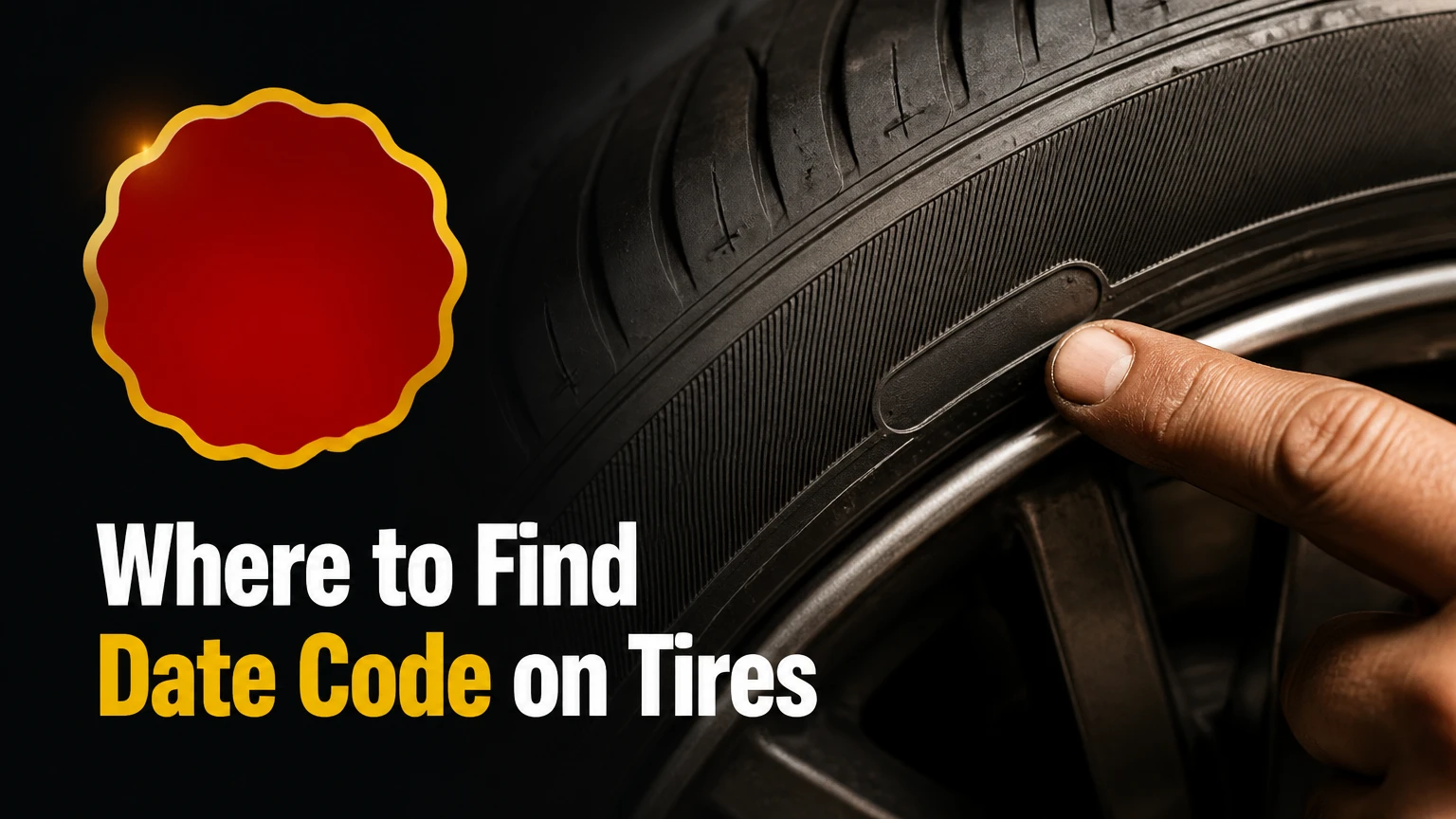
To find the date code on tires, inspect the sidewall for a marking that begins with DOT, then locate the final four digits of the complete Tire Identification Number. Those digits may face outward or appear only on the inner sidewall, and they identify the tire’s manufacturing week and year.
Key Facts at a Glance
- The tire date code is the final four digits of the complete DOT Tire Identification Number.
- The first two date-code digits identify the manufacturing week.
- The final two digits identify the manufacturing year.
- A code of 3522 means the tire was manufactured in week 35 of 2022.
- The complete code may appear only on the sidewall facing underneath the vehicle.
- Tire age must be evaluated with tread depth, cracking, damage, pressure history, and storage conditions.
Where to Find Date Code on Tires
The date code is molded into one of the tire’s two sidewalls, usually near the wheel rim and at the end of a longer sequence beginning with DOT. Look for four raised numbers grouped together, sometimes inside a shallow oval or recessed panel.
The marking is part of the Tire Identification Number, commonly shortened to TIN. It is not printed on a removable sticker, and it is different from the large tire-size marking such as 225/60R17.
Use the following process on each tire:
- Park on a flat surface and apply the parking brake.
- Inspect the visible sidewall near the rim.
- Find the letters DOT.
- Follow the complete sequence from left to right.
- Locate the final group of four numbers.
- Check the inner sidewall when the visible DOT marking does not end in four digits.
- Record the code from every road tire and the spare.
NHTSA explains the code plainly: “The last four digits represent the week and year the tire was made.”
Before You Start
| Item | Typical requirement | Practical note |
| Inspection time | 1-3 minutes per accessible tire | Inner sidewalls may take longer |
| Difficulty | Easy | Visibility is the main challenge |
| Basic cost | $0 | No special diagnostic tool is required |
| Lighting | 100-300 lumen flashlight | Side lighting reveals raised characters |
| Cleaning | Damp cloth and mild soap | Remove road dust without harsh solvents |
| Optional tool | Small inspection mirror | Useful behind wheels and under trailers |
| Safety condition | Vehicle parked and secured | Never crawl under an unsupported vehicle |
Do not apply tire shine before reading the code. Glossy dressing can fill shallow characters and reflect flashlight glare, which makes the four-digit stamp harder to distinguish.
Step 1: Identify the Correct Sidewall Markings
Begin with the sidewall, which is the smooth rubber section between the tread and wheel rim. A tire sidewall contains several unrelated numbers, so locating any four digits is not enough.
Common markings include tire size, load index, speed rating, maximum pressure, construction details, branding, safety warnings, and the DOT Tire Identification Number. The date appears only at the end of the complete DOT sequence.
| Example marking | What it identifies | Is it the date code? |
| 225/60R17 | Tire width, aspect ratio, construction, rim diameter | No |
| 99H | Load index and speed rating | No |
| MAX PRESS 44 PSI | Maximum tire pressure marking | No |
| DOT ABCD EFGH 2424 | Tire Identification Number ending in week and year | Yes |
| TREADWEAR 600 | Uniform Tire Quality Grading treadwear value | No |
| 2424 | Week 24 of 2024 when it ends the full TIN | Yes |
You will know you have found the correct area when DOT appears before a sequence of letters and numbers.
Step 2: Follow the DOT Number to Its End
The date code is located at the end of the complete DOT Tire Identification Number. The characters before it identify manufacturing information such as the plant and other tire-specific details.
Do not assume the first numbers after DOT represent the date. Plant and manufacturer codes can contain both letters and numbers, and they may resemble an abbreviated date.
A simplified modern sequence looks like this:
DOT AB CD EFGH 2426
- DOT: Federal tire-marking lead-in
- AB: Manufacturing plant identifier
- CD: Tire or manufacturer-related identification
- EFGH: Optional descriptive or manufacturer code
- 2426: Manufactured during week 24 of 2026
NHTSA describes the date code as a four-digit TIN segment identifying the week and year of manufacture.
The number of characters preceding the date can vary. Use the final four digits of the complete sequence rather than trying to count a fixed number of positions from the letters DOT.
Step 3: Decode the Final Four Digits
Read the four-digit date code as WWYY, where WW is the production week and YY is the final two digits of the production year. Michelin gives the same interpretation and uses 4714 as an example of week 47 in 2014.
| Date code | Manufacturing week | Manufacturing year | Approximate calendar period |
| 0521 | Week 5 | 2021 | Early February 2021 |
| 3522 | Week 35 | 2022 | Late August or early September 2022 |
| 0124 | Week 1 | 2024 | Early January 2024 |
| 5224 | Week 52 | 2024 | Late December 2024 |
| 2426 | Week 24 | 2026 | Mid-June 2026 |
| 5324 | Invalid or questionable | 2024 | Verify the marking professionally |
The first number pair normally runs from 01 to 52. Calendar systems can occasionally involve a 53rd numbered week, but a questionable tire marking should be checked carefully against the complete TIN rather than accepted from memory.
You will know the interpretation is plausible when the week falls within the calendar range and the year fits the tire’s purchase or vehicle history.
Why Might the Full Code Be on the Inner Sidewall?
The complete Tire Identification Number may be molded on only one sidewall, while the opposite side displays a shortened or partial DOT marking. Therefore, seeing DOT without a four-digit ending does not mean the tire lacks a date code.
NHTSA regulations require tire identification markings, but the same complete sequence has not always been duplicated identically on both sides. NHTSA has explained that the required DOT number must appear on at least one sidewall.
The inward-facing placement is especially common when:
- The tire has a designated outside and inside.
- The installer mounted a nondirectional tire with the full TIN inward.
- Decorative white lettering or branding was positioned outward.
- The visible side carries only a partial identification sequence.
- Dual rear wheels hide one tire’s readable sidewall.
Safe Ways to Inspect an Inner Sidewall
First, turn the steering wheel to create more space around a front tire. Use a flashlight from one angle and view the rubber from another, since side lighting makes molded characters more visible.
For rear tires, move the vehicle a short distance to rotate the hidden section into an accessible position. A phone camera in video mode can also capture the code when your head cannot fit comfortably behind the wheel.
Use these methods in order:
- Turn the front wheels fully left or right.
- Roll the vehicle forward 12-24 inches.
- Use a flashlight and inspection mirror.
- Photograph small sections of the inner sidewall.
- Ask a tire shop to place the vehicle on a lift.
Never position your body beneath a vehicle supported only by a jack. A jack raises the vehicle, but approved jack stands or a professional lift provide the necessary support.
Tire Date Code Versus DOT Number
The date code is one component of the DOT Tire Identification Number, not a separate certification number. Every complete date stamp belongs to a larger identification sequence.
| Term | Typical form | Purpose |
| DOT marking | DOT | Introduces the federally required tire identification |
| Complete TIN | DOT plus letters and numbers | Identifies manufacturing details and production date |
| Date code | Four final digits, such as 2426 | Identifies manufacturing week and year |
| Tire size | 225/60R17 | Identifies physical fitment dimensions |
| Load and speed code | 99H | Identifies rated load capacity and speed category |
| UTQG marking | 600 A A | Rates treadwear, traction, and temperature categories |
Michelin confirms that the initial TIN characters relate to the manufacturer and production facility, while the final four digits identify the week and year.
Should All Four Tires Have Matching Date Codes?
All four tires do not need identical manufacturing dates, but a large age difference can reveal previous replacements, uneven maintenance, or a mismatched tire set. Check each tire independently rather than assuming one code represents the whole vehicle.
A difference of several weeks or months is common when tires come from separate production batches. A difference of several years deserves closer examination.
For example, a vehicle may have:
- Three tires manufactured in 2024 and one replacement from 2026.
- Two newer front tires and two older rear tires.
- A full-size spare several years older than the road tires.
- Used replacement tires with unrelated production dates.
- A recently purchased tire that spent significant time in inventory.
Different dates do not automatically make the vehicle unsafe. The practical question is whether every tire has the correct size, suitable specification, adequate tread, sound structure, proper pressure, and acceptable condition for its service.
What Does a Three-Digit Tire Date Code Mean?
A three-digit date code generally indicates a tire manufactured before 2000. The first two digits represent the production week, while the final digit represents a year within a decade.
For example, 149 means week 14 of a year ending in 9. Older conventions may use an additional triangle to distinguish production in the 1990s, but the decade can remain ambiguous without supporting markings and records.
| Code type | Example | Interpretation | Current practical meaning |
| Modern four-digit | 1424 | Week 14 of 2024 | Normal current format |
| Modern four-digit | 3999 | Week 39 of 1999 | Early four-digit-era tire |
| Older three-digit | 149 | Week 14 of a year ending in 9 | Decade may need additional identification |
| Three digits with triangle | 149 plus triangle | Commonly associated with the 1990s format | Tire is far beyond normal road-service age |
| No recognizable date ending | DOT letters only on visible side | Likely partial TIN | Inspect the opposite sidewall |
Any tire genuinely old enough to carry a pre-2000 three-digit code is unsuitable for ordinary road use today, regardless of how deep the tread appears. Age, storage, internal oxidation, heat exposure, and casing deterioration cannot be evaluated from tread depth alone.
Does the Date Code Tell You When to Replace the Tire?
The manufacture date provides age information, but it does not independently determine whether a tire is safe today. Tire condition also depends on mileage, inflation, loading, heat, impacts, repairs, storage, climate, chemical exposure, and vehicle alignment.
The uploaded AI Overview presents ten years as a “maximum legal/recommended limit.” That wording combines two different concepts. A manufacturer’s replacement recommendation is not automatically a universal legal expiration date across every jurisdiction and tire category.
USTMA states that the service life of a specific tire cannot be predicted accurately from calendar age alone because service and storage conditions vary widely. Michelin separately recommends replacement ten years after manufacture as a precaution, regardless of visible tread depth or apparent condition.
Use the date code as a trigger for closer inspection, not as permission to ignore physical damage before a particular birthday.
Replace or Professionally Inspect a Tire When You Find
- Sidewall bulges or bubbles
- Exposed cords or fabric
- Deep cracking between tread blocks
- Cuts that reach structural material
- Repeated pressure loss
- Tread separation or distorted tread
- Vibration that began after a road impact
- Repairs near the shoulder or sidewall
- Tread worn to 2/32 inch
- Manufacturer or vehicle-maker age limits
USTMA advises replacement when tread reaches 2/32 inch and recommends routine visual checks for uneven wear and damage.
How Long Does Checking Tire Dates Take?
Checking four easily accessible date codes usually takes 5-10 minutes. A complete inspection that includes inner sidewalls, a spare tire, photographs, and condition notes may take 15-30 minutes.
| Inspection situation | Typical time | Typical DIY cost | Professional help |
| Four outward-facing codes | 5-10 minutes | $0 | Usually unnecessary |
| Two codes facing inward | 10-20 minutes | $0 | Helpful if access is poor |
| Full-size spare under cargo floor | 5-15 minutes | $0 | Usually unnecessary |
| Underslung truck spare | 15-30 minutes | $0 | Useful if lowering mechanism is seized |
| Dual-wheel truck or RV | 20-40 minutes | $0 | Recommended for safe access |
| Unreadable or damaged markings | 10-30 minutes | $0-$25 typical | Tire removal may be required |
Many tire shops will read a code during rotation, pressure service, or a tire inspection. Charges depend on whether the vehicle requires lifting, wheel removal, or a separate diagnostic appointment.
Troubleshooting Missing or Unreadable Codes
A date code that cannot be seen from the outside is usually on the opposite sidewall, hidden by dirt, positioned near the ground, or mistaken for another marking. Clean and inspect the complete circumference before concluding that the code is absent.
| Problem | Likely cause | Correct action |
| DOT appears but no four digits follow | Visible side has a partial TIN | Inspect the inner sidewall |
| Four digits are near the ground | Wheel position blocks access | Roll vehicle forward slightly |
| Numbers look smooth or shallow | Dirt, dressing, or low contrast | Wash gently and use side lighting |
| Photograph is blurry | Camera is too close | Step back and use optical zoom |
| Code is scuffed | Curb abrasion or age | Inspect from multiple angles |
| No DOT marking is visible anywhere | Wrong side, specialty tire, severe damage, or compliance concern | Ask a qualified tire professional |
| Two possible four-digit groups appear | One may be a mold or production marking | Confirm which group ends the full DOT sequence |
Do not carve, sand, scrape, or heat the sidewall to expose a faint marking. Sidewall rubber protects structural components, and an aggressive cleaning method can cause damage.
Checking Tires Before Buying
Check the date code before buying new-old-stock tires, used tires, a used vehicle, a trailer, or an RV. The inspection reveals how long the tire has existed, although it does not show when it was installed or how it was stored.
For new tires, compare all date codes before installation. A tire manufactured earlier than the others may still be serviceable, but the seller should disclose unusual inventory age and explain applicable warranty terms.
For used tires, reject the purchase when you cannot inspect both sidewalls, the interior, repairs, bead condition, tread depth, and date code. A deep tread pattern does not reveal underinflation history, overloading, impact damage, internal repairs, or prolonged outdoor storage.
For used vehicles, document:
- Date code from every road tire.
- Date code from the spare.
- Tread depth at inner, center, and outer grooves.
- Visible cracking and sidewall damage.
- Tire brand, model, size, and load rating.
- Differences between front and rear pairs.
- Evidence of plugs, patches, or shoulder repairs.
NHTSA specifically recommends checking the manufacturing date when purchasing tires.
Checking Spare, Trailer, and RV Tires
Spare, trailer, and RV tires often age before they wear out because they accumulate limited mileage while remaining exposed to oxygen, heat, sunlight, moisture, and long periods of static loading. Their date codes deserve the same attention as those on frequently driven tires.
A temporary spare may be hidden under a cargo floor, behind an exterior panel, or beneath the vehicle. Lower or remove it according to the owner’s manual so both sidewalls can be inspected.
Trailer and RV owners should also check:
- Tires mounted with date codes facing the chassis
- Inside tires on dual-wheel assemblies
- Unused spares exposed to sunlight
- Cracking near the bead and rim
- Flat spots after extended storage
- Valve-stem condition
- Inflation when the tire is cold
- Vehicle and tire load ratings
Low mileage is not proof of low risk. A tire can deteriorate while parked, particularly when exposed to heat, ozone, sunlight, moisture, petroleum products, or chronic underinflation.
Expert Inspection Rules
Read Every Tire, Not One Representative Tire
A vehicle’s tires may come from different production batches or replacement events. Recording one front tire’s code cannot establish the age of the other three tires or the spare.
Treat the Date as Evidence, Not a Complete Diagnosis
The date code answers when the tire was manufactured. It does not document storage quality, mounting date, inflation history, impacts, repairs, loading, alignment, heat cycles, or internal damage.
Photograph the Entire DOT Sequence
A close photograph of only the final four digits can lose essential context. Capture the letters DOT, the intervening characters, and the date ending in one image or a sequence of overlapping images.
Check the Oldest Tire First
When time is limited, inspect the oldest-looking, most cracked, least-used, or least-accessible tire first. Spare and trailer tires frequently reveal the greatest age difference.
Frequently Asked Questions
Is the date code always inside an oval?
No. Many date codes appear inside a small oval or recessed panel, but the shape is a manufacturing feature rather than the information itself. Identify the correct code by finding the complete DOT sequence and reading its final four digits. Do not reject a valid date code merely because no oval surrounds it.
Can a tire date code show the exact day?
No. A standard modern tire date code identifies the production week and year, not the exact day. For example, 2426 means week 24 of 2026. It does not reveal whether production occurred on Monday, Friday, or another day within that manufacturing week.
Is the tire date based on purchase or installation?
The tire date code records manufacture, not purchase, shipment, sale, or installation. A tire can therefore be several months old when installed. Receipts, service records, and warranty registration documents are needed to establish the sale or installation date.
Do motorcycle and trailer tires use the same format?
Many road-going motorcycle, trailer, passenger, and light-truck tires use a four-digit week-and-year date format as part of their identification markings. Marking rules and placement can vary by tire type and market, so inspect both sidewalls and consult the manufacturer when the code format is unclear.
Can I determine tire age from the serial number online?
The final four digits usually let you calculate the manufacturing week and year without an online decoder. Online databases may help identify a production plant or recall population, but the physical TIN must be copied accurately. A mistyped letter or number can produce an incorrect result.
Should I replace tires that are six years old?
Six-year-old tires should not be judged by age alone. Review the vehicle manufacturer’s instructions, tire manufacturer’s recommendations, tread depth, cracking, repairs, inflation history, climate, mileage, and professional inspection findings. Replace the tire sooner when structural damage, severe weathering, pressure loss, or another unsafe condition is present.
The Bottom Line
To determine where to find date code on tires, locate the DOT marking on the sidewall and read the final four digits of the complete identification sequence. The first pair identifies the manufacturing week, and the second pair identifies the year.
Check both sidewalls when the visible sequence does not end in four digits. Record every tire separately, including the spare, and evaluate age together with tread depth, structural condition, pressure history, storage, loading, repairs, and manufacturer guidance.