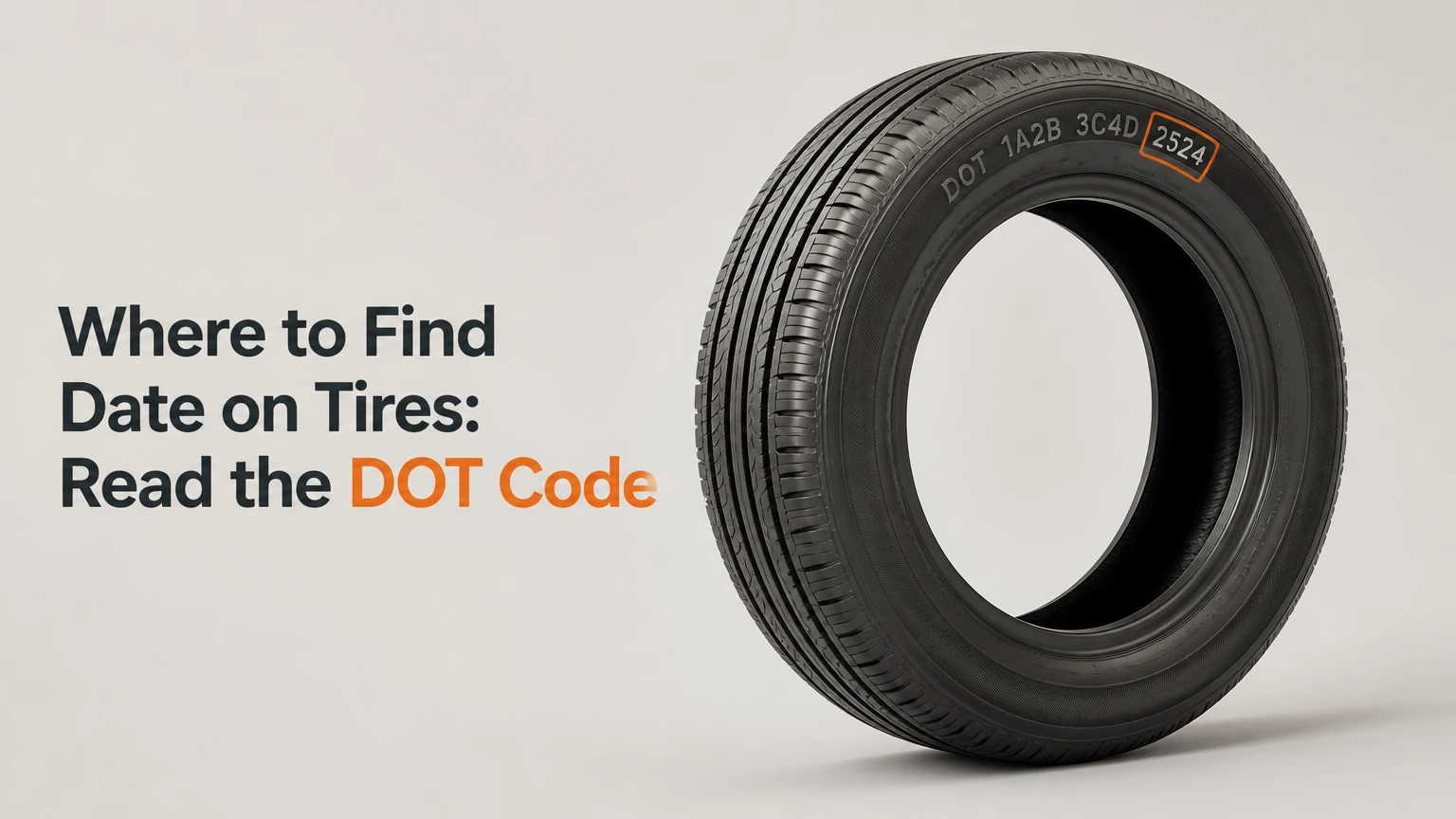
The tire manufacturing date is on the sidewall, within the tire identification number that begins with “DOT.” On modern tires, the date is the final four digits: the first two identify the production week, and the last two identify the production year. The complete code may appear only on the inward-facing sidewall.
Key Facts
The tire date code is usually the final four digits of the DOT tire identification number.
A code such as 3423 means the tire was manufactured during week 34 of 2023.
The full DOT code may be molded on only one sidewall, so the outside may show an incomplete sequence.
The first two digits indicate the week, not the month.
Tire age begins at the manufacturing date, not the date of installation.
Six years is a common point for annual professional inspection, while many manufacturers recommend replacement at ten years regardless of tread.
Where to Find Date on Tires
You can find the tire date on the raised lettering of the sidewall, near the end of a longer code marked “DOT.” Look at both sidewalls of each tire, because tire manufacturers commonly mold the complete tire identification number on one side and a shortened version on the opposite side.
The sidewall is the rubber area between the tread and the wheel rim. The DOT marking may be close to the rim, near the bead, or among other molded information such as the tire size, load index, speed rating, and brand name. It is not usually printed as a separate month and year.
Park on level ground, turn the steering wheel fully to one side for better access to the front tires, and use a flashlight. Read the raised characters from several angles because dirt, brake dust, and shallow molding can make the final four digits difficult to see.
What Does the DOT Code Look Like?
A modern tire identification number often begins with DOT, followed by plant and tire-identification characters, and ends with a four-digit date group. The complete sequence can appear longer than the example below:
DOT ABCD 1XYZ 3423
In that example, 3423 is the manufacturing date. The preceding characters identify the production plant and tire characteristics; they do not indicate the tire’s age.
The exact letters before the date vary by manufacturer and production facility. Do not search for a fixed number of characters. Search for the final four-digit group associated with the complete DOT marking.
How Do You Read the Four-Digit Code?
Read a modern four-digit tire date code in two pairs: the first pair is the manufacturing week, and the second pair is the last two digits of the manufacturing year. Therefore, 1225 means week 12 of 2025, while 4822 means week 48 of 2022.
The U.S. Department of Transportation tire identification system uses the final four digits to identify the week and year of manufacture for tires produced since 2000. The legal framework appears in 49 CFR Part 574, which specifies the tire identification number used for traceability and recalls. NHTSA consumer guidance also identifies the last four digits as the date code.
Four-Digit Code Examples
| Code | Manufacturing Week | Manufacturing Year | Approximate Calendar Period |
|---|---|---|---|
| 0124 | Week 1 | 2024 | Early January 2024 |
| 1823 | Week 18 | 2023 | Early May 2023 |
| 3423 | Week 34 | 2023 | Late August 2023 |
| 4822 | Week 48 | 2022 | Late November or early December 2022 |
| 0625 | Week 6 | 2025 | Early to mid-February 2025 |
The week number is not a month number. A code beginning with 06 means the sixth production week, not June. Tire production weeks generally run from 01 through 52, although an unusual code outside that range requires confirmation from the manufacturer or a tire professional.
A tire marked 3423 was manufactured in the 34th week of 2023. The code identifies a production week rather than a specific day, so it cannot establish the exact date on which the tire left the mold.
How Do You Calculate Tire Age?
Calculate tire age from the beginning of the manufacturing week to the current date, using the tire’s production year and week. A tire marked 3423 was roughly two years old in week 34 of 2025, but its exact age in days cannot be determined from the code alone.
For a practical inspection, record each tire’s week and year, then compare that age with the vehicle manufacturer’s maintenance advice and the tire manufacturer’s service guidance. Tire age is not the same as mileage. A tire can reach an age threshold while retaining substantial tread, especially on an RV, collector car, trailer, or lightly driven commuter vehicle.
Age calculations become less exact around New Year because a production week may overlap calendar boundaries. Use the week-year pair for screening, and ask a tire dealer for a precise service recommendation when the tire is near a replacement threshold.
Which Tire Date-Code Formats Exist?
Modern passenger tires normally use a four-digit date code, while tires manufactured before 2000 may use a three-digit code. Vintage, military, off-road, agricultural, and some specialty tires can use additional identification systems, so a tire without a recognizable modern code requires manufacturer verification rather than guesswork.
| Date-Code Format | Example | Meaning | Recommended Action |
|---|---|---|---|
| Modern four-digit | 3423 | Week 34 of 2023 | Calculate age normally |
| Pre-2000 three-digit | 218 | Week 21 of a year ending in 8 | Treat as obsolete or ambiguous |
| Three-digit with triangle | 218▲ | Week 21 of a 1990s year ending in 8 | Replace or obtain specialist advice |
| Specialty identification | Manufacturer-specific | May combine plant and serial data | Ask the manufacturer or dealer |
| No visible date group | Partial or damaged code | Date cannot be confirmed visually | Inspect the other sidewall and other tires |
What Does a Three-Digit Tire Code Mean?
A three-digit code such as 218 means the tire was made in the 21st week of a year ending in 8, but the code alone cannot reliably distinguish 1988 from 1998. Some tires from the 1990s include a small triangle after the three digits to identify that decade.
A three-digit date code indicates a tire made before the modern four-digit system. Such a tire is far beyond the normal service period for current road use. Do not install or continue driving on an old three-digit-code tire because its age and construction history create an unacceptable safety uncertainty.
The triangle symbol can be difficult to distinguish from mold marks, tread-wear indicators, or damage. It does not make a decades-old tire suitable for regular driving.
Do Tire Size Numbers Show the Manufacturing Date?
Tire size numbers do not show the manufacturing date. A marking such as 225/55R17 97V describes width, aspect ratio, construction, wheel diameter, load index, and speed rating, while the DOT date code identifies when the tire was produced.
| Sidewall Marking | Example | Information Provided | Is It the Date? |
|---|---|---|---|
| Tire size | 225/55R17 | Dimensions and wheel fitment | No |
| Load index | 97 | Maximum load rating | No |
| Speed rating | V | Speed capability category | No |
| UTQG treadwear | 500 | Relative treadwear grade | No |
| DOT date group | 3423 | Week 34 of 2023 | Yes |
The plant code and tire-characteristic characters immediately after “DOT” also are not the date. Follow the identification number to its final four-digit group.
What If the Code Is Not on the Outer Sidewall?
If the outer sidewall shows “DOT” but ends before four digits, inspect the inner-facing sidewall. Tire manufacturers may mold the full tire identification number on only one side, while the visible side carries a partial code for manufacturing and regulatory identification.
Do not crawl beneath an unsupported vehicle to read the inner sidewall. Use a flashlight and camera from a safe position, or ask a tire shop to inspect the tire while it is on a lift. A mechanic can also check the portion hidden behind suspension components or the wheel well.
Step 1: Identify the Tire Identification Number
Find the raised letters DOT on the sidewall. Clean the surrounding rubber with a damp cloth, not a solvent, and photograph the entire sequence before interpreting any digits.
Success checkpoint: The photograph includes “DOT” and the characters that follow it.
Common mistake: Reading the nearest group of numbers, such as the tire size, instead of the DOT sequence.
Step 2: Find the Final Four Digits
Trace the DOT sequence toward its end and locate the final four-digit group, often molded inside a rounded or oval-shaped panel. Do not stop at the plant code or the first group of numbers.
Success checkpoint: The candidate date has exactly four digits and appears at the end of the complete code.
Common mistake: Treating a code such as ABCD or 1XYZ as the date because it appears immediately after DOT.
Step 3: Inspect the Opposite Sidewall
If the visible code ends in letters, symbols, or a shorter number, inspect the sidewall facing the vehicle. Compare the code with the three other tires, but do not assume matching tires have matching production dates.
Success checkpoint: You have either found a complete four-digit date or confirmed that a professional inspection is needed.
Common mistake: Declaring the tire undated after checking only the outward-facing wall.
Step 4: Record All Four Dates
Write down the date code for the left front, right front, left rear, and right rear tires. Include the spare, because a spare may remain unused for years while its rubber ages.
Success checkpoint: Each tire has a documented week-year pair or a clear note that the code could not be verified.
Common mistake: Checking only the tire with the deepest tread.
Why Does Tire Age Matter When Tread Looks Good?
Tire age matters because rubber compounds, fabric, adhesives, and internal structures change with heat, oxygen, ozone, ultraviolet exposure, inflation pressure, and storage conditions. Tread depth measures remaining tread, but it does not directly measure sidewall flexibility, belt adhesion, or internal fatigue.
The U.S. National Highway Traffic Safety Administration describes tire aging as a complex issue affected by climate, storage, operating conditions, and maintenance. Bridgestone and Michelin both publish guidance that calls for increased inspection as tires age and replacement by ten years from manufacture as a precaution, even when tread remains.
A tire can look acceptable during a quick visual check and still require professional evaluation. Surface cracks between tread blocks, cracks in grooves, bulges, exposed cords, vibration, air loss, and irregular wear are warning signs at any age.
How Old Is Too Old for a Tire?
Many major tire manufacturers recommend replacing tires at ten years from the manufacturing date, regardless of remaining tread. Six years is commonly treated as a point for annual professional inspection, but neither figure is a universal expiration law for every tire, vehicle, climate, or jurisdiction.
| Tire Age From Manufacture | Typical Decision | Reason for the Decision | Owner Action |
|---|---|---|---|
| 0-5 years | Normal service if condition is good | Lower age-related risk | Maintain pressure and inspect monthly |
| 6-9 years | Increased inspection | Aging effects become more relevant | Obtain annual professional inspection |
| 10 years or more | Replace | Manufacturer precautionary limits commonly apply | Do not rely on tread depth alone |
| Any age with bulge or exposed cord | Remove from service | Structural damage can cause sudden failure | Replace immediately |
| Unknown age | Do not assume new | Age cannot be established | Verify code before road use |
These are practical service thresholds, not a substitute for the tire maker’s instructions. Some manufacturers specify shorter periods for particular tire types, while commercial, agricultural, racing, and specialty applications can have separate rules.
Which Tires Need Special Attention?
RV, trailer, spare, seasonal, collector-car, and low-mileage tires need special attention because time may accumulate faster than mileage. A tire that travels only 2,000 miles per year can still experience years of heat cycles, pressure loss, ozone exposure, and prolonged loading.
RV and Motorhome Tires
Check all motorhome tire dates before long trips and include the inner dual-tire sidewalls. Dual assemblies can hide cracking, rub against each other when incorrectly spaced, and experience high loads that make inflation maintenance especially important.
Follow the RV manufacturer’s load information and the tire maker’s cold-inflation table. Never use a date code to justify carrying a tire beyond a manufacturer’s stated service limit.
Trailer Tires
Trailer tires often sit for long periods, sometimes under full load and in direct sunlight. Check the date code, sidewall condition, inflation pressure, load range, and the spare before towing.
A trailer tire’s age does not become acceptable because the tread has traveled only a few hundred miles. Replace tires with sidewall cracking, impact damage, repeated underinflation, or an age beyond the manufacturer’s guidance.
Spare Tires
A spare can be older than the four tires currently on the vehicle. Check its date during every tire replacement and before a road trip, then verify that its size, load rating, and pressure match the vehicle requirements.
A full-size spare may be suitable for normal use if it is within its service guidance and in good condition. A temporary spare has separate speed, distance, and pressure restrictions printed on its sidewall.
What Mistakes Cause Wrong Readings?
The most common reading errors involve confusing the tire size with the date, reading the first two digits as a month, and checking only the visible sidewall. A correct inspection follows the complete DOT sequence to its final four digits and confirms the result on the opposite side when necessary.
| Mistake | Incorrect Interpretation | Correct Interpretation | Fix |
|---|---|---|---|
| Reading 225 as a date | June 2025 or week 22 | Tire width is 225 millimeters | Find the DOT sequence |
| Reading 06 as June | June 2025 | Week 6 of 2025 | Treat the first pair as a week |
| Stopping at plant code | First four characters are the date | Date is the final four digits | Trace the entire code |
| Checking one sidewall | No date exists | Full TIN may face inward | Inspect both sidewalls |
| Trusting tread depth | Deep tread means safe tire | Tread does not reveal internal aging | Check age and condition |
| Assuming all four match | One date represents the set | Tires can be different batches | Record every tire |
A damaged or scraped date code creates an evidence problem. Compare the other tires to identify a possible batch, but use that comparison only as a clue. It cannot prove the damaged tire’s production date.
Can You Drive on a Tire Without a Date Code?
Do not treat an unverified date code as proof that a tire is safe or new. If the code is missing because the visible sidewall is the partial side, have a tire professional inspect the opposite side; if the entire identification area is damaged, replace the tire or obtain written manufacturer guidance.
This limitation matters for used vehicles and private tire sales. A seller’s statement that a tire is “recent” does not establish its manufacturing date, storage conditions, load history, or repair history.
What Does Checking or Replacing Tires Cost?
Checking a tire date code costs nothing if you inspect it yourself and have access to a flashlight or phone camera. Typical replacement pricing ranges from approximately $80-$350 or more per tire, depending on tire size, vehicle type, performance category, commercial requirements, and location.
| Service or Purchase | Typical U.S. Price Range | Time Range | Variables |
|---|---|---|---|
| At-home date-code check | $0-$5 | 5-15 minutes | Lighting and access |
| Professional inspection | $0-$40 | 15-45 minutes | Shop policy and lift access |
| Passenger-car tire | $80-$250 each | 30-90 minutes for four | Size, brand, performance rating |
| SUV or light-truck tire | $140-$350 each | 45-120 minutes for four | Load range and diameter |
| Mounting and balancing | $20-$60 per tire | 15-30 minutes each | Local labor and wheel size |
| Disposal or environmental fee | $2-$10 per tire | Included in visit | State and retailer policy |
These are typical retail ranges, not fixed prices. A tire quote may also include valve stems, TPMS service, road-hazard coverage, alignment, taxes, and shop fees. Compare the installed price rather than the tire-only price.
A date-code inspection is not a substitute for a complete tire evaluation. Replacement decisions should also consider tread depth, tread wear pattern, pressure history, puncture repairs, vibration, load rating, speed rating, and vehicle alignment.
How Should You Check Tires on a Used Car?
Check the DOT date on all four road tires and the spare before buying a used car. Compare each tire’s age with its visible condition, tread depth, size, load rating, and the seller’s stated maintenance history.
A vehicle can have recently installed tires that were manufactured several years earlier. That does not automatically make the tires defective, but it changes their remaining service life and should affect the purchase calculation.
Use the inspection to negotiate based on a documented replacement need, not on age alone. If a tire is ten years old, has cracking or a bulge, carries the wrong load rating, or has an unknown repair history, arrange a professional inspection before driving the vehicle at highway speed.
What Should You Check When Buying New Tires?
When buying new tires, ask the retailer to confirm the production date before installation, especially for uncommon sizes, seasonal products, RV tires, and low-volume performance tires. Warehouse age alone does not establish that a tire is unsafe, because proper storage can slow environmental aging, but older stock leaves less time before age-based replacement guidance applies.
The practical target is recent production, often within 6-12 months, when availability permits. Do not reject a properly stored tire solely because it is several months old, and do not accept a very old tire merely because it is unused.
Ask for the date codes on the mounted tires, verify that all four are reasonably matched, and photograph them for your maintenance records. A tire dealer should also set cold inflation pressure to the vehicle placard specification, not the maximum pressure molded into the sidewall.
The Bottom Line
To find the date on tires, locate the raised DOT marking on the sidewall and read the final four digits of the complete tire identification number. The first two digits show the production week, and the last two show the production year, so 3423 means week 34 of 2023.
Check the inner sidewall when the outer sidewall lacks four final digits. Record every tire and the spare, because production dates can differ across a vehicle. Treat a three-digit code as pre-2000 and unsuitable for ordinary modern road service, and follow the tire manufacturer’s inspection and replacement guidance as the tire ages.
Frequently Asked Questions
Is the Tire Date the Same as the Purchase Date?
No. The tire date is the manufacturing week and year, while the purchase date is when a retailer sold the tire. Tire age is calculated from manufacture, so a tire purchased in 2025 could have been produced in 2023 or earlier.
Where Is the Date on a Motorcycle Tire?
The motorcycle tire date normally appears in the DOT identification marking on a sidewall, using the same modern four-digit week-year pattern when applicable. Motorcycle tires can have limited sidewall space and specialty markings, so inspect both sides and consult the tire manufacturer if the code is unclear.
Do Tires Expire if They Have Never Been Used?
Unused tires still age because rubber and internal materials change during storage. Proper indoor storage can reduce heat, sunlight, moisture, and ozone exposure, but it does not reset the manufacturing date or extend a manufacturer’s stated service limit.
Should All Four Tires Have the Same Date Code?
No. Tires installed as a set often come from different production batches, so their date codes may differ by weeks or months. Large age differences deserve closer inspection, particularly when one tire is several years older than the others.
Can a Tire Shop Find a Date Code I Cannot See?
Yes. A tire shop can raise the vehicle safely, rotate the wheel, clean the sidewall, and inspect the inward-facing portion of the tire. A shop cannot reliably reconstruct a date that has been completely removed or damaged, so an unreadable code remains an age uncertainty.
Does a New Tire Have to Be Made This Year?
No. A tire does not have to be manufactured in the current calendar year to be saleable or usable. Condition, storage, age, manufacturer guidance, and correct application matter. Buyers should request recent stock when possible, then compare the date with the tire’s expected service life.