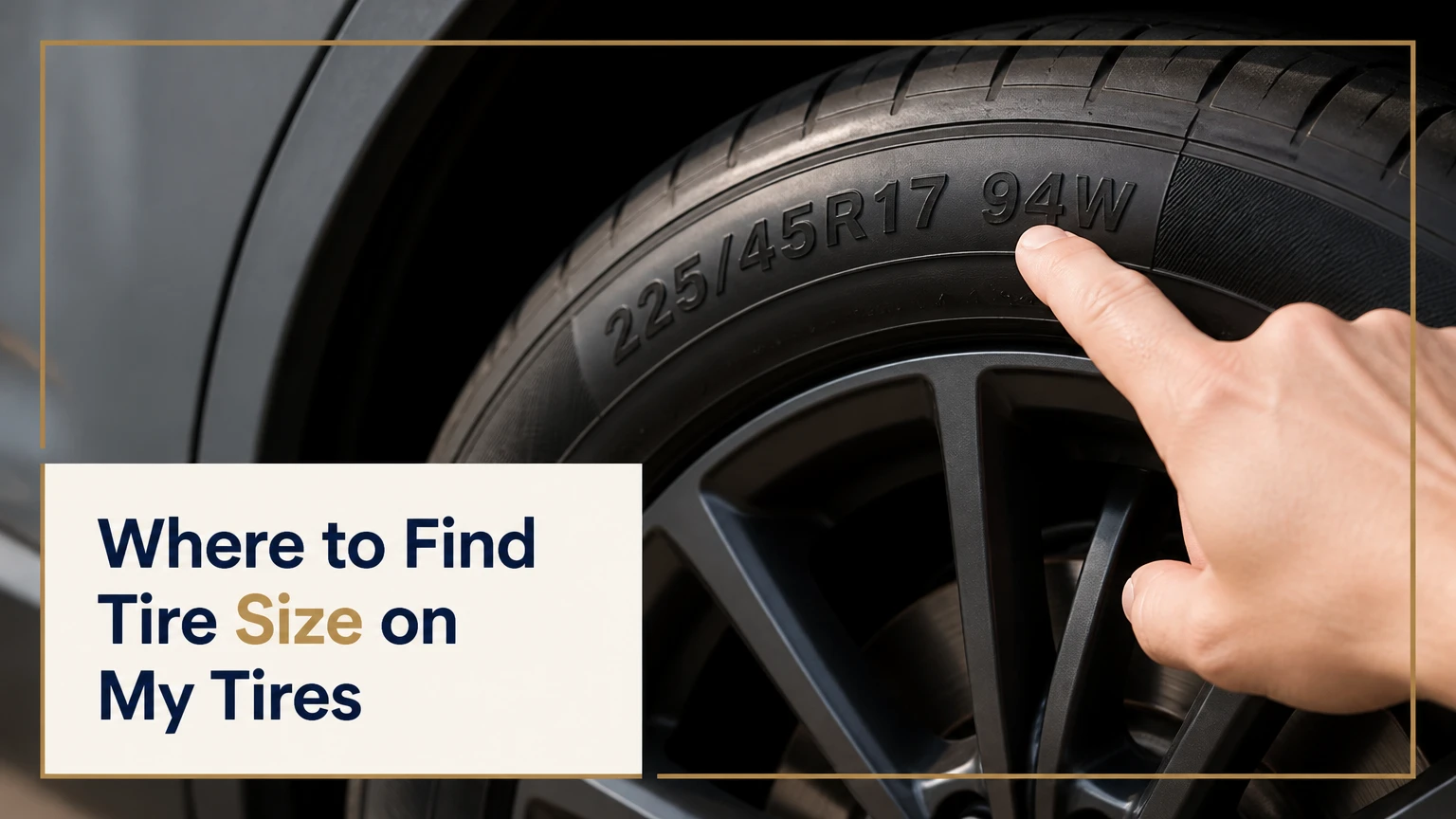
To find the tire size on your tires, look on the outer sidewall for a raised code such as P215/65R15 95H. You should also check the Tire and Loading Information placard inside the driver-side door because it lists the vehicle manufacturer’s recommended front, rear, and spare tire sizes.
Key Facts at a Glance
- The tire-size code is molded into the rubber sidewall.
- A typical passenger-tire size looks like P215/65R15 95H.
- The driver-side door placard shows the factory-recommended size.
- The number after “R” is the required wheel diameter in inches.
- Front and rear sizes may differ on vehicles with staggered fitment.
- The four-digit DOT date code is not part of the tire size.
Before You Start
| Item | Typical requirement |
| Time | 1-3 minutes |
| Difficulty | Beginner |
| Cost | $0 |
| Tools | Flashlight, cloth, mild soapy water |
| Best conditions | Parked vehicle, engine off, parking brake applied |
| Main success factor | Finding the complete size code, not a partial marking |
Park on a flat surface before inspecting a tire. Do not crawl beneath a vehicle, loosen a wheel, or place your hands near moving traffic merely to read the inner sidewall.
Where to Find Tire Size on My Tires
The tire size is normally printed in raised lettering on the sidewall, which is the rubber section between the tread and the wheel. Look for a grouped sequence containing a slash and the letter R, such as 225/60R17, rather than a brand name, safety warning, or pressure marking.
Step 1: Look at the Outer Sidewall
Stand beside one tire and examine the side facing away from the vehicle. Most tire manufacturers place the complete size on both sidewalls, although the styling, letter size, and exact position vary.
The code often appears near the tire model name or wheel rim. Rotate your viewpoint around the tire because the size may be positioned near the ground and partly hidden by the wheel arch.
You will know you found the right marking when the sequence resembles one of these examples:
- P215/65R15 95H
- 225/50R18 95V
- LT265/70R17 121/118S
- 33×12.50R15LT
- ST205/75R15
Do not confuse the tire size with wording such as “MAX LOAD,” “MAX PRESS,” “TUBELESS,” “RADIAL,” or a four-digit production code.
Step 2: Clean the Lettering if Necessary
Wipe away dirt using a damp cloth and mild soapy water. A flashlight held at an angle can create shadows across raised lettering, making a low-contrast code easier to read.
Avoid aggressive solvents, wire brushes, sharp tools, and petroleum-based cleaners. These products may discolor the rubber or damage the sidewall surface.
The code should become readable without scraping the tire. If cracks, cuts, bubbles, or exposed cords prevent safe inspection, have the tire examined professionally.
Step 3: Record the Complete Code
Write down or photograph the full sequence, including any prefix, width, aspect ratio, construction letter, wheel diameter, load index, and speed rating. Recording only “215/65R15” may omit specifications needed to select a suitable replacement.
For example, the complete marking may be:
P215/65R15 95H
The dimensional portion is P215/65R15. The service description is 95H, representing the load index and speed rating.
Step 4: Check More Than One Tire
Inspect at least one front tire and one rear tire. Some vehicles use wider rear tires, different load ratings, or different wheel diameters between the two axles.
Checking multiple tires also exposes accidental mismatches. If three tires show 225/55R17 and one shows 215/55R17, do not assume the odd tire is acceptable merely because it is mounted on the wheel.
What Does a Tire-Size Code Look Like?
A tire-size code combines dimensions, construction, load capacity, and speed capability in a standardized sequence. In P215/65R15 95H, each group answers a different fitment question, from vehicle category to wheel diameter.
| Marking | Meaning | Value in the example |
| P | Tire service type | Passenger vehicle |
| 215 | Nominal section width | 215 millimeters |
| 65 | Aspect ratio | Sidewall height is 65% of width |
| R | Construction | Radial |
| 15 | Wheel diameter | 15 inches |
| 95 | Load index | 1,521 pounds per tire |
| H | Speed rating | Up to 130 mph under rated conditions |
What Does the First Letter Mean?
A leading letter identifies the tire’s intended service category. Some passenger tires begin directly with the width, so the absence of a P does not mean the tire lacks a size designation.
| Prefix | Tire category | Common application |
| P | P-metric passenger tire | Cars, minivans, crossovers |
| LT | Light-truck tire | Pickups, vans, heavy-duty SUVs |
| ST | Special-trailer tire | Travel, utility, and boat trailers |
| T | Temporary spare | Compact emergency spare |
| No prefix | Euro-metric tire | Passenger cars and crossovers |
P-metric and Euro-metric tires with similar dimensions are not automatically identical in load-carrying behavior. Confirm the vehicle placard, load index, and tire manufacturer’s specifications before substituting one format for another.
What Does the Width Number Mean?
The first three-digit number is the nominal tire width in millimeters. A 215 tire is approximately 215 millimeters wide at its specified measuring rim, although actual dimensions vary slightly by tire model and wheel width.
The measurement describes section width, not tread width. Tread patterns, sidewall shapes, rim widths, and manufacturer tolerances can make two tires labeled 215 look slightly different.
What Does the Number After the Slash Mean?
The aspect ratio states the sidewall height as a percentage of the nominal width. In a 215/65 tire, the sidewall height is approximately 65% of 215 millimeters.
The calculation is:
215 × 0.65 = 139.75 millimeters
A lower aspect ratio generally produces a shorter sidewall when width remains constant. However, comparing “55” and “65” without considering width can be misleading because the number is a percentage rather than a fixed measurement.
What Do R and the Wheel Number Mean?
The letter R indicates radial construction, which is standard for most modern passenger and light-truck tires. The following number identifies the diameter of the wheel seat in inches.
A P215/65R15 tire fits a 15-inch wheel. It cannot be installed correctly on a 16-inch or 17-inch wheel, even when the tire width appears similar.
This wheel-diameter number is sometimes called the rim size. Technically, it describes the wheel’s tire-bead seat diameter rather than the wheel’s visible outside edge.
What Do 95H and Similar Ratings Mean?
The number following the dimensional size is the load index. The final letter is the speed rating.
A load index of 95 corresponds to 1,521 pounds per tire when the tire is used according to its specified inflation and service conditions. Four such tires do not automatically give a vehicle a usable payload of 6,084 pounds because vehicle axle ratings, suspension, brakes, and weight distribution also impose limits.
An H speed rating corresponds to 130 mph under controlled rating conditions. It is not a recommendation to drive at that speed, and the rating may be reduced by damage, underinflation, overloading, repairs, heat, or wear.
Is the Driver-Side Door Sticker More Reliable?
The driver-side door placard is normally the best source for the vehicle manufacturer’s original tire-size and inflation specifications. The mounted sidewall tells you what is installed now, while the placard tells you what the vehicle was designed to use in its factory configuration.
Open the driver-side door and inspect:
- The door frame
- The B-pillar behind the driver
- The rear edge of the door
- The lower door-opening area
Look for a white or yellow label titled Tire and Loading Information. It commonly lists front tire size, rear tire size, spare tire size, seating capacity, combined occupant and cargo weight, and recommended cold inflation pressure.
Sidewall Size Versus Door Placard Size
| Source | What it identifies | Main advantage | Main limitation |
| Tire sidewall | Tire currently mounted | Confirms the present wheel-and-tire setup | Current tire may be incorrect |
| Door placard | Factory-approved size | Preserves intended load, clearance, and calibration | May not match modified wheels |
| Owner’s manual | Factory specifications and warnings | Explains approved configurations | May cover multiple trims |
| Manufacturer lookup | Size by year, model, and trim | Useful when labels are damaged | Incorrect trim selection gives wrong results |
| Tire retailer database | Catalog fitment options | Fast for shopping | Results still require vehicle verification |
A common claim is that you should always buy the sidewall size when it differs from the door sticker. That advice is incomplete. A previous owner may have installed an unsuitable tire, so a mismatch should trigger a fitment check rather than automatic replacement with either number.
Confirm the wheel diameter, vehicle trim, axle requirements, load rating, clearance, and any documented modification. A qualified tire shop can inspect the wheel markings and current setup when the history is unknown.
Where Else Can You Find the Factory Tire Size?
The factory tire size may also appear in the owner’s manual, inside the fuel door, in the glove compartment, or through the vehicle manufacturer’s online resources. These locations are especially useful when the door placard is damaged, painted over, or missing.
| Location | What to search for | When it is useful |
| Owner’s manual | Tires, specifications, capacities | Verifying original equipment |
| Digital manual | Tire size or tire pressure | Manual is missing |
| Fuel-filler door | Size and pressure label | Common on some European vehicles |
| Glove box | Equipment or service label | Certain older vehicles |
| Manufacturer website | Year, model, trim, VIN tools | Checking trim-specific fitment |
| Dealership parts department | VIN-based build information | Multiple factory wheel options exist |
The vehicle identification number can help identify the model, engine, trim, and original equipment package. However, a VIN search cannot confirm aftermarket wheels installed after production.
Can Front and Rear Tire Sizes Be Different?
Front and rear tires can have different sizes on vehicles with staggered fitment. Sports cars, performance sedans, some SUVs, and certain electric vehicles may use wider rear tires or different wheel diameters between axles.
A staggered vehicle might use:
| Position | Example size | Main difference |
| Front | 225/40R19 93Y | Narrower width |
| Rear | 255/35R19 96Y | Wider width |
| Temporary spare | T125/80R17 | Emergency-only design |
| Door placard | Lists each position separately | Factory reference |
Never assume four tires should match merely because the vehicle has four wheels. Copy the front and rear specifications separately.
All-wheel-drive systems can also be sensitive to differences in overall tire diameter and tread depth. Even when all four sidewalls show the same size, a heavily worn tire paired with three new tires may create an unacceptable circumference difference for some drivetrains.
Is the Four-Digit DOT Number the Tire Size?
A four-digit code such as 2422 is a manufacturing date, not the tire size. It means the tire was manufactured during the 24th week of 2022.
The date appears at the end of the Department of Transportation identification number. Only one sidewall may contain the complete DOT number and date code, so you may need to inspect the inner sidewall.
| Marking example | Meaning | Is it part of tire size? |
| 2422 | Week 24 of 2022 | No |
| DOT ABCD 1234 2422 | Tire identification string | No |
| P215/65R15 | Dimensional size | Yes |
| 95H | Load and speed rating | Service description |
| 35 PSI MAX | Maximum sidewall pressure marking | No |
Do not use the sidewall’s maximum pressure as the routine inflation target. Use the vehicle placard’s recommended cold pressure unless the vehicle or tire manufacturer provides specific alternative instructions.
What If the Tire Size Is Unreadable?
An unreadable sidewall does not require guessing. Use the door placard, owner’s manual, manufacturer data, wheel markings, or a professional inspection to identify the correct specification.
Common Problems and Solutions
| Problem | Likely cause | Recommended action |
| Letters are hidden by dirt | Road film or tire dressing | Clean with mild soapy water |
| Code faces inward | Tire mounted with styled side inward | Check the opposite side safely |
| Sidewall is scraped | Curb damage | Use placard and inspect for damage |
| Door sticker is missing | Age, repainting, collision repair | Check manual or VIN-based records |
| Placard and tire disagree | Modification or wrong replacement | Verify wheels and vehicle trim |
| Only part of the code is visible | Ground or wheel arch blocks view | Move the vehicle slightly when safe |
Do not drive solely to rotate the tire unless the route is safe and the tire shows no signs of severe damage. Moving the vehicle forward a few feet on private, level ground is usually enough to expose a hidden code.
Can You Install a Different Tire Size?
A different tire size may be possible, but dimensional fit is only one requirement. The replacement must also provide suitable load capacity, wheel compatibility, clearance, inflation behavior, and overall diameter.
Changing overall diameter can affect:
- Speedometer and odometer readings
- Anti-lock braking calculations
- Traction and stability control
- Transmission shift behavior
- Fender and suspension clearance
- Steering response
- Effective gearing
A common rule of thumb is to keep the replacement tire’s overall diameter close to the original, often within about 3%. That figure is a screening guideline, not universal approval. Vehicle manufacturers may impose tighter limits, particularly for all-wheel-drive, performance, or electric vehicles.
Use an approved alternative listed by the manufacturer or have a tire professional calculate and inspect the proposed fitment.
Replacement Checklist Before Ordering Tires
Record more than the three dimensional numbers. A safe replacement decision considers the complete tire specification and the vehicle’s actual use.
- Confirm front and rear sizes separately.
- Match the wheel diameter exactly.
- Verify the service type, such as P, LT, or ST.
- Meet or exceed the required load index.
- Follow the manufacturer’s speed-rating requirements.
- Confirm the correct load range for trucks and trailers.
- Check whether the tire is directional or asymmetric.
- Verify seasonal type, such as summer, winter, or all-season.
- Check wheel and body clearance if the vehicle is modified.
- Compare the proposed size with the door placard and current wheels.
Never replace an LT tire with a passenger tire solely because the dimensions look similar. Light-truck applications may require different load and inflation characteristics.
Trailer tires also require special attention. An ST tire is engineered for trailer service and should not be treated as a passenger-vehicle substitute.
Expert Fitment Insights
The Mounted Tire Is Evidence, Not Proof
A mounted tire proves that someone installed that size. It does not prove the size is safe, factory-approved, or suitable for the vehicle’s maximum axle load.
Wheel Diameter Must Match Exactly
Width and aspect ratio can vary within approved alternatives, but the tire’s wheel-diameter number must match the wheel’s bead-seat diameter. An R17 tire does not fit an R18 wheel.
Matching Dimensions May Still Hide a Mismatch
Two tires can share the same dimensional size while carrying different load indexes, speed ratings, load ranges, seasonal ratings, or reinforced constructions. Shopping by 225/60R17 alone can therefore produce an unsuitable replacement.
Frequently Asked Questions
Is tire size printed on every tire?
Yes. A compliant road tire normally carries dimensional and service markings molded into its sidewall. The complete information may be easier to read on one side than the other. Search for a sequence containing a slash and a wheel-diameter number, such as 235/55R18.
Can I find my tire size using my license plate?
Some tire-retailer databases use license-plate registration data to identify the vehicle’s year, make, model, and trim. The result usually reflects factory fitment and may not identify aftermarket wheels. Confirm the suggested size against the door placard and mounted tires before ordering.
Can I find my tire size using the VIN?
A VIN-based lookup can identify factory equipment with greater precision than a model-only search, especially when several trims used different wheels. It cannot verify later modifications, replacement wheels, suspension changes, or an axle conversion, so a physical inspection remains necessary.
Does the tire-pressure number show the tire size?
No. Pressure markings use units such as PSI, kPa, or bar and do not describe tire dimensions. Use the vehicle’s door placard for normal cold inflation pressure. The pressure molded on a sidewall is not automatically the correct everyday setting for the vehicle.
What size tire fits a 17-inch rim?
A 17-inch wheel requires a tire whose dimensional code contains R17, but that alone is insufficient. Tire width must suit the wheel width, while overall diameter, load index, clearance, and vehicle specifications must also be checked. Examples include 215/55R17, 225/65R17, and 265/70R17.
Why does my spare tire show a different size?
A compact spare may be narrower and smaller than the regular tires because it is intended for temporary, restricted use. Follow the speed, distance, and inflation limits printed on the spare and described in the owner’s manual. Replace or repair the normal tire promptly.
The Bottom Line
To answer “where to find tire size on my tires,” inspect the outer sidewall for a code such as P215/65R15 95H, then compare it with the driver-side Tire and Loading Information placard. Record the complete front, rear, and spare specifications before purchasing replacements.
The sidewall identifies what is installed, while the placard identifies the factory recommendation. When those sources disagree, verify the wheel size, vehicle trim, load requirements, and modification history instead of assuming either marking is automatically correct.