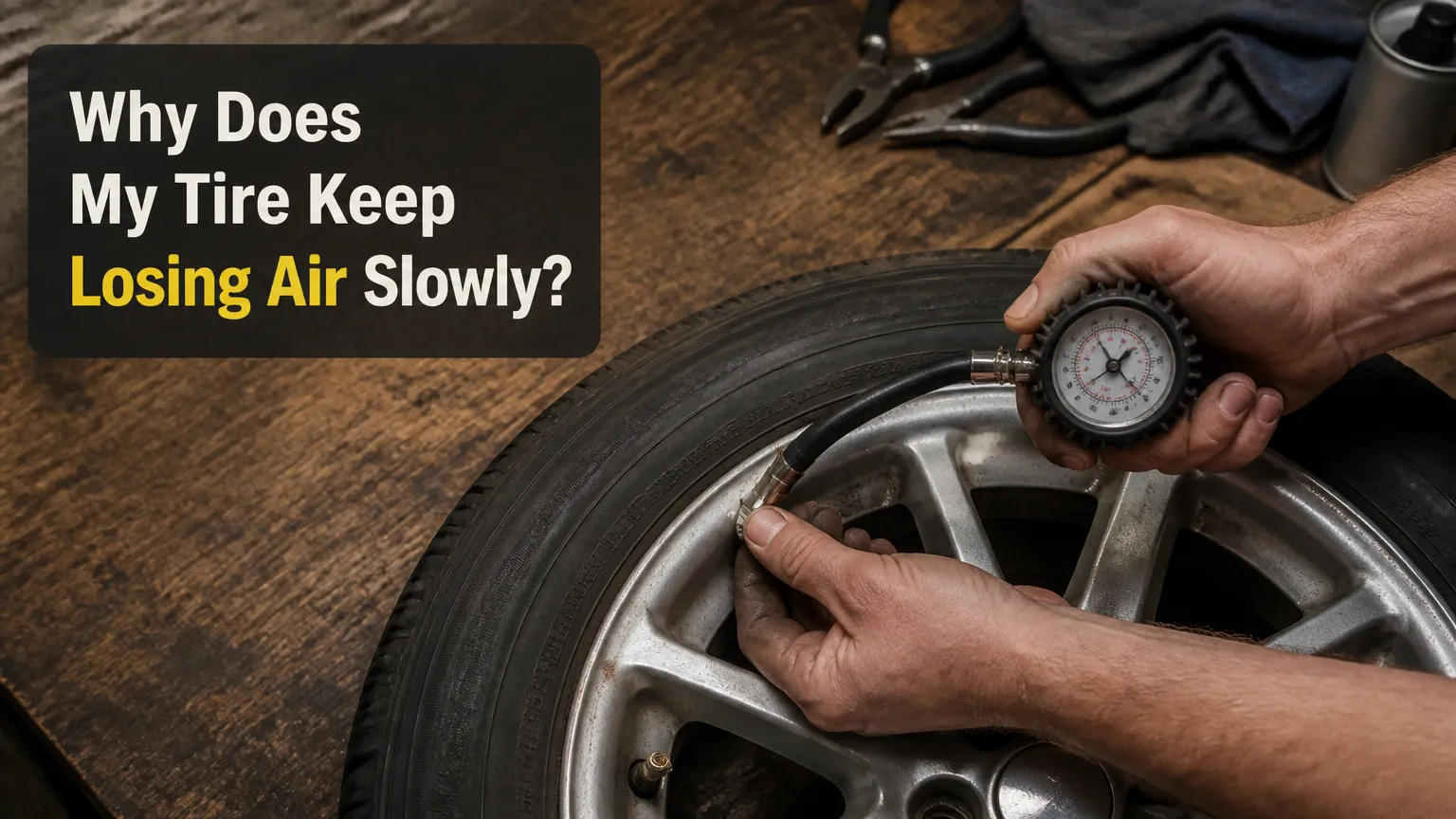
A tire keeps losing air slowly due to microscopic tread punctures, wheel bead corrosion, a faulty valve core, or natural rubber permeation. While natural permeation releases 1 to 1.5 PSI per month, any air loss exceeding 1 PSI per week indicates a mechanical flaw requiring repair.
At a Glance
- Natural Loss: Tires lose 1 to 1.5 PSI monthly through natural rubber permeation under stable ambient temperatures.
- Environmental Shift: Cold weather drops tire pressure by 1 PSI for every 10°F (5.6°C) drop in temperature without a leak.
- Common Mechanical Causes: Pinhole nail punctures, oxidized alloy wheel beads, and leaking valve cores cause 1 to 3 PSI weekly loss.
- Severe Failures: Rim cracks, severe bead corrosion, or damaged valve stems cause 1 to 2 PSI daily loss.
- Safety Risk: Continuously inflating a leaking tire without fixing it leads to internal heat breakdown and highway blowouts.
What Is Normal Tire Pressure Loss vs. a Slow Air Leak?
Normal tire pressure loss is limited to 1 to 1.5 PSI per month caused by natural oxygen permeation through microscopic pores in the rubber. Any tire air loss exceeding 1 PSI per week qualifies as a mechanical slow leak that requires diagnostic inspection and repair.
| Rate of Air Loss | Primary Cause | Risk Level | Recommended Action |
| 1–1.5 PSI / month | Natural rubber permeation | Low (Normal) | Top off air during monthly maintenance checks. |
| 1–3 PSI / week | Small tread punctures, loose valve core, minor bead leak | Moderate | Inspect tire for nails; check valve core tightness; repair within 7 days. |
| 1–2 PSI / day | Cracked alloy rim, severe rim oxidation, torn valve stem base | High | Discontinue long-distance driving; repair or replace component immediately. |
| 1 PSI per 10°F drop | Ambient temperature contraction | Environmental | Re-check pressure warm; inflate to door-jamb spec when cold. |
Understanding these specific rates allows drivers to distinguish between environmental fluctuations and structural wheel assembly failures.
What Are the Main Mechanical Causes of a Slow Tire Leak?
The main mechanical causes of a slow tire leak are pinhole tread punctures, damaged valve cores, and bead seal failures between the tire rubber and metal wheel rim.
                                  [ TIRE TREAD ]
                                        │
             ┌──────────────────────────┼──────────────────────────┐
             ▼                          ▼                          ▼
   [ Micro Punctures ]          [ Valve Assembly ]          [ Bead Contact Area ]
   • Flush nail/screw heads     • Loose valve core          • Flaking chrome/paint
   • Wire/staple penetration    • Cracked rubber stem       • Alloy rim oxidation
   • Flex-induced air seepage   • Speed-flexing seal failure • Dirt/debris buildup
Pinhole Tread Punctures
Small nails, screws, or steel construction wires can penetrate the tread block and break off completely flush with the rubber surface. The embedded fastener acts as a semi-effective plug, allowing high-pressure air to seep out slowly around the threads only when the tire flexes as it rotates under load.
Valve Stem and Core Degradation
The valve stem contains a spring-loaded brass valve core that deteriorates from exposure to moisture, road salt, and dirt. A loose valve core or a dried-out rubber stem base allows pressurized air to bleed out continuously through the valve tip.
Bead Sealing Defects
The tire bead is the reinforced edge of rubber that seats tightly against the inner lip of the metal rim. Dirt accumulation, rust, or improper tire mounting creates microscopic gaps along this boundary, resulting in a continuous perimeter air leak.
How Does Temperature Affect Slow Tire Pressure Loss?
Temperature affects tire pressure through thermal expansion and contraction, dropping pressure by approximately 1 PSI for every 10°F (5.6°C) decrease in ambient temperature. This seasonal drop represents a temporary physical density change of the trapped air, not an actual structural leak.
When the outside temperature drops suddenly overnight, the compressed air molecules inside the tire contract, occupying less volume and lowering the pressure readout on your gauge. Conversely, driving at highway speeds heats the air inside the tire, temporarily increasing pressure by 3 to 5 PSI.
To verify if pressure loss is caused by cold weather or a true mechanical leak, measure tire pressure indoors or early in the morning before driving. If pressure rises back to baseline as ambient temperatures warm up, the loss is purely environmental. If pressure stays low despite warming weather, a mechanical leak is present.
Why Do Alloy Wheels and Chrome Rims Cause Slow Tire Leaks?
Alloy wheels and chrome rims cause slow tire leaks when moisture enters the tire assembly, initiating aluminum oxidation or causing chrome coatings to flake off along the mounting bead.
       TYPICAL ALLOY RIM CORROSION LEAK

          Tire Sidewall
             ║       //
             ║      //
    ┌────────╝     // ◄── Air escapes through gap
    │  Corroded   //
    │  Metal Lip //
    └────────┐  //
             ╚═//══════════════════
               Alloy Wheel Barrel
Aluminum alloy reacts with oxygen and road salt to form a chalky, uneven white powder (aluminum oxide) along the inner rim lip. Similarly, chrome plating on older wheels eventually blisters and flakes, leaving sharp metal ridges that push against the rubber. These surface irregularities break the airtight contact between the rubber bead and the rim wall, allowing air to escape at a rate of 1 to 3 PSI per week.
Resolving bead corrosion requires dismounting the tire from the wheel, removing the oxidation or flaking chrome with a wire wheel or angle grinder, and applying a heavy bead sealer compound before remounting.
Why Does My Tire Only Lose Air When Parked in a Specific Position?
A tire only loses air when parked in a specific position because the vehicle’s resting weight compresses a specific tread area or damaged bead point, opening a microscopic gap that stays sealed when unweighted.
When a tire rotates, its contact patch flattens against the pavement. If a hidden nail, a micro-crack, or a minor bead flaw is located precisely at the bottom of the wheel’s rotation, the localized downward force of several thousand pounds distorts the rubber compound around the defect. This mechanical distortion widens the microscopic pathway, releasing air until the vehicle is moved and the pressure point shifts.
Why Does the Soapy Water Test Fail to Find Slow Tire Leaks?
The soapy water test fails to find slow tire leaks because thick soap solutions create a surface tension barrier that low-volume air releases (0.5 to 1 PSI per day) cannot push through to form visible bubbles.
Standard liquid dish soap mixed with minimal water yields a thick film. Extremely slow leaks exert very little kinetic energy as air exits the tire; this weak airflow simply diverts around the soap layer without inflating a bubble.
Professional Submersion Alternatives
Professional tire facilities use specialized diagnostic dunk tanks to identify microscopic leaks that resist soapy water detection:
- Complete Assembly Submersion: The wheel and tire assembly is pressurized to its maximum cold rating and submerged entirely in clear water.
- Extended Hold Time: The assembly remains submerged under bright lighting for 3 to 5 minutes to allow slow-forming micro-bubbles to accumulate.
- High-Speed Valve Flexing: Technicians manually deflect the rubber valve stem while under water to simulate the centrifugal forces experienced during highway driving.
Is It Dangerous to Keep Pumping Up a Slowly Leaking Tire Every Week?
Yes, continuously pumping up a slowly leaking tire without repairing the root cause is extremely dangerous and dramatically increases the risk of a catastrophic highway blowout.
Driving on a tire that operates below its recommended cold inflation pressure causes the rubber sidewalls to flex excessively. This continuous mechanical flexing generates intense internal friction and heat up to 200°F (93°C) or higher. Over time, heat degrades the internal rubber bonds, causing the inner liner to disintegrate and separating the steel belts from the carcass.
Under-Inflated Running ──► Excessive Sidewall Flex ──► Extreme Heat Build-up ──► Belt Separation ──► Highway Blowout
Does Fix-a-Flat or Aerosol Sealant Permanently Fix Slow Leaks?
No, aerosol tire sealants do not permanently fix slow tire leaks and are engineered strictly as emergency temporary measures to reach a repair facility.
Liquid chemical sealants coat the inner lining of the tire with a sticky latex or fibrous sludge. This coating creates several critical long-term issues:
- TPMS Damage: Liquid sealant clogs the microscopic port of electronic Tire Pressure Monitoring System (TPMS) sensors, permanently ruining the sensor module.
- Wheel Imbalance: The sealantpools at the bottom of the tire when parked, curing into an asymmetrical mass that causes severe wheel vibration at highway speeds.
- Corrosion Promotion: Water-based chemicals trapped inside the sealed tire accelerate rim oxidation on raw alloy wheels.
Proper repair requires dismounting the tire, cleaning out all liquid sealant residue, inspecting the inner liner, and installing an industry-standard rubber patch-plug combination.
How Do I Isolate a Slow Tire Leak at Home When Soapy Water Fails?
To isolate an elusive slow tire leak at home, follow a systematic diagnostic process using a high-density liquid solution, a precise digital tire pressure gauge, and physical component isolation.
1.Inflate to Maximum Rated Pressure:Increase pressure to raise leak energy.
Inflate the tire to the maximum safety cold PSI printed directly on the tire sidewall (typically 40 to 50 PSI). Higher internal air pressure forces more volume through microscopic openings, making micro-leaks easier to locate.
2.Mix a Thin Diagnostic Spray:Lower surface tension for easier bubble formation.
Mix 1 part liquid dish soap with 10 parts warm water, or use a dedicated aerosol leak detector spray. Avoid concentrated soap mixes that impede bubble formation.
3.Spray and Inspect Systematically in Sections:Isolate one component at a time.
Spray the valve core tip, the base of the rubber valve stem, the entire outer tire bead rim, and the tread face in 12-inch sections. Wait a full 60 seconds per section to spot micro-foaming.
4.Test the Valve Stem for Centrifugal Motion Leakage:Simulate driving forces manually.
Wiggle the rubber valve stem gently side-to-side while applying the leak detector solution at its base. If tiny bubbles form at the joint, the stem rubber has dry-rotted and requires replacement.
Can a Faulty TPMS Sensor Cause a Slow Air Leak?
Yes, a faulty Tire Pressure Monitoring System (TPMS) sensor can directly cause a slow air leak if its rubber grommet dries out or its aluminum retaining nut corrodes.
Direct TPMS sensors are mounted through the valve stem hole of the wheel. They rely on a rubber sealing grommet, an aluminum hex nut, and a nickel-plated valve core to maintain an airtight seal:
- Grommet Degradation: Exposure to road salt and heat cycles causes the rubber grommet to harden and shrink, releasing 1 to 2 PSI per week around the valve hole.
- Galvanic Corrosion: Inserting a standard brass valve core into an aluminum TPMS valve stem causes galvanic corrosion. The dissimilar metals react, seizing the core and destroying the threads, which creates an unsealable air path. Always use nickel-plated valve cores in aluminum TPMS stems.
When Can a Slowly Leaking Tire Be Safely Patched vs. Replaced?
A slowly leaking tire can be safely patched only if the puncture is strictly located within the central tread area and does not exceed 1/4 inch (6 mm) in diameter.
    CAN IT BE PATCHED?

      Puncture Location
             │
      ┌──────┴──────┐
      ▼             ▼
  [ Tread ]    [ Sidewall / Shoulder ]
      │             │
      ▼             ▼
  ≤ 1/4 inch?    UNSAFE!
   /      \      Replace Tire
 Yes       No
  │         │
  ▼         ▼
PATCHABLE  REPLACE
Safety Criteria for Tire Repairs
- Permissible Repair Zone: Punctures must occur inside the central tread area—specifically at least 0.5 inches (12.7 mm) inward from the outer tread shoulders.
- Impermissible Repair Zones: Punctures on the tire shoulder, sidewall, or bead area can never be repaired. The sidewall undergoes continuous flexing; a patch applied here will dislodge and cause catastrophic failure.
- Industry Standard Method: Repairs must be completed from the inside of the tire using a one-piece patch-plug combination unit. Simple tire plugs inserted from the outside without dismounting the tire are temporary and unapproved by the Rubber Manufacturers Association (RMA).
How Much Does It Cost to Repair a Slow Tire Leak vs. Replacing Components?
Repairing a slow tire leak typically costs $15 to $45 for a standard patch-plug repair, whereas component replacements range from $25 to over $600.
| Component / Service | Average Repair Cost | Notes / Scope |
| Professional Patch-Plug Repair | $15 – $45 | Dismounts tire, cleans inner liner, applies one-piece patch-plug. |
| Valve Stem / Core Replacement | $10 – $25 | Replaces leaking core or rubber stem; includes wheel rebalancing. |
| TPMS Service Kit / Sensor | $25 – $120 | Replaces rubber grommet, nut, core, or entire electronic sensor unit. |
| Rim Corrosion Refurbishing | $50 – $150 per wheel | Wire-brushes rim bead surface, removes flaking paint, applies bead sealant. |
| New Replacement Tire | $100 – $400+ | Required for sidewall punctures, dry rot, or internal carcass damage. |
| New Alloy Rim Replacement | $150 – $600+ | Required if wheel barrel has structural cracks or deep bends. |
Why Does a Tire Lose Air Slowly on the Highway but Hold Pressure in the Driveway?
A tire loses air slowly on the highway while holding pressure in the driveway due to dynamic centrifugal forces and elevated thermal expansion.
When a vehicle travels at highway speeds (65+ mph), two dynamic factors force air out of small defects:
- Centrifugal Valve Stem Flexing: Centrifugal force pushes outward on heavy rubber valve stems. If the stem rubber is aged or cracked at its base, this bending force opens up micro-cracks that allow air to escape dynamically. When parked, the stem snaps back straight and seals perfectly.
- Tread Flexing Under Kinetic Load: The physical impact of hitting road joints at high speed repeatedly compresses and flexes tread blocks. A flush-mounted nail or a minor belt separation opens and closes rapidly with every wheel revolution, pumping air out under dynamic load while remaining sealed during static garage inspections.
The Bottom Line
A slow tire leak losing more than 1 PSI per week indicates a structural or mechanical issue—such as a flush tread nail, bead corrosion on an alloy rim, or an aging valve stem—rather than simple seasonal temperature drops. Leaving a slowly leaking tire unrepaired causes excessive heat build-up and internal rubber breakdown, elevating the risk of a highway blowout. Have a professional shop dismount the tire to perform a submersion dunk test and apply a permanent, internal patch-plug repair.