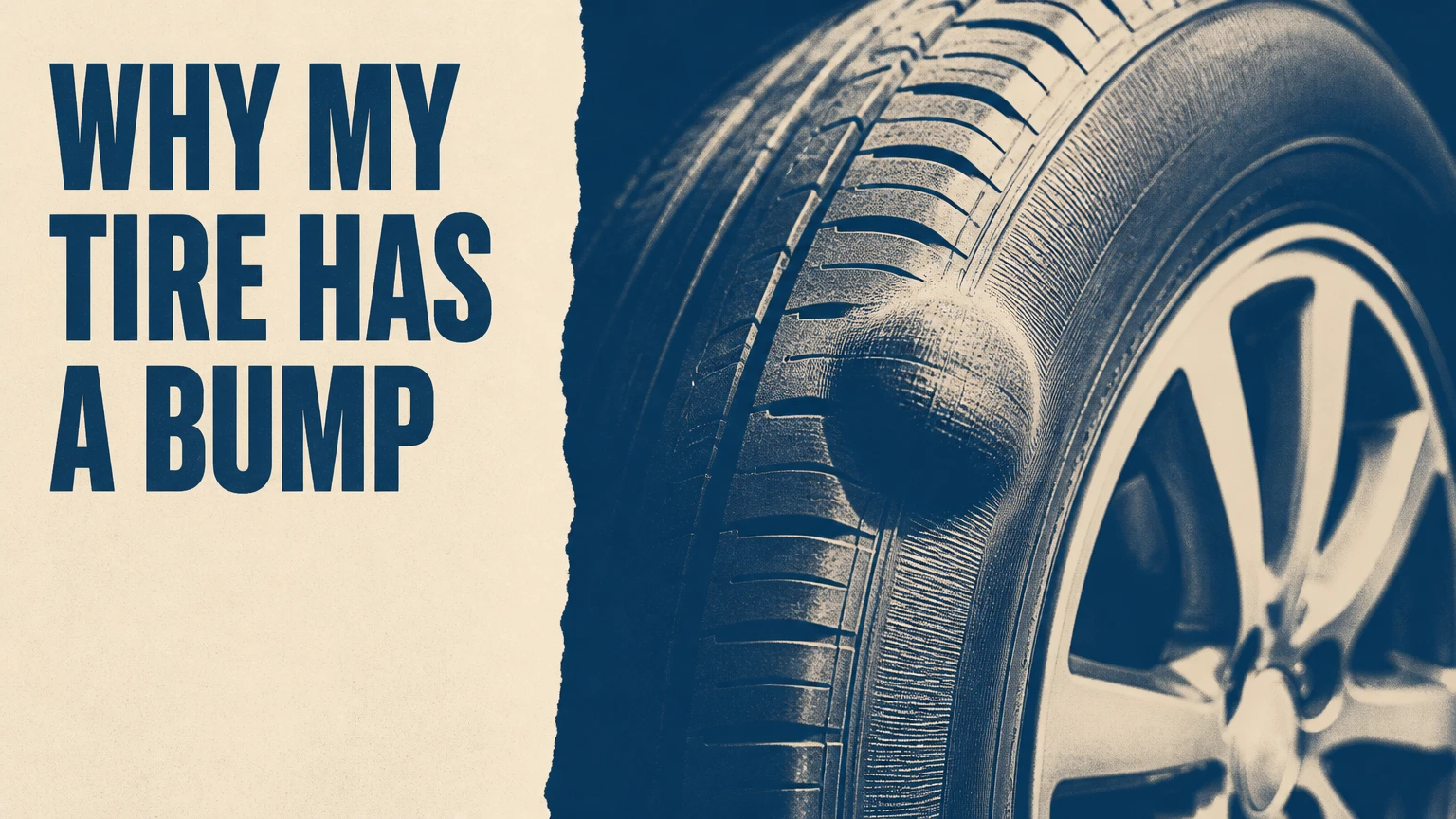
A bump or bubble on a tire indicates that the internal structural cords have ruptured, allowing pressurized air to leak through the inner liner and inflate the outer rubber layer. This damage is structurally irreversible, severely compromises tire integrity, and creates an immediate blowout risk that requires urgent tire replacement.
At a Glance
- Primary Cause: Impact pinches from potholes or curbs snapping internal fabric cords.
- Safety Status: High risk; the outer rubber has zero structural strength to contain air pressure.
- Repairability: Unrepairable; sidewall cord ruptures cannot be patched, plugged, or welded.
- Cosmetic Exception: Inward dimples (undulations) are harmless manufacturing seams.
- Action Required: Install a spare tire or tow the vehicle directly to a service center.
Is It Safe to Drive on a Tire With a Bump or Bubble?
No, driving on a tire with a bump or bubble is not safe under any standard operating conditions. The protruding bubble is held together only by a thin layer of flexible surface rubber with zero structural cord reinforcement, making an explosive blowout likely at highway speeds, over bumps, or under high loads.
[Normal Sidewall]           [Impact Strike]           [Resulting Bubble]

   |  |  |  |                 \  /  /  /                  |        /---\
   |  |  |  |                  ||  || ||                  |  Air  | Bump|
   |  |  |  |                 /  \  \  \                  |  Leaks \---/
 Inner  Cords  Outer        Rim Pinches Cords            Inner  Cords  Outer
 Liner  Broken Rubber       Breaks Inner Liner           Liner  Broken Rubber
When internal body plies snap, the 30 to 35+ PSI of air pressure inside the tire pushes against the outer sidewall. While a intact sidewall relies on woven nylon or polyester cords to contain this force, the bubble itself has lost all structural backing. Continuing to drive subjects this weakened area to cyclic flexing, friction, and heat buildup. A sudden impact with a minor road bump or a small pebble can trigger instant structural failure. If a bubble is noticed, driving should be restricted to moving the vehicle at low speeds (under 20 mph) to a safe pull-off area or repair shop; otherwise, the tire must be changed immediately.
How Long Can You Drive on a Tire Bubble Before It Pops?
There is no safe duration or distance you can drive on a tire bubble, as it can rupture instantly or last a few miles depending on load and impact. Vehicle safety testing demonstrates that a compromised sidewall bubble can suffer explosive failure in less than one mile under highway conditions.
The exact point of failure depends on four primary variables:
- Vehicle Speed: Speeds over 40 mph exponentially increase centrifugal force and internal air pressure.
- Ambient Temperature: Ambient heat exceeding 90°F ($32^\circ\text{C}$) raises internal tire temperatures past $180^\circ\text{F}$ ($82^\circ\text{C}$), expanding the trapped air mass.
- Road Surface: Hitting a $1\text{-inch}$ pothole edge or asphalt seam delivers concentrated force directly to the unreinforced rubber bubble.
- Payload Weight: A fully loaded vehicle increases sidewall bulge flexing, accelerating ply separation.
If driving on a bubbled tire is unavoidable, limit speed to under 25 mph, avoid highways entirely, and navigate directly to the nearest tire center.
What Actually Causes a Tire Sidewall Bubble to Form?
A tire sidewall bubble forms when a hard impact violently pinches the tire sidewall between an obstacle and the rigid metal wheel rim, snapping the inner structural plies. This structural breakdown occurs in three precise mechanical stages during an impact event:
- The Pinch Event: When a vehicle strikes a pothole edge, curb, or speed bump at speed, the tire carcass compresses completely. The flexible sidewall is squeezed against the rigid steel or aluminum wheel flange.
- Internal Rupture: The heavy shock breaks the internal polyester or rayon body plies. Concurrently, the airtight inner liner membrane develops a tear under extreme tension.
- Inflation of the Outer Layer: Pressurized air ($30\text{–}45 \text{ PSI}$) rushes through the torn inner liner into the body of the sidewall, inflating the flexible outer cosmetic rubber into a visible dome.
Pothole Impact ---> Sidewall Compression ---> Inner Liner Tear ---> Cord Rupture ---> Pressurized Air Escapes ---> Outer Rubber Bulge
What Is the Difference Between an Outward Tire Bump and an Inward Indentation?
An outward tire bump is a structural failure caused by broken internal cords that protruding outward, while an inward indentation (undulation) is a harmless cosmetic condition where internal ply splices pull the rubber slightly inward. Distinguishing between outward protrusions and inward dimples is essential for proper safety diagnosis.
| Feature | Outward Sidewall Bump | Inward Sidewall Indentation (Undulation) |
| Direction | Protrudes outward like a dome or bubble | Depressed inward like a shallow groove or dimple |
| Cause | Broken internal plies from impact damage | Overlapping ply seams from factory manufacturing |
| Structural Integrity | Critically compromised; elevated blowout risk | Fully intact; meets original safety standards |
| Action Required | Immediate tire replacement required | No repair or replacement necessary; safe to drive |
Inward indentations occur during manufacturing when the overlapping fabric plies create a double-thickness vertical seam. When the tire is inflated, this reinforced seam flexes less than the surrounding single-ply areas, causing a visible vertical valley along the sidewall.
Why Is There a Bump on My Tire Tread Instead of the Sidewall?
A bump on the tire tread indicates a broken or delaminated internal steel belt directly beneath the running surface, rather than broken fabric plies in the sidewall. Tread bumps alter the tire’s outer circumference and usually create a rhythmic vibration or heavy steering wheel wobble at low speeds ($10\text{–}20 \text{ mph}$).
Tread blisters develop when water penetrates small tread cuts, rusting the steel belts until the adhesive bonding fails, or when a hard impact snaps an underlying steel cord. As the steel belt separates from the tread rubber, pressurized air forces the tread block upward, creating an uneven bulge across the contact patch. Driving on a tread bump causes rapid, uneven tread wear and compromises braking traction, requiring full tire replacement.
Can Low Tire Pressure or Summer Heat Cause a Bubble Without Hitting a Pothole?
Yes, severe underinflation combined with high summer temperatures can cause a sidewall bubble through thermal degradation without an immediate road impact. Driving on an underinflated tire causes extreme flexing in the sidewalls, generating internal thermal heat that can melt structural adhesives and separate the plies.
When tire pressure drops significantly below the vehicle’s recommended PSI rating:
- Flexing Generation: A tire running at $15 \text{ PSI}$ instead of the recommended $35 \text{ PSI}$ experiences severe sidewall deflection during every wheel rotation.
- Heat Accumulation: This rapid flexing generates internal temperatures exceeding $200^\circ\text{F}$ ($93^\circ\text{C}$), weakening the rubber bonding compounds holding the textile plies together.
- Delayed Rupture: Over time, these heat-damaged plies separate under normal load. Combined with ambient heat, air forces its way between the delaminated layers, creating a delayed bubble weeks after the thermal damage occurred.
Can Tire Shop Installation Tools Cause a Sidewall Bubble?
Yes, improper mounting techniques or uncalibrated tire-changing machinery can tear a tire’s bead rubber and cause a bubble near the rim line. The tire bead contains high-tensile steel wire bands that hold the tire securely against the metal wheel rim.
If a tire technician uses dull manual levers or applies excessive force with a mechanical mounting arm without sufficient tire lubricant, the metal tool can tear the inner bead lining. Once inflated, pressurized air escapes through the damaged bead area and travels up into the lower sidewall rubber, creating an localized bulge near the wheel flange within hours or days of installation.
Can a Tire Bump or Bubble Be Repaired or Patched?
No, a tire with a sidewall bump or tread bulge cannot be repaired, patched, or plugged under any circumstances. Industry safety standards from the U.S. Tire Manufacturers Association (USTMA) strictly prohibit structural repairs outside the tread’s central crown area.
Standard tire repairs use vulcanized rubber patches and plugs to seal punctures up to $1/4 \text{ inch}$ ($6 \text{ mm}$) in the tread zone. However, these patches only seal air leaks; they cannot stitch together or restore structural tension to snapped internal nylon, rayon, or steel cords. Because the sidewall experiences continuous flex and bending during driving, any patch applied to an internal sidewall rupture will fail, making tire replacement the only safe resolution.
What Happens If You Pop or Prick a Tire Bubble With a Needle?
Pricking or popping a tire bubble with a needle or sharp tool triggers a rapid, uncontrolled release of pressurized air that can cause severe physical injury. The outer rubber layer holds back internal air pressure ranging from $30 \text{ to } 50+ \text{ PSI}$.
Puncturing the bubble creates an immediate weak point in an already compromised structure, often resulting in an explosive tear. The escaping air stream can throw rubber fragments, metallic dust, and hand tools outward at high velocity. To safely deflate a compromised tire, remove the valve stem core using a dedicated valve tool while standing to the side of the tread face.
How Much Does It Cost to Replace a Tire With a Bubble?
Replacing a tire damaged by a bubble generally costs between $100 and $400 for a standard passenger car, and up to $600 or more for performance, electric, or heavy-duty all-terrain vehicles. Total replacement costs depend on tire size, performance rating, and drivetrain configuration:
- Economy Passenger Tires: $\$100\text{–}\$175$ per tire.
- Performance / SUV / EV Tires: $\$200\text{–}\$450$ per tire.
- Mounting and Balancing Fees: $\$20\text{–}\$45$ per wheel.
- AWD Matching Considerations: On All-Wheel Drive (AWD) vehicles, tread depth differences between tires must usually stay within $2/32 \text{ inches}$. If the remaining tires are significantly worn, replacing a single tire may require purchasing a matching pair or set of four—or shaving the new tire to match—to prevent mechanical damage to the transfer case.
Is a Tire Bubble Covered Under Warranty or Road Hazard Protection?
A tire bubble is covered only if you have an active Road Hazard Warranty or if an inspection proves the damage was caused by a manufacturing defect rather than an environmental impact.
                      Tire Bubble Warranty Coverage
                                    |
            -------------------------------------------------
           |                                                 |
  Impact Marks Present?                             Zero Impact Marks?
 (Scrapes, Rim Dent, Bruise)                     (Clean Rim, Intact Bead)
           |                                                 |
  Road Hazard Protection                             Standard Warranty
           |                                                 |
  --------------------                              --------------------
 |                    |                            |                    |
Active?           No Coverage?                  Defect Proven?       Impact Proven?
 |                    |                            |                    |
Covered            Out-of-Pocket               Free/Prorated       Out-of-Pocket
(Prorated/Free)    Replacement                 Replacement         Replacement
- Standard Manufacturer Workmanship Warranty: Covers tire replacement only if an authorized dealer confirms zero signs of impact (no wheel rim scuffs, tread cuts, or internal pinch bruising) and attributes the ply separation to factory bonding defects.
- Road Hazard Protection Certificates: Covers impact damage caused by potholes, curbs, and road debris. Most plans replace the damaged tire free of charge during the first $2/32 \text{ inches}$ of tread wear, or offer a prorated credit based on remaining tread depth thereafter.
How Do You Safely Transport Your Vehicle When a Tire Has a Bump?
To transport a vehicle with a tire bump safely, avoid standard road driving and fit a spare tire or arrange flatbed towing. Follow this four-step safety procedure:
- Park and Inspect: Park the vehicle on a flat surface away from traffic. Turn on hazard lights and engage the parking brake.
- Mount the Spare Tire: Swap the damaged tire with the compact temporary spare (“donut”) or full-size spare tire. Torque lug nuts to manufacturer specifications.
- Check Spare PSI: Ensure the compact spare is inflated to its rated pressure (typically $60 \text{ PSI}$) before driving. Limit speed to under $50 \text{ mph}$ ($80 \text{ km/h}$).
- Arrange Towing if No Spare: If your vehicle lacks a spare tire or uses run-flat tires with large sidewall bubbles, call a flatbed tow truck to transport the vehicle directly to a repair shop.
The Bottom Line
A tire bump indicates snapped internal structural plies and an unreinforced outer rubber layer holding back full inflation pressure. This condition cannot be patched or repaired and poses a serious blowout risk. If an outward bulge appears on your tire’s sidewall or tread, install a spare tire or call a tow truck immediately to replace the damaged tire before returning to normal driving conditions.